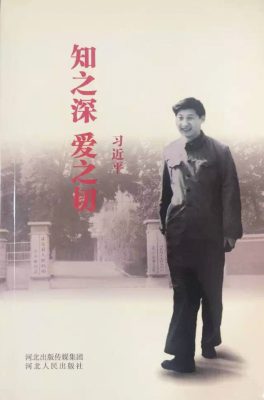
To Xi Jinping’s growing list of titles as Chairman of Everything, add one more: Storyteller-in-Chief. In the five years since he became general secretary of the Chinese Communist Party in November 2012, Xi has authored no less than four books, including The Governance of China (the tome on his ruling vision that Facebook’s Mark Zuckerberg made such a show of placing on his desk), Up and Out of Poverty (a collection of his writings through the 1990s), The Chinese Dream and the Great Rejuvenation of the Chinese Nation (which helps readers “come to understand the true nature of the Chinese Dream“), and the tenderly titled Knowing Deeply: Loving Keenly (a book of his writings from the early 1980s).
Search up Xi Jinping on Amazon and you’ll find scores of other published volumes of his “important speeches.” Perhaps the most entertaining is a volume commemorating, just in the nick of time, the 2,565th birthday of Confucius.
As China’s top leader and chief messager, Xi Jinping is the custodian of the “China story” — the authorized version of how the country and its leadership wish to be perceived by us all. At his first national meeting on propaganda and ideology in August 2013, Xi said leaders needed to find new ways to “tell China’s story well, and properly disseminate China’s voice.” More than a year later, at a foreign affairs work meeting in November 2014, he said that China “must raise our country’s soft power, telling China’s story well.”
The idea of the “China story” as a coherent narrative reflecting the Party-state agenda, as a product of centrally conceived “soft power,” is not so new. The phrase appeared in the Party’s official People’s Daily as early as 2004, and a 2010 piece in the newspaper under the pen name “Guo Jiping” (国纪平), short for “important commentary on international affairs,” or you guan guoji de zhongyao pinglun (有关国际的重要评论), was adamant that “China’s story must become a world story.”
But what distinguishes Xi Jinping, or so we are told, from the wooden general secretaries of the recent past, is his gift and penchant for the telling of stories.
Following the release in June this year of Xi Jinping Tells A Story (习近平讲故事), a collection of stories and parables drawn from Xi’s public and private addresses, Yang Zhenwu (杨振武), the publisher of the People’s Daily, was dazzled by the profound messages Xi managed to get across through simple and relatable anecdotes:
Telling stories well has been a common characteristic of celebrated statesmen and thinkers in China and beyond since ancient times — and it is a clear characteristic of General Secretary Xi Jinping’s leadership style. Whether in his conference addresses, in conversation during his inspection tours, in his speeches during his overseas visits, or in his printed articles, he proves to be adept in using stories to convey deeper meanings and to move people. Woven through these stories is the tao (way) of Chinese history and culture, the tao of Chinese reform and development, the tao of Chinese participation in global governance. They convey the general secretary’s profound thoughts on internal and foreign affairs, on national security, on the governance of the Party, the nation and the military. They are concrete and vivid, relatable and profound, opening a window on the study of the spirit of [Xi’s] series of important speeches.
Xi has said repeatedly that “telling stories is the best form of international dissemination” when it comes to telegraphing China’s messages to the world. So how are Xi Jinping’s stories faring beyond the captive audience of his own state media, and those fellow statesmen whose job it is to be obsequious?
While the “going out” of Chinese media and Chinese publishing remains an important priority for officials, much of it now wrapped up in the idea of “One Belt, One Road,” there is little evidence that foreign audiences are buying — off the bookshelves, anyway — this line about Xi and the profundity of his visions. Despite the endorsement by Mark Zuckerberg, the English-language edition of Xi’s The Governance of China is ranked #220,000 among books at Amazon; that compares, just consider, to a #107,391 ranking for Minxin Pei’s latest, China’s Crony Capitalism: The Dynamics of Regime Decay.
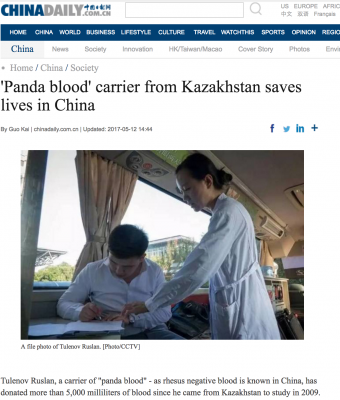
As for those engaging yarns that we are told animate Xi’s “important speeches,” they tend to be played up by Chinese state media alone. One oft-cited example, noted by Caixin two years ago in a piece on the president’s storytelling chops, came in a speech at Kazakhstan’s Nazarbayev University in 2013. It was the story of Tulenov Ruslan, an exchange student from Kazakhstan who was said to have donated five liters of blood in China (not all at once, thankfully) after learning that his relatively scarce blood type, rhesus negative (known in Chinese as “panda blood”), was in urgent need.
Ruslan’s sacrifice for the sake of the Chinese people was amplified across the various foreign channels of China Daily and Xinhua News Agency. But it appeared nowhere else.
As for “using stories to convey deeper meanings,” we might inquire what message Xi Jinping’s story of Kazakhstan blood sacrifice is supposed to convey. Couldn’t the “panda blood” story actually come across as a crass yarn about China’s demand for Kazakh oil and gas, implying that China’s continued economic well-being requires that it sap Central Asia of its precious resources?
The problem with parables, you see, is that their meanings have to translate.
Which brings me to another core question when it comes to Xi Jinping’s visibility as a global storyteller: Who is it that translates, prints and distributes the general secretary’s stories outside of China? And when this does happen, is it a matter of appeal, or a matter of pulling strings?
In fact, if we dig a bit deeper into state media coverage of the president’s latest collection, Xi Jinping Tells A Story, we find interesting backstories that make the international release of the general secretary’s profound stories seem a great deal more like vanity publishing on a grand scale.
Xi Jinping Tells A Story has recently been back in the headlines. The People’s Daily reported on the front page of its September 19 edition that close to 1.5 million copies of the book had been distributed, and that it had been “widely praised.” The praise, in fact, was a familiar rehashing of the kudos Xi received back in June. Xu Jiong (徐炯), a press control official in Shanghai, echoed the remarks of publisher Yang Zhenwu, saying Xi’s book deftly used storytelling to convey “the way,” or tao, of Chinese development.

Yang Jingjie (杨镜洁), a student at Beijing Foreign Languages University who attended a public discussion event for the book explained to those gathered that she had discovered in Xi Jinping’s book the “golden key” to bring together China and the outside world, and she hoped that more and more young people in China would discover this key too, becoming “convincing tellers of China’s story.”
“A single story can beat out a dozen arguments,” she said.
Finally, the People’s Daily noted that as soon as the book had been released, “the renowned international publisher Springer contacted the People’s Publishing House wanting to buy world English rights for the book.” Springer Nature confirmed in an e-mail to CMP that they “have signed a letter of intent with the People’s Publishing House,” but could not offer further details.
But Russian and Japanese versions were also touted by Chinese state media as examples of the book’s broad appeal.
Rights to the Japanese edition of Xi Jinping Tells a Story were reportedly snatched up by Duan Press (侨报社), which Japan’s Kyodo News has described as “a publishing house in Japan that specialises in books on Sino-Japanese relations, many of which are written by Chinese authors and translated into Japanese.”
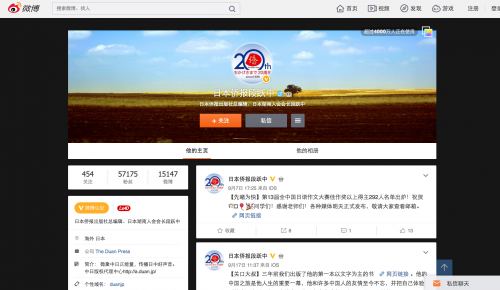
The publishing outfit is run by Duan Yuezhong (段跃中), who founded it in 1999. Duan has consistently over the past two decades published books in Japanese that mirror very closely the mainstream official view. He is a regular guest appearing in Chinese official media to discuss the challenge of “telling China’s story in Japan,” and the way he understands that story aligns perfectly with China’s own external propaganda, to the point of parroting its latest official vocabularies. Currently, the personal introduction on Duan’s Weibo account reads, in a nod to a propaganda buzzword Xi Jinping introduced back in 2012: “Gathering positive energy for China-Japan, spreading good voices for Japan-China.”
At a public signing ceremony two years ago, Duan and his press obtained the Japanese rights to a series of Chinese-language books including The Eastern Battlefield (东方主战场), an edited volume accompanying an official China Central Television documentary commemorating the 70th anniversary of the victory against fascism, and How the CCP Makes Progress — both books published by New World Press (新世界出版社), a division of China International Publishing Group (CIPG), the central-level publisher responsible for the overseas distribution of Party and government publications as part of its overseas propaganda efforts.
The Chinese-language website for Duan Press is full of articles from Xinhua News Agency and the People’s Daily about recent Japanese releases, and interviewing Duan about his work promoting China’s voice in Japan. Duan is apparently getting a lot of attention for its release of Chinese books onto the Japanese market — but this attention is coming almost exclusively from the familiar Chinese state media outfits, which makes this look very much like an inside job.
Russia is another interesting case of apparent self-dealing. At the Beijing International Book Fair (BIBF) in August, a signing ceremony for the foreign editions of Xi Jinping Tells a Story was held in the exhibition area of the People’s Publishing House, and it was announced that the Russian edition of Xi’s book would be published by Chance International Group (尚斯国际集团).
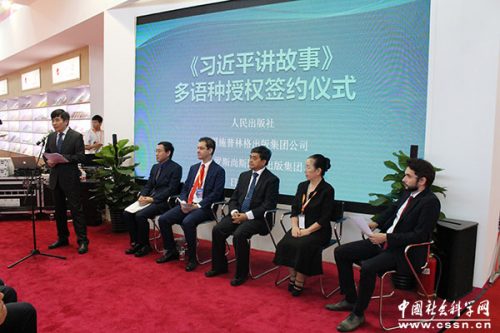
Chance, in fact, was quite active at this year’s BIBF, its general manager, Roman Gerasimov (the guy with the dark beard), attending several signing events at the fair. There was the signing of the deal over Xi Jinping Tells a Story, and with Beijing Publishing House signing of Russian-language rights to In the Name of the People, the book produced from the 55-episode hit propaganda series on the anti-graft drive orchestrated by the Central Commission for Discipline Inspection (and which television regulators praised as a must-see propaganda flick ahead of this fall’s 19th National Congress of the CCP.) The book was also cited by state media as a bright point of success in the strategy of “going out” for Chinese publishing. Finally, with Joint Publishing, Chance signed a deal for the Russian edition of a book about the Analects by Beijing Normal University professor Yu Dan (于丹).
During the BIBF events, Gerasimov, which Chinese state media variously called editor-in-chief and general manager of “the Russian publisher Chance International Group,” was a visible representative of Russian interest — and no doubt his face, so suitably foreign, was a welcome addition to signing panels advertising the foreign appeal of Chinese books.
But to call Chance a “Russian publisher” is to gloss over a very colorful story — and, as I advertised from the beginning, this piece is about colorful stories.
According to a report from the official China News Service, Chance was created back in 2010 by a retired People’s Liberation Army soldier by the name of Mu Ping (穆平), a native of China’s Shaanxi province. Mu started small, he says, by selling Russian translations of Chinese books overseas. When he found he could make a bit of money this way, he sold off two properties he owned, borrowed a bit, and used this to support his fledgling press. The news report picks up the story:
The transition came in 2013. That year, General Secretary Xi Jinping raised his call for “One Belt, One Road.” Very quickly, as this call deepened in the countries and regions of the Silk Road, demand started for Chinese books just as for Chinese manufacturing, and the market was opened overseas.
At that time, the demand for Chinese books overseas started to increase. Publishing houses back home, says Mu Ping, started seeking them out, and business picked up.
In July 2016, Mu and his Russian publishing company linked up with Zhejiang Publishing United Group (浙江出版联合集团) to open what they advertised as Russia’s first Chinese bookstore, Chance Books (尚斯博库). Mu Ping’s new bookstore was located right in the heart of Moscow, with the goal, he says, of “providing a window on Chinese culture in Russia.”
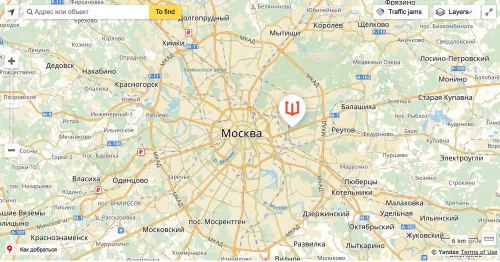
But this was no ordinary partner. Zhejiang Publishing United Group was an enterprise directly under the Zhejiang provincial government — and from there the crystal stairs led straight up to Beijing, for the top leader of Zhejiang at the time, Party Secretary Xia Baolong (夏宝龙), had served as deputy party secretary in Zhejiang under Xi Jinping from 2003 to 2007 and was regarded as a member of the group of Xi loyalists referred to as the “New Zhijiang Army.”
The opening of Chance Books on July 5, 2016, was to all appearances not just a lively affair, but a very senior one diplomatically. Attending the ribbon-cutting ceremony was Vice-Premier Liu Yandong (刘延东), who has travelled to many countries preaching the virtues of “One Belt, One Road,” and who recently told a gathering in Hungary (English here) that the two sides must “continue to deepen cooperation” in a range of areas, including media and think tank development, “working together to tell our bilateral story of ‘One Belt One Road.'”
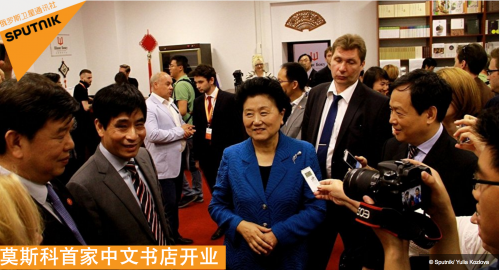
Marking what was billed as a landmark occasion for relations between China and Russia in the publishing field, Liu told Sputnik News:
Today is the 20th anniversary of the strategic partnership between China and Russia, and the 15th anniversary of the signing of the Sino-Russian Friendship Treaty. And so, on this day to remember, the opening of the first Chinese bookstore in Russia is also cause for celebration.
Back in July this year, the Global Times ran a photo profile of Chance founder Mu Ping, giving every impression this was a bootstrap story about a guy who just wanted to open a bookshop, never mind his backing from a powerful state publishing enterprise.
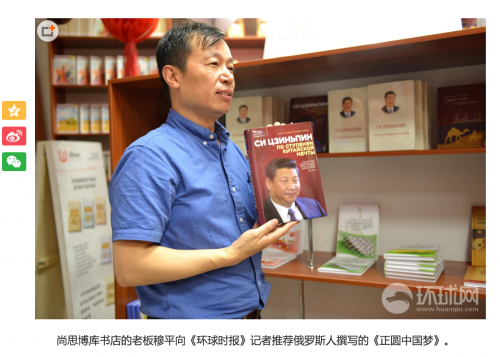
Mu was pictured holding holding up Russian writer Yuri Tavrovsky’s 2015 monograph about Xi Jinping, a book so uncritical in its portrayal that its Chinese-language edition was snatched up by none other than the publishing house run by the CCP’s Central Party School — as was, incidentally, Tavrovsky’s more recent book on “One Belt, One Road.” The shelves behind Mu Ping, meanwhile, were stocked with Russian editions of Xi’s The Governance of China.
Another image in the Global Times profile series showed a promotional placard, in both Russian and Chinese, for Xi Jinping Tells a Story. Appearing also, at least seven weeks ahead of the Beijing International Book Fair, was Mr. Gerasimov, editor-in-chief and general manager — though here, as he was pictured fiddling with the stock, his title was given only as a “salesclerk.”
When I mentioned the story of Chance International Group to a friend from the Czech Republic recently, he was not the least bit surprised. Xi Jinping’s book, he noted, had also been published in his country in what he called a “weird underground manner.”
I suspect that as China’s official story, and Xi Jinping’s copious works, fan out over the “New Silk Road,” there will be many such stories from Xinhua News Agency, China Daily and the Global Times about the “Russian,” “Hungarian” or “Latvian” publishers who have snatched up the publishing rights.
What an interesting fable indeed. And there must, surely, be a moral in there somewhere.