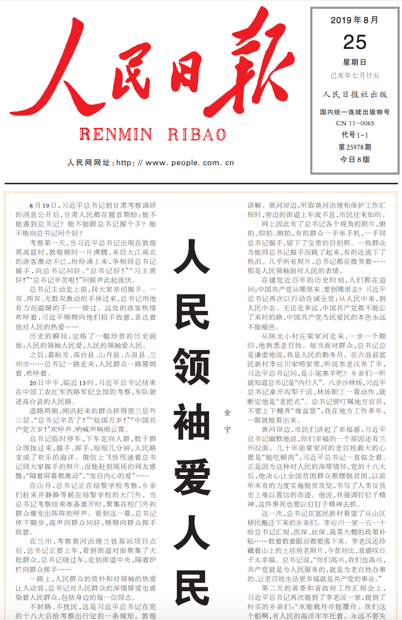
On August 25, 2019,
the official People’s Daily newspaper ran a bold headline on the front
page that included a term that caused some
observers to sit up and take
notice. “The people’s leader loves the people,” the headline read.
The term “people’s
leader” is a rare title of praise in
China’s political discourse, reminiscent of the personality cult that prevailed
during the Mao Zedong era, and its re-emergence was rightly read by many as a
further aggrandizing of Xi Jinping. The appellation was apparently greenlighted
by the Chinese Communist Party at a conclave in Beidaihe that same month.
The reference to Xi
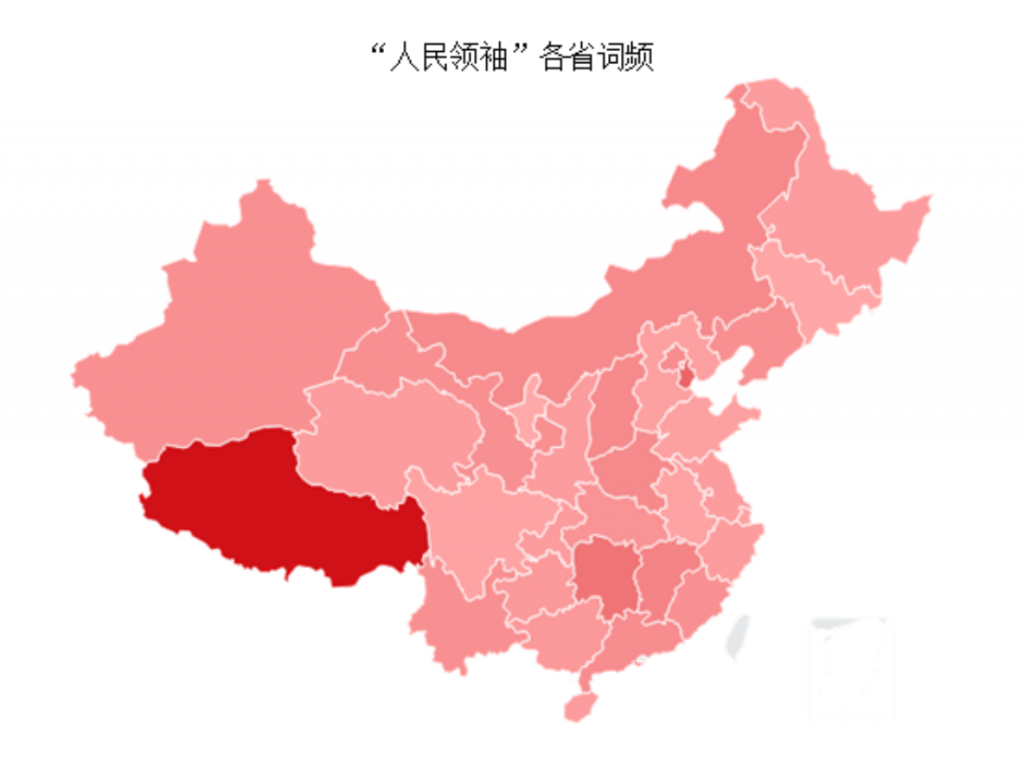
Jinping as the “people’s leader” first came about six months after Xi Jinping
was designated as the “core” in October 2016. In reporting on
an internal CCP study campaign on April 17, 2017, the People’s Daily said that the
curriculum focused on “looking back on the resolute and core role of the people’s
leader for our Party at important historical moments, leading everyone to build
a solid foundation of loyalty and maintain the core.”
In October 2017, right
around the 19th National Congress of the CCP, Party
media began using a new phrase to describe Xi, who was formally given a
second term as general secretary. He was referred to as “the core of the Party,
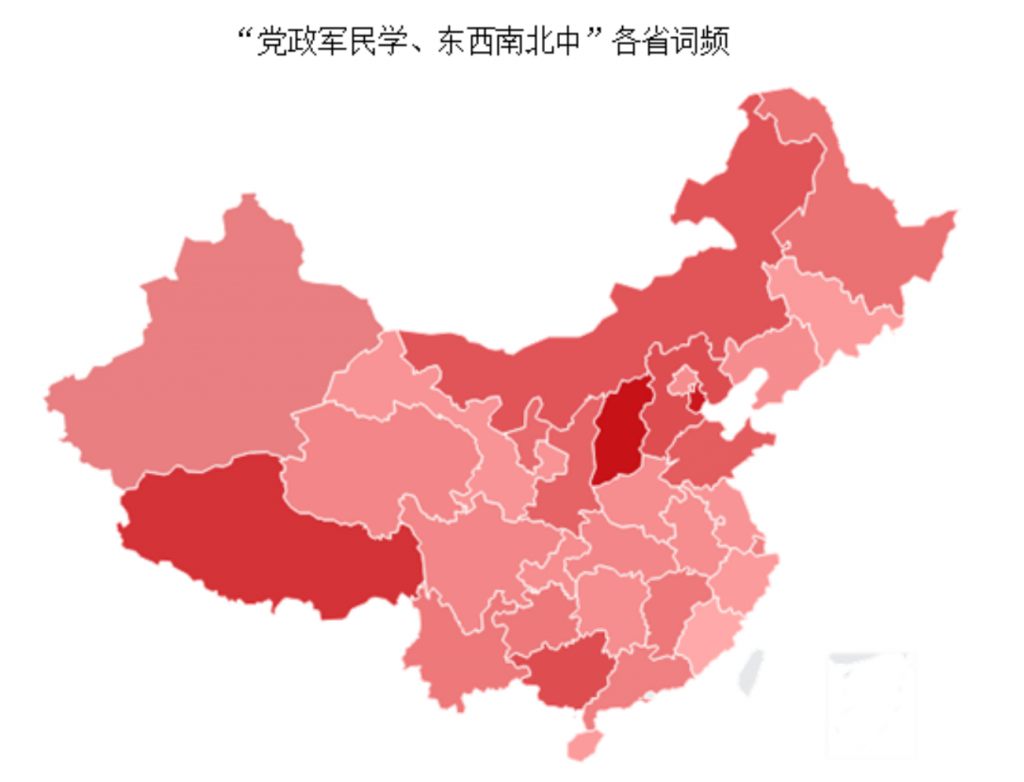
commander of the army and people’s leader” (党的核心,军队统帅,人民领袖). In the run-up to the congress, some local
leaders in China, considering and calculating their own political futures, made
declarations of fealty to Xi that were fawning in a way reminiscent of the Mao era,
and quite out of keeping with language in the CCP charter about avoiding cults
of personality.
Rumors circulated at
that time that the central authorities had issued guidelines to caution against
acts of excessive praise, and on November 1, 2017, the CCP released a
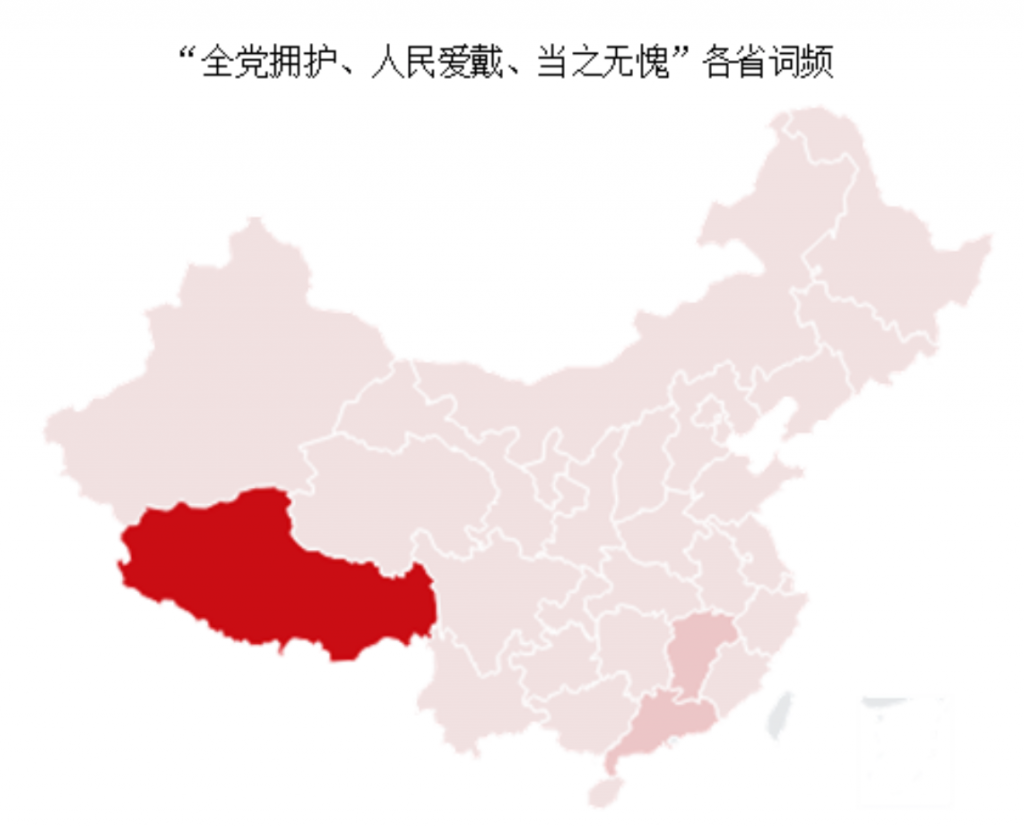
“Decision” outlining three phrases that were acceptable when it came to signaling
Xi’s preeminence and stroking his ego. These
were: “Loved by the entire Party” (全党拥护), “loved and respected by the people” (人民爱戴) and “full worthy and deserving [of core
leadership status]” (当之无愧).
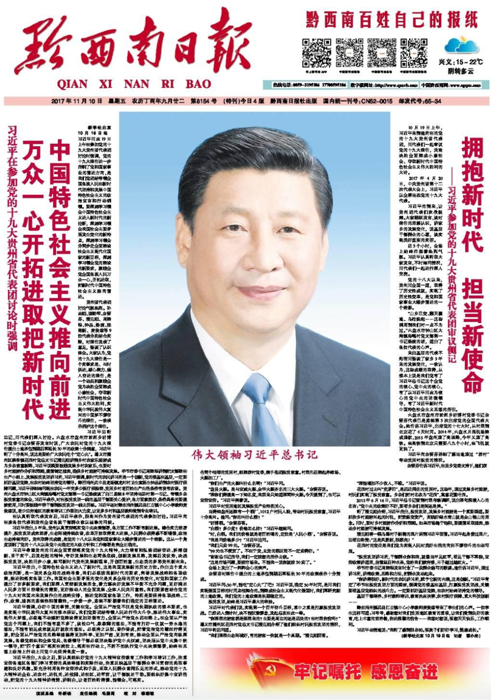
After a local Party newspaper in Guizhou province, Qianxinan Daily, referred to Xi Jinping as “great leader,” or weida lingxiu (伟大领袖), on its front page on November 10, 2017, the digital version of the newspaper was doctored to remove the page – a sign that the central leadership was still wary of seeming excessive or premature.
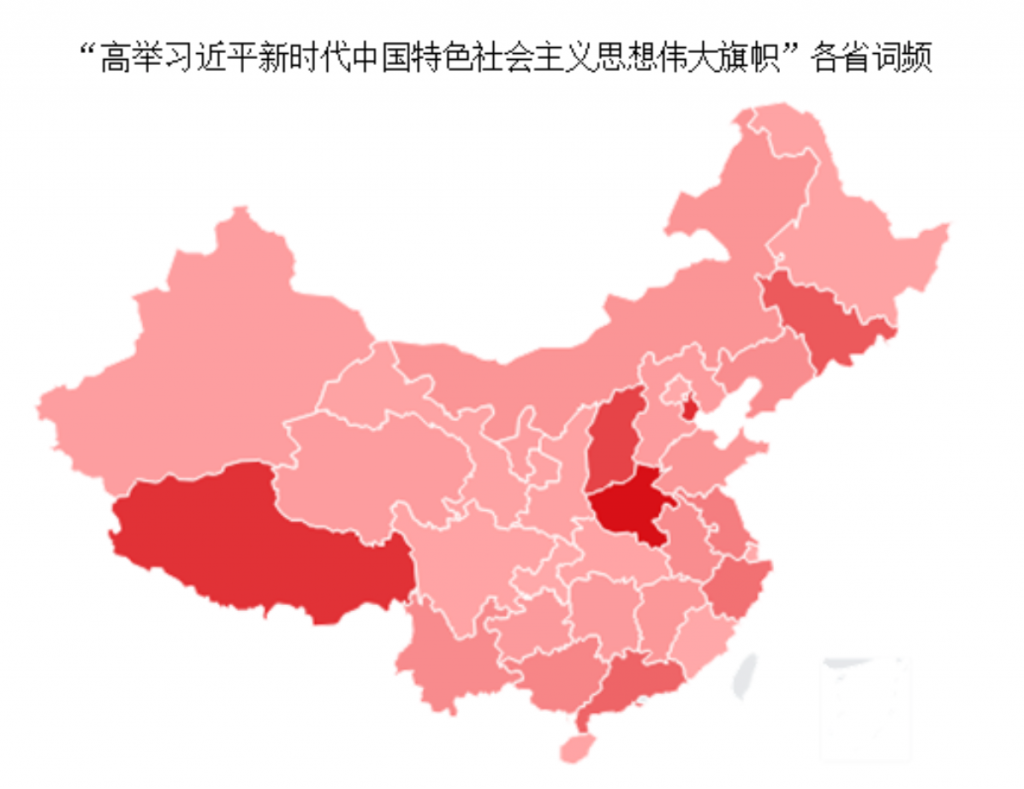
As I said before, the term “people’s leader” to refer to Xi Jinping actually emerged in April 2017, but such elevated praise was more cautious and exploratory, the 19th National Congress and its internal power-brokering almost certainly playing an important role behind the scenes. But by the end of 2017 and through to February-March 2018, Xi seemed to be in a strong position, his unwieldy banner term, “Xi Jinping thought on socialism with Chinese characteristics for the new era” having been written into the Party charter and set to be added to the preamble of the state constitution, along with an amendment on presidential term limits. The inclusion of Xi’s name in his banner term was a clear political victory not achieved by any leader since Mao and Deng.
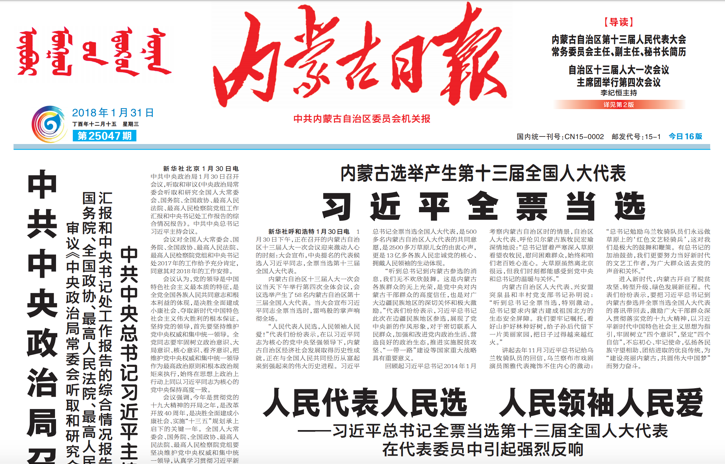
In January 2018, the term “peoples leader,” or renminlingxiu, re-emerged, as though Xi and his allies apparently saw an opening. The Global Times reported that month that this was “the first time for People’s Daily to refer to Xi as lingxiu,” an act it referred to as “swearing allegiance” to Xi. This was not entirely accurate, as we have seen, but perhaps there was a feeling that the term had come out of hibernation.
As the March National People’s Congress drew nearer, many headlines appeared in newspapers across the country referring to Xi as the “people’s leader.” These often occurred within the phrase “the people’s leader is loved by the people” (人民领袖人民爱).
But the climate was about
to shift. By late March 2018, warm relations between the US and China, trailing
in the wake of President Trump’s November 2017 state visit to China, were
rapidly chilling. On March 22, President
Trump signed a memorandum directing a series of tariffs and restrictions
against China. The ensuing trade war was a shock to China’s political system,
and internal fault lines could be glimpsed as propaganda officials made some
attempts to calm a
rising national exuberance, much of it focused on the personality of Xi,
that risked becoming insensate arrogance.
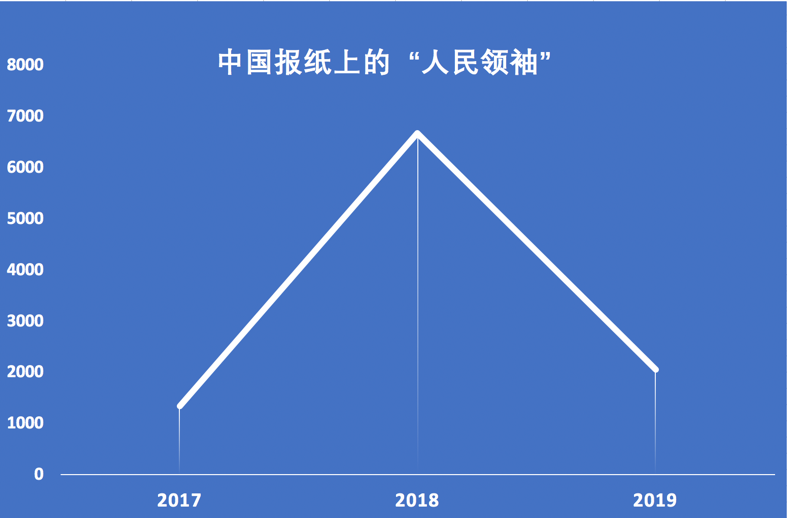
By the second half of 2018, the brakes were clearly being applied. We find a unmistakable drop in use of phrases like “core of the Party, commander of the army, people’s leader.” Looking at the People’s Daily alone, we can note that 47 articles in 2018 made use of “people’s leader,” most of these clustered in the first quarter, ahead of the NPC. In 2019, use of the term was halved to 23 articles. But if we look more broadly at use of the term in newspapers across the country, based on the QianFang database, the fall is much more obvious, 2018 forming an abrupt peak, following by a precipitous decline.
Why then did the use of “people’s leader” in the People’s Daily cause such a wave of interest and speculation on August 25 last year? The reason is that the term appeared in a prominent headline on the front page of the newspaper, right under the masthead. This was in fact the first time it had appeared in a headline, and it seemed a visual declaration of intent, a sign that Xi and those close to him were once again ready to test the waters.
Last month, the Politburo
held a special conference on “democratic life” that gave us a further glimpse
of recent shifts in the discourse of praise. How the conference promoted
democracy is unclear, but the following passage from an article appearing in
the People’s Daily on December 28, 2019, elucidates the true purpose of
the meeting:
The conference
emphasized that protecting General Secretary Xi Jinping’s status as the core of
the central Party, and the core of the whole Party, and protecting the Party’s
centralized authority and unified leadership, is the fundamental political
guarantee of the steady and forward development of socialism with Chinese
characteristics in the new era.
The
article spoke of the need to address “major tasks,” about facing a “great
struggle of historical character,” and so on. But perhaps most importantly, it
said that “General Secretary Xi Jinping is looking ahead,” while “evincing the
firm idealism and faith of a Party member, and the deep feelings for the
people of a people’s leader.”
Is this the
start of a new round of worshipful praise for China’s top leader? Yes,
possibly. But we must continue to observe the development of this term “people’s
leader.” It is quite possible that in 2020 it will experience a notable rise,
which of course would be reflective of Xi’s further consolidation of power and
strengthening of his position.
On December 20, 2019, the Cyberspace Administration of China, the country’s top body for internet control and regulation, released new rules governing online information, setting out both generally encouraged content types and content that would be regarded as unacceptable — and making clear that all members of Chinese society have a responsibility to take part in internet governance.
The “Provisions on the Governance of the Online Information Content Ecosystem” (网络信息内容生态治理规定), available in translation at China Law Translate, were released in draft form back in September as the CAC formally solicited feedback on the regulations from other departments and the public. The final regulations show little substantive change based on a comparison of the texts, although fines for serious content violations that were specified in the draft version at “100,000 yuan or above, not exceeding 500,000 yuan” were apparently removed in the final version, leaving the question of fines ambiguous.
A reading of the new regulations posted during the draft phase in September by the news app of China Youth Daily, a newspaper published by the Communist Youth League, said one of the most notable aspects of the new approach in the draft was the “diversification of the agents of internet ecology governance” (网络生态治理主体的多元化). The post suggested the new approach amounted to a “collaborative governance model” (协同共治的治理模式), and that the process of internet governance “needs to break through the dominant oppositional and singular model of opposition between the market and the government.”
Internet
governance, in other words, is a process that should include all aspects of
society, focusing the energies of more diverse parties on achieving the information
control objectives of the Chinese Communist Party. All of this is very much in
keeping with Xi Jinping’s interest in reviving the notion of the “mass
line” in social governance, and his emphasis on Mao-era approaches such as
the so-called “Fengqiao
experience,” which the official Xinhua News
Agency touted as a Xi interest as late as November.
Article
Two of the new regulation states clearly that “governance of the online
information content ecosystem” as stipulated in the document refers to a
range of actions, including deletion of “illegal and harmful
information,” carried out by “the government, enterprises,
society, internet users and others.”
The “Provisions” also reflect this mass line participatory approach to control in defining not just areas of prohibition, but information content to be encouraged. While news and propaganda policy language in the past – particularly in the Jiang Zemin and Hu Jintao eras – would often refer to “emphasizing positive propaganda” (正面宣传为主) as a duty of the news media, the nature of such propaganda was generally not made explicit – and this was the prerogative of the media as the front line in maintaining “correct guidance of public opinion,” not of broader society. By contrast, Article 5 of the new regulations defines 7 points of “encouragement” for “producers of online information content” (网络信息内容生产者), which can be defined quite broadly in the world of interactive digital media, where the line between producer and consumer is blurred:
Propagating Xi Jinping Though on Socialism with Chinese Characteristics for a New Era; comprehensive, accurate and vivid interpretation of the path, theories, system and culture of socialism with Chinese characteristics.
Propagating the Party’s theoretical line, policies, and major central decisions.
Displaying the highlights of economic and social development, reflecting the great struggle and fiery life of the people.
Carrying forward socialist core values, publicizing the outstanding moral culture and the spirit of the times, and fully demonstrating the uplifting spirit of the Chinese nation.
Effectively responding to social concerns, solving doubts, clarifying matters, and assisting with the formation of mass consensus.
Increasing the international influence of Chinese culture, showing the world a true and comprehensive China.
Other content dealing with proper taste, responsibility, encouraging truth and beauty, and promoting solidarity and stability.
In a December interview, an unnamed official at the CAC said that the new regulations served to clarify for “producers of online information content” the nature of “positive energy” (正能量), or content deemed to advance the social and policy goals of the CCP. The official said: “The regulations clarify the concrete scope of positive energy information, illegal information and harmful information. They encourage producers of online information content to produce, copy and distribute information with positive energy content.”
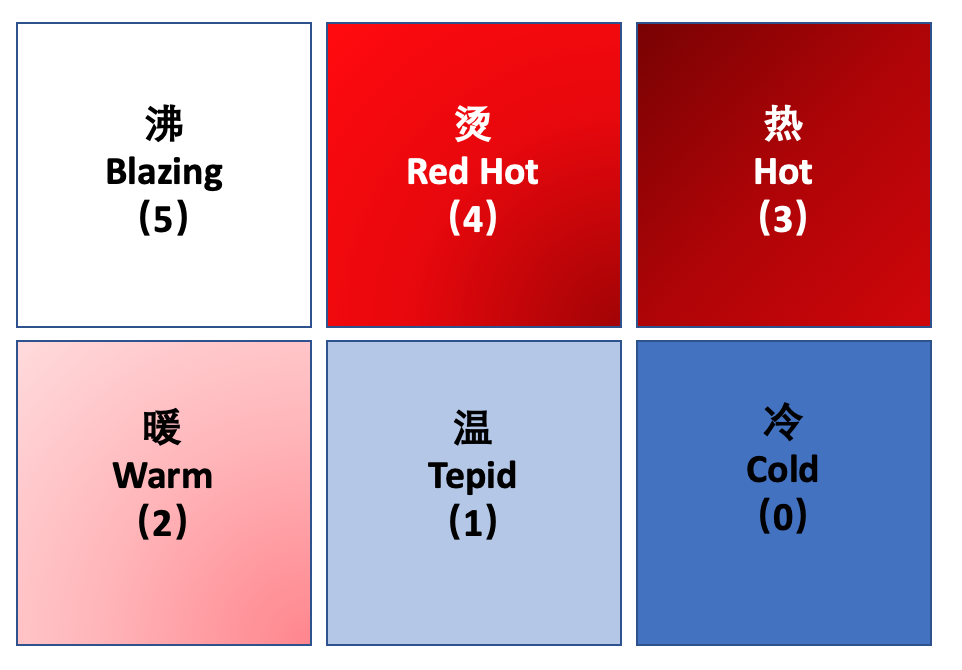
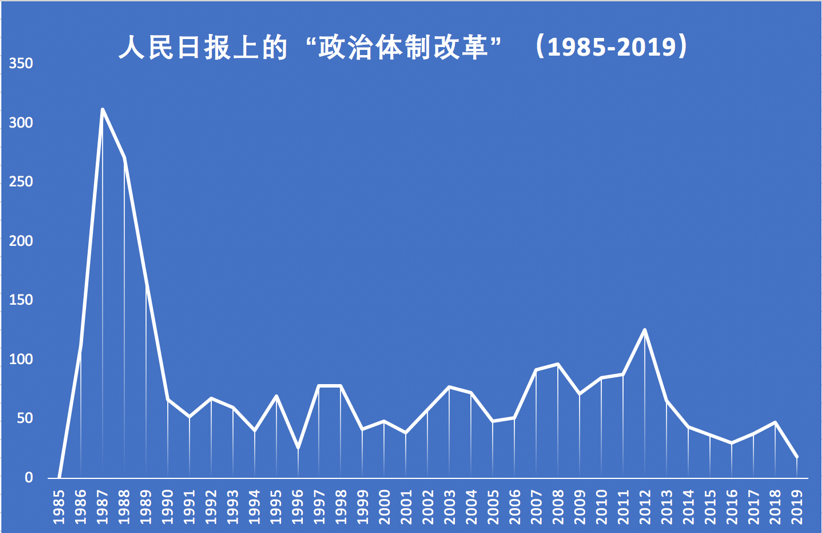
In 2019, the most important change we saw in the political discourse of the Chinese Communist Party was the complete abandonment of the phrase “political system reform,” or zhengzhi tizhi gaige (政治体制改革). The process of political reform in China was jump-started in the 1980s by Deng Xiaoping (邓小平), Hu Yaobang (胡耀邦) and Zhao Ziyang (赵紫阳) between 1986 and 1988, and during this period the term “political system reform” actually became what we label a “hot” (热) phrase within the discourse heat scale I have developed with the discourse analysis team at the China Media Project.
The political reform wave – speaking here from a discourse standpoint –
culminated with the first ever inclusion of the phrase “political system
reform” in the political report to the 13th National Congress of the
CCP in 1987. But ever since that time, we can say that the phrase has sputtered
and sizzled, fading and returning, as it has progressively cooled within the
overall discourse environment.
Since the 18th National Congress in 2012, which marked Xi Jinping’s rise to power, use of the phrase “political system reform,” already rare enough, has dropped off dramatically. And we now can say with some confidence that we are seeing the complete elimination of the term, a trend we noted at CMP back in October.
Below I’ll provide just a quick summary in English of the trends we saw in the Chinese political discourse in 2019, and then look at the key words used to discuss the economy and what these reveal about anxieties in the leadership. For our full discourse report, I refer readers to the Chinese-language version, which I’ve included in full further down.
The Blazing and the Red Hot
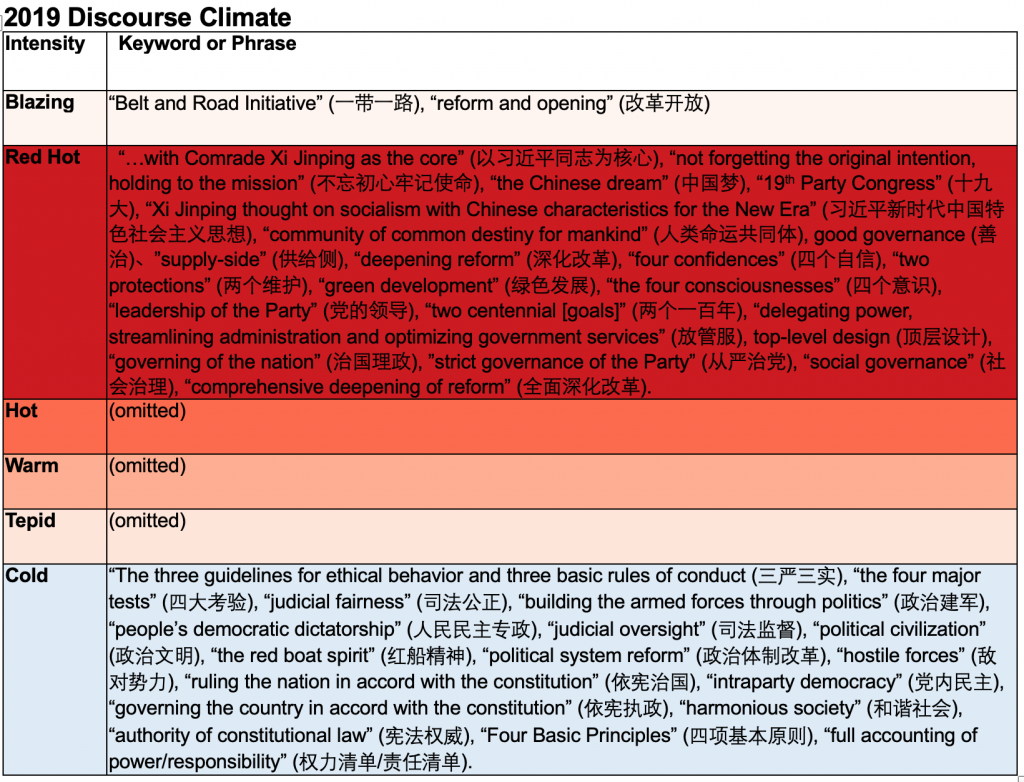
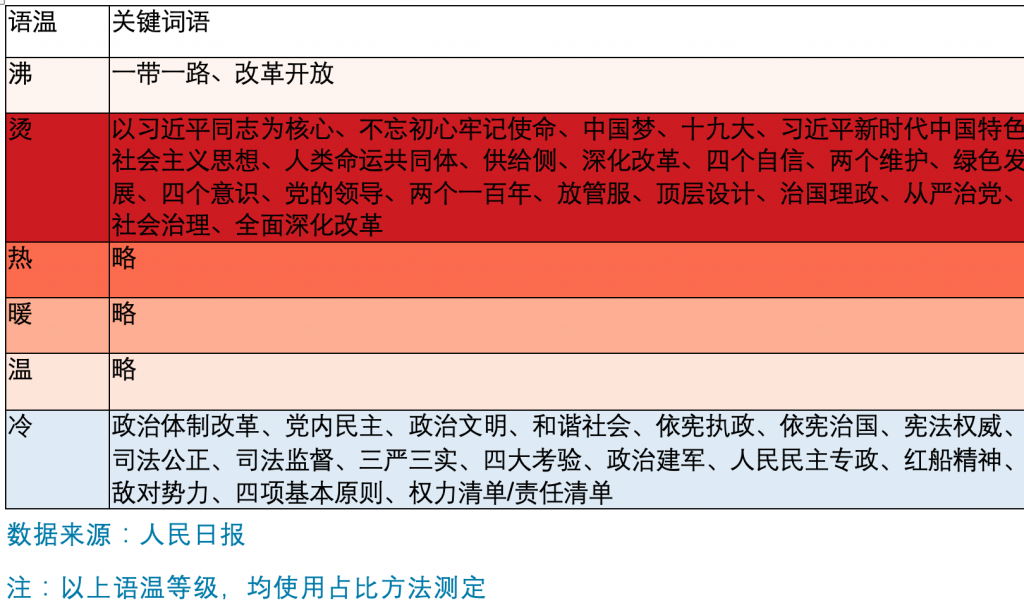
Using the index of political discourse terminologies and their “temperature” as developed by the China Media Project on the basis of frequency of use in the CCP’s official People’s Daily newspaper, we can note that in 2019 the following phrases stood out either for their intensity of use (“blazing” and “red hot” being the strongest intensities) or for their shift in temperature within the index.
Source: People’s Daily Full Database.
Compared to our study of discourse for 2018, the overall position of
these terms and phrases shows little change. At the top of the chart, the
biggest difference is that two of the four terms in the “blazing” category last
year – namely, “19th National Congress” and “Xi Jinping thought on
socialism with Chinese characteristics for the New Era” – have dropped into the
“red hot” category for 2019. The Belt and Road Initiative and “reform and opening”
top the charts this year, showing the greatest intensity of use in the People’s
Daily on a per article basis.
In the “red hot” category, meanwhile, we have two new additions this
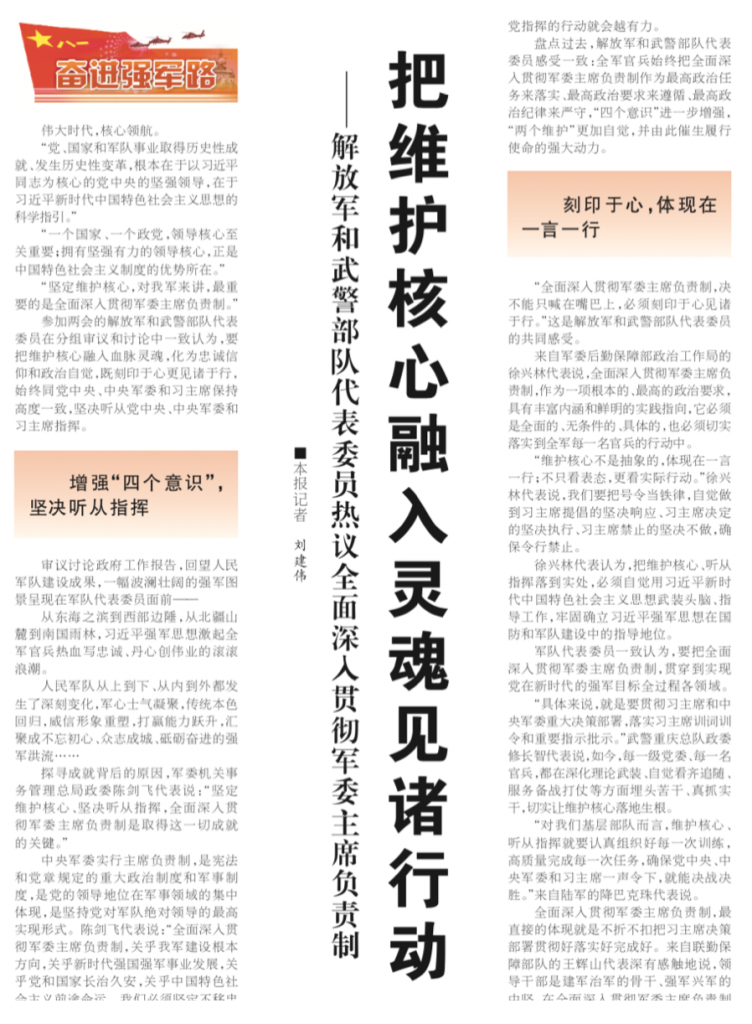
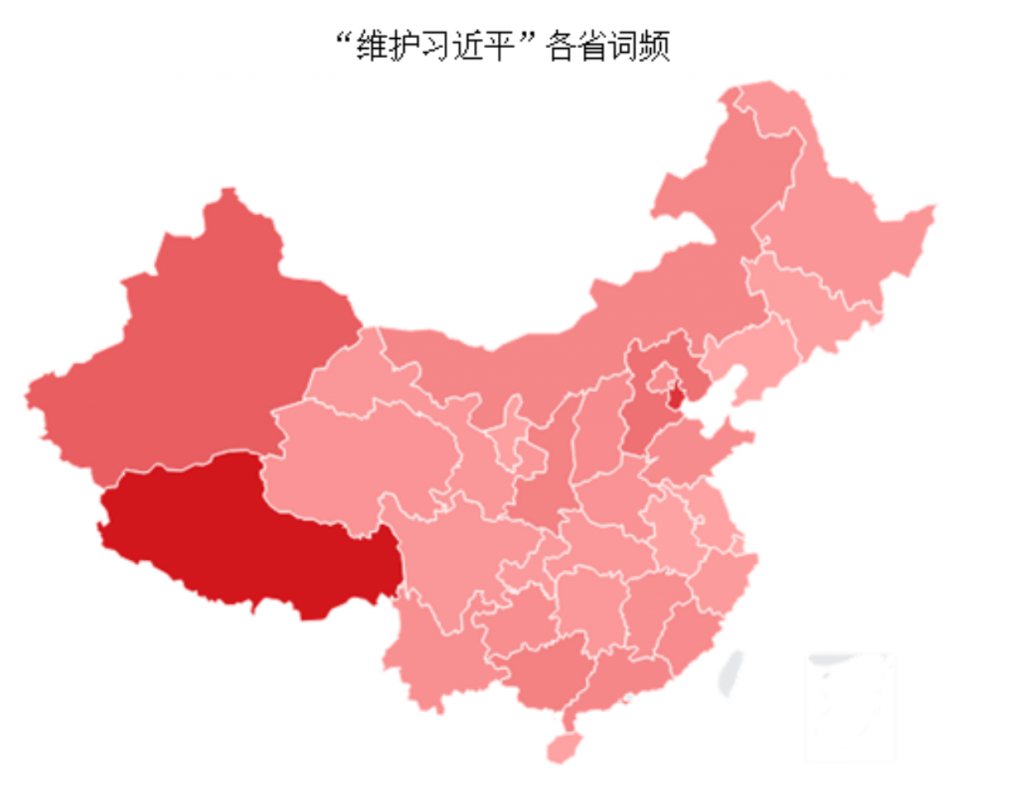
year. These are the “two protections,” essentially protecting Xi as the “core”
of the Party leadership and protecting the Party’s unified leadership, and that
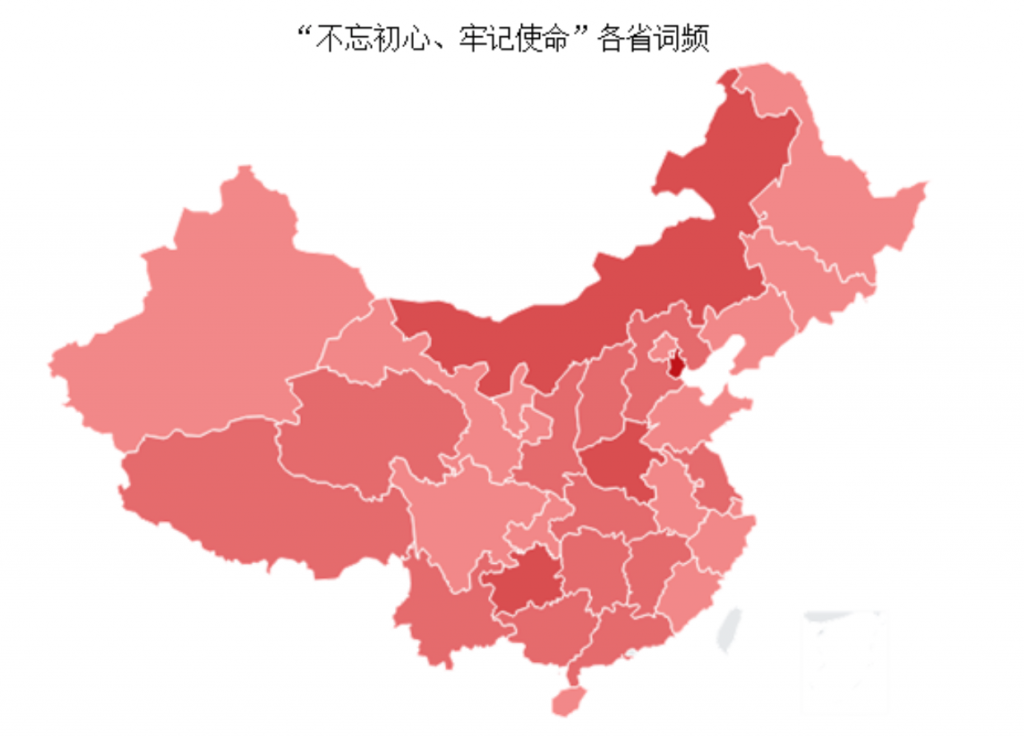
stay-the-course phrase so common this year, “not forgetting the original
intention, holding to the mission.”
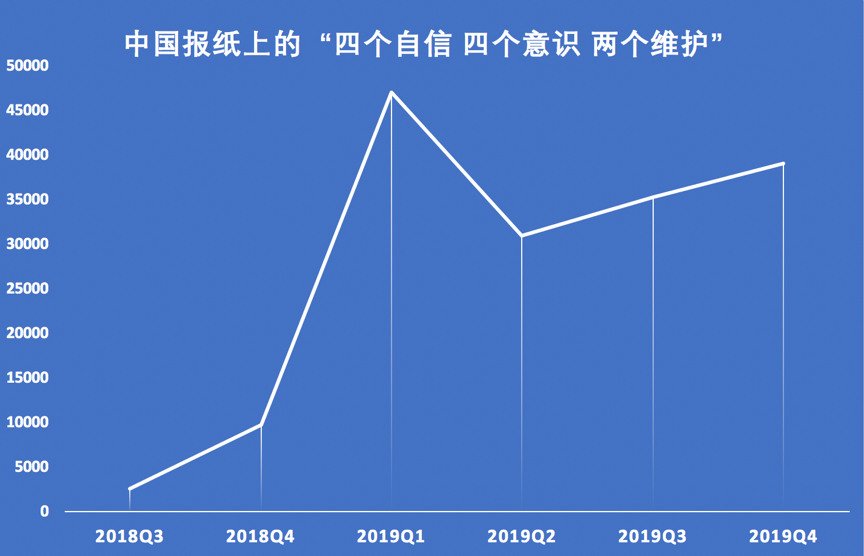
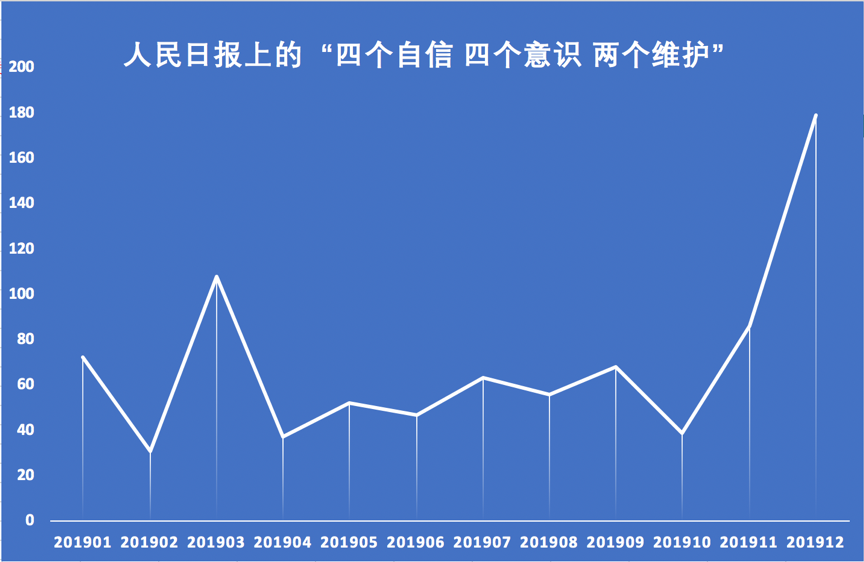
In 2018, the “two protections” joined the “four consciousnesses” and
the “four confidences” to become standard phrases (规范用语) in the Party press. “Not forgetting
the original intention, holding to the mission,” a phrase introduced during the 19th National Congress of
the CCP in October 2017, became a “hot” phrase in 2018, rising in use in the People’s
Daily. In 2019, the phrase rose further, entering the “red hot” category.
The term “good governance” (善治), rose two
levels in 2019, from “warm” to “red hot”.
In 2019, we have a handful of phrases that appeared in the “red hot”
category in 2018 that dropped down to “hot.” These include the “village revival
strategy” (乡村振兴战略), “innovation-driven” (创新驱动) and “administration in accord with the law” (依法治国).
Among the “cold” terms in 2019, we find “political civilization”
(dropping two levels from “warm”), “ruling the nation in accord with the
constitution” (dropping two levels from “warm”), “authority of constitutional
law” (dropping two levels from “warm”), and “full accounting of
power/responsibility” (dropping two levels from “warm”).
One result that may surprise, given official propaganda over perceived foreign meddling in Hong Kong, is that the phrase “hostile forces” (敌对势力) remained in the “cold” category in 2019. But this does not necessarily mean a drop in the use of related phrases, and in fact in the second half of the year we see a marked rise in these use of the term “external forces” (外部势力), which brought the term into the “hot” category.
The Economy
What does the political discourse in 2019 tell us about the economic
situation?
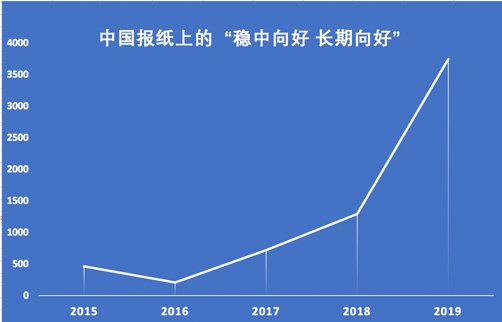
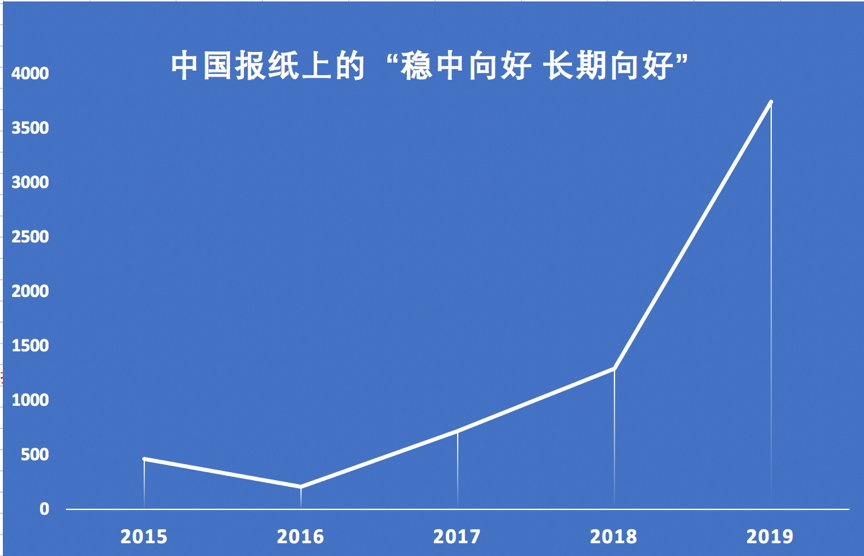
In 2019, we saw a dramatic rise in use of the phrase “steady
improvement, long-term improvement” (稳中向好, 长期向好) in the official discourse, and broadly used across Chinese
newspapers, based on our search of the –
an indication that the authorities are keen to send a message that all is well.
But if we look beyond the Party-run newspapers and digital outlets, we
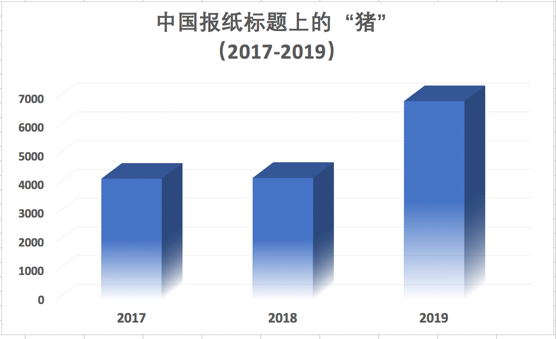
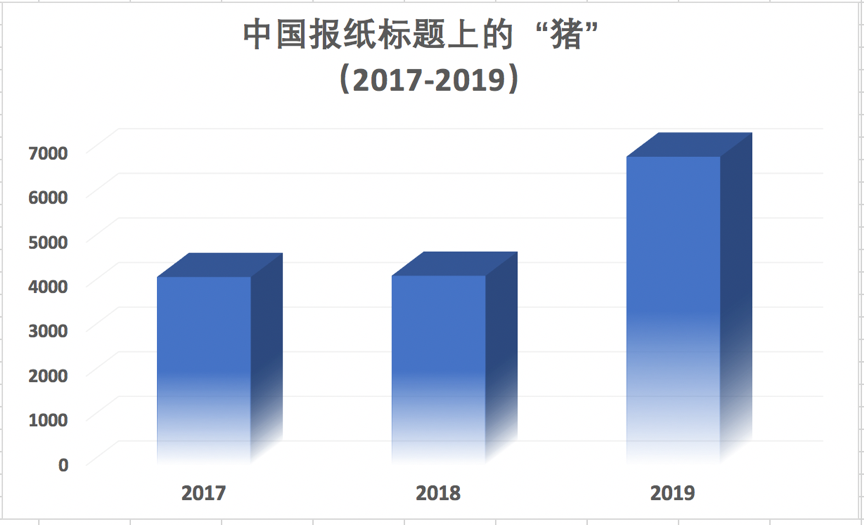
see other indicators of economic concern. Here, for example, we see the
dramatic rise in 2019 of the word “pig” in news headlines, reflecting the
nationwide crisis over pork prices.
The increase in coverage seen in the above graph is driven by news
about pork prices and supply shortages. While this is just one factor within
the overall economy, it was without a doubt a source of anxiety for the leadership
and a factor that undermined the sense that all was “steady” and “improving.”
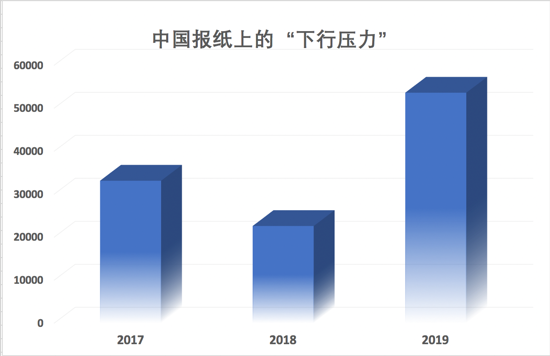
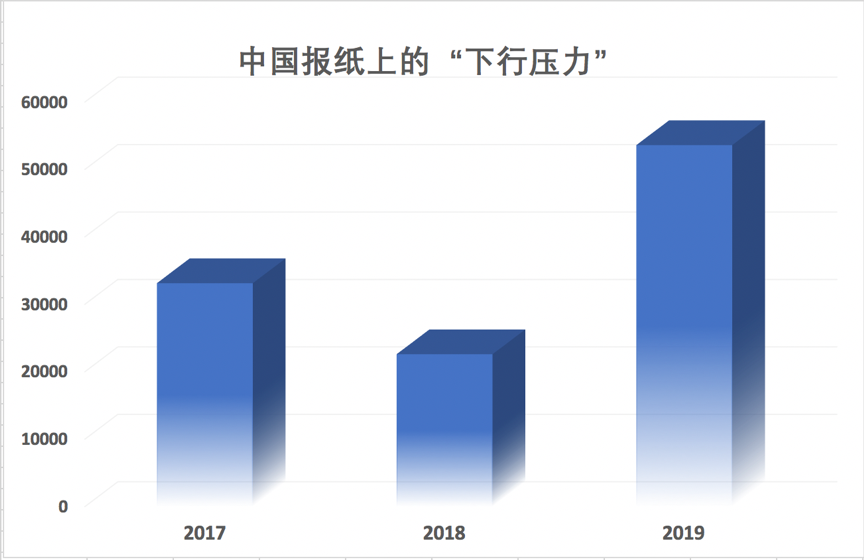
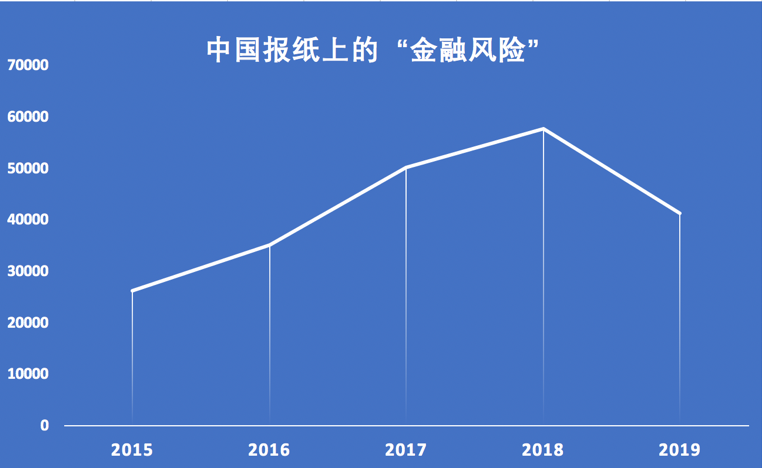
When we look at the economic picture in China after the 19th
National Congress in 2017, we can observe the term “economic downturn” (下行压力). This term experienced a peak back in 2015 but later declined. Here
is how the term has looked in Chinese newspapers over the past three years.
At the end of every year, the CCP’s Central Committee holds an important
economic work conference that sends signals about economic sentiment and
policy, though the language often requires a great deal of reading between the
lines. Since 2012 there have been eight such work conferences, and here is the key
language emerging from each, reflected in the official discourse played across
Party media.
2012: “comprehensive deepening of economic system reforms” (全面深化经济体制改革)
When we review these eight terms we can note the diminishing sense of
optimism over time, and a rising sense of crisis that is understated in the
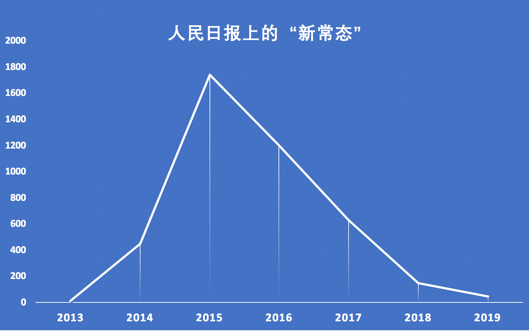
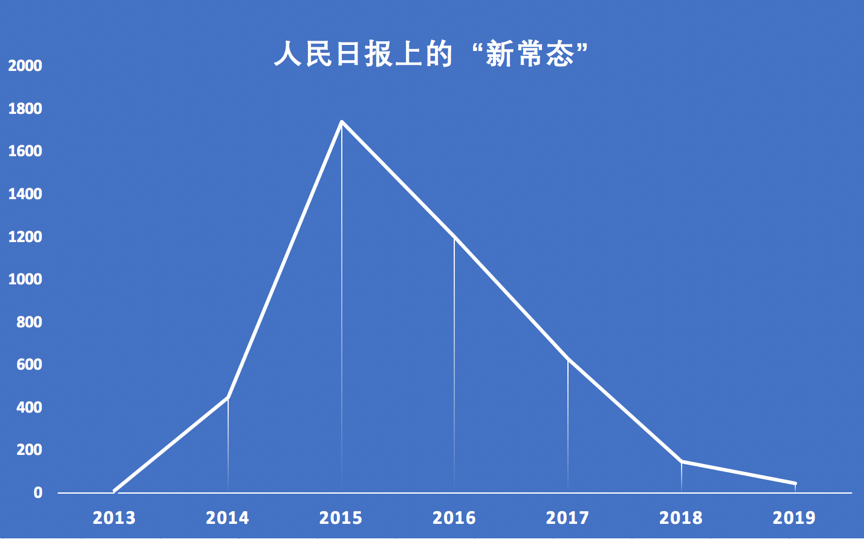
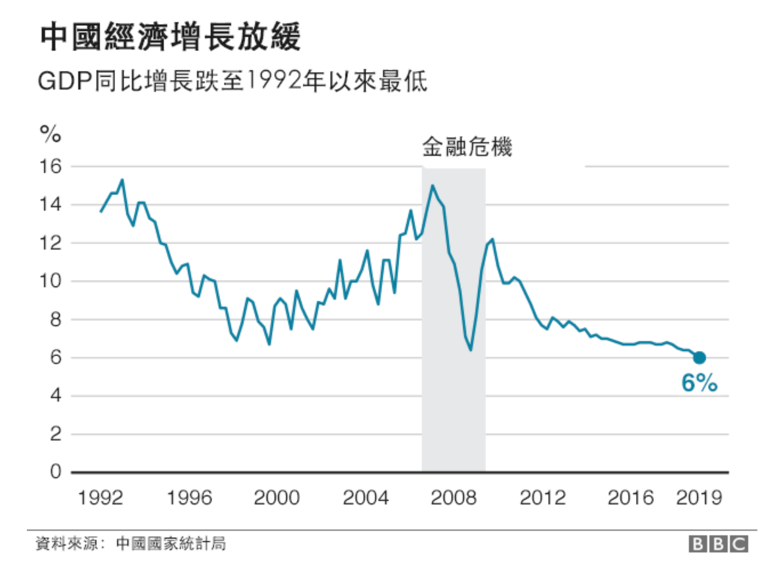
official discourse. “A new normal for the Chinese economy” was a phrase
introduced when GDP growth in China was falling below the 8 percent level, the
goal being to habituate Chinese to the idea that GDP growth between 7 and 8
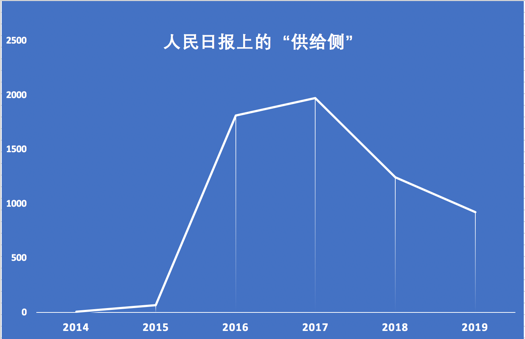
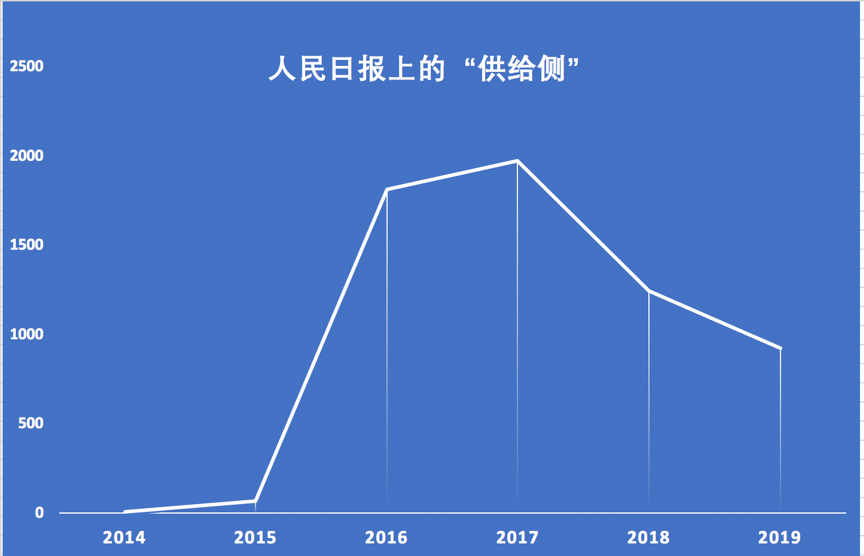
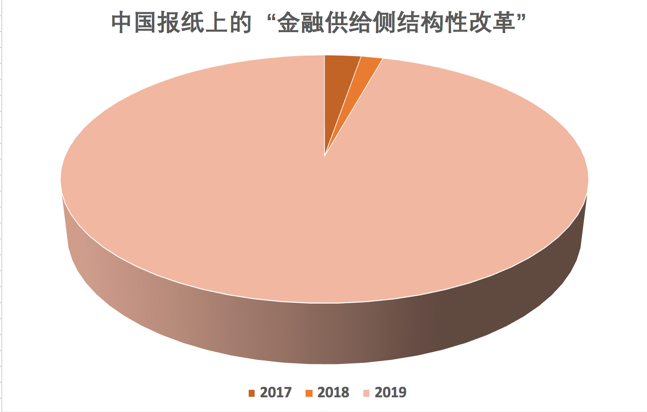
percent was acceptable. The phrase “supply-side structural reforms,” meanwhile,
was a way of coping with continued weakness, the goal being to regain momentum.
Both “new normal” and “supply-side” rose rapidly to become “red hot” terms
after their introduction. But in 2019, we have seen signs of fatigue for both
terms when we look at use within the official People’s Daily on a
per-article basis.
In 2019, we see “supply-side” maintaining its “red hot” status, but
with significantly diminished use in the People’s Daily, about half the
level of use recorded for 2017. The “new normal,” meanwhile, drops down to the “warm”
category, understandable considering that the 7-8 percent GDP growth level it
pointed to is no longer sustainable.
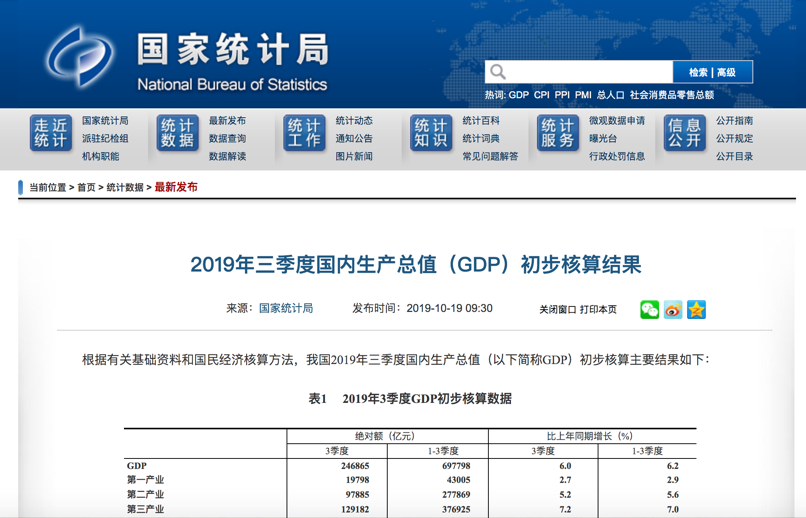
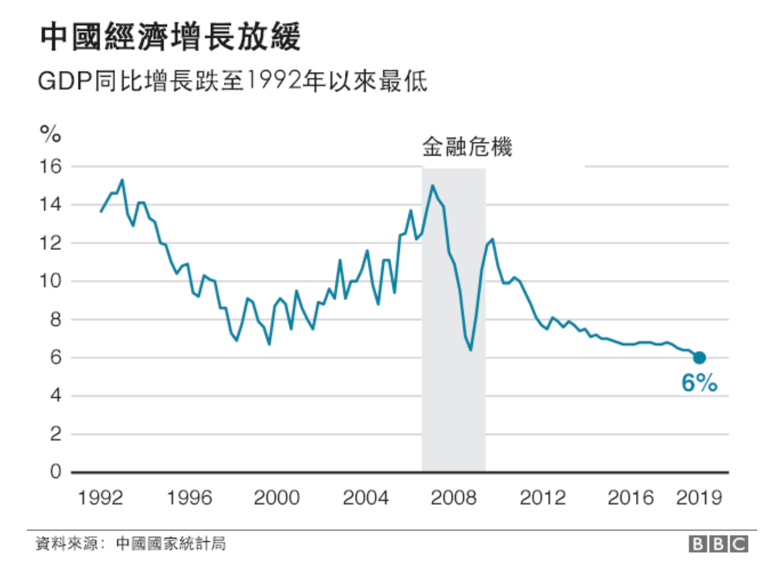
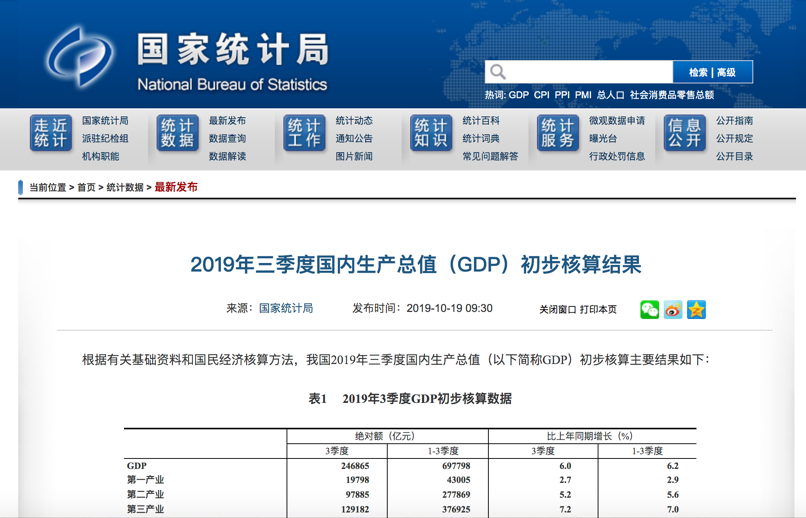
On October 19, 2019, the National Bureau of Statistics released the
latest GDP estimates, which drew a great deal of attention globally. GDP growth
came in at what Deutsche
Welle and other news outlets referred to as an “underwhelming” 6 percent
for the quarter.
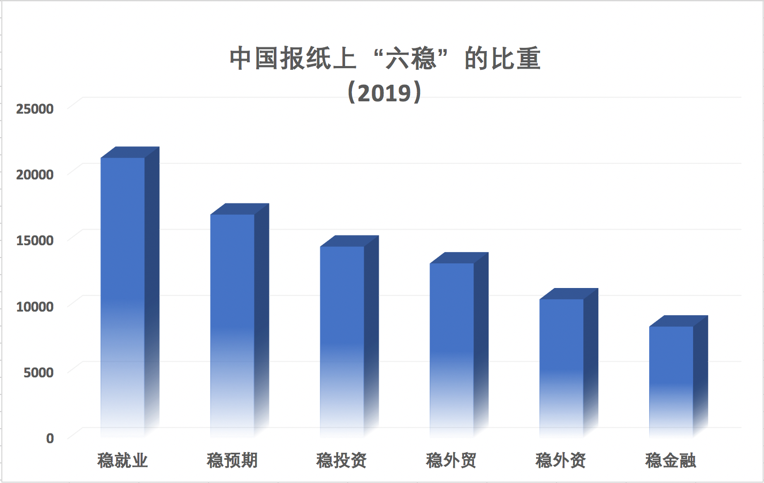
China’s economy currently faces a downturn unlike anything it has faced
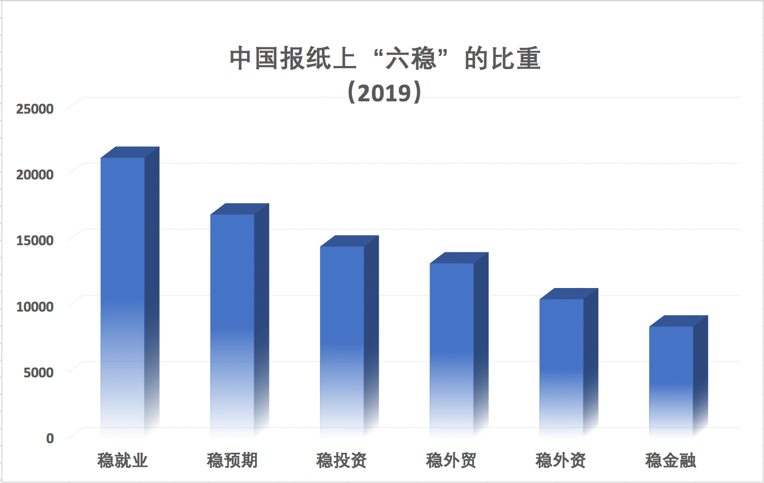
in the past several decades. We now see the term “Six Steadies” (六稳) being used as a provisional response to this weakness – the next
conditioning of the public to lower expectations. The goal now, in other words,
is holding the line in terms of employment, investment and so on. Use of the term “Six Steadies” was 2.8
times higher in Chinese newspapers in 2019 (based on the Qianfang database) than
in 2018.
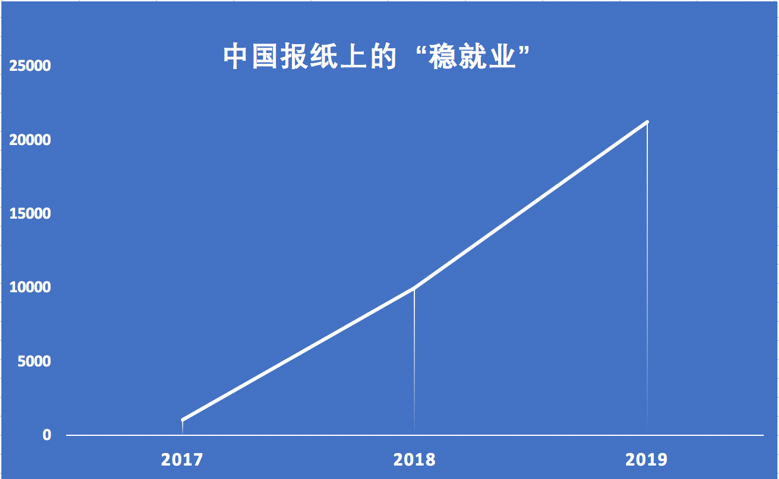
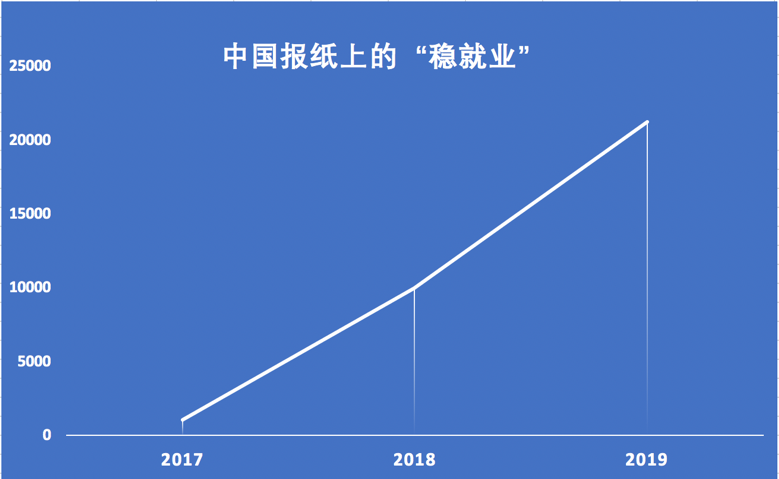
Among the six priorities outlined in the “Six Steadies” formula, we saw
“steady expectations” leading in 2018. In 2019, the clear priority seems to be “steady
employment,” which shows quite a dramatic rise over the past two years.
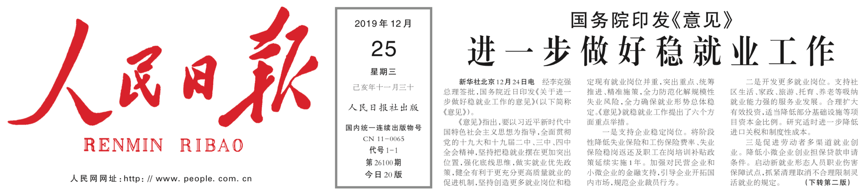
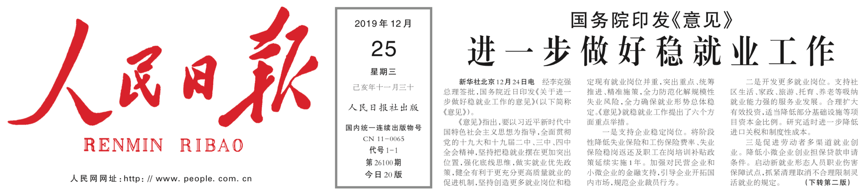
The release just last month by the State Council of “Opinions
Concerning Further Stabilizing Employment Work” (关于进一步做好稳就业工作的意见) can be read as a further sign of just how
serious the issue of employment has become for the leadership.
The announcement of the State Council document took prime position in
the People’s Daily on Christmas Day, appearing right next to the newspaper’s
masthead.
The full text in Chinese of our 2019 political discourse report is included below, including a discussion of what I call the “442 Formula,” referring to the “Four Consciousnesses,” “Four Confidences” and “Two Protects,” which warmed up toward the end of the year, along with increased talk of Xi Jinping as the “people’s leader” (人民领袖) — a direct result of the reformulating of the “442” formula.
You will also find a more in-depth discussion of the phrase “political system reforms,” which as I said at the outset seems very much to be on its way out.