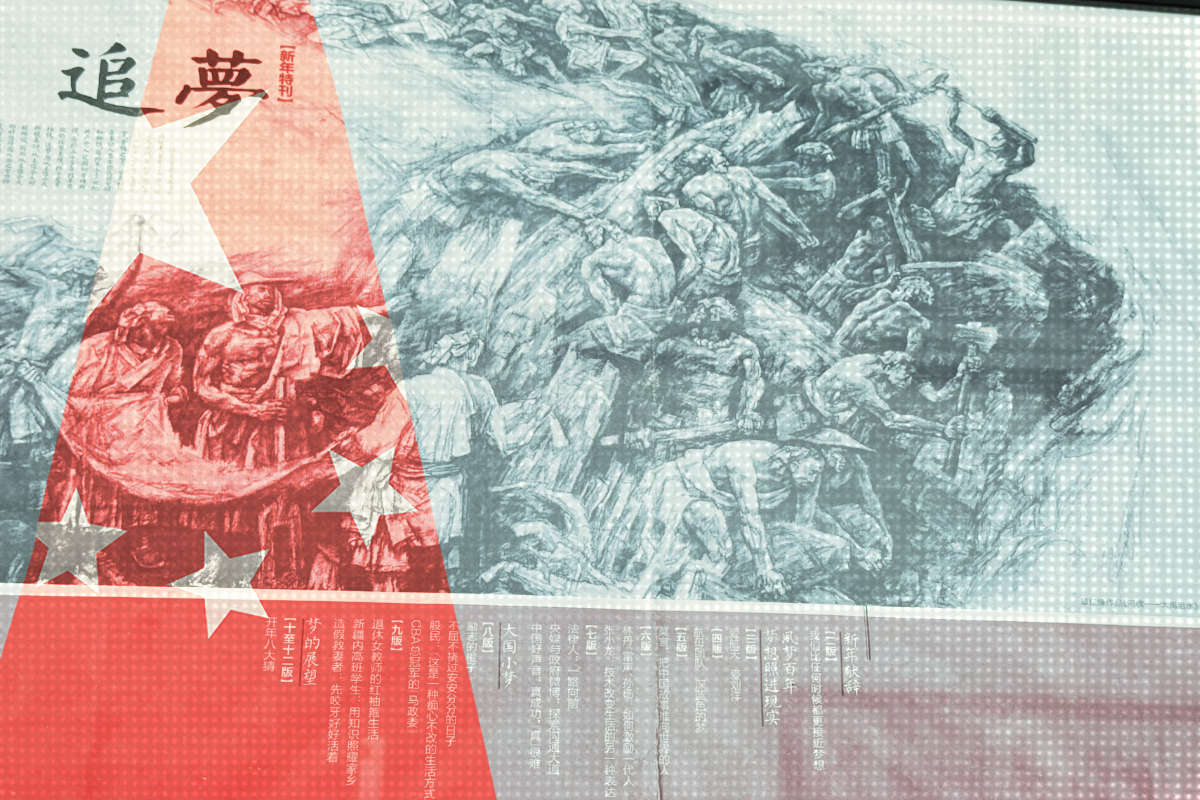
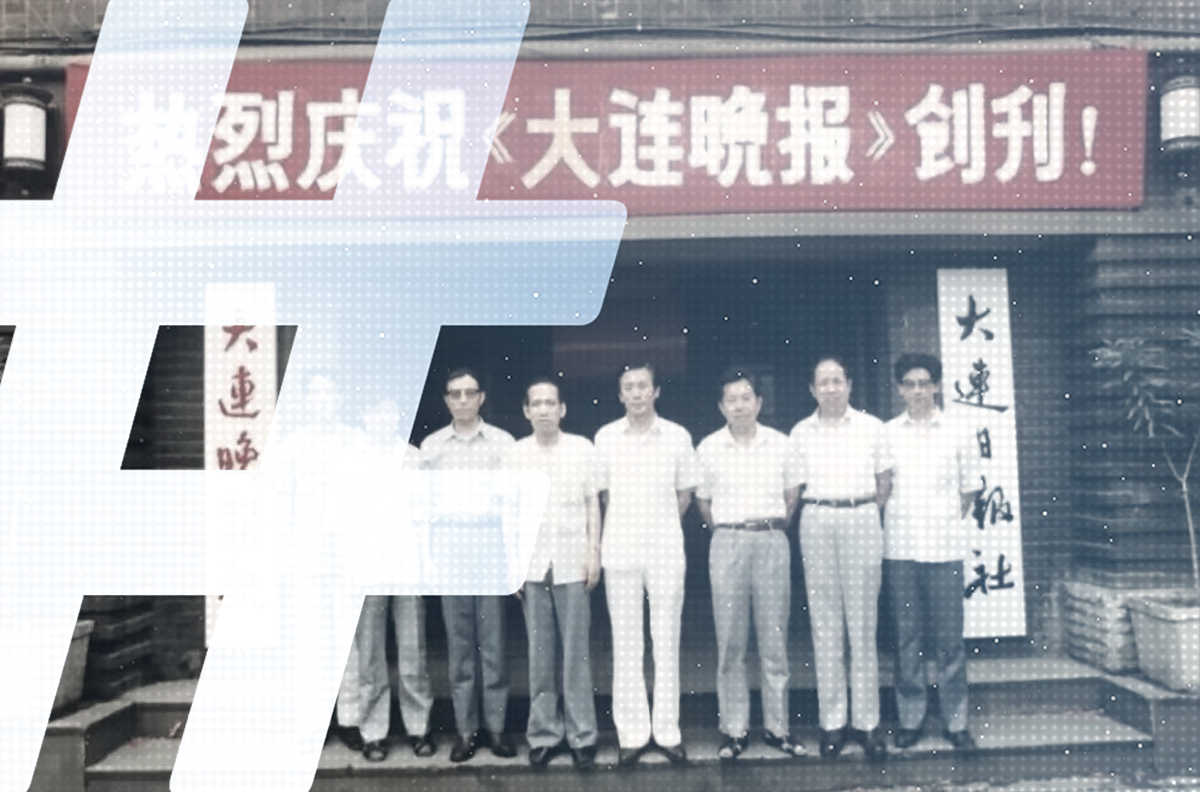
At the start of each new year, it has become a tradition in Chinese journalism since the late 1990s to publish carefully crafted editorial messages welcoming the year ahead. These messages to readers, called xinnian xianci (新年献词), or “New Year’s messages,” are typically penned by commentary departments within media organizations and serve as statements of purpose and vision — a rare moment when Chinese media can systematically express values and reflect on the year past. This year, as 2026 began, these messages arrived as expected, with Chinese media and some foreign Chinese-language outlets publishing their own New Year’s messages one after another.
The Communist Party’s flagship People’s Daily (人民日报) newspaper and the government’s official Xinhua News Agency ran New Year’s messages that followed similar lines. Both called blandly for a new journey in 2026, the country charging ahead. The New Year’s messages at some “mainstream media“ — a term that in China refers to Party-run media meant to set the tone for broader public opinion — took a more lyrical approach, with language that read more like whispered confidences to readers.
Shanghai’s The Paper (澎湃新闻), an outlet published by the state-run Shanghai Media Group (SMG), ran its message with the title “Until the Wind Blows” (直到风吹起). The message urged people to focus on themselves and cherish the beauty in life, awaiting the time — when the wind blows — that they could experience the true fullness of life. The meaning was at once evasive and conspicuous. The expected coming of the wind could be an allusion to favorable winds and the arrival of change, implying a current stasis or constraint that readers were meant to understand without naming.
Each New Year’s message was carefully crafted with beautiful prose. And many selected their own golden phrases that then were circulated widely on WeChat.
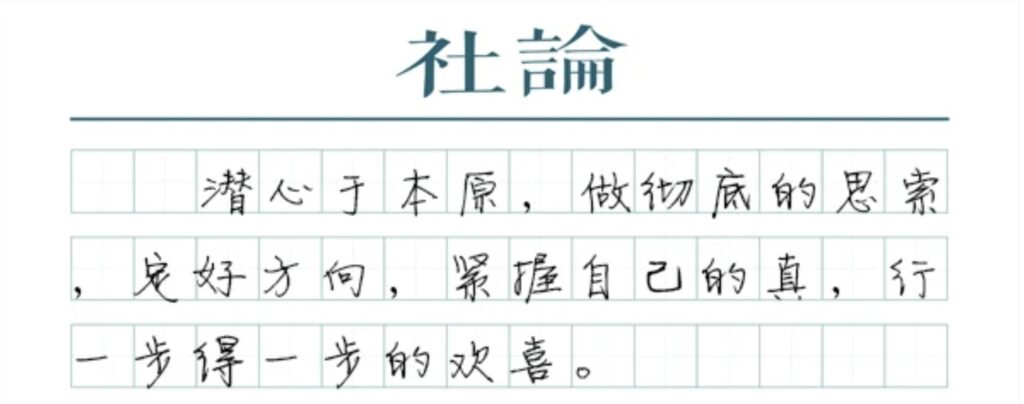
However, the most anticipated New Year’s message each year comes from the Guangzhou-based Southern Weekend (南方周末), once known for its more probing journalism. Southern Weekend‘s 2026 New Year’s message was titled “The Softest Power Can Also Build the Most Solid Human World” (最柔软的力量,也能修筑最坚固的人间). It was about returning to fundamental human values and connections in a time of upheaval, when individuals feel fragmented by rapid technological change, economic pressures, and social divisions. To date, the article has drawn more than 100,000 shares on WeChat and hundreds of comments. One passage read:
“The meaning of humanity is not to chase the future, but to go all out after confirming a direction worth pursuing; one person may not be strong, but countless of the softest powers can also build the most solid human world.”
But for some readers, the message about the “softest powers” was a pale echo of Southern Weekend‘s bolder New Year’s messages from years past. One post circulating on the social media platform Zhihu reminded readers of what a different kind of New Year’s message might look like — one that spoke more directly to the struggles and emotions of ordinary people navigating difficult times. “This year, have you felt anger, or have you become numb?” the post asked, alluding to several of the year’s controversies exposing the darker side of society. “When you saw the bullying in Mianyang, when you saw the earrings in Huangyang and Dianxi, the Nanjing Museum, the busiest group of five.”
Tradition and Constraint
Tracing back the history of New Year’s messages, People’s Daily actually had New Year’s messages as early as 1947. At that time, the Chinese Civil War between the Kuomintang-led government of the Republic of China and the Chinese Communist Party was still in full swing, and the People’s Daily was the organ of the CCP’s Shanxi-Hebei-Shandong-Henan Central Bureau, and its New Year’s messages were mostly leaders’ calls to the people, discussing national construction and prospects.
It was not until 1997 that New Year’s messages appeared with different styles and themes from these messages chiefly praising the CCP and encouraging national development, shifting to focus on citizens as protagonists. Southern Weekend published an editor’s message at year-end in 1997, followed by another at the close of 1998 titled, “Give Power to the Powerless, Let the Pessimistic Move Forward” (让无力者有力,让悲观者前行). Then, on January 1, 1999, the paper published what would become its first annual New Year’s message: “There is Always a Power That Moves Us to Tears” (总有一种力量让我们泪流满面). It included this emotive passage:
“Sunshine falls on your face, warmth remains in our hearts. Why do our eyes always fill with tears? Because we love so deeply; why are we always full of spirit? Because we love so deeply; why do we constantly seek? Because we love so deeply. We love this country, and her people — they are kind, they are upright, they know how to care for one another.”
From the 1990s to the 2000s, as economic growth accelerated, the CCP began somewhat to relax control over ideology. Although the media and journalists could not openly call for press freedom, they worked hard to practice its spirit through their work by means of journalistic professionalism. During this period, in-depth reporting gradually emerged, and commentary discussing civic issues slowly developed too. New Year’s messages were written by the commentary departments within media organizations, often with a growing sense of idealism. During those ten-plus years, the media navigated between what could and could not be said — and they used “New Year’s messages” to set their hopes and intentions down in writing.
Jiang Xue (江雪), an independent journalist who once served as director of the commentary department at an institutional media outlet (机构媒体), meaning that it had a license and was formally authorized to publish in China, shared her experience participating in writing New Year’s messages: “We would discuss the important news of the year, generally [topics] related to civil rights and values. At that time there was a certain degree of freedom of speech — although censorship was always in mind, we tried to express some things,” she said. “In institutional media, you still had to consider whether it could be published.” Before 2013, Southern Weekend‘s New Year’s messages were often related to civic resistance and fighting for rights.
“We would try to speak some human words, speak some truth. The principle in Chinese media is that you can’t say all the truth — speaking 100 percent truth makes it impossible to survive,” Jiang said. “So I say part of the truth, that part of the truth that benefits the public, and everyone is willing to make this compromise [to express it].”
Under conditions without press freedom, after a whole year of repression and frustration, there always needs to be an outlet for expression,” Jiang Xue said. She described New Year’s messages as “like walking at night and cheering yourself on, telling yourself not to be afraid of ghosts.” “I think media [in China] use New Year’s messages to encourage themselves,” she said.
Hong Kong also has several media outlets with a tradition of writing New Year’s messages. Chen Yin (陈音), a former Ming Pao (明报) reporter, said that New Year’s messages often do not depend on specific news events, but rather represent one of the few moments in a year when media can systematically express value judgments. In the Hong Kong context, New Year’s messages were previously understood as a media outlet’s annual statement of position. “Even if there aren’t many readers and circulation is limited, the editorial department still considers this an article that should be completed,” she said. “In recent years under the self-censorship system, much sensitive content, including criticism of the government, is avoided. It may not necessarily change reality, but it symbolizes that a newspaper still considers itself part of public discussion.”
Mr. Qiu, a senior editor who has long worked in Hong Kong’s press, said that publishing New Year’s messages on New Year’s Day has always been seen as a form of institutional writing in Hong Kong journalism, rather than simple holiday greetings. “It’s more like a media outlet’s summary of the past year’s public affairs, and also an affirmation of its own role,” he said.
In China, the 2013 incident at Southern Weekend marked a more fundamental shift (coverage from CMP in 2013 here). That year, just weeks after Xi Jinping came to power, the original draft of the New Year’s message written by the Southern Weekend editorial team, “China Dream, Constitutional Dream” (中国梦,宪政梦), was subjected by the authorities to deep revisions. First, the compromised title became, “Dreams Are Our Commitment to What Should Be” (梦想是我们对应然之事的承诺), but this was then subsequently edited by Guangdong Propaganda Office — in an unprecedented act of direct editorial involvement — to the even more positive, “We Are Closer to Our Dreams Than Ever Before” (我们比任何时候都更接近梦想).
The censorship provoked newsroom staff to post online criticisms of the damage being done to press freedom in China, and some joined a four-day strike. Public demonstrations against press censorship erupted outside Southern Weekend‘s headquarters in Guangzhou. The newspaper’s chief editor ultimately took responsibility for the incident, and the protests were suppressed. Though the newspaper continued to publish, the impact on the space for public discussion that had developed over many years — in what some now remember as a “golden age” for Chinese journalism — was devastating. In the months and years that followed, there came wave after wave of press restrictions.
In an article published in 2024, the now-defunct diaspora outlet Wainao (歪脑) reflected back on the events in January 2013: “This incident of the message being edited was actually the final blow to Southern Weekend: after this, Southern Weekend was no longer the same newspaper.”
The article also mentioned that after the Southern Weekend incident, imitations of the form of the New Year’s message proliferated, with every media outlet publishing its own New Year’s message. They became an even more popular form of “elegant writing” (美文) — a style emphasizing literary aesthetics over journalistic substance — and the collective New Year’s messages resembled an essay competition. “A unique literary style that stripped away journalistic professionalism and core values while emphasizing gorgeous prose began to prevail,” the Wainao article observed. Hong Kong’s institutional media still maintain this tradition too, but diaspora media have largely abandoned the practice of publishing New Year’s messages.
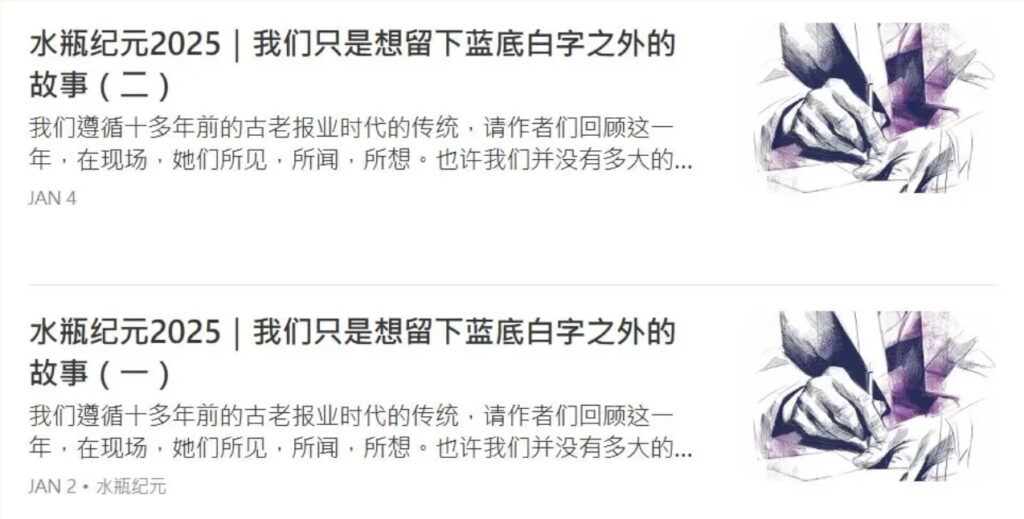
The independent Chinese-language media outlet Mangmang (莽莽) wrote New Year’s messages in 2023 and 2024, but stopped in 2025. Another independent media outlet, Aquarius Era (水瓶纪元), welcomed 2026 in the form of reporters’ reviews under the title “Stories Beyond Blue Backgrounds and White Text” (留下蓝底白字之外的故事), a reference to the simple factual bulletins so often released in recent years by police and government offices and shared by news outlets in lieu of actual journalism. The editor’s note at the beginning read: “Our thinking is simple: since things are important, we go to the scene; since we are at the scene, we don’t want to castrate or whitewash the facts in any way. . . . This country has such a large population, yet the stories being told are becoming fewer and fewer. There are still many such moments that show us journalism still matters.”
Speaking truth is the reason New Year’s messages carry weight. After leaving institutional media, Jiang Xue became an independent journalist focusing on human rights reporting. For several years, she continued to publish New Year’s messages on WeChat. “Stories defending human rights generally won’t be seen in institutional media. I wanted readers to see these stories of these silenced people, to let everyone see the interviews I did through the year,” she said. Writing New Year’s messages was to urge readers to pay attention to those important social issues — and this was her intention with one post called “Ten Days in Chang’an” (长安十日), which was eventually removed by online censors.
“Actually, writing ‘Ten Days in Chang’an’ was a kind of alternative New Year’s message,” Jiang Xue explains. “I wanted to record what was happening around me.” On January 4, 2022, she published the article through her WeChat public account “Mocun Gewu” (默存格物). “At that time I was in Xi’an, locked down for a month [during the pandemic]. By year’s end I kept thinking about writing something,” she said, “but then I thought about a friend saying New Year’s messages are linguistic corruption, which made me feel it wasn’t quite right to write.”
“For me, a New Year’s message is nothing more than a literary form, equally a vehicle for expressing journalistic pursuits,” Jiang Xue said. “Any vehicle will do.”
This feature was originally published at Tian Jian (田間), CMP’s Chinese-language outlet devoted to the discussion of journalism and media development. Tian Jian is also on Substack.