In the current Chinese-language media environment, occupational risks for journalists have become the norm. Whether inside or outside China’s institutional media system (体制内外), the scope for reporting and publication continues to narrow, and the space for discussing public issues is vanishing. These changes are reflected not just in legal provisions and political measures, but permeate every aspect of the daily work of journalism.
In recent years, the pressure facing Chinese journalists has intensified considerably. When reporters in multiple regions cover stories such as mass incidents or the debt problems facing local governments, they are now routinely required to remove or revise reports, or to hand over their interview materials. Local propaganda offices continue to strengthen their review of news coverage, prompting frontline reporters to resort to self-censorship simply to survive professionally. Internet regulatory agencies have also increased real-time monitoring of news platforms and self-media accounts — independently operated accounts on social media platforms like WeChat that remain subject to strict licensing and content regulations. Reports involving social issues are often required to undergo a process of “pre-publication review” (先审後发).
There is little to celebrate. And yet, every year in China, November 8 marks Journalists’ Day — established in 2000 as one of the country’s professional holidays. On the surface Journalists’ Day remains a festival celebrating the news industry, but it has more accurately become a collective moment of silence, reminding everyone that the boundary between recording the truth and erasing it has become hopelessly blurred.
In consultation with Tian Jian, the sources interviewed for this story opted for pseudonyms out of consideration of personal and professional risk. They include Xiao Hong (小紅), Pan Hong (潘虹), Ying Ping (應平), “U” and “N” — all current or former journalists living in China. The overseas media observers interviewed for this story, who maintain connections inside China, also chose to remain anonymous.
News Reports That Disappeared
On the eve of China’s 2025 Journalists’ Day, the WeChat account “Shijia” (十驾) published an article by veteran journalist Li Wei’ao (李微敖) called “A Journalist’s Work Is Definitely Not ‘Waiting for Notices’ or ‘Reading Bulletins’ — My 23rd China Press Day.” Li revealed in his article that he had published a total of 43 news reports in the 12 months to 2025 Journalists’ Day, of which 10 were deleted or taken down shortly after publication. Some of the pieces, he said, survived for just a few hours. The “disappeared” (被消失) content mostly involved socially sensitive issues such as official corruption, internal state-owned enterprise investigations, sexual assault scandals, and reports of religious figures under investigation. News censorship, Li pointed out, has become not merely part of the editorial process, but the core force determining the fate of reports.
Li’s Journalists’ Day reflection, which was eventually removed from WeChat, can now be viewed in the archive at China Digital Times.
Li’s WeChat post added that the disappearance of nearly a quarter of his articles revealed not just intensified censorship, but the impossible position of Chinese journalists, who are now completely trapped between their professional duty and institutional red lines. For reporters working within the system, articles serving a public watchdog function — what in the past was sometimes grudgingly accepted as acts of constructive “supervision by public opinion” (舆论监督) — are routinely deemed to have crossed the line. For those working outside the system, publication has become a roll of the dice. That the truth can be instantly erased is an occupational constant, a fact that made China’s 2025 Journalists’ Day particularly somber.
Wang Miaoling, a Beijing journalist interviewed recently by Tian Jian, said that on-site reporting has become a high-risk activity. “In some areas, police appear directly at news scenes, demanding deletion of footage when they see cameras, asking which organization you’re from,” she said. Such intervention has long become routine, with many reporters having to assess, as Wang says, “whether they can safely return” before setting out.
Wang says “disappeared reports” like those mentioned by Li Wei’ao in his post are not at all uncommon. They are, she says, a mirror of the news environment. “What journalists fear most now isn’t writing incorrectly — it is writing correctly yet still finding it impossible to publish,” she says. “This situation leads many to simply stop asking questions and stop recording reality. What can’t be published you just hand on to your friends in the foreign media.”
Zhao Renyi, a Beijing media research scholar, told Tian Jian that Wang Miaoling’s experience reflects structural changes in the current news environment. “In China, the method of censorship is no longer just about deleting articles,” he said, “but about making journalists self-restrain psychologically through layers of accountability and institutional punishment.” Though many young journalists still harbor ideals when entering the profession, they quickly learn how to avoid risks. “When Press Day becomes a day for wishing ‘safety’ rather than a moment for recognizing professionalism, the meaning of press freedom has been rewritten,” Zhao says.
Institutionalized News Censorship
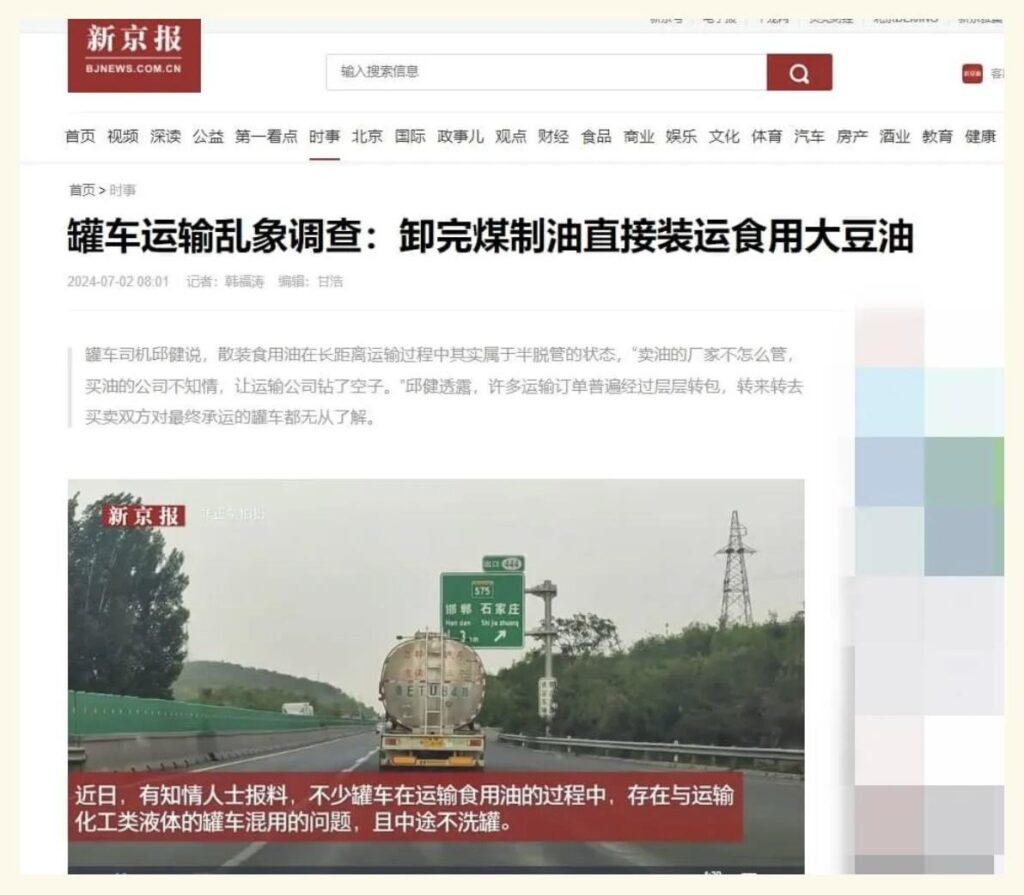
Xiao Hong, another reporter working at The Beijing News, told Tian Jian that many news organizations no longer encourage investigative reporting. “In July 2024, after investigative reporter Han Futao and two other reporters jointly investigated and published a story about [industrial] oil tankers transporting [edible] oils, the higher-ups were really unhappy,” she said. “Now all similar reports must go through several layers of approval. We all know which topics can’t be touched — and even if we do touch them, they can’t be published. Now when we receive complaints [from citizens about public interest issues], even with evidence, we don’t write about them.”
The story to which Xiao refers was published in The Beijing News on July 2, 2024. It revealed that oil transport trucks carrying toxic coal-to-oil (CTL) products were transporting soybean oil without cleaning the oil tanks between loads. After the report was published, it attracted widespread attention in China and internationally. The coverage forced officials to intervene and announce an investigation. As public opinion simmered, however, the Weibo account of journalist Han Futao (韩福涛), who had led reporting of the story, suddenly vanished. Searches for the account turned up a message that read: “User does not exist.” Many netizens left messages expressing concern for Han’s personal safety and questioning the platform’s reasons for blocking his account.
Compounding the pressure experienced at news reporting outlets, institutional-level review has also tightened considerably. Over the past decade, the system of news censorship in China has become a comprehensive system reaching down to the local level.
For local reporters, the sources of risk lie not only in direct obstruction at the scene, but also in dual pressure of information censorship and self-censorship. Reports on many public events are compressed into official “bulletins” (通报) [from the local authorities] that convey uniform information and tone, and under this system the media have gradually lost their role carrying out on-site reporting. Reporters working at institutional media (体制内记者) face a tug-of-war between “performance indicators” [that assess how frequently they publish] and the “risk of deletion.” Meanwhile, writers outside the institutional media system — trying their luck on platforms like WeChat — find viable publishing channels increasingly tightening.
As transparency around information has declined in recent years in China, the more comprehensive reporting of the facts often depends entirely on the courage and luck of the individual journalist. Ying Ping, a veteran Beijing media professional, told Tian Jian that direct news censorship and interference have driven a sharp decline in the number of working investigative reporters in the past decade. “In today’s journalism world, the number of investigative reporters has plummeted from over a thousand at its peak to just a few dozen, mainly concentrated in super tier-one cities like Beijing, Shanghai, Guangzhou and Shenzhen,” he says. “Most investigative reporters at media outlets in second-tier cities have either changed careers, turning to advertising or publishing self-media.”
Ying recalls that back in 2008, after the poisoned milk scandal was exposed by Shanghai’s Oriental Morning Post, a commercial daily under the state-run Shanghai United Media Group (SUMG), the newspaper received a call from the propaganda department wanting to track down investigative reporter Jian Guangzhou (简光洲), who was behind the report. Jian had revealed how infants who had consumed milk powder manufactured by Hebei’s Sanlu Group were being sickened with kidney stones. The milk powder was found to contain the industrial chemical melamine. “Back then you could still publish investigative reports,” says Ying. “Who dares pursue an exposé now?”
Political Review Makes Reporting High-Risk Work
Institutional mechanisms of political review in the media have become a routine part of the risk newspapers bear. Multiple senior reporters who have worked at official media such as Guangming Daily and the People’s Daily told Tian Jian that over the past decade, any topics involving local debt, urban village redevelopment, corporate layoffs, and financial risks must be approved by higher-level propaganda departments prior to publication. “Given the complexity of approval procedures, most editors now simply give up on such reports,” said one journalist. “When the propaganda department makes a phone call saying not to write about it, you can’t write.” Three decades ago, they said, the understood rule was the “three-seven split” (三七開), meaning three parts over the line could stand with seven parts in bounds. Today, the rule is the “one-nine split” — leaving almost no space for anything that crosses the line.
Pan Hong, a former Guangming Daily reporter, told Tian Jian: “Guangming Daily cannot publish so-called negative energy articles — not even one. Many young reporters are children of bureau-level officials within the system. Without needing to be told, their articles are almost all praise. They have long ago lost all basic sense of the journalist’s professional duty.”
In central-level party media, she said, the core of censorship has shifted from scrutiny of content to the signaling of allegiance. “Guangming Daily is managed on behalf of the Central Propaganda Department, and the department head can directly call the president or editor-in-chief,” Pan says. “Censoring us isn’t just about content, it’s about your degree of loyalty.”
Key Chinese Terms Referenced in This Story
| Chinese | Pinyin | English | Audio |
|---|---|---|---|
| 体制内外 | tǐzhì nèi wài | Inside and outside the institutional media system | |
| 先审後发 | xiān shěn hòu fā | Pre-publication review | |
| 被消失 | bèi xiāoshī | Disappeared (in reference to content and reports) | |
| 舆论监督 | yúlùn jiāndū | Supervision by public opinion | |
| 通报 | tōngbào | Bulletins (official notices) | |
| 导向分析会 | dǎoxiàng fēnxī huì | Guidance analysis meetings | |
| 习近平新闻思想 | Xí Jìnpíng xīnwén sīxiǎng | Xi Jinping Thought on Journalism |
To avoid risk, some newspapers have simply ceased in-depth investigation of economic and social issues, filling the space instead by republishing official reports or propaganda pieces from other papers. Liu Hao, a reporter and editor who once worked at a metropolitan newspaper in the south, told Tian Jian: “We used to report on local official corruption or environmental pollution. Now all such news must go through the province’s prescribed approval procedures and are mostly shelved. Many reporters have turned to corporate public relations or commercial outlets.”
“Journalism has become a dangerous profession,” they said.
Foreign correspondents in China also complain about the journalism environment in China, which has become a society full of risks for reporters. U, a foreign journalist based in China, who spoke on condition of anonymity out of fear of repercussions, told Tian Jian that he was once approached by government officials who said he would find it difficult to renew his visa if he filed reports critical of the Chinese government. “Coverage by Chinese reporters is censored, and as foreign journalists we are unable to run ‘sensitive’ news stories [without repercussions],” he said. “Even if our colleagues outside publish articles [that are critical], we will ultimately be used to settle accounts.”
Wang Haitao (汪海濤), a scholar of press freedom and digital control, told Tian Jian that as censorship has tightened, the risks for journalists have risen. “I recently discussed this topic with some former investigative reporters from Zhejiang Television,” he said. “TV reporters are now far more cautious than in the past — footage cannot show police on duty without their caps, you can’t capture scenes of [police] pulling and tugging with passersby, and even background music cannot use songs from Hong Kong or Taiwan.”
“Journalism has become a dangerous profession.”
Wang pointed out that these points of sensitivity generate pressure in on-the-scene reporting — censorship no longer existing just in the newsroom but permeating every shot and every word choice. “Censorship now is more like air,” he said. “Journalists know which footage shouldn’t be filmed, which words can’t be written.” This institutionalized contraction, says Wang, forces journalistic professionalism to give way to political security. “When journalism loses the ability to affect reality,” he said, “its social role is fundamentally altered.”
Journalism Students Also Required to Self-Censor
Zhou Bin (周斌), a veteran journalist who previously taught at journalism programs in China, told Tian Jian that a university where he once worked conducted a confidential survey in 2024 of journalism students and media interns, with a sample of about 1,500 respondents. “The results showed that most respondents acknowledged they would consider avoiding sensitive content when writing about social or political issues,” he said, adding that “this tendency becomes more pronounced after entering the workforce.”
This, says Zhou, reflects a critical gap. “Although this is not a strict industry survey, it does reflect the disconnect between journalism education and field practice,” he said. “Students in school still emphasize objectivity and fairness, but once they intern, they are required to learn self-censorship. Once this mentality forms, it’s very difficult to change after entering media within the system in the future.”
At the local level, the propaganda system’s “mechanism of political responsibility” (政治責任制) has been strengthened. J, a former management-level editor at Beijing Youth Daily, disclosed to Tian Jian that the propaganda department regularly convenes “guidance analysis meetings” (导向分析会) that serve as internal disciplinary sessions to enforce. These sessions trace accountability to individuals for “incorrect” reports, and require media to “not hype, not elaborate, not guide emotions” (不炒作、不延伸、不引导情绪).
“Once when I was on duty, because of wording problems in a headline, both the editor and the responsible reporter were summoned for talks, suspended for inspection, and had three months of bonuses deducted,” J said.
Gradual Loss of Public Oversight Role
News risks not only affect media but also transform interactions between media and the public. N, a freelance writer from Jiangsu province’s capital city of Nanjing, says that they must maintain extreme caution at the drafting stage to ensure their reports can survive. “Before we publish, we review the text ourselves first, checking for ‘sensitive words,’” said N. “Now even writing about livelihood news and falling housing prices requires caution.” N cited such topics as conflicts over urban management, workers’ demands for unpaid wages, and disputes over property — all generally not published any longer in local media.
“Sometimes after an article is written, no one dares accept it, and no one dares publish it,” N adds.
When it comes to the internet, the automation of censorship technology makes the application of controls on information more covert. Since 2021, the Cyberspace Administration of China has launched nearly constant “Clear and Bright” actions, which include “cracking down on irregular news gathering and editing” (打击违规新闻采编), “rectifying false news on self-media” (整治自媒体假新闻), and “preventing negative speculation” (防範负面炒作). According to official reports on these actions, more than 800 million pieces of “irregular information” had been cumulatively cleared by the end of 2024, and around two million accounts had been blocked. This level of account oversight means that journalists writing for self-media do not have latitude to test the boundaries.
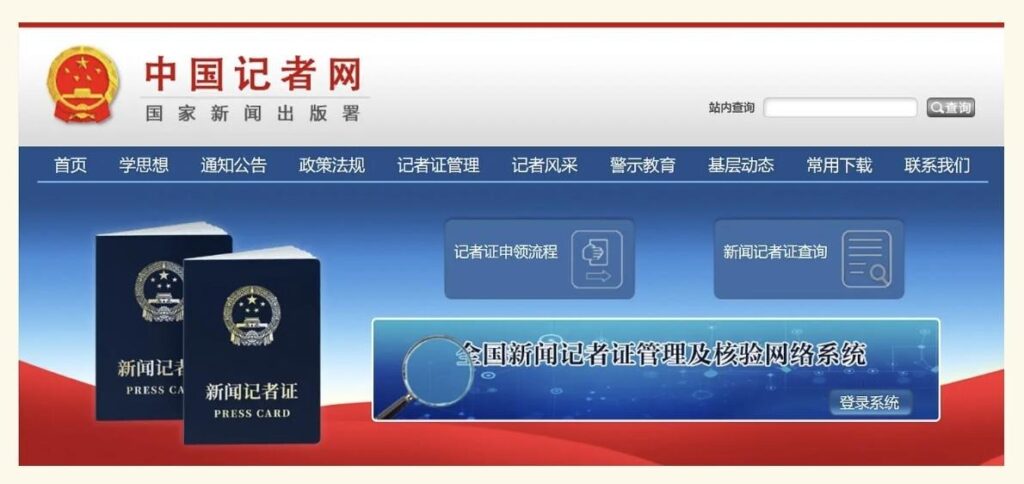
Between platform algorithms and professional guidelines and restrictions, the space that remains online and offline for pursuing stories has been severely contracted. The process for official government credentialing of journalists has also been strengthened. According to documents from the National Press and Publication Administration (NPPA), the agency linked to the Central Propaganda Department in charge of news and publishing, and the Ministry of Human Resources and Social Security, press cards — which journalists technically require to conduct reporting — are subject to annual verification and are uniformly re-issued on a five-year basis.
At the same time, journalists are obliged to take part in assessments of their knowledge of political theory including “Xi Jinping Thought on Journalism” (习近平新闻思想) and the “Marxist View of Journalism,” both of which essentially put the Party at the center of the media and journalism. These institutionalized requirements place professional journalists within what is essentially a system of political loyalty assessment.
The risks of reporting the news, observers say, are no longer simply about direct legal and political restrictions, but about the contraction of the entire public space in China. As pressure from local governments and corporate public opinion departments ratchets up, making local reporting and industry reporting nearly impossible, media can no longer serve a public oversight role. Instead, they have become cogs in the machine of propaganda and image management.
For many journalists, says Li Jia (李嘉), a former lecturer at Communication University of China (CUC), departure from the profession is a logical and necessary choice given this state of affairs: “The boundary between inside and outside the system is narrowing, and journalists are all thinking of ways to survive. The best way is just to leave the media industry.”