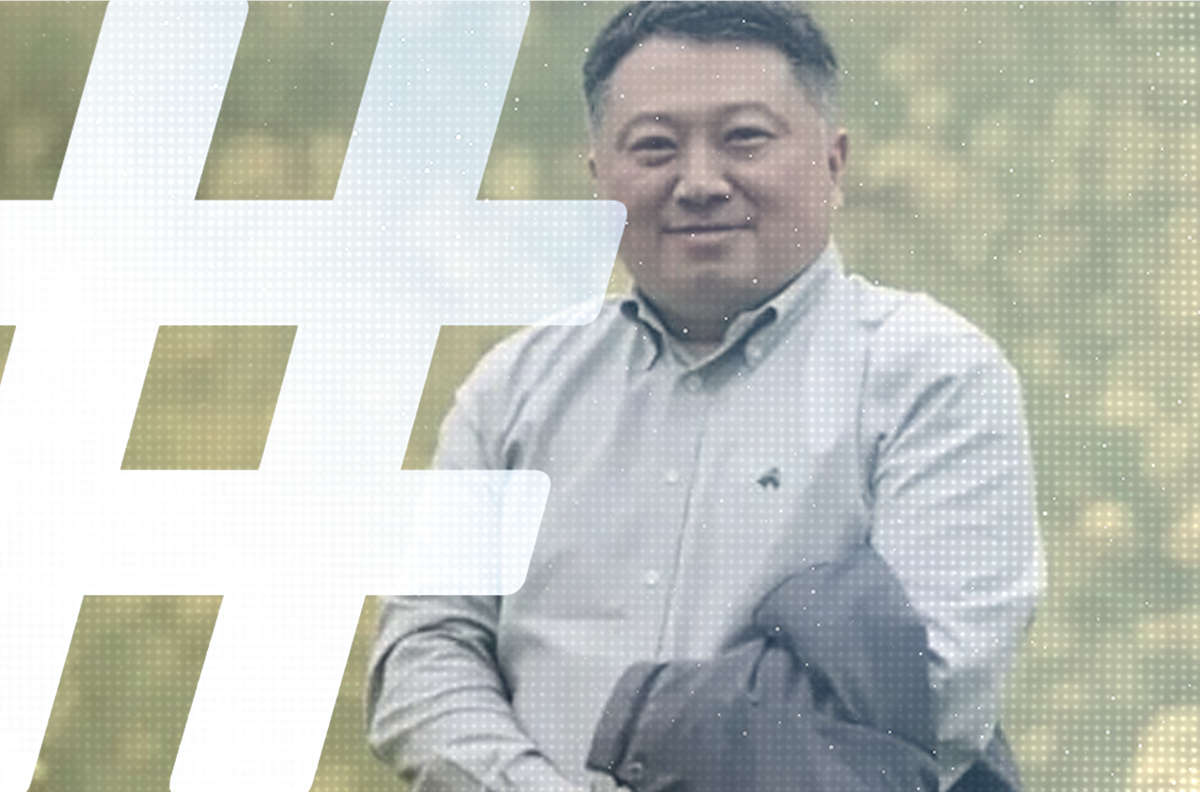
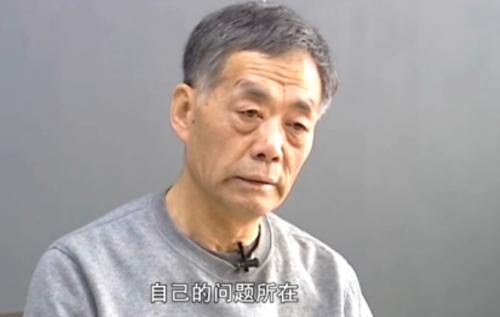
Shi Lianwen (史联文), until 2012 the top executive at one of China’s most successful television networks, is cowed and contrite. Dark circles sag under his bloodshot eyes as he confesses his crimes.
But this is not a courtroom. Speaking against an ashen backdrop, the silver-haired former reporter, winner of numerous journalism awards, is framed in the lens of Communist Party corruption investigators. Clipped to the collar of his somber grey t-shirt, a black lavalier microphone registers his shame with pin-drop clarity.
“I see now where my problem lies,” he says, his weary voice rasping. “I feel great pain from the bottom of my heart, having failed to do what my leaders demanded.”
A long-established practice in Communist China, the act of self-confession, or jiantao (检讨), is a psychological tool of power, about commanding deference and enforcing docility. In Notes of the Shamed, the essayist Mo Luo wrote that the ritual of self-confession — also known as “self-criticism” or “self-denunciation” — is about “exercising control over the spirit,” and “one of the principal means of [ideological] education and rule employed by those who wield power in China.”
For many Chinese, public acts of forced confession are relics of a bygone time, conjuring memories of the political turmoil of China’s pre-reform era. But over the past three years, as President Xi Jinping has consolidated power through an ambitious anti-corruption drive, combined with a “mass-line” strategy to cut down on extravagance, waste and bureaucratic inaction, the self-confession has enjoyed a resurgence in China. While Xi has talked about the need for rule of law in order to “shut power inside the cage of regulation,” the return of the Party confessional throws Xi’s unyielding exercise of power into sharp relief — and exposes the enduring supremacy of an internal politics of dominance.
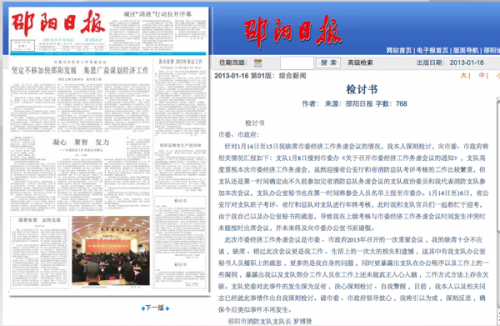
On January 16, 2013, just over a month after the release of Xi Jinping’s new eight-points guideline on official conduct, a Party newspaper in Hunan province published two letters of self-confession on its front page. The letter’s were penned by fire safety officials who failed to attend a departmental meeting. “This economic work retreat . . . was an important 2013 conference, and my absence was unacceptable in the extreme,” the first official, Luo Boxian wrote. “Recently, I and other relevant comrades have made profound self-confessions on this matter.”
Such public confessions, frightfully common during the political purges of the 1950s-1970s, have been rare in reform-era China. But in Xi Jinping’s China, it seems, they are par for the course.
Back in January a general meeting of China’s anti-corruption body, the Central Commission for Discipline Inspection, developed an anti-corruption “task list” that formally included the writing of “letters of regret,” according to a recent report by the official Xinhua News Agency.
On March 6, 2015, an article in Qiushi, the Party’s chief journal of theory, argued that acts of self-criticism were an essential means of assuring the cleanness and effectiveness of the Chinese Communist Party. “Surveying the Party’s history, criticism and self-criticism have been important parts of successive campaigns to clean up the Party and rectify work styles and thinking,” said the article. “If self-criticism is done properly . . . the effectiveness and quality of mass line education movement can be ensured.”
The idea of the “self-criticism,” or ziwo piping, the origin of the “letter of self-confession” in China’s modern era, can be traced back to Soviet Russia. In his 1928 essay “Against Vulgarising the Slogan of Self-Criticism,” Joseph Stalin, the leader of the Soviet Union, wrote:
Self-criticism is a specific method, a Bolshevik method, of training the forces of the Party and of the working class generally in the spirit of revolutionary development. Marx himself spoke of self-criticism as a method of strengthening the proletarian revolution.
The method the self-criticism was adopted in China’s Communist Party-controlled areas during the 1940s. In his remarks during the Yan’an Talks on Arts and Culture, Mao Zedong said: “The masses too have shortcomings. These shortcomings must be overcome through criticisms among the people and through self-criticisms, and the process of such criticisms and self-criticisms is one of the most important tasks of arts and culture.”
As for what self-confession meant to generations of Chinese after the adoption of the practice, the playwright Sha Yexin (沙叶新) offers a good working definition in his essay “The Culture of ‘Self-Confession’.”
These self-confessions I speak of refer to ‘admissions of guilt’ and pledges to ‘reform oneself’ made against one’s will to superior leaders . . . in a centralised [power] system, in the midst of ideological brainwashing campaigns, in the midst of baseless political campaigns, in the midst of exaggerated internal Party power plays, and under intense authoritarian pressure.
In the 1950s, letters of self-confession became a widely-practiced means of subjugating China’s intellectuals and ensuring unity with the ideas of the Party and its supreme leader, Mao Zedong. But confession also became a way of life for all, inculcating a political mindset of conformity at every level of Chinese society. Even schoolchildren confessed to their teachers or headmasters for peccadillos real, imagined or fabricated — a writing exercise so pervasive it became, to a very real extent, the national route to literacy.
Facing wave after wave of political upheaval, poets, playwrights and journalists were often most prolific when chronicling their ideological failings. Facing a struggle session at the China Writers Association in October 1959, the poet Guo Xiaochuan (郭小川) wrote:
Looking at things now, it seems I can only express petit bourgeois and bourgeois feelings, and I am completely unable to express the feelings of the people. Those works of mine are a complete and total mess, and looking at them recently I couldn’t even stand to read them.
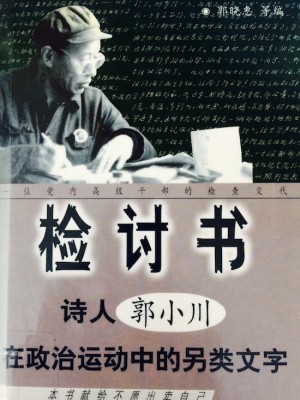
The letter of self-confession was one of China’s most defining genres of writing in the 20th century, a “language of torture,” as Guo Xiaochuan’s daughter, Guo Xiaohui, later called it, by which those in positions of authority consolidate their power and assert the supremacy of their ideas.
In 1967, while China was in the throes of the Cultural Revolution, Chen Zaidao, a ranking general in the People’s Liberation Army, wrote with apparent frankness of his crimes and cravenness as he faced allegations of misconduct:
My ideas were slowly corrupted, my life eroding, my [work] style becoming rogue. When I saw my female comrades or nurses, I acted like a hooligan. I pawed them, not even behaving like a human being. I was degenerate and promiscuous.
Only Mao Zedong, the “Great Helmsman” at the tip-top of the power pyramid, could escape the writing of self-confessions. Deng Xiaoping, later the architect of market economic reforms in China, wrote quite a number himself. They included this one, dated August 3, 1972, addressed to Chairman Mao:
I have made a great many errors. These are laid out in my ‘personal statement,’ and I will not set them out again here. The root of my errors is the fact that my bourgeois worldview has not been utterly eradicated, and the fact that I have become estranged from the masses and the truth.
Likening the act of self-confession to “a first-person ‘struggle session’,” the poet Shao Yanxiang (邵燕祥) suggested the Soviet origin of the tactic was just part of the story. There were also precedents, she said, in China’s ancient imperial system and in the Republican era after the Xinhai Revolution of 1911, evidenced in the way “advisors, eunuchs and various Ah Q’s would strike their own ears and say, ‘The servant must die!’”
In Xi Jinping’s new confessional movement, there are shades of the Party’s troubled political past. Questions of guilt and innocence are subservient to the imperatives of political power.
Shi Lianwen, the former television executive whose videotaped self-confession is now being promoted through the official website of the Central Commission for Discipline Inspection, may not be innocent. He stands convicted of clearly specified acts of graft, including the acceptance of cash payouts of 11.4 million yuan, about US$1.8 million, while he was director of Liaoning Television from 2009 to 2012. (Corruption investigators, with their penchant for peppering corruption-related releases with lurid and colourful details, have also said Shi accepted a valuable piece of bloodstone.)
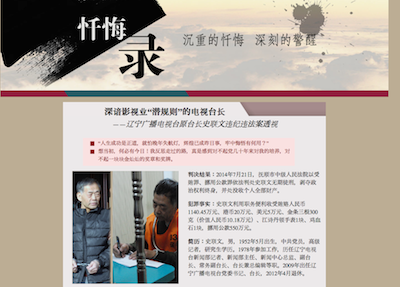
But watch or read Shi Lianwen’s “confession” on the CCDI website, where it is part of a new multimedia feature series called “Records of Confession” (忏悔录), and it becomes clear that Shi’s primary crime is not the breaking of the law per se — rather, it is his betrayal of the trust and responsibility vested in him by the Chinese Communist Party.
The supremacy of politics and ideology over the law becomes oddly clear as Shi Lianwen confesses to having an overly commercial mindset in his management of Liaoning Television.
At the television station, I came to apply the “money” standard alone in determining the quality of the work produced by my comrades. I even put forward the slogan, “Not a cent can be lost within our business scope.” . . . While Liaoning Television did achieve influence, this was not by adhering to the cause of the Party but rather by serving the interests of various groups or individuals, through the service of small groups.
Media commercialization has been a part of de facto media policy in China since the middle of the 1990s. Over the past 20 years, Chinese media have moved boldly into the marketplace, spawning a whole new generation of magazines and tabloids that survive by being relevant to their audiences, and to those “small groups” of interest we call advertisers.
For all but a handful of core Party and government media — the likes of the People’s Daily and the official Xinhua News Agency — state support is a distant memory. The Party still places weighty political demands on the shoulders of the media, and censorship is a daily (or even minute-to-minute) concern. But without the “’money’ standard” for which Shi Lianwen is so contrite, without the succour of the market, media in China could not survive.
Does Shi Lianwen’s self-confession augur a change in the Party’s outlook on media commercialisation? Almost certainly not. The content of Shi’s confession, like the content of his alleged misdeeds, is largely irrelevent. It is the ritual and form of his confession that truly matters in the context of Xi Jinping’s mass-line reformation of the Chinese Communist Party.
As in the past, today’s culture of confession is not about accountability, clean government or a rules-based system. It is about dominance and submission.
Xi Jinping is China’s confessor-in-chief. You serve at his pleasure.
Read our translation of Shi Lianwen’s letter of self-confession on Medium.