Today, on the eve of the 100th anniversary of the May Fourth Movement, the political movement that arose out of student protests in Beijing in response to the Treaty of Versailles, “the youth” figure strongly in official propaganda. But as China’s leadership walks a tightrope, acknowledging this crucial anniversary while seeking to drain it of all hints of sanguine insurgence and youthful opposition (we are just weeks away from the anniversary of June Fourth), the story’s real protagonist is not China’s youth, but rather President Xi Jinping and the Party he leads.
The two most famous figures at the core of the “spirit” of the May Fourth Movement, Mr. Democracy and Mr. Science, are conspicuously absent.
“Chinese youth of the new era must continue to make full use of the spirit of May Fourth,” Xi Jinping told his audience at an official event last Tuesday to commemorate the anniversary. But what is that “spirit”? In Xi’s articulation, its essence is nationalism, a force that must be focused, moreover, through the leadership of the Chinese Communist Party. The youth, said Xi, must “[take] as their task the great rejuvenation of the Chinese people, not failing the hopes of the Party, the expectations of the people, and the great trust placed in them by all people of Chinese ethnicity.”
If we ask what values — aside from the narrow ideology of nationalism and fealty to the Party — should guide Chinese youth today, we are again told that the answer lies with Xi Jinping and the Party. An official commentary placed prominently at the top of the front page of today’s edition of the People’s Daily bundles the entire question of the May Fourth Movement into the political ideology of Xi Jinping and his recent articulation of his “Six Hopes” for the youth of China.
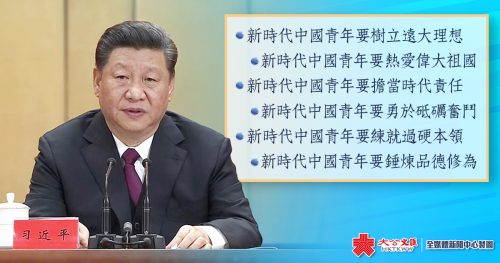
“To continue making full use of the spirit of May Fourth, and to take on the great task of national rejuvenation, [youth] must have a profound understanding of the Six Hopes raised by General Secretary Xi Jinping,” the commentary said. The “Six Hopes” are as follows:
The formation of far-reaching ideals (树立远大理想) — which means having faith in Marxism, and a belief in socialism with Chinese characteristics.
Ardent love for the great motherland (热爱伟大祖国) — which means it is imperative to “listen to Party and walk with the Party” (听党话、跟党走).
Taking on the responsibility of the age (担当时代责任) — which means becoming “builders and successors” of the socialist system.
Daring to struggle on (勇于砥砺奋斗) — which means being “pioneers moving at the forefront of our times,” “pushing through the brambles to open up new possibilities.”
Reaching mastery of abilities (练就过硬本领) — which means diligently applying oneself to one’s studies and self-betterment.
Refining moral character (锤炼品德修为) — which means “putting socialist core values into practice” (社会主义核心价值观).
In Xi Jinping’s “Six Hopes” we see the “May Fourth spirit” trapped on the Möbius loop of Party ideology. All questions of value ultimately come down to the fundamental question of the Party’s legitimacy and dominance. And this question hinges on Xi Jinping as the “core” of the Party.
This is why you will not find, anywhere across China’s vast media landscape, any mention in recent days of “Mr. Democracy,” or de xiansheng (德先生), and “Mr. Science,” sai xiansheng (赛先生), two concepts that were absolutely core to the May Fourth Movement in 1919, and that inspired Chinese youth at other times through the interceding decades, not least in the spring of 1989. These nicknames, given to democracy and science as a sign of respect by none other than Chen Duxiu (陈独秀), one of the founders of the Chinese Communist Party, became the core of the so-called “May Fourth spirit.” In an essay published in January 1919 the journal New Youth (新青年), a publication Chen founded in 1915, he wrote that “these two gentlemen can save China from the political, moral, academic and intellectual darkness in which it finds itself.“
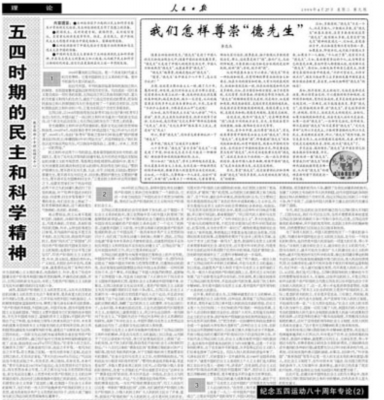
I won’t go into detail about the Chen’s concepts of “Mr. Democracy” and “Mr. Science,” and their significance through the decades. Nor will I attempt to lay out what exactly Chen and others have meant or understood by “Mr. Democracy.” But it is worth remarking that this 100th anniversary of May Fourth comes as Xi Jinping has consolidated power to an extent not seen in the reform era, when even the notion of collective leadership within the Party is in question.
And as it happens, the Party’s official People’s Daily newspaper explored the question of “Mr. Democracy” 20 years ago, during the leadership of Jiang Zemin, to mark the 80th anniversary of the May Fourth Movement.
I should emphasize that the term “Mr. Democracy” has appeared in just four articles throughout the entire history of the People’s Daily, going back more than seven decades. Three of these articles, all under the title, “How to Revere ‘Mr. Democracy,” appear in 1999, just ahead of and after the 80th anniversary of the movement.
The first in the series, appearing on April 27, 1999, is written by Li Zhongjie (李忠杰), a well-known scholar of Party history who, quite literally, wrote the book on The Governing Principles of the Communist Party of China.
Here is one passage in which Li discusses the meaning of “Mr. Democracy”:
Next, in order to revere ‘Mr. Democracy,’ we must gain a new understanding and accurately grasp many principles concerning ‘Mr. Democracy,’ in this way better making use of the spirit of ‘Mr. Democracy.’
For example, the principle of the majority (多数原则). ‘Mr. Democracy’ is not a single individual, but rather a majority of people. The minority deferring to the majority is the basic principle of ‘Mr. Democracy.’ Without the principle of the majority there is no ‘Mr. Democracy.’ Whether or not the principle of the majority prevails is one sign of whether the spirit of ‘Mr. Democracy’ exists. For example, within the Party committee, the secretary and the committee members all have only one vote. If a decision by vote is held, even if you are the secretary, the minority must defer to the majority. If someone comes and slaps the table and says, ‘What I say goes!’, this in fact is not ‘Mr. Democracy.’ If there is a person whose view differs, and they insist on thinking their opinion is correct and others must go along, this also is not ‘Mr. Democracy.’
In this “new era,” in which the Chinese Communist Party has moved in reverse on collective leadership and routinely fetes Xi Jinping as its unquestionable core — even removing presidential term limits and speaking of “one position as the highest authority” — these lines from Li Zhongjie on governance within the Party and reverence for “Mr. Democracy” sound almost progressive.
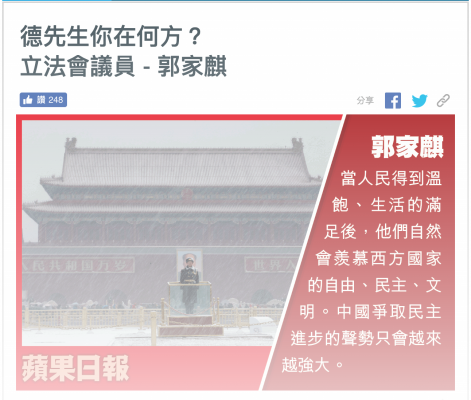
Here in Hong Kong still, such questions can be discussed more openly, of course. And so Kwok Ka-ki (郭家麒), a Legislative Council member from the Civic Party, wrote this week in the Apple Daily that today, 100 years after the May Fourth Movement, “China blindly develops its economy, and science and technology, mistakenly believing that this translates into national strength.”
Kwok suggested that China was only strong on the outside while brittle on the inside. “In a country without freedom and without democracy, there is no space for the people to make their will and demands heard,” he wrote. “Once people have satisfied their basic hunger for life, they will naturally grow envious of the freedom, democracy and culture of Western countries. The voices in China calling for democratic progress will only grow louder and louder. . . . I believe that someday the totalitarian [government] will fall, and Mr. Democracy will be found on Chinese soil.”
In response today, the Ta Kung Pao, a newspaper controlled by the Central Government’s Liaison Office, went on the attack, dismissing the “distorted reports” of the Apple Daily, which it said had wrongly suggested that President Xi Jinping had twisted the meaning of the May Fourth Movement by placing his emphasis on nationalism.
“This is a distortion of history, and a major insult to the spirit of the May Fourth Movement,” said the newspaper. “As we know, one of the slogans of the May Fourth Movement that year was a call for ‘Mr. Democracy’ and ‘Mr. Science,’ meaning for democracy and science. But why did the youth call for and demand ‘Mr. Democracy’ and ‘Mr. Science’? What was their goal? Was it not so that the nation could prosper and grow strong, for love of their country?”
The Ta Kung Pao returned the issue to the core logic of the Chinese Communist Party — that the youth must love their country, and this means love for the Party and its leader:
Xi Jinping’s speech was profound and comprehensive, and he spoke of everything from the history of May Fourth to the responsibility of youth today, pointing out that the core of the spirit of May Fourth is patriotism. The country today is ruled by the Chinese Communist Party, taking the path of socialism, and therefore for the youth of China today, loving the country, loving the Party and loving socialism are identical, and they are the only true patriotism.