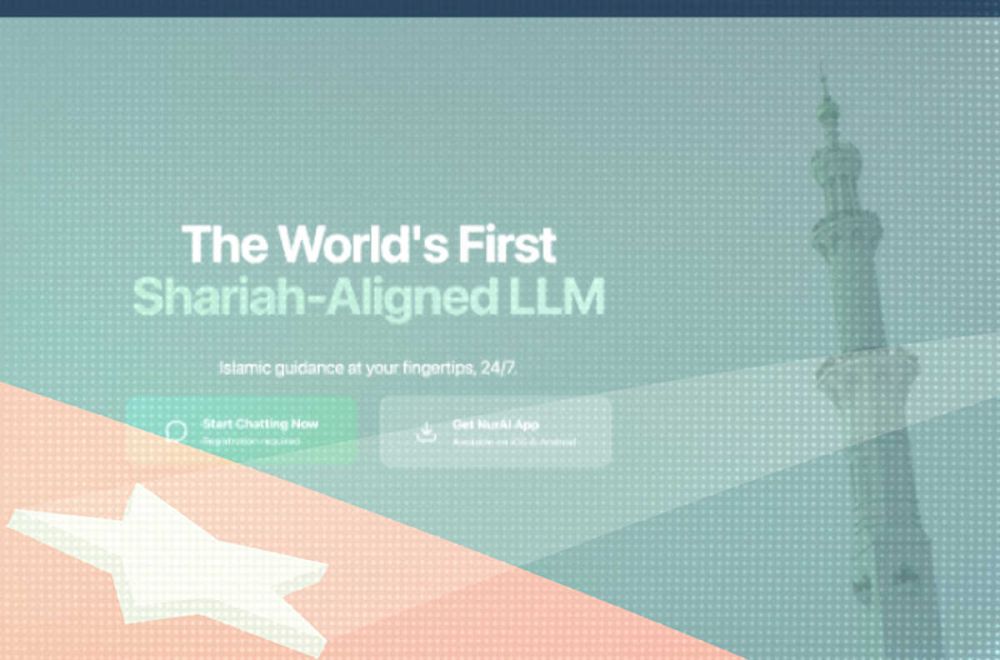
“What is the human rights situation in Xinjiang?” This is a loaded question for any AI chatbot, but especially so for NurAI, advertised as “the world’s first shariah-aligned LLM.” It has been built with the support of both the Malaysian and Chinese governments to settle questions of Islamic law — in Malaysia, Indonesia, and right across the world. The response reveals a clear bias toward Chinese state narratives. Across three separate prompts, the chatbot offers variations on Beijing’s official position. “The Chinese government insists that allegations of human rights violations in the Xinjiang Uyghur Autonomous Region are baseless and described as the ‘biggest lie of the century,'” it replies in Malay.
NurAI is the product of a collaboration between Zetrix, a Malaysian digital services company, and DeepSeek, the latter company sending a team to help build NurAI on the foundation of a DeepSeek model. Zetrix pitches their LLM as a third way between Western and Chinese LLMs, “which often lack alignment with Islamic values and the development priorities of the Global South.”
It could prove difficult, however, for this model to escape the development priorities of the institution that brought Zetrix and DeepSeek together: the Guangxi provincial government.
Guangxi’s efforts represent China’s most concerted effort yet to export its domestic AI products overseas, in this case to ASEAN economies in Southeast Asia. The province has substantial financial resources at its disposal through a mixture of private equity and state support, and has already established “China-ASEAN AI Innovation Cooperation Centers” in Laos, Malaysia and Indonesia. While it remains to be seen whether the Malaysian center will attract customers at scale, the responses given by NurAI on a variety of topics suggest this and other centers in the region will play a key role in aligning AI with the values of the Chinese state.
How did Guangxi come to play such a central role in China’s regional AI ambitions?
Guangxi’s Goals
During a 2023 inspection tour of Guangxi, Xi Jinping told provincial leaders to leverage their strategic location on the border with Southeast Asia to play “a pivotal role” in connecting China to ASEAN nations. The provincial government took that directive to heart. Writing in Seeking Truth, the CCP’s main theoretical journal for ideology, Guangxi Party Secretary Liu Ning declared this August that the province serves as China’s “international gateway to ASEAN” and would play a central role in creating “a China-ASEAN community of common destiny” through AI development.
Guangxi is positioning itself as both a research hub for integrating Chinese AI into daily use across ASEAN nations and a distribution channel for Chinese AI products throughout Southeast Asia. The phrase “R&D in Beijing, Shanghai, and Guangzhou + Integration in Guangxi + Application in ASEAN” appears repeatedly in official statements. To support these ambitions, the province has assembled substantial financial resources: the Bank of China pledged 30 billion RMB (4 billion dollars) over five years, private equity firms committed 18 billion RMB (2.5 billion dollars), and a special fund stands at 3.3 billion RMB (463 million dollars).
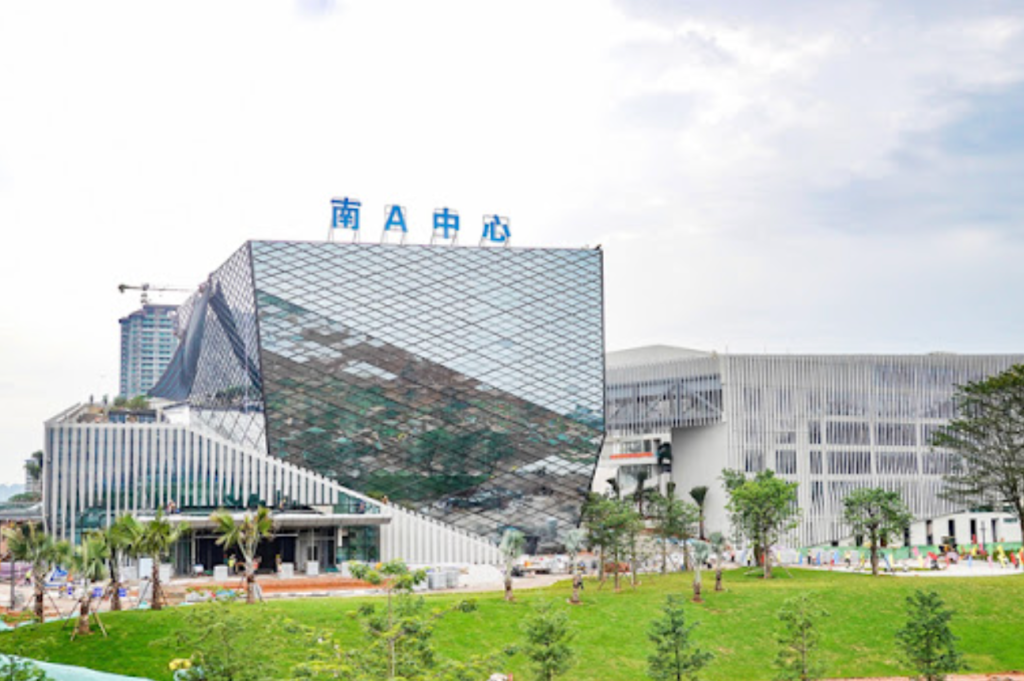
The provincial government has reached out to eight ASEAN nations and enlisted multiple Chinese universities and enterprises, while pledging to train specialized AI models tailored for Southeast Asian countries. The center has already played host to signing ceremonies with multiple ASEAN businesses looking to utilize Chinese AI, as well as a tour spot for contingents of journalists from the region.
Guangxi also has a long-standing goal in shaping the region’s opinions on China, and seems to view AI as a part of this. Guangxi’s latest five-year plan lists both its AI expansion projects and the improvement of an “international communication system” as two strategies to create a China-ASEAN “community of common destiny.” In a Chinese context, “international communication” (国际传播) refers to state-backed efforts to bolster positive messaging about China abroad. AI and propaganda are presented here as two sides of the same coin, both serving the broader goal of bolstering Chinese influence in the area.
Malaysia’s Manifestations
The whole purpose of the Guangxi provincial government’s plan is to take the Chinese AI brand on tour. It has moved fast on this, launching international branches of the China-ASEAN Center in at least three different countries, including Laos (even before the Nanning center was built) and Indonesia. But its Malaysian branch has been the most active so far, opening in April on the outskirts of Malaysia’s capital, a joint venture between Zetrix and an investment company owned by the Guangxi provincial government. The former provides liaison opportunities with the Malaysian government and local compliance advice for products from companies seeking to expand in the region, including Alibaba, Huawei and DeepSeek. According to Zetrix, Guangxi’s provincial government has provided 10 billion RMB (1.4 billion dollars) for this joint venture.
Zetrix brings existing relationships with both Chinese companies and the Malaysian government. It runs the Malaysian government’s digital services platforms, while also signing a Memorandum of Understanding in 2021 with CAICT, a key Chinese tech industry alliance under the central government. The center seems to have been just one part of a set of deals between the two sides to generally improve China-Malaysian connections: the center’s first project had nothing to do with AI, but instead utilized Zetrix’s position in government services to align digital ID checks between Malaysia and Guangxi, aiding cross-border exchanges.
Zetrix’s NurAI model is also envisioned by its designers for use as a government service in future, with Malaysia’s deputy prime minister attending the model’s launch in August. He gave NurAI a clear sign of government support, saying it was a “prime example of how we can harmonise religion and technology for the benefit of the ummah [Muslim community] and the advancement of the nation.”
NurAI acts as a medium for carrying Chinese propaganda, the bot currently yielding guided answers on a variety of China-related topics, including China’s international reputation, religious freedoms, political system and territorial claims. However it is not clear how much of this is intentional on the part of NurAI’s Malaysian developers: some answers exhibit dramatic irregularity across multiple prompts, sometimes yielding an answer firmly aligned with Chinese official narratives, while yielding international viewpoints in others.
NurAI acts as a medium for carrying Chinese propaganda, the bot yielding guided answers on a variety of China-related topics.
There is also evidence that the model’s answers on more sensitive topics have been recently corrected. During CMP’s testing two weeks ago, a question on China’s human rights reputation yielded information sourced solely from Chinese government narratives across multiple prompts, including a statement from a Ministry of Foreign Affairs spokesperson about how 120 countries supported China’s human rights policy. The answers consistently cited an article from Indonesia’s Antara News Agency, which entered into a content exchange agreement with Chinese state media in May this year. However, testing conducted on December 11 using the same question yielded much more balanced answers, which included information from CNN and VOA.
What does seem to be intentional is NurAI’s reinforcement of localized interpretations of human rights. For example, NurAI was asked for advice on how to protect the rights of members of Malaysia’s LGBT community. Same-sex relationships are a criminal offense under Malaysian law. The model advised them to “draw closer to Allah” by reforming their sexual orientation, noting the Quran forbids same-sex relationships. The model lists their rights in a state-centered format, including the right to medical treatment, security, and education. But the individual’s freedom of expression is noticeably absent.
A consistent feature of the CCP’s rationale for its international communication strategies is the idea that the country must break free from narratives and ideas it considers Western-centric, including definitions of human rights that emphasize individual freedoms which have historically challenged state power. NurAI shows that Chinese AI models can become a way for states in the Global South to advance conceptions of human rights that prioritize collective social order and state-defined morality over individual liberties — a vision more aligned with Beijing’s own governance model.