Since 2018, China’s leadership under Xi Jinping has pushed a radical reinvention of the country’s international communication — what the Chinese Communist Party still refers to as “external propaganda” (对外宣传) — by thinking beyond central-level media giants like Xinhua News Agency and CGTN and leveraging local and regional networks. The model builds on integrated media centers (融媒体中心) established nationwide to consolidate local propaganda resources, with content then repurposed for international audiences and distributed through international communication centers (国际传播中心), or ICCs. These centers have expanded rapidly to more than 200 nationwide, spanning provincial, municipal, and county levels in a multi-tiered system designed to tell “China’s story” through localized cultural and regional narratives.
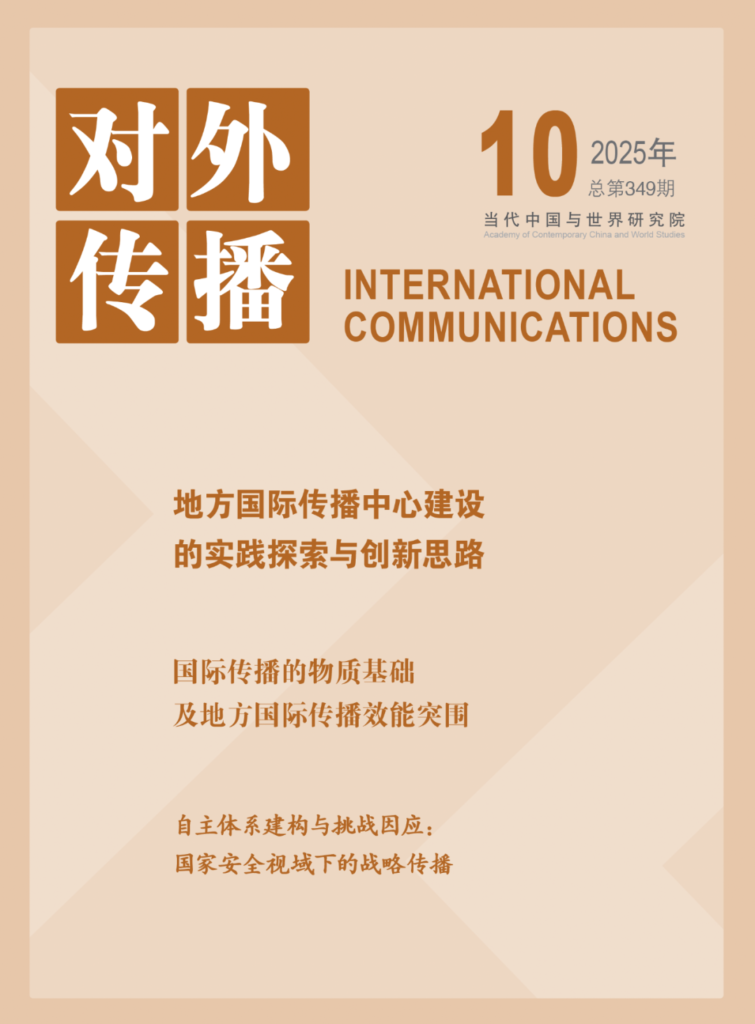
But just two years into the rapid expansion of ICCs, the rough edges of the policy are showing. In a cover story for the most recent edition of the journal International Communications (对外传播), published by the China International Communications Group (CICG) under the Central Propaganda Department, scholars Huang Dianlin (黄典林) and Cheng Bingshun (程柄舜) identify deep structural problems threatening how well these centers actually work despite their numerical growth — the authors count more than 150 — across more than 30 provincial-level regions by early 2025.
The article focuses on three key challenges facing ICCs as they attempt to boost China’s international discourse power (国际话语权).
Resource imbalances and poor coordination plague the ICC system from top to bottom, according to the authors. Centers depend overwhelmingly on government budgets rather than market revenue, which could leave them vulnerable when regional finances tighten. (This point is an interesting hint, mirrored in a report last month from the Central Propaganda Department’s Media Regulation Bureau, that policymakers have actually imagined — foolishly, one might say — that ICCs will be commercially viable). Geography makes things worse. Eastern coastal regions monopolize professional talent, mature content production chains, and industry resources, while central and western areas face severe shortages.
The provincial-municipal-county hierarchy suffers from blurred roles, with county-level centers burdened beyond their capacity while provincial centers handle overly detailed work. Regions with similar cultural and tourism resources produce nearly identical content, creating serious homogenization (同质化严重) that wastes resources through redundant competition rather than creating distinctive appeal.
Platform mismatches hurt content performance on international social media. The authors write that ICC operators, typically drawn from traditional broadcast and print media backgrounds, produce content following conventional media logic that fails to adapt to different platforms and audiences. In a critique that will be familiar to media organizations everywhere, they note that distribution strategies at ICCs mirror traditional one-way publishing and generally fail to take advantage of the interactive social features of platforms.
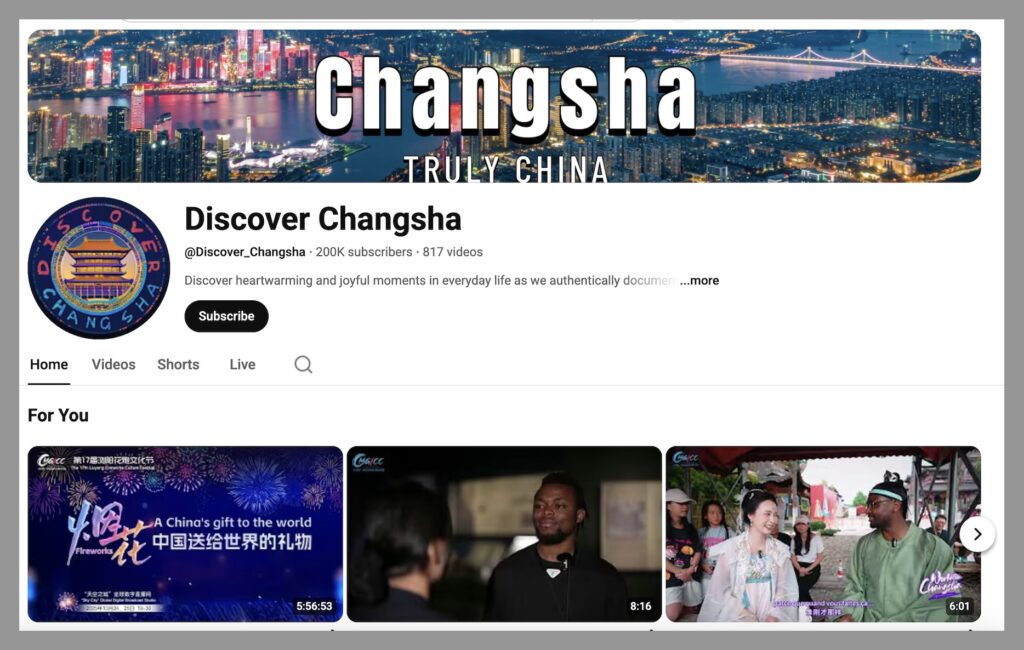
The tension between propaganda goals and viral content leaves many centers with little motivation for creative innovation, making it difficult for them to truly stand out on crowded overseas platforms. Account matrices (账号矩阵) — a term Chinese thinkers on international communication often use to refer to overseas accounts on channels generally banned from inside China — across platforms like X (formerly Twitter) and Facebook suffer from weak differentiation, with most adopting formulaic “Discover + place name” naming patterns with muddled branding and overlapping content styles that hurt their chances of algorithmic promotion and weaken user loyalty.
Weak evaluation systems are a basic constraint on improving effectiveness. Current assessment metrics, the authors write, stop at superficial indicators like follower counts, views, and likes, failing to capture deeper measures of content reach rates, user emotional identification, attitude change, or behavioral guidance. This shallow evaluation system prevents centers from accurately understanding what overseas audiences actually need and prefer, making it impossible to adjust content strategies in a meaningful way.
The result is that ICC international communication easily falls into the trap of “talking to oneself” (自说自话), unable to move from quantitative expansion to real quality improvement. What the authors fall short of saying here, in their focus on better metrics, is that ICCs (like central state media before them) have made no real attempt to understand foreign audiences at all. This is a fundamental underlying tension in “external propaganda,” which assumes at its core one-way communication.
The CCP Elephant in the Room
How can ICCs become more effective? This is the question the authors pose — because of course it goes beyond their rights to suggest that the entire push for ICC development might be ill-conceived and wasteful. The authors offer solutions centered on “coordination” (协同) across three dimensions. Cross-regional collaboration should pool resources through “mega-region” models grouping provinces with similar cultural backgrounds and development levels, establishing shared funding mechanisms and talent exchange programs. Beyond this, multi-tier operations should clarify roles, they say. Provincial centers should focus on strategy, technology development, and training while municipal and county centers concentrate on producing localized, distinctive content. They add that professional content production chains should bring in commercial content companies and adopt product-oriented thinking with sophisticated data-driven performance evaluation, moving beyond simple engagement metrics.
This all sounds reasonable. But behind this assessment and its concrete recommendations lies an unspoken bind. The authors are essentially calling for ICCs and the media involved to act like credible and relevant media in order to attract and serve audiences. This is, of course, exactly what they cannot do. The point is to “tell China’s story well,” and so many of these limitations and complications stem from this top-down demand, which more often than not makes Party superiors (if we are honest) the true audience.
The study concludes by emphasizing that local ICCs stand at a critical turning point from "quantitative expansion" to "effectiveness enhancement" (效能提升). Achieving high-quality development, the authors say, requires "jumping out of the thinking limitations of single-point breakthroughs" to build an efficient, flexible, integrated system. Only through better coordination of resources, precise alignment across administrative levels, and market-oriented content production can these centers activate their "endogenous momentum" and truly improve their international communication effectiveness.
All of this will be a tall order for local and regional ICCs, which are operated generally by propaganda officials rather than media professionals. A deep problem glossed over by the International Communications report is a serious deficit of the latter. Real media talent, particularly from the standpoint of international understanding, is in woefully short supply in China, where the renewed emphasis — even as Xi Jinping has pushed to remake the media — has been on Party control. But the ambition behind China's vision of international communication, and the industrial scale at which the project is being pursued, mean that this is a trend observers globally must take seriously. Even if China's ICCs fall short of genuine engagement with foreign audiences, the flooding of the global information space with shoddy and insipid propaganda could impact information integrity, particularly on China-related news, in ways that are unforeseeable.