A Prize Against the Odds
Over the weekend, the results of the seventh edition of the Journalists Home News Prize (记者的家新闻奖), a grassroots journalism awards initiative that has been affectionately called “China’s Pulitzers” (中国普利策), were published through the WeChat public account of veteran investigative journalist Liu Hu (刘虎). The release is remarkable considering Liu’s circumstances just a few short weeks earlier.
On February 1, public security officers in the western city of Chengdu detained both Liu and his colleague Wu Yingjiao (巫英蛟) as they were traveling separately — Liu en route to Beijing, and Wu in Hebei. The next day, Chengdu police formally announced that the journalists each faced criminal charges of false accusation (诬告陷害罪) and illegal business operations (非法经营罪) stemming from a report on WeChat alleging that local officials in Sichuan had broken a previous agreement with investors in a construction project, seizing control of the assets.
The police actions triggered a wave of public attention in China — and a countervailing wave of online censorship. China Digital Times reported that 21 articles dealing with the case were added to its deleted-content archive in the five days following the detentions, nearly double the total number of deleted articles added to CDT’s archive on all topics in December last year. The detentions backfired, as one blogger predicted they would. Writing in a post that was subsequently deleted, Xu Peng (徐鹏) observed that few people had actually read Liu’s article before it was taken down — but that the arrests had spread awareness of the case “at home and abroad,” leaving officials with a mess of their own making. “In the end, public opinion spiraled far beyond their control,” Xu wrote, “and the whole plan backfired.”
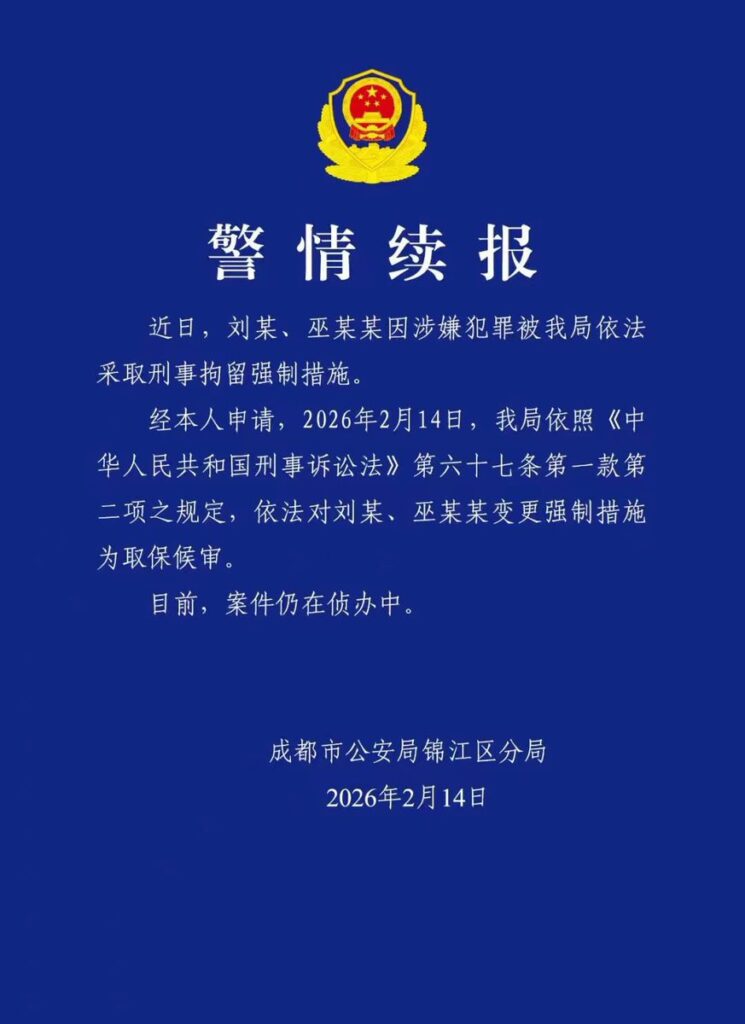
Liu Hu and Wu Yingjiao were released on bail on February 16, just two weeks before the prize results appeared. “I believe everyone will welcome this ‘follow-up police report,’” wrote rights defense lawyer Pu Zhiqiang (浦志强) on social media. “Best wishes to you both: get some proper rest and have a good New Year.”
This recent brush with the authorities was not Liu Hu’s first. He had previously been detained in 2013 on defamation charges after publicly naming officials he accused of corruption; those charges were eventually dropped.
It was against that backdrop that Liu launched the Journalists Home News Prize in 2019, reviving a name with deep roots in Chinese journalism. “Journalists Home” (记者的家) began as a BBS forum in 2000, a gathering place for reporters during an era of relative openness, when forms of journalism like investigative reporting were flourishing in a relative sense. The prize started with four categories, a public service award added in 2021. Now in its seventh year, it has become what one longtime participant called “possibly the best cross-platform journalism prize on the Chinese mainland.”
That the seventh edition appeared at all — published after delays caused by what Liu described only as ‘an unmentionable mishap’ (不可描述的意外) — is a reminder of the tug-and-pull that persists in China’s media environment, where idealistic professionals can actively seek out space for their work despite immense risks. This year’s jury added four additional commendations beyond the original slate, citing an unusually strong field — an expansion requiring an additional 50,000 yuan in prize money. Southern Weekly (南方周末), a commercial newspaper under Guangdong’s CCP-run Nanfang Daily Group, and the independent WeChat-based platform Aquarius Era (水瓶纪元) emerged as the strongest performers across categories, each taking two prizes.
The nonfiction grand prize went to Luo Ting (罗婷) for “Rape in the Bridal Chamber” (婚房里的强奸案), published in April 2025 in “Everyday People” (每日人物), a WeChat public account run by People (人物) magazine under Beijing Boya Tianxia Media Culture Development, a company majority owned by entrepreneur Rong Bo (荣波) . The piece reconstructed an engagement rape case in Shanxi province, tracing not only the assault itself but the months of family negotiation and legal maneuvering that followed. The story exposed what the jury described as “the brutal landscape of China’s county-town marriage market.”
The public service grand prize recognized Xie Chan’s (谢婵) return to Wuhan on the fifth anniversary of the COVID-19 lockdown, published by Aquarius Era. The report revisited journalists, artists, volunteers and ordinary citizens to recover recollections of the early chaos and grassroots mutual aid — memories the jury described as filling a gap in the collective memory of a national disaster.
The major social event reporting prize went to Han Qian (韩谦) of Southern Weekly for a multi-year series (archived) on the practice of residential surveillance at a designated location (指定居所监视居住), or RSDL, a legally defined but widely criticized form of residential surveillance that critics say has been systematically abused as a tool of extrajudicial interrogation. Han’s reporting helped transform an arcane legal debate into a public issue and was credited with contributing pressure that preceded new regulations jointly issued by the Supreme Procuratorate — China’s top prosecutorial authority — and the Ministry of Public Security.
The outstanding media professional grand prize honored Zhou Zhimin (周智敏), a senior reporter at Shanghai Television (上海广播电视台), for a 24-minute video investigation into a school dormitory fire in Henan province that killed 13 primary school students in January 2024. Though authorities had quickly promised a public accounting, 16 months passed in silence. Zhou’s report, published in December 2025, pushed the story back into the spotlight, and within nine days the investigation results were released through Xinhua and CCTV, with the related trial opened to the public. Shanghai Television is the broadcast arm of the municipal-level Shanghai Media Group (SMG), run by the local CCP leadership through the Shanghai State-owned Assets Supervision and Administration Commission.
The best commentary prize recognized Peng Yuanwen (彭远文), a former CCTV producer, for more than thirty articles arguing for higher rural pension benefits — a campaign the jury said had helped build momentum toward what is now a growing policy consensus on one of China’s most urgent social questions.
One key lesson to emerge from these latest awards is that the efforts of Chinese journalists — even at state-run outlets, which accounted for half the prizes awarded — must not be overlooked. The awards and the work they recognize, which have appeared despite intense pressure at every level of China’s media control system, are a testament to that persistence.