Tag: Chinese media

Paper Cuts

The Dalian Evening News, a fixture of daily life in the northeastern port city for 37 years, published its final edition on December 30, announcing it would cease publication with a brief notice thanking readers and contributors. The closure makes it the second major newspaper in Dalian to fold in recent years, following Xinshang News (新商报), which ceased publication in 2019.

Founded in 1988, the Dalian Evening News (大连晚报) was part of a wave of metropolitan newspapers that proliferated across China during the reform and opening era, serving as a key source of local news and advertising. These papers emerged in the early 1990s, with the metropolitan newspaper model accelerating after 1995 with the establishment of Chengdu’s Huaxi Metropolitan News (华西都市报) as the prototype for commercial urban dailies, followed by staples such as Guangdong’s Southern Metropolis Daily (南方都市报), founded in 1997. Through to the Xi Jinping era these and other commercial papers were at the heart of a slow-burning professional revolution for journalism in China, breaking important and socially, even politically, relevant stories. Huaxi Metropolitan News, for example, was instrumental in early reporting on the AIDS epidemic in Henan province caused by contaminated blood collection practices that infected as many as a million people.

The Dalian Evening News is one of approximately 14 newspapers that announced cessation or suspension around the start of 2026, including Jiangnan Travel News (江南游报) in the Yangtze River Delta, Yanzhao Rural News (燕赵农村报) in Hebei province, and Langfang Metropolitan News (廊坊都市报) in Langfang, Hebei.

Folding Up

At least 14 newspapers announced cessation or suspension at the start of 2026 in China, marking another wave in the ongoing decline of China’s print media sector.

Newspaper Name Chinese Name Founded Years Active
Dalian Evening News 大连晚报 1988 37 years
Jiangnan Travel News 江南游报 1986 38 years
Yanzhao Rural News 燕赵农村报 1964 / 1982 (relaunched) 60 years
Pingyuan Evening News 平原晚报 2004 20 years
Langfang Metropolitan News 廊坊都市报 2009 16 years
Huanghai Morning Post 黄海晨刊 2003 22 years
Yandu Morning Post 燕都晨报 2003 22 years
Suqian Evening News 宿迁晚报 2001 24 years
Linchuan Evening News 临川晚报 2017 (media convergence) 8 years
Xinyu News 新渝报 1926 99 years
China Philatelic News 中国集邮报 1992 33 years
Today Ningguo 今日宁国 Unknown
Yalu River Evening News 鸭绿江晚报 1996 29 years
Southern Radio & TV News 南方声屏报 1994 31 years

The wave of closures reflects years of financial crisis in Chinese print media stemming from broader changes in the media landscape in China and globally. Newspaper advertising peaked in 2011, then declined 55 percent by 2015 — and the freefall continued. By 2021, newspaper advertising revenue had shrunk to just one-fifteenth of what it was in 2011. Metropolitan newspapers were hit hardest: commercial advertising dropped over 70 percent, with some papers reduced to operating with zero advertising and forced to rely on their parent organizations for survival.

Circulation has similarly collapsed. Subscription and newsstand sales in 70 major Chinese cities plunged 46.5 percent in 2015, with metropolitan newspapers declining 50.8 percent.

Peking University professor Zhang Yiwu (张颐武) explained in analysis two years ago that short videos and livestreaming have replaced text-based newspapers as readers’ information consumption habits have changed. The most profitable local media outlets — metropolitan newspapers and evening papers — took the hardest hit, he said. Party newspapers maintained operations because the government needed them to disseminate propaganda and other official information. Zhang described the decline as initially gradual, giving false hope for recovery, but then becoming cliff-like, with many newspapers ultimately destroyed by their own wishful thinking about a potential rebound.
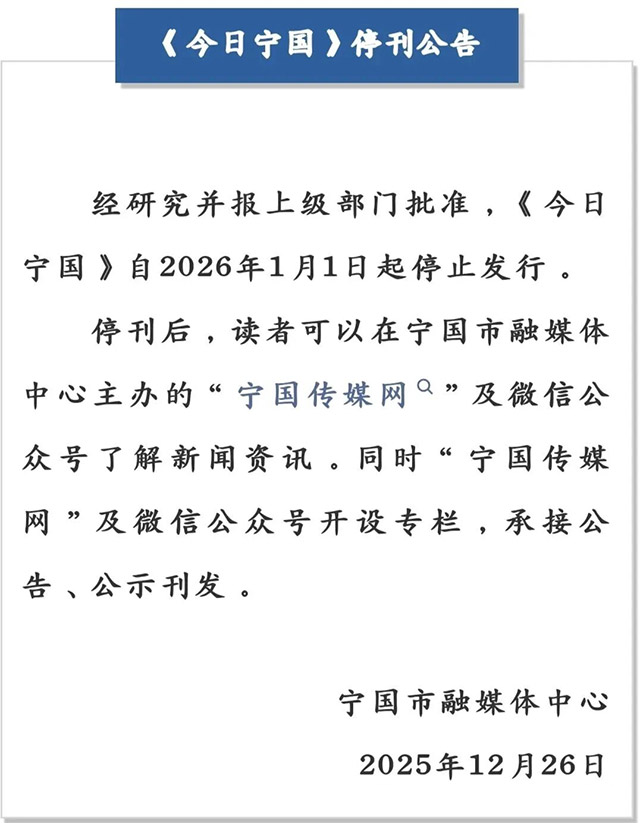
Today Ningguo announces its closure on December 26, 2025.

The decline of commercial print newspapers and periodicals in China since around 2010 has had a dramatic impact on the professional journalism cultures that once flourished in these contexts. The more local and relevant reporting they once fostered has also suffered in the face of efforts under Xi Jinping to wrest back control of news reporting, in part by building up Party-run digital convergence media centers (融媒体中心) and empowering local government bodies to lead on digital communication. One sign of this latter trend has been the proliferation of “blue notices” (蓝底通报), official statements released by local authorities on social media that sideline professional journalists and replace independent reporting with government-controlled narratives.

In its year-end reflection, the WeChat public account Aquarius Era (水瓶纪元), run by veterans of China’s commercial newspaper era, described its mission as telling “stories outside the blue background and white text” (蓝底白字之外的故事), a clear criticism of the dominance of official blue notices and the news vacuum in which they dominate. The year-end letter affirmed that despite intense censorship, journalists from different generations continue work in their own ways to document overlooked people and events.

The decline of print media can be seen in the precipitous decline of newsprint consumption, which has devastated the paper industry over the past decade. The Chinese newspaper industry reached its peak in 2012 with domestic newsprint production of 385 million tons annually and over 20 paper mills operating, but declining demand has forced most mills to reduce production or shut down entirely. According to the China Newspaper Association (中国报业协会), nationwide newspaper newsprint consumption totaled just 106.4 million tons in 2023, projected to decline another 3 percent to approximately 103.2 million tons in 2024, leaving only three newsprint producers nationally.

Rather than outright closures — though that is the real meaning — many newspapers are now choosing to announce “suspension” over permanent closure. The reason for that is political and regulatory, rather than commercial or financial. Under China’s tightly controlled press system, all news and other publishing or media outlets that do original content production are required to have licenses, or kanhao (刊号), scarce administrative resources issued by the National Press and Publication Administration that cannot be easily reacquired. By announcing suspension rather than closure, newspapers preserve these licenses even as they cease operations indefinitely.

Because in an era of profound digital, economic and political uncertainty, you just never know.

Xi Jinping’s Global Quartet

The front page of today’s People’s Daily announces the publication of a major policy article by Chinese leader Xi Jinping (习近平) in the party’s flagship theoretical journal Qiushi (求是), bundling together what the party now characterizes as “Four Great Global Initiatives” (四大全球倡议) — a quartet of related solutions for international challenges. The article, titled “Promoting Implementation of the Global Development Initiative, Global Security Initiative, Global Civilization Initiative, and Global Governance Initiative,” collects Xi’s statements from September 2021 to September 2025, organizing them around his concept of a “community of shared future for mankind” (人类命运共同体).

The piece is meant to synthesize China’s response to what the party characterizes as four critical “deficits” (赤字) facing the world. These are: the “peace deficit” (和平赤字); the “development deficit” (发展赤字); the “security deficit” (安全赤字); and the “governance deficit” (治理赤字).

Xi’s Four Great Global Initiatives
四大全球倡议
Global Development Initiative Development Deficit
全球发展倡议发展赤字
Emphasizes “inclusive” economic globalization with six core principles, including development prioritization, people-centered approaches, and harmony between humanity and nature. Positions the Belt and Road Initiative as a practical vehicle for achieving these goals.
Global Security Initiative Security Deficit
全球安全倡议安全赤字
Promotes “common, comprehensive, cooperative and sustainable security” while rejecting countries “pursuing their own so-called absolute security”—a clear reference to U.S. security policy. Advocates for a security framework based on cooperation rather than zero-sum competition.
Global Civilization Initiative Peace Deficit
全球文明倡议和平赤字
Emphasizes respecting “diversity of world civilizations”—an implicit challenge to universal values that promotes China’s concept of “common values for all humanity.” This formula emphasizes the power of the nation state over citizens, with the “rights” of countries and their systems taking precedence over individual rights.
Global Governance Initiative Governance Deficit
全球治理倡议治理赤字
Confronts what Beijing portrays as threats from “Cold War mentality, hegemonism, and protectionism” — coded language for U.S. policies. Argues that global governance has reached a crossroads, with the implication that the world must turn in China’s direction.

This suite of global initiatives, the People’s Daily read-out today says, is China’s effort “to resolve the above deficits and promote the building of a better world” (破解上述赤字, 推动建设一个更加美好的世界). This framing positions Xi as a responsible and responsive global leader offering comprehensive solutions to international challenges. In this equation, the Belt and Road Initiative (一带一路), lionized during Xi’s first and second terms, is subordinated as a practical vehicle for these loftier aspirations.

The bundling of Xi’s “Four Great” initiatives has gathered pace particularly since late August and early September, taking the stage during the annual summit of the Shanghai Cooperation Organization (SCO). The push to promote the concepts has redoubled this month with a crucial CCP plenum next week and the upcoming 80th anniversary of the founding of the United Nations. The quartet signals Xi’s effort to consolidate his standing with both domestic party elites and the international community.

The People’s Daily read-out hailing the Qiushi article referred to this year “an important moment to remember history and create the future together” (铭记历史、共创未来的重要时刻). And the central idea here is that Xi Jinping is claiming this crossroads for China under the rule of the CCP.

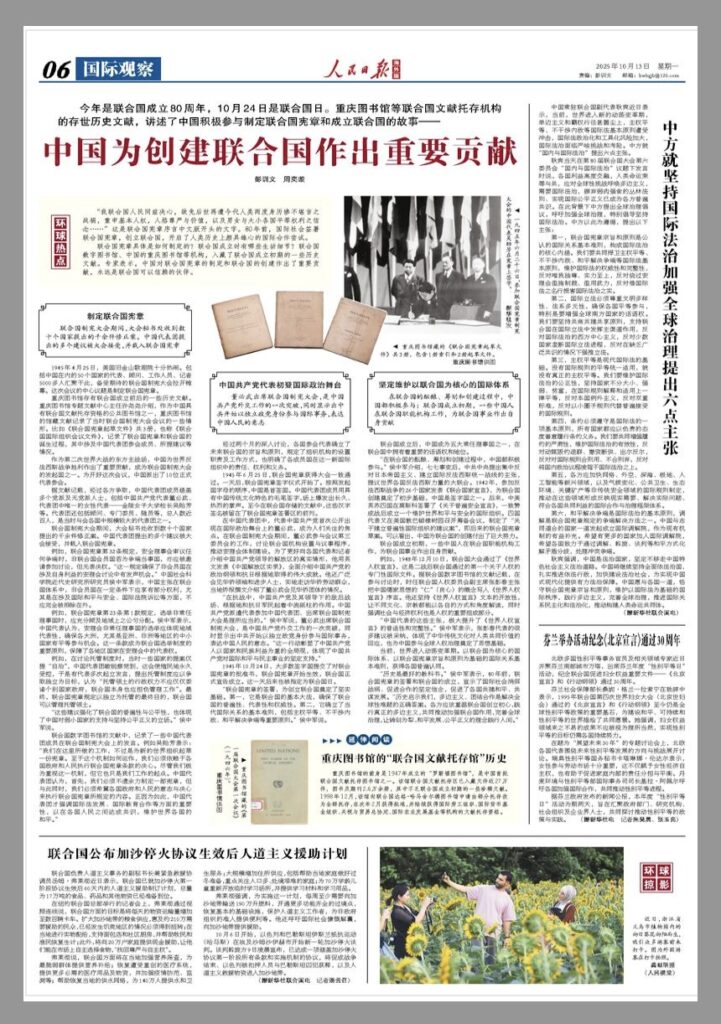
Page 6 of the overseas edition of the CCP’s People’s Daily on October 13, a huge feature on China’s role in founding the UN (erasing the ROC from the story).

In recent weeks, before and through the grand military parade held in Beijing on September 3, state media have promoted a revisionist view of history in which China — meaning the current People’s Republic of China under the leadership of the party — played the most decisive role in the founding of the United Nations. Among these efforts, a large feature story in the overseas edition of the People’s Daily on Monday focused on China’s “immense contributions” to the founding of the UN, with framing that completely erased the role of the Republic of China (ROC) — the current name for Taiwan. The feature story showcased materials from the first session of the UN General Assembly now kept in Chongqing, the wartime capital of the ROC.

When it comes to China’s gaze on the future as glimpsed in Xi’s Qiushi article, there is an implicit but unmistakable message about the values of the West as failing to be “inclusive” (包容). Language about the Global Civilization Initiative (GCI) speaks of respecting “diversity of world civilizations” (世界文明多样性), an implicit challenge to the notion of universal values that promotes China’s own concept of “common values for all humanity” (全人类共同价值). While those may sound superficially similar, China’s formula emphasizes the power of the nation state over citizens and communities — the “rights” of countries and their systems taking precedence over individual rights.

Another clear message between the lines is about the United States as an irresponsible force. The Global Governance Initiative (GGI) directly confronts what the party portrays as threats from “Cold War mentality, hegemonism, and protectionism” (冷战思维、霸权主义、保护主义) — barely coded language that is a clear reference US policies. The article argues that while the UN emerged from the “painful lessons” (痛定思痛) of two world wars 80 years ago, “the world has entered a new period of turbulence and transformation, and global governance has reached a new crossroads” (世界进入新的动荡变革期,全球治理走到新的十字路口).

The underlying message is unmistakable: Standing at this crossroads, the world must turn in the direction of China.

China Issues Approved News Source List

Earlier this month, China’s top control body for the internet and social media released its updated list of approved internet news information sources, a roster of outlets first issued a decade ago to curtail the sharing of articles and news reports by unauthorized sources — those without close Chinese Communist Party (CCP) and government ties. The publication of the list starting in 2015 was part of a general tightening of control over news and information in the early Xi Jinping era, as the internet and social media came to dominate news consumption.

The 2025 list from the Cyberspace Administration of China (CAC), issued on August 14, includes 1,456 government-run media outlets whose content can be legally republished by other websites and news platforms — a carefully selected group that is meant to establish the CCP’s dominance over news content in China. All digital media platforms are forbidden from republishing news stories that originate from sources not included on the approved roster, including international media as well as public accounts on major platforms like WeChat and Weibo.

CAC Approved News Sources List

CAC Approved News Sources List (2021-2025)

Category 2021 2025 Change Growth Rate
Total Sources 1,358 1,456 +98 +7.2%
Central Level 286 286 0 0%
Provincial Level 992 1,074 +82 +8.3%
Government Platforms 80 96 +16 +20.0%
Source: Cyberspace Administration of China

The Cyberspace Administration of China (CAC) first introduced the system in 2015 as part of broader internet governance reforms under Xi that include the formation of the CAC as a powerful control and oversight body for cyberspace. The inaugural “Source List” included Caixin, a professional news outlet founded in 2009 by the highly-respected editor Hu Shuli (胡舒立), but the list was further tightened during the second iteration in 2021, at which time Caixin was removed. The 2021 list contained 1,358 approved sources, nearly four times the number in the 2016 list of just 340. These changes reflected the addition of official government accounts within the country’s expanding digital news ecosystem.

The CAC explained that the 2021 update followed three priorities: “adds a group” of trusted sources adhering to correct political orientation, “verifies a group” to update closures and name changes from institutional reforms, and “eliminates a group” of units with “poor regular performance” or lacking influence.

While the overall list grew by just 7.2 percent between this year and 2021 — from 1,358 to 1,456 sources — the distribution of this growth tells a more complex story about Beijing’s information control strategy. Central-level sources remained unchanged at 286 units, suggesting authorities consider the media structure at the national level to be complete. Provincial-level sources, meanwhile, expanded by 8.3 percent (from 992 to 1,074), reflecting efforts to strengthen regional information control infrastructure. This mirrors the trend since 2018 of encouraging the development of local and regional communication hubs, including the creation of “international communication centers” (国际传播中心), or ICCs, which are meant to enhance CCP messaging globally by leveraging provincial, city and county-level media resources.

Government platform sources showed the most dramatic growth at 20 percent, jumping from 80 to 96 units. Among the new additions are several municipal government social media platforms, including the official WeChat accounts of Shenzhen Municipal Government and Chengdu City Administration, reflecting a push in recent years to centralize local news creation by government agencies while adapting to social media-driven information consumption.

The CAC warned that websites not adhering strictly to the approved source list “will be punished according to law and regulations.”