
Tag: media

A Prize Against the Odds

Over the weekend, the results of the seventh edition of the Journalists Home News Prize (记者的家新闻奖), a grassroots journalism awards initiative that has been affectionately called “China’s Pulitzers” (中国普利策), were published through the WeChat public account of veteran investigative journalist Liu Hu (刘虎). The release is remarkable considering Liu’s circumstances just a few short weeks earlier.

On February 1, public security officers in the western city of Chengdu detained both Liu and his colleague Wu Yingjiao (巫英蛟) as they were traveling separately — Liu en route to Beijing, and Wu in Hebei. The next day, Chengdu police formally announced that the journalists each faced criminal charges of false accusation (诬告陷害罪) and illegal business operations (非法经营罪) stemming from a report on WeChat alleging that local officials in Sichuan had broken a previous agreement with investors in a construction project, seizing control of the assets.

The police actions triggered a wave of public attention in China — and a countervailing wave of online censorship. China Digital Times reported that 21 articles dealing with the case were added to its deleted-content archive in the five days following the detentions, nearly double the total number of deleted articles added to CDT’s archive on all topics in December last year. The detentions backfired, as one blogger predicted they would. Writing in a post that was subsequently deleted, Xu Peng (徐鹏) observed that few people had actually read Liu’s article before it was taken down — but that the arrests had spread awareness of the case “at home and abroad,” leaving officials with a mess of their own making. “In the end, public opinion spiraled far beyond their control,” Xu wrote, “and the whole plan backfired.”

Liu Hu and Wu Yingjiao were released on bail on February 16, just two weeks before the prize results appeared. “I believe everyone will welcome this ‘follow-up police report,’” wrote rights defense lawyer Pu Zhiqiang (浦志强) on social media. “Best wishes to you both: get some proper rest and have a good New Year.”
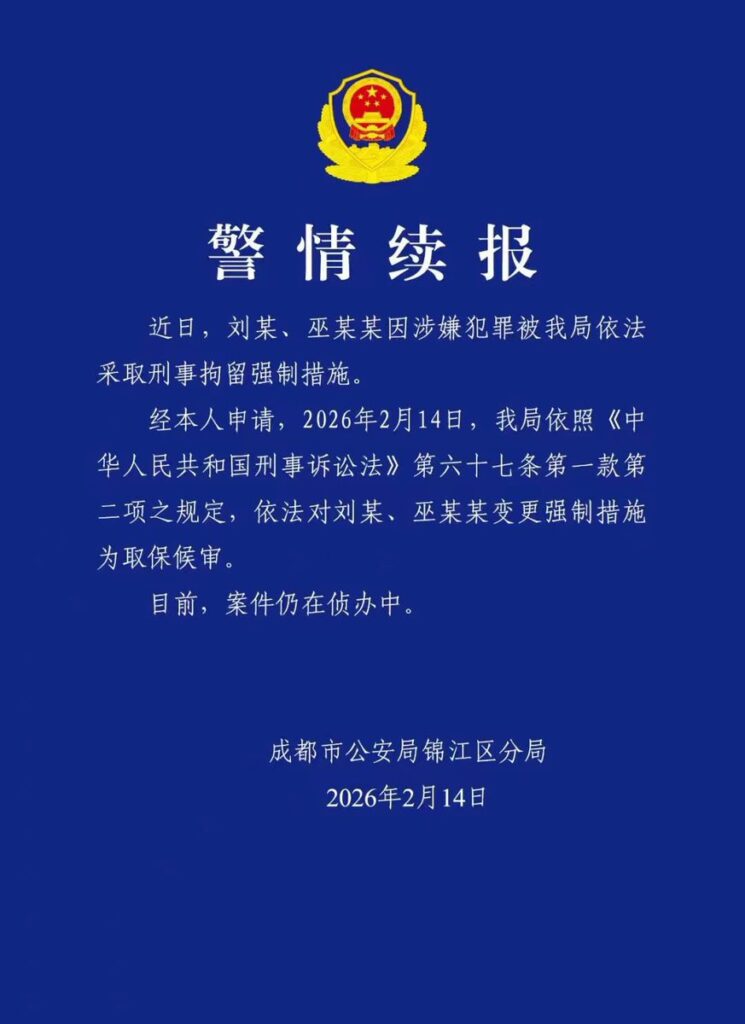
SOURCE: Pu Zhiqiang on X.

This recent brush with the authorities was not Liu Hu’s first. He had previously been detained in 2013 on defamation charges after publicly naming officials he accused of corruption; those charges were eventually dropped.

It was against that backdrop that Liu launched the Journalists Home News Prize in 2019, reviving a name with deep roots in Chinese journalism. “Journalists Home” (记者的家) began as a BBS forum in 2000, a gathering place for reporters during an era of relative openness, when forms of journalism like investigative reporting were flourishing in a relative sense. The prize started with four categories, a public service award added in 2021. Now in its seventh year, it has become what one longtime participant called “possibly the best cross-platform journalism prize on the Chinese mainland.”

That the seventh edition appeared at all — published after delays caused by what Liu described only as ‘an unmentionable mishap’ (不可描述的意外) — is a reminder of the tug-and-pull that persists in China’s media environment, where idealistic professionals can actively seek out space for their work despite immense risks. This year’s jury added four additional commendations beyond the original slate, citing an unusually strong field — an expansion requiring an additional 50,000 yuan in prize money. Southern Weekly (南方周末), a commercial newspaper under Guangdong’s CCP-run Nanfang Daily Group, and the independent WeChat-based platform Aquarius Era (水瓶纪元) emerged as the strongest performers across categories, each taking two prizes.

The nonfiction grand prize went to Luo Ting (罗婷) for “Rape in the Bridal Chamber” (婚房里的强奸案), published in April 2025 in “Everyday People” (每日人物), a WeChat public account run by People (人物) magazine under Beijing Boya Tianxia Media Culture Development, a company majority owned by entrepreneur Rong Bo (荣波) . The piece reconstructed an engagement rape case in Shanxi province, tracing not only the assault itself but the months of family negotiation and legal maneuvering that followed. The story exposed what the jury described as “the brutal landscape of China’s county-town marriage market.”

The public service grand prize recognized Xie Chan’s (谢婵) return to Wuhan on the fifth anniversary of the COVID-19 lockdown, published by Aquarius Era. The report revisited journalists, artists, volunteers and ordinary citizens to recover recollections of the early chaos and grassroots mutual aid — memories the jury described as filling a gap in the collective memory of a national disaster.

The major social event reporting prize went to Han Qian (韩谦) of Southern Weekly for a multi-year series (archived) on the practice of residential surveillance at a designated location (指定居所监视居住), or RSDL, a legally defined but widely criticized form of residential surveillance that critics say has been systematically abused as a tool of extrajudicial interrogation. Han’s reporting helped transform an arcane legal debate into a public issue and was credited with contributing pressure that preceded new regulations jointly issued by the Supreme Procuratorate — China’s top prosecutorial authority — and the Ministry of Public Security.

i
Residential Surveillance at a Designated Location (RSDL)
指定居所监视居住

Residential Surveillance at a Designated Location (RSDL) is a form of pre-trial detention authorized under Article 73 of China’s Criminal Procedure Law, as amended in 2012. It allows authorities to detain a suspect for up to six months at a location of the police’s choosing — typically a hotel, guesthouse, or other non-official facility — without disclosing that location to the suspect’s family or lawyer.

Although technically classified as a non-custodial measure weaker than formal arrest, RSDL functions in practice as incommunicado detention. Key features include:

  • Detention for up to six months without formal charges
  • No requirement to disclose the detention location, particularly in cases involving alleged national security offenses
  • Severely restricted or denied access to legal counsel
  • No meaningful judicial oversight or review

Between 2013 and 2020, an estimated 57,000 people were held under RSDL, with usage peaking in 2020 at a 136 percent increase over the previous year. UN human rights experts have concluded that RSDL, as applied, constitutes a form of enforced disappearance and may amount to torture or cruel, inhuman, or degrading treatment. It has been disproportionately used against journalists, lawyers, and human rights defenders. In June 2025, China’s Supreme Procuratorate and Ministry of Public Security jointly issued new regulations intended to curb RSDL abuses, including stricter approval requirements and mandatory prosecutorial oversight — reforms legal experts have welcomed while noting significant gaps remain.

Source: International Service for Human Rights

The outstanding media professional grand prize honored Zhou Zhimin (周智敏), a senior reporter at Shanghai Television (上海广播电视台), for a 24-minute video investigation into a school dormitory fire in Henan province that killed 13 primary school students in January 2024. Though authorities had quickly promised a public accounting, 16 months passed in silence. Zhou’s report, published in December 2025, pushed the story back into the spotlight, and within nine days the investigation results were released through Xinhua and CCTV, with the related trial opened to the public. Shanghai Television is the broadcast arm of the municipal-level Shanghai Media Group (SMG), run by the local CCP leadership through the Shanghai State-owned Assets Supervision and Administration Commission.

The best commentary prize recognized Peng Yuanwen (彭远文), a former CCTV producer, for more than thirty articles arguing for higher rural pension benefits — a campaign the jury said had helped build momentum toward what is now a growing policy consensus on one of China’s most urgent social questions.

One key lesson to emerge from these latest awards is that the efforts of Chinese journalists — even at state-run outlets, which accounted for half the prizes awarded — must not be overlooked. The awards and the work they recognize, which have appeared despite intense pressure at every level of China’s media control system, are a testament to that persistence.

Historical Revisions on Parade

For the Chinese leadership, the 80th anniversary of the country’s victory in the War of Resistance Against Japan in World War II is a major milestone — an opportunity to signal the power of the ruling Chinese Communist Party to people at home, and the country’s global ambitions to audiences abroad. These goals were on full display during the ritualized pageantry of the military parade yesterday in Beijing, attended by Russian leader Vladimir Putin and North Korean dictator Kim Jong Un.

Preparations for the celebrations, coinciding with this week’s Tianjin meeting of the Shanghai Cooperation Organization (SCO), an event that has sparked lively discussion and speculation about whether or not we are witnessing a fundamental shift in the world order, were months in the making. In recent days, the logistical preparations have brought the center of the capital to a literal standstill.

But in the days ahead of this week’s parade of high-tech weaponry, ideological moves of equal or greater importance have prepared the way for the CCP’s new historical consensus. This view rewrites the history of global war and peace to firm up the narrative of China’s centrality. It was the CCP, the story goes, that decisively won the war for Asia and for the world.

Backbone Narratives

On Sunday, the China Youth Daily, an official newspaper under the Chinese Communist Youth League (CCYL), ran an article by Shi Quanwei (史全伟), a research fellow at the Party History and Literature Research Institute of the CCP Central Committee. Shi argued the CCP had been the “backbone” (中流砥柱) of the entire nation’s resistance during the War of Resistance Against Japan. Furthermore, Shi says it was the united front leadership, guerrilla warfare tactics, and exemplary governance of the CCP that made it crucial to China’s wartime resistance.

“The experience of three revolutions, especially the War of Resistance, has given us and the Chinese people this confidence,” he wrote. “Without the efforts of the Communist Party, without Communists serving as the backbone of the Chinese people, China’s independence and liberation would have been impossible.”

Just as the celebrations yesterday invited talk of the conspicuous sidelining of the United States as a global leader — and by extension what state media like to call the “US-led West”(美西方) — reconstructed narratives made much of the historically inflated importance of the US in the global conflict 80 years ago. 

Quoting from several global talking heads, the government-run China Daily pressed the point that the attack on Pearl Harbor in 1941, the quintessential inflection point in American narratives of fascist resistance, had been given too central a role in the broader global story — as had the role of the United States in the Pacific theater. Instead, it was the CCP that had led the decisive grassroots resistance years before the belated American entry. As the descendant of one Soviet pilot was quoted as saying, glossing over the role of Republican forces in China at the time: “China’s resistance war was already underway before the Pearl Harbor incident. Chinese forces long tied down Japanese military strength and manpower, preventing them from extending their influence to the Pacific and the entire Far East region at that time.”

This wave of writing and commentary on WWII history was promoted through traditional state-run outlets and new social media accounts all through August. According to these pieces, the emphasis on the US role had for decades overshadowed, or inexcusably sidelined, China’s role in the global conflict.

On August 16, an article appeared on WeChat that claimed American academia had deliberately downplayed China’s role — which was to say, the role of the CCP. In recent years, the author wrote, the geopolitical rivalry between China and the US had led American historians to overlook China’s role in the Pacific theater, “fully exposing the United States’ political manipulation of history to gain political advantage.” 

A man identified as a descendant of a World War II-era Soviet fighter pilot praises China’s central role in the Pacific theater, accusing the US of broad historical revisionism.

That argument, of course, has many flaws — not least the absurd assumption that US historians (like Chinese ones?) are an organized and geopolitically-motivated force, lacking professional integrity and unable to distinguish between the present-day People’s Republic of China (PRC) and the Republic of China (ROC). This latter was China’s recognized government during World War II.

But the nature of the messenger in this and many other instances of historical redrafting in recent weeks is perhaps more telling than the substance. The author of this piece, “How Has American WWII Historical Research ‘Drifted’?,” was a scholar from the American Academy (美国研究所), a unit within the China Institute of Contemporary International Relations (中国现代国际关系研究院) — a front organization operated by the Ministry of State Security (MSS) and charged with engaging with foreign scholars.

And what of the outlet that published this piece — a drop in the wave of efforts to re-center China at the expense of the truth? It is a website launched in 2021 called “China’s Diplomacy in the New Era” (习近平外交思想和新时代中国外交), an outlet under the China International Communications Group (中国外文出版发行事业局), or CICG. The office, which masquerades as a press group, operates scores of online outlets including such government sites as China.com.cn, and has been tasked by Xi Jinping as a key vehicle for the CCP’s international communication. CICG’s parent is the Central Propaganda Department of the CCP Central Committee. 

The social media account of “China’s Diplomacy in the New Era” — whose Chinese moniker bears the name of Xi Jinping himself — has been pushing a variety of articles on World War II in recent weeks. These mostly re-interpret the conflict through the lens of current geopolitics, colored with familiar state narratives, including contemporary Chinese claims to sovereignty in the South China Sea.

As the soldiers, tanks, missiles and drones goose-stepped and rolled along Chang’an Avenue on Wednesday, and Vladimir Putin had his smiling moment with Xi Jinping, some might have felt a sense of America sliding out of contemporary relevance. But behind the physical demonstrations of military might and the cementing of partnerships, there was an insistent narrative effort on all fronts to re-position China — and by extension, the CCP — at the center of the global historical narrative. For the leadership’s vision of a “new type of international relations,” nudging American leadership out of contemporary geopolitics is only half the battle; ensuring that it slips out of the history books may be equally important.

China Issues Approved News Source List

Earlier this month, China’s top control body for the internet and social media released its updated list of approved internet news information sources, a roster of outlets first issued a decade ago to curtail the sharing of articles and news reports by unauthorized sources — those without close Chinese Communist Party (CCP) and government ties. The publication of the list starting in 2015 was part of a general tightening of control over news and information in the early Xi Jinping era, as the internet and social media came to dominate news consumption.

The 2025 list from the Cyberspace Administration of China (CAC), issued on August 14, includes 1,456 government-run media outlets whose content can be legally republished by other websites and news platforms — a carefully selected group that is meant to establish the CCP’s dominance over news content in China. All digital media platforms are forbidden from republishing news stories that originate from sources not included on the approved roster, including international media as well as public accounts on major platforms like WeChat and Weibo.

CAC Approved News Sources List

CAC Approved News Sources List (2021-2025)

Category 2021 2025 Change Growth Rate
Total Sources 1,358 1,456 +98 +7.2%
Central Level 286 286 0 0%
Provincial Level 992 1,074 +82 +8.3%
Government Platforms 80 96 +16 +20.0%
Source: Cyberspace Administration of China

The Cyberspace Administration of China (CAC) first introduced the system in 2015 as part of broader internet governance reforms under Xi that include the formation of the CAC as a powerful control and oversight body for cyberspace. The inaugural “Source List” included Caixin, a professional news outlet founded in 2009 by the highly-respected editor Hu Shuli (胡舒立), but the list was further tightened during the second iteration in 2021, at which time Caixin was removed. The 2021 list contained 1,358 approved sources, nearly four times the number in the 2016 list of just 340. These changes reflected the addition of official government accounts within the country’s expanding digital news ecosystem.

The CAC explained that the 2021 update followed three priorities: “adds a group” of trusted sources adhering to correct political orientation, “verifies a group” to update closures and name changes from institutional reforms, and “eliminates a group” of units with “poor regular performance” or lacking influence.

While the overall list grew by just 7.2 percent between this year and 2021 — from 1,358 to 1,456 sources — the distribution of this growth tells a more complex story about Beijing’s information control strategy. Central-level sources remained unchanged at 286 units, suggesting authorities consider the media structure at the national level to be complete. Provincial-level sources, meanwhile, expanded by 8.3 percent (from 992 to 1,074), reflecting efforts to strengthen regional information control infrastructure. This mirrors the trend since 2018 of encouraging the development of local and regional communication hubs, including the creation of “international communication centers” (国际传播中心), or ICCs, which are meant to enhance CCP messaging globally by leveraging provincial, city and county-level media resources.

Government platform sources showed the most dramatic growth at 20 percent, jumping from 80 to 96 units. Among the new additions are several municipal government social media platforms, including the official WeChat accounts of Shenzhen Municipal Government and Chengdu City Administration, reflecting a push in recent years to centralize local news creation by government agencies while adapting to social media-driven information consumption.

The CAC warned that websites not adhering strictly to the approved source list “will be punished according to law and regulations.”