As head of the Central Policy Research Office for almost two decades, Wang Huning (王沪宁) is China’s most influential political theorist, the chief architect of the political thought of three generations of top leaders. He was the key drafter of Jiang Zemin’s “Three Represents” and Hu Jintao’s “Harmonious Society,” political banner terms framed during a period when China’s CCP-led political system seemed to be progressing toward a more deliberative form of collective leadership. He is behind the theoretical confections of the so-called “New Era,” political phrases including “Xi Jinping Thought” that point to the unravelling of collective leadership and the consolidation of personal power under an increasingly authoritarian General Secretary.
But before he was theorist-in-chief, writing speeches for China’s top leaders, Wang, who since October 2017 has served on the CCP’s Politburo Standing Committee, was a professor in the politics department at Shanghai’s Fudan University. In the balmier reform days of the 1980s, he once appeared on the cover of the Party’s official China Comment journal under the headline: “China’s Youngest Associate Professor.” What ideas did he espouse as a young thinker in that old era of reform?
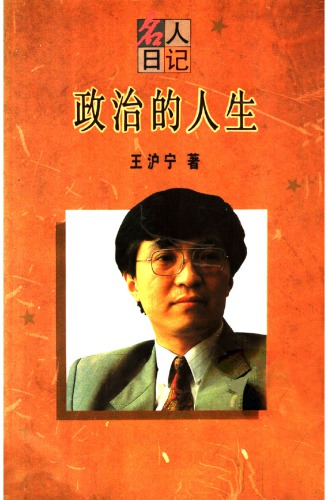
“Life in Politics,” a collection of Wang Huning’s diary entries published in 1995.
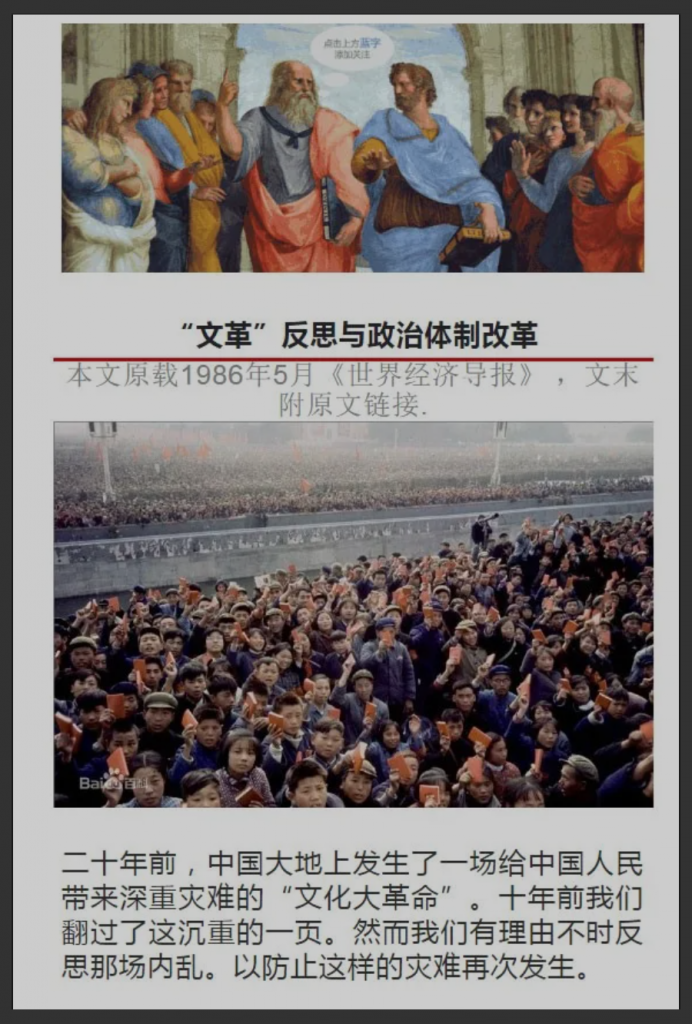
Last week, a number of accounts on WeChat, including CCVI and “Guangxun Vision” (广讯视界), posted an early piece of writing from Wang Huning that provides a fascinating answer to this question. The essay, “Reflections on the ‘Cultural Revolution’ and Political Reform” (“文革”反思与政治体制改革), was published in May 1986 in Shanghai’s World Economic Herald (世界经济导报).
One of the most critical newspapers of the day, the World
Economic Herald had been founded in 1980 by Qin Benli (钦本立), a former Wenhui Bao journalist who had been harshly
disciplined during the Anti-Rightist Movement of 1957, and who had been imprisoned
for seven months by Red Guards during the Cultural Revolution. By the late
1980s, Qin’s newspaper had become a leading
advocate of political reform, seeking to move China away from the excesses
of Mao Zedong’s Cultural Revolution.
Wang Huning is now the most defining figure of Xi era political theory, the creator of political formulas that have made the case for a return to centralized power and charismatic politics – and his 1986 essay in the World Economic Herald reads today like a dissenting voice against this “new era” orthodoxy. “Twenty years ago, the ‘Cultural Revolution,’ which subjected the Chinese people to untold disaster, occurred in the vast land of China,” the young Wang writes. “Ten years ago we turned over a new and profound page. And yet, there is reason for us to continue to reflect on the chaos of those times. In order to prevent such a disaster from happening again.”
Summing up the causes of the Cultural Revolution, Wang continues: “Aside from historical, social, economic and other causes, the imperfect and incomplete nature of political reforms were a cause that cannot be underestimated.”
Wang Huning’s 1986 essay from the World Economic Herald on a recent WeChat post.
Here
is Wang laying out the specific failings of China’s political system, including
the inability to achieve “vertical decentralization” of power. I have included
under his bullet points only the original bolded statements summarizing his
arguments:
Analyzing from the standpoint of the political system, we can see the following structures and functions are connected to the inability to prevent the Cultural Revolution:
1. The ruling party as the core of the country’s political life had not formed a complete set of democratic systems. The system for division of roles between the Party and government was not sound, and balance of power within the political system had not been clearly .
2. The National People’s Congress was unable as a national authority to effectively exercise its powers.
3. There was a lack of a strong constitutional guarantees in political life.
4. In social life, there was a lack of an independent judicial system.
5. There was no adequate mechanism for vertical decentralization in the political system.
6. There was no sound national public servant system.
7. There was no strict system in political life to protect the rights of citizens.
All of these reflections on the political system and the conditions that made the Cultural Revolution possible are sharply at odds with the principles Wang has championed since becoming a member of the Politburo, including his promotion of the so-called “442 formula,” an abbreviated reference to a set of political principles now used to signal loyalty to Xi Jinping and his leadership of the CCP.
Even as censorship and surveillance have become ubiquitous on Chinese social media, forestalling criticism of the leadership and its policies, a range of more extreme voices expressing nationalistic views have been permitted to survive, and even thrive, in Chinese cyberspace. Over last weekend, however, this apparent blind eye for extreme views was questioned by many Chinese as a post by a prominent “Big V” on Weibo went to the most extreme of extremes, advocating global nuclear annihilation in the event that the United States curtails China’s ambitions.
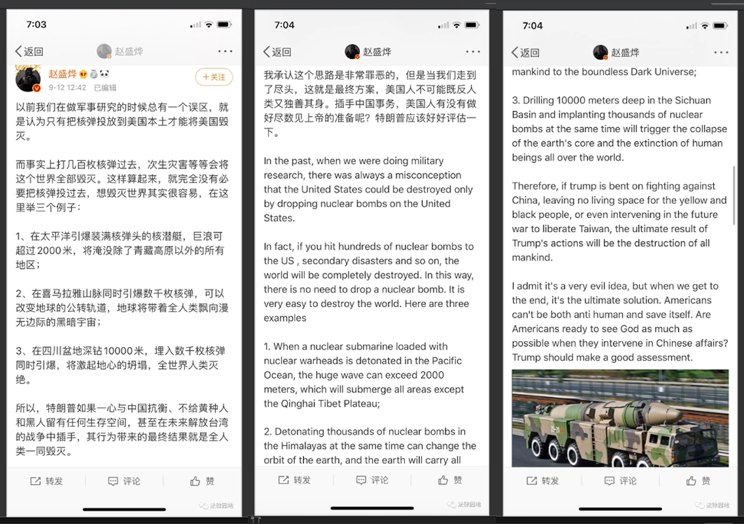
The post in question, made in both Chinese and English on September 12 by Zhao Shengye (赵盛烨), a well-known blogger and amateur scientist with more than three million followers on the Weibo platform, outlined three concrete ways that China could bring about earth-wide destruction “if Trump is bent on fighting against China, leaving no living space for the yellow and black people.”
“[The] ultimate result of
Trump’s actions,” wrote Zhao, “will be the destruction of all mankind.”
In his post, Zhao argued that a direct nuclear attack on the United States was unnecessary, as the ultimate result in any case would be that “the world will be completely destroyed.” Instead, he suggested three ways that China could more directly achieve global annihilation, depriving the United States of ultimate dominance.
1. China could detonate a nuclear submarine loaded with warheads in the Pacific Ocean, submerging “all areas except the Qinghai Tibet Plateau.”
2. China could detonate “thousands of nuclear bombs in the Himalayas,” thus changing the orbit of the earth.
3. China could drill down into the Sichuan Basin, detonating thousands of nuclear warheads deep beneath the earth, triggering “the collapse of the earth’s core.”
“I admit it’s a very evil idea,” Zhao wrote, “but when we get to the end, it’s the ultimate solution. America can’t be both anti human and save itself.”
Zhao Shengye is a known member of the “Nine-Three Society” (九三学社), one of just nine recognized pro-CCP political parties in China, founded in 1945, that has generally counted among its members intellectuals working in technology. Zhao made the news in China last year when he was accused of defamation by JD.com founder and CEO Richard Liu, who was accused of rape by a Chinese student in the US.
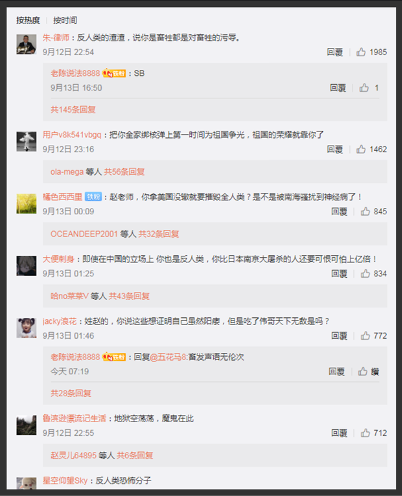
Zhao’s recent post sparked anger on Chinese social media. At his WeChat public account, “Legal Garden” (法律园地), human rights lawyer Liu Xiaoyuan (刘晓原) published a post called, “A Big V Who Imagines the Destruction of the World and the Elimination of Humankind” (一个幻想毁灭世界,灭掉人类的网络大V), in which he archived Zhao’s original post and remarked: “Were he to be supreme military commander, he would most definitely become a ‘madman’ in the event of nuclear war. The earth and humankind would truly be in peril! But we are ‘fortunate’ that Zhao Shengye is little more than an online Big V who speaks wildly.”
Liu added that he felt Zhao’s post had
“exceeded the bounds of freedom of speech and deserves to arouse the vigilance
of peace-loving people.”
At the time of Liu’s WeChat
post on September 14, Zhao’s original Weibo had been shared nearly 3,000 times,
had attracted more than 3,000 comments, and had been read more than 23,000
times. Zhao’s post was apparently deleted later that day, as it had been,
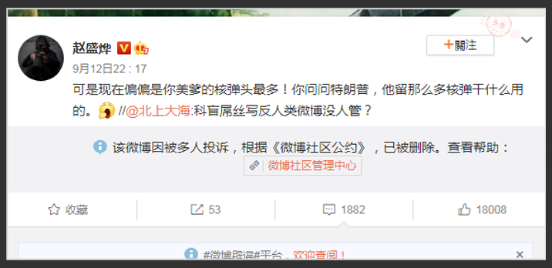
according to a Weibo notice, “reported by many people.”
Users continued to post
comments on Zhao’s account, however, even after the deletion. Most comments
were either directly critical or personal attacks on Zhao. “You anti-human
scum,” wrote one user. “I would call you livestock if this weren’t an
insult to all livestock.”
Another user made what appeared
to be a reference to the 1964 film “Doctor Strangelove,” a Cold War
black comedy in which B-52 pilot Maj. “King” Kong rides a nuclear bomb
cowboy-style as it plunges toward its Soviet target. “Let’s strap your whole
family to a nuclear missile so they can earn glory for the motherland at the
first opportunity. The glory of the motherland depends on you!”
A screenshot of one page of comments directed
at Zhao Shengye follows.
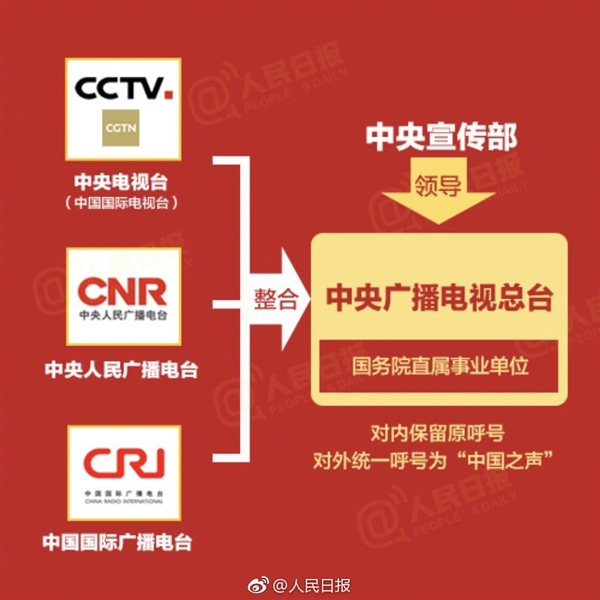
Politico reported
this week that China Media Group (CMG), the state media super-conglomerate created in
March 2018 through the merger of three major media groups, including China
Central Television, China National Radio and China Radio International, is now
planning to open a European office in Brussels. CMG, which is also
known as “Voice of China” (中国之声), has been portrayed
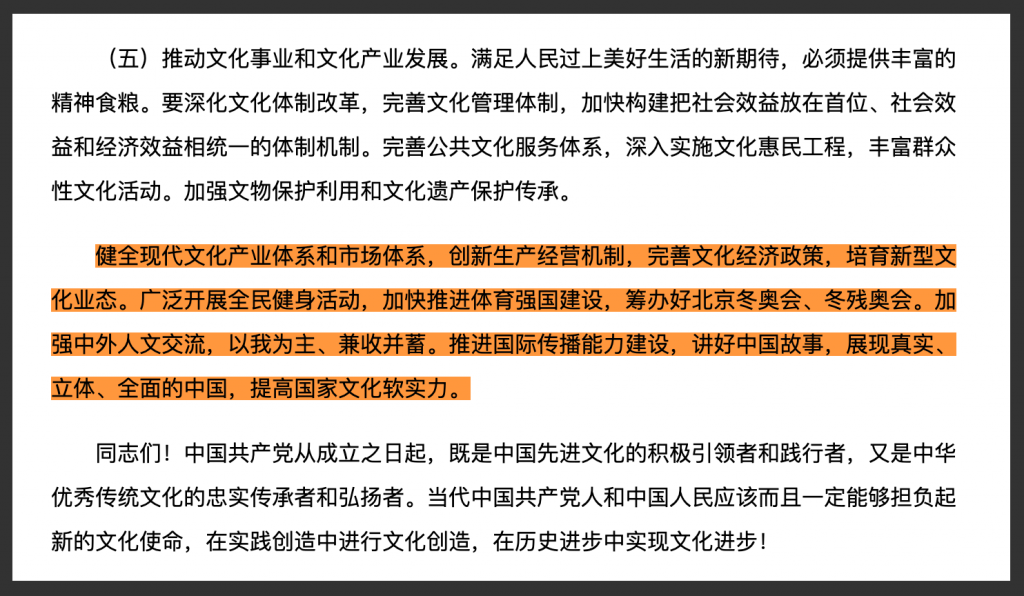
by state media sources as a key step in “advancing [China’s] international
transmission capacity and telling China’s story well,” both demands that Xi Jinping
made in his political
report to the 19th National Congress of the CCP in October 2017.
The establishment of the Brussels office almost certainly signals China’s
intention to bolster its media presence and deployment of CCP narratives in Europe,
and perhaps to seek partnerships that can help to advance coverage in the
region that is favorable to China’s interests. The move comes as the CGTN, part
of the group, faces possible sanctions in the UK over its broadcasting
in 2013 of a forced confession by British national Peter
Humphrey.
A chart from the WeChat public account of the official People’s Daily explains the merger of major state media entities into China Media Group in 2018.
So it seems that
the “China story” could soon be broadcast loudly from the CMG headquarters in
Brussels. What does it mean to “tell China’s story”?
One of the clearest definitions of Xi’s phrase, which is not about Chinese voices but rather about national discourse power, came in an article written for the People’s Daily by Xu Shana (徐姗娜), head of the Fujian provincial section of the All-China Women’s Federation. In her article, “Strengthening Agenda Setting, Telling the China Story Well” (加强议题设置 讲好中国故事), Xu breaks “China’s story” down into four aspects.
The Party
First, and this
should not surprise, comes the Chinese Communist Party. Xu begins by explaining that “the core of
telling ‘China’s story’ is the ‘story of the Chinese Communist Party, and the
crux of telling the story of the Chinese Communist Party well is properly
explaining why the CCP ‘can’.” The point here is that the CCP must be portrayed
as pre-eminently competent. This fits with the foreign and domestic propaganda
we have seen from China this year, emphasizing the CCP’s leadership of the
effort against COVID-19, and even the superiority of China’s political system
in grappling with the crisis.
Xu writes:
We must
scientifically set up issues around why the Chinese Communist Party ‘can,’ in
this way fully demonstrating the Chinese Communist Party’s political wisdom,
its sense of responsibility about its mission, the care it shows for the
people, and how its experiences can provide lessons for political parties in
developing countries.
Stories in the media,
Xu adds, must “clearly speak to why history and the people would choose
the Chinese Communist Party, showing the political advantages of adhering to
the leadership of the Party.”
Screenshot of a section of Xi Jinping’s political report to the 19th National Congress of the CCP discussing the priorities of external propaganda and “soft power.”
The Dream
Next, telling China’s
story well means telling stories about “the struggle of the Chinese people to fulfil
their dream.” This, of course, is not at all about personal aspirations, but rather
about Xi Jinping’s so-called “Chinese dream” of the “great rejuvenation of the
Chinese people.” It is wrapped up with nationalistic notions of China’s inevitable
return to the center of the global stage, and its newfound prosperity and
strength.
Xu writes:
Telling the Chinese
dream well is about [conveying] the dream of national prosperity, national
rejuvenation, and the happiness of the people, showing the essential content of
the Chinese dream. To tell the Chinese dream comprehensively and accurately it
is necessary to make it clear that the essential content of the Chinese dream is
the prosperity of the country, the revitalization of the nation, and the
happiness of the people.
But if telling China’s
story well is about “soft power” – Nye’s term that China’s has appropriated, and
reinterpreted, in official documents since
the 2007 CCP National Congress
– how do such nationalistic aspirations speak to foreign audiences? Isn’t this
just “China First”? Xu suggests that the story of the “great struggle of the
Chinese people” (中华民族的伟大奋斗精神) has resonance for other countries,
because it is also, she says, “a dream of peace, development, cooperation and
win-win.” The logic here, at the heart of China’s foreign policy thinking
around such phrases as “community of common destiny for mankind” (人类命运共同体), is that China’s ascendance enmeshes it more
deeply with the world in ways that benefit all.
This is where the Belt and Road Initiative, Chinese investment and Chinese
aid come into the picture, though these of course have generated a great deal
of opposition in recent years as “an
unsettling extension of China’s rising power,” as clearly evidenced by ongoing
US-China tensions and by
the changing debate in Europe. For China, building a global media presence through
the China Media Group and other players is about combatting such reservations
and smoothing the way for Chinese engagement, as much as possible on China’s
terms. And in Xu’s discussion of the “Chinese dream” we can also detect a
strong whiff of what has been called “wolf warrior diplomacy,” or zhanlang
waijiao (战狼外交), the readiness
to be tough and raise China’s hackles over what are seen as counter-narratives:
We must actively set a positive agenda and a counter-agenda, actively showing
our swords, eliminating misunderstanding, speaking clearly from a historical
perspective about how certain Western hegemonic countries are self-interested,
hypocritical and cold-blooded. [We must] make it clear that no matter how far
China develops, it is always a builder of world peace.
In this passage we can note a clear disconnect that runs through Chinese
diplomacy, and at least partly explains the
difficulties Foreign Minister Wang Yi had on his recent trip to Europe. China’s
attitude toward partners in the West has seesawed from friendly overtures about
“win-win” and “cooperation,” to aggressive
displays of intractability that underscore fundamental gaps in core values.
Xu’s language, intended for an internal Party audience, is in a sense more
honest – making clear that undermining the credibility of the “hypocritical and
cold-blooded” West is an ongoing strategy.
The Culture
Moving on, Xu
highlights the importance of using “China’s excellent traditional culture” as a
means to convey the “true,” the “good” and the
“beautiful” of China in the world. Here we get the usual language about
traditional culture as “China’s deepest source of cultural soft power” (最深厚的文化软实力). There is little else to say
here, except to observe that this is another aspect on which the CCP’s policies
could be said to show incredible short-sightedness. The focus on “traditional culture” smacks of the sort of
narrowness that has characterized much of China’s cultural diplomacy for
decades, which has focussed on “art troupes” and colorful performances that
lend, as I wrote five years ago, a “circus quality” to China’s
outreach activities.
These criticisms have, on rare occasions, been made by
people within China’s cultural diplomacy apparatus, as they were
in 2015 by Zhou Hong (周虹), the director of the Cultural Division of the Overseas Chinese Affairs Office of the State Council. “The belief that culture equals the arts means that overseas
performances are almost without exception arts troupes,” Zhou wrote, “giving
foreigners the impression that Chinese culture is all about singing and
dancing.” Moreover, he said, the “habitual reliance on government planning and
financing” for such programs overseas, which have a “thick government tint,” invites
“suspicion and resentment.”
Behind Zhou’s
cautious criticisms is a key point of weakness in China’s efforts to
manufacture “soft power” – the failure, and the inability given political restrictions
at home, to harness the strength of civil society. Now, more than ever, more
even than was true in 2015, China equals the CCP. And the CCP is not itself revered
as a cultural phenomenon.
Win-Win Cooperation
In the last section
of her article, Xu address the fourth and final aspect of “telling China’s
story,” which readers will recognize for its overlap the Chinese dream. Here
again the talk is about convincing the world that China’s rise is peaceful, and
that its fundamental interest is to build a “community of common destiny for mankind”
in which all countries and peoples can benefit. To do this, Chinese media and
exchange initiatives must “break through” the notion, which Xu associates with
the West and the proponents of the “China Threat Theory” (中国威胁论), that “countries that strengthen must seek hegemony” (国强必霸).
While the section
on the Chinese dream was primarily about a domestically focused aspect of “telling
China’s story,” hinting that the rise of the Chinese people is a story that can
be shared by all, it is this section that concretely mentions the Belt and Road
Initiative, which Xu says, with a tone-deafness that now seems prerequisite in
Chinese officialdom, has “received widespread enthusiastic responses from
countries along the route.”
China’s tasks here
are two-fold: to break through the “anti-Chinese politicians and media in the West,”
and to showcase China as a successful model that can be admired, and perhaps emulated,
by the world. Xu writes:
Talking about the
concept of a community of common destiny for mankind, we can set agendas around
the solution for the global governance crisis, clarifying the practical and
effective “Chinese solutions” that China today offers for world
development, showing the world China’s wisdom as a major power and its [warm]
feelings for the world.
Will the “China story” as outlined above actually translate? Keep your eyes on Brussels.
The top official news story in China today is the national celebration event for the country’s fight against COVID-19, a so-called “commendation ceremony,” or biaoyang dahui (表扬大会), televised live from the Great Hall of the People. The event culminated as Xi Jinping, who delivered a speech about how “China’s power” and “China’s responsibility” were proven by its pandemic response, draped a golden Medal of the Republic, the country’s highest honor, over the neck of respiratory disease expert Zhong Nanshan (钟南山).
Three others, including disease experts Zhang Boli, Zhang Dingyu and Chen Wei, were given People’s Hero medals, all four taking to the stage to a chorus of trumpets. Zhang Boli, president of Tianjin University of Traditional Chinese Medicine, has this year been an outspoken advocate of the use of TCM to fight COVID-19. Zhang Dingyu is the top official at Wuhan’s Jinyintan Hospital (and state media have made much of the fact that he suffers from ALS, a true selfless soldier). Chen Wei is a medical researcher with the People’s Liberation Army who has been involved in vaccine research.
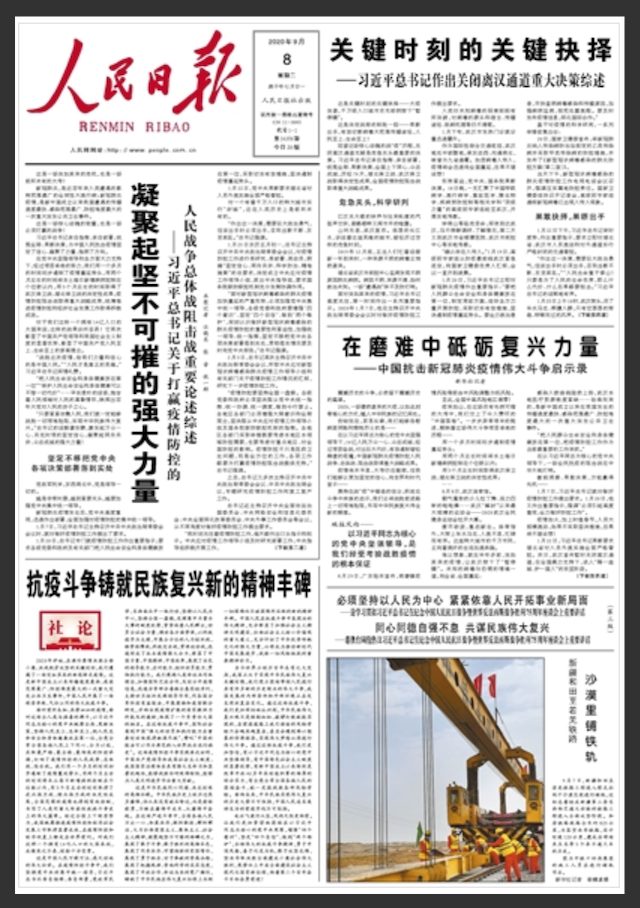
The entire front page of the People’s Daily newspaper is dominated today by the declaration of the Chinese Communist Party’s victory over the disease, and a lead editorial refers to the anti-epidemic effort as a “great spiritual achievement.”
The final, penultimate paragraph of this shelun (社论) provides the clearest picture of what the pomp and circumstance today were really about – namely, the home stretch in the leadership’s marathon re-positioning of the COVID-19 pandemic as a story about the power and position of Xi Jinping and the CCP. The paragraph is jam-packed with political phrases meant to signal loud and clear that Xi Jinping is strong, and that the CCP is back on track when it comes to central agendas for 2020, including the achievement of “a comprehensively well-off society.”
In quick succession,
it gives us a poetic reference to Mao Zedong (乱云飞渡仍从容), a reiteration of
Xi Jinping as the CCP’s “core,” and a mention of the so-called “442 formula,”
ultimately about pledging allegiance to Xi.
Riotous clouds sweep past, swift
and tranquil, and we move forward through the storm unimpeded. Let us unite
even more closely around Comrade Xi Jinping as the core of the CCP Central
Committee, strengthening the “four consciousnesses”, strengthening
the “four self-confidences,” and achieving the “two safeguards,”
bearing forward the great spirit of the anti-epidemic fight. [Let us] bravely
open our sails and take the lead, turning crisis into opportunity, daring to
overcome difficulties, resolutely achieving the great victory of building a
comprehensively well-off society, taking advantage of the situation and
embarking on a new journey of fully building a socialist modern society, and
marching bravely towards the second centenary goal!
The Mao reference
here to “riotous clouds” sweeping past should be understood as a reference to
storms of criticism from other countries that have buffeted China in recent
months – from the United States, Australia, Canada, India, the Czech Republic
and other EU member states. The winds may be strong, the reference suggests,
but Xi Jinping steadies the Party as helmsman.
Sweeping away international concerns about human rights in China –which were recently raised during Foreign Minister Wang Yi’s recent trip to Europe — Zhong Nanshan said in his address to the commemoration ceremony today (pictured at the top of this article): “What is the greatest human right? We saved so many lives, and this is the greatest expression of our human rights.”
But beyond the official propaganda today there were eyerolls of irritation, sighs of resignation, and sometimes lightning flashes of oblique disobedience.
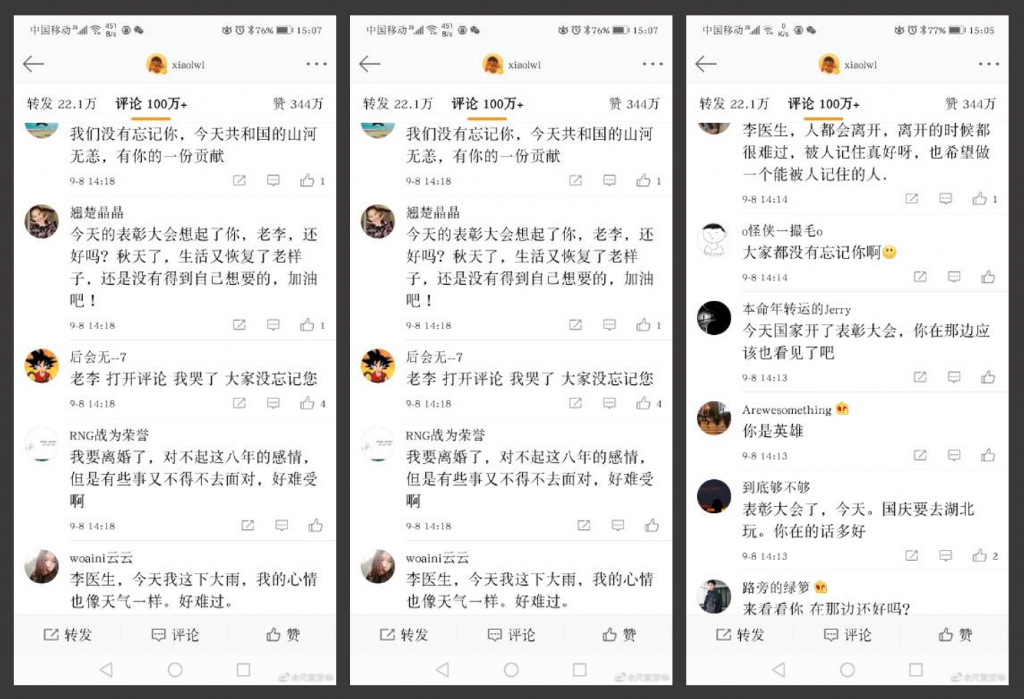
Even as the live “commendation ceremony” commemorated the heroic eight-month “struggle,” emphasizing Party and country, users on social media fought to raise the voices of those who were conspicuously absent. Many of the comments were tributes to Li Wenliang (李文亮), the Wuhan doctor who was interrogated and harshly reprimanded by police in December 2019 for sharing information about on WeChat about suspicious cases of pneumonia.
State media made no mention whatsoever of Li Wenliang today, but users flocked to the Li’s account on the Sina Weibo platform, which remains available, and posted comments, many addressing him directly.
“They have begun the praises, but we have not
forgotten you,” said one user as the ceremony was underway. Wrote another:
“It doesn’t matter who they praise, or whether or not they mention you. We
remember.”
Referring to the live ceremony, one user wrote:
“All of these awards go to Li Wenliang, and they are just collecting them
on his behalf. It’s so excessive!” Another said, addressing the deceased doctor
directly: “It is you who are our hero.”
Still others rejected the notion of heroism, suggesting
such honors only spoiled the genuineness of basic acts of professional courage,
such as that shown early on by Li Wenliang. “Doctor Li was a good doctor,
but don’t render him as a hero.”
Direct criticism of the government could not be readily found among the comments, but one user could barely contain his scorn for the proceedings. He referenced Lu Xun’s 1919 short story “Medicine,” the writer’s indictment of dimwitted superstition and conformity to power, in which poor and illiterate parents attempt to cure their son’s tuberculosis by offering him a steamed bun soaked in the blood of an executed revolutionary. “How do the blood-soaked dumplings taste?” he asked.
Weibo user “Che Su Youth” (尺素芳华) aggregated 8 images of recent comments made to Li Wenliang into a single image with a commemorative sketch of Dr. Li at the center, a post that itself received 217,000 “likes.” Since February 1 this year, more than one million comments have been left on Weibo account of Li Wenliaang, who passed away on February 7 from COVID-19.
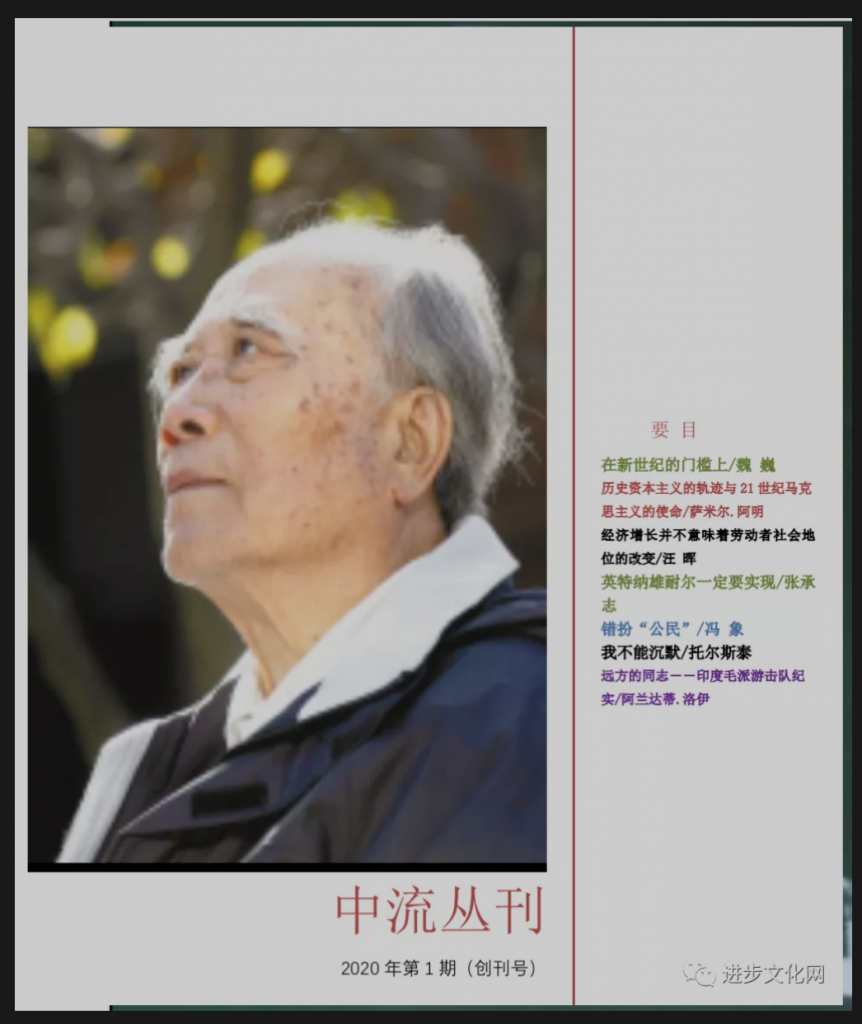
On August 24, a post on the WeChat public account “Progress Culture Online” (进步文化网) announced the launch this year of a “large-scale thought and humanities magazine” to be called Midstream Collections (中流丛刋). For those whose memory of press events in China goes back two decades, this is interesting news, because the name of this new online publication is a clear reference to Midstream (中流), a leftist magazine launched in 1988 by poet and novelist Wei Wei (魏巍), pictured above.
A novelist and poet from Henan province, Wei Wei joined
the revolutionary Eighth Route Army during China’s civil war. He held firmly to
his leftist political convictions even after the end of the Cultural Revolution.
Midstream, a leading leftist voice in its day, was shut down in 2001 following
sharp criticism of Jiang Zemin’s so-called “July
1 speech,” in which the leader urged
that private entrepreneurs be allowed to join the Chinese Communist Party.
According to a
2011 report from the official China News Service, Midstream and Pursuit
of Truth (真理的追求), both magazines strongly
associated with old leftist figures within the CCP (many being veterans of the
Yan’an days), had continuously published articles ahead of the CCP’s 80th
anniversary in 2001 stressing the Party’s “proletarian character” and strongly
opposing membership by capitalists.
Following Jiang’s “July 1” speech, Wei Wei led “a group
of CCP members,” including the critic Lin Mohan (林默涵) and journalist and
former press official Wu Lengxi (吴冷西), in writing a petition to the senior leadership called “On the Major
Political Error of the “July 1 Speech” (“七一讲话”是极其重大的政治错误事件). The petition
accused CCP leaders of “surrendering to capitalism” and of carrying out a “theoretical
coup d’état” (理论政变), and it directly
criticized the “Three Represents,” the banner term meant to encapsulate Jiang
Zemin’s legacy.
The petition from Wei Wei was published in Midstream
the same month as Jiang’s speech, and the shutdown of both Midstream and Pursuit of Truth followed
shortly after. The petition was itself harshly criticized by state media and
prominent scholars, including economist Hu Xingdou (胡星斗), who said the petition “irrationally attacked the
Party’s general secretary.”
The announcement on “Progress Culture Online” made plain the new publication’s association with Wei Wei’s leftist legacy: “Wei Wei was an outstanding contemporary proletarian writer in our country. He launched the magazine Midstream in the 1980s, and before his death [in 2008] left behind the words, ‘Continue the revolution, and never surrender.’” Noting that this year marks the centennial of Wei Wei’s birth, the announcement added that “to launch this year, and to use the name of a publication launched by Wei Wei, has clear symbolic significance for Midstream Collections in the continuation of the spirit of Wei Wei.”
So far, there is no evidence that the newly launched Midstream Collections has support from influential figures within the CCP, but it has invited speculation on social media that leftist voices are now generally more accepted as China under Xi Jinping has reembraced Marx. The crucial question may be whether the magazine is able to publish openly offline. For now, Midstream Collections is being distributed only online to users who follow the public account of the publication’s editors. But “Progress Culture Online” reports that the print edition of the publication will be released “when conditions are right.” If that does happen, it would mean that a highly visible leftist publication is able to find an official government office to serve as its sponsoring institution, something necessary in China for any publication. And that would also mean official endorsement of the magazine’s content.
Over the past week, as floods continued to devastate communities across southwestern China, the country’s top leaders descended from the capital to tour flood-stricken areas, visits meant to signal their resolve in dealing with the crisis.
Xi Jinping’s destination was Anhui, where he “delivered instructions to guide flood control efforts” and visited local residents, credited by party-state media for his “people first” approach. Meanwhile, Premier Li Keqiang, the head of the government and Xi’s number two on the Politburo Standing Committee (PSC), visited the city of Chongqing, where already this year the Yangtze River has topped its banks five times.
But beyond signalling the resolve of the leadership, these visits offered a glimpse of apparent divisions behind the scenes, and revealed how efforts to elevate Xi Jinping over his peers have led to a politics of the preposterous. The goal of the men driving the Chinese Communist Party’s propaganda efforts – right-hand ideas man Wang Huning (王沪宁), propaganda chief Huang Kunming (黄坤明) and China Media Group boss Shen Haixiong (慎海雄) – may be to show Xi in the best light, and to ensure that he dominates centre stage. But the result of such determined efforts in the digital age can be to focus attention instead on the act of propaganda itself, highlighting its grotesqueness.
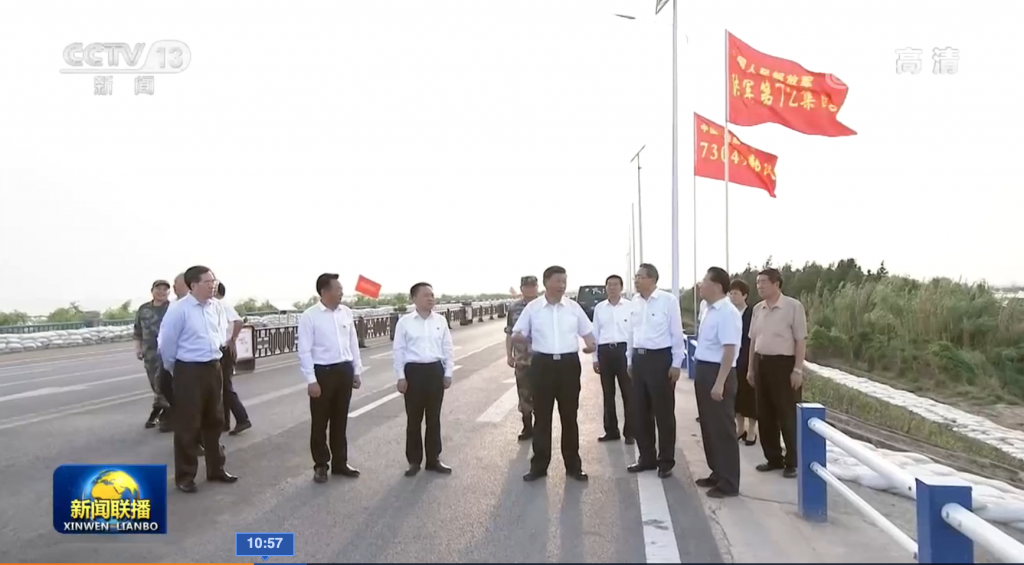
The problem begins with Xi Jinping’s bright white shirt and shiny, shiny shoes. Throughout his visit to Anhui, the “core” leader was depicted as immaculate. He gave pep talks to workers and soldiers. He visited museums and businesses. But he never, ever, got his feet or hands dirty. Readers can click here for a Google Image search of his Anhui visit.
An immaculate Xi addresses his immaculate comrades during the trip to Anhui.
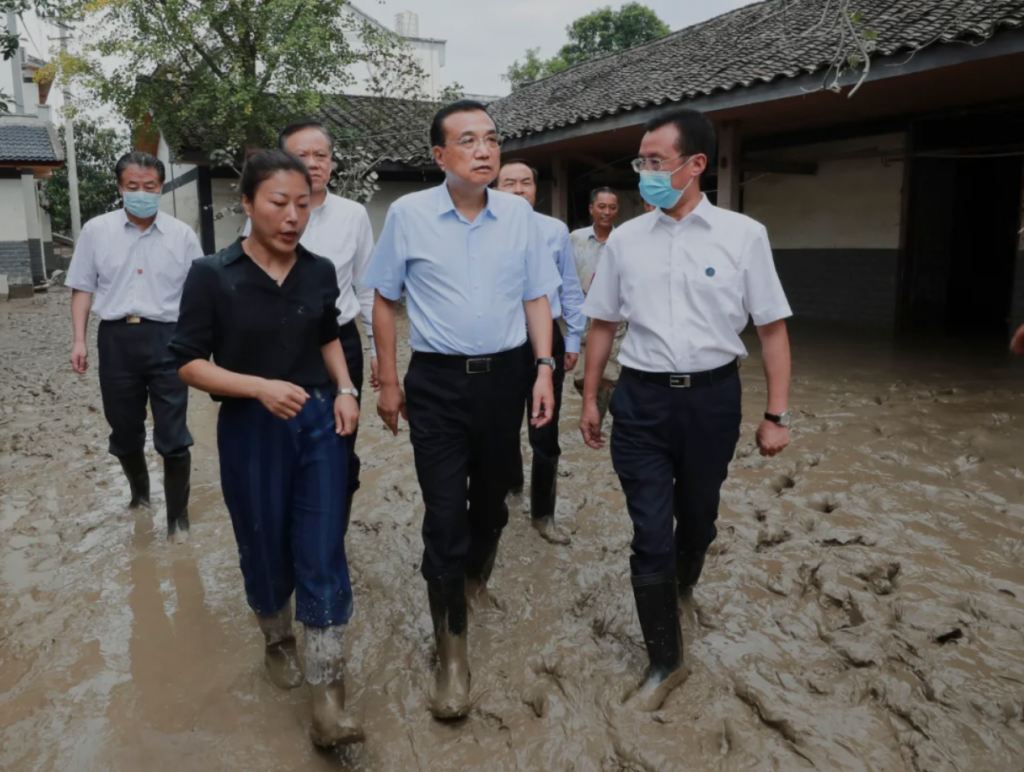
And what of Li Keqiang? The iconic image of the premier’s trip to Chongqing (below), which was shared on Friday through the State Council’s own www.gov.cn (中国政府网), shows Li trudging through the muddy waters, engaged in an active discussion with local officials. A man of the muck. A man of the people.
Image of Li Keqiang visiting Chongqing. Shared via www.gov.cn.
In a second image, featured at
the top of this article, Li stands in the clay-coloured slurry holding a
shovel.
But it is not just the
contrast that matters. On both Friday and Saturday, Premier Li was entirely
excluded from China’s official nightly newscast, Xinwen Lianbo, save for a passing
mention in the lower-third of his planned participation
in the third Lancang-Mekong River Cooperation (LMC) leaders’ meeting taking
place today. In the People’s Daily too on Saturday, Xi Jinping dominated
the headlines, while Li received only a tiny mention on page three – again, of
the LMC meeting.
The August
21 broadcast of Xinwen Lianbo should be archived and studied, against the
absent news of Li Keqiang’s visit, as an outstanding example of the vagaries of
official propaganda that makes its chief priority not any particular policy
objective but rather the center-staging of a single leader, elevating his
personal image and interests over all else.
The effect, one could argue,
is to achieve exactly the opposite. It is to make Xi not a dynamic leader – as Li
appears to be in the Chongqing images – but an almost comically static figure, as
though he was photoshopped into his own tour.
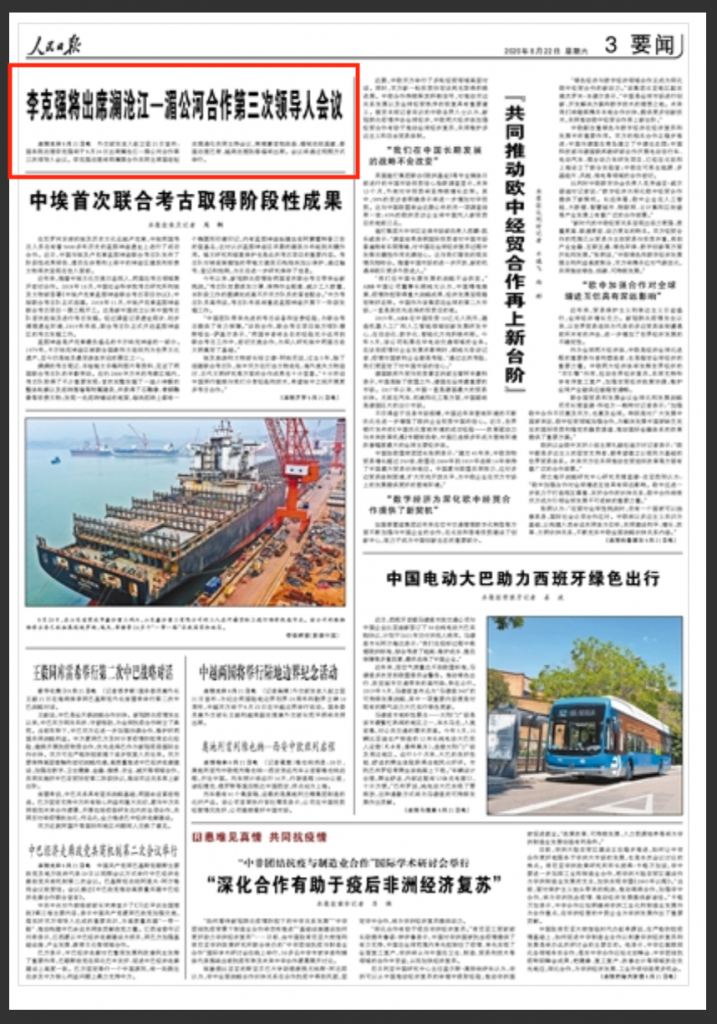
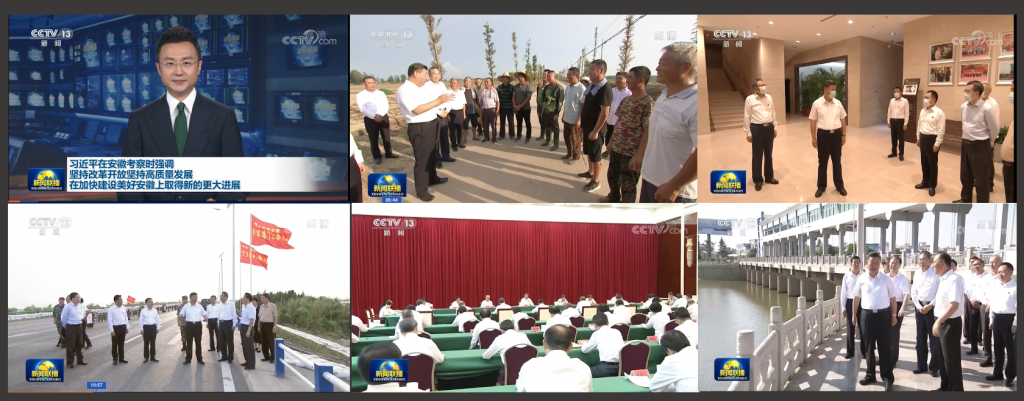
Individual scenes from the first 25 minutes of the August 21 broadcast of Xinwen Lianbo.
The first 25 minutes of the August
21 broadcast deal entirely with Xi Jinping in Anhui, a tiresome succession of
clips, including (lofty, distant) drone footage of the flooded region. The only
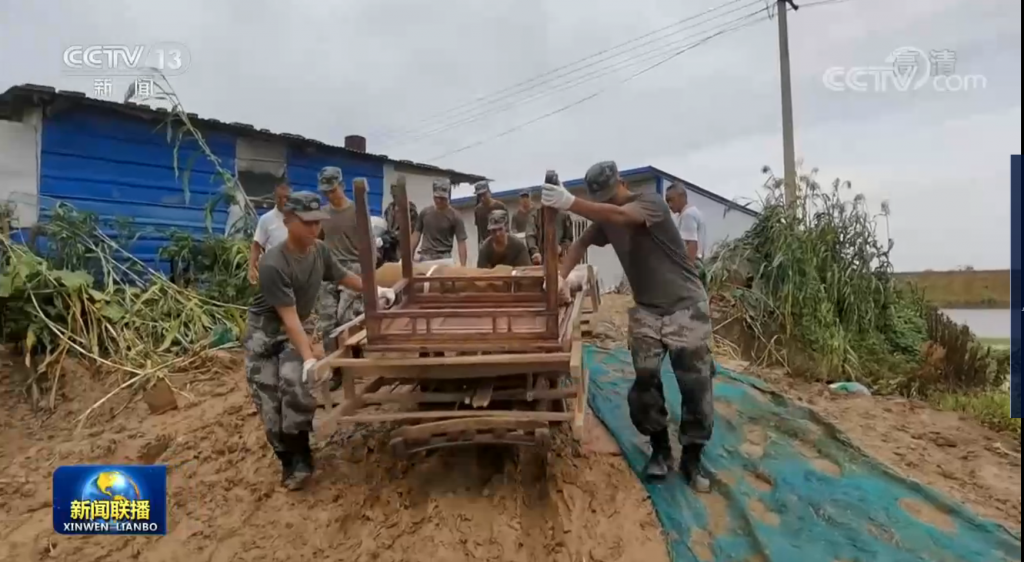
action that is remotely human and relatable is that of the soldiers of the People’s
Liberation Army, who are shown in scenes of mucky action after Xi had blandly
directed them.
PLA soldiers work to clear flooded homes in Anhui.
In the digital age, the apparent restraints on the use of footage of Li Keqiang’s Chongqing tour present a real problem, but one of which the CCP’s top propaganda masters, including Wang Huning, seem unaware.
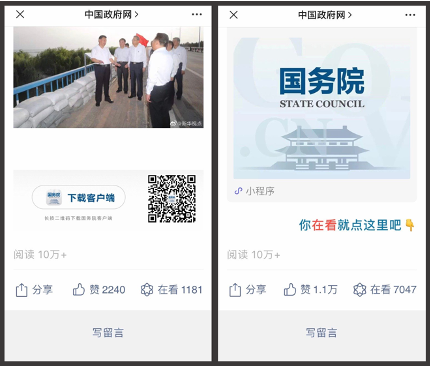
Here, for example, is a screen capture of the release on Xi Jinping’s trip to Anhui (left) as it appeared on the official WeChat account of www.gov.cn on Friday. Next to it (at right) is the release about Li Keqiang’s trip to Chongqing. Notice that while the Xi Jinping news has just 2,240 “likes,” the Li Keqiang story already has more than 11,000.
The contrasts were certainly
noted by Chinese readers, whose chatter was picked up also by Chinese-language
media internationally, including Deutsche
Welle and RFA.
The ultimate effect is arguably something for which the Chinese Communist Party
has
lately shown great sensitivity, the phenomenon of “high-level black,” or gaojihei
(高级黑), in which CCP ideals, principles, policies and
discourse are interpreted in such a way as to achieve a critical or embarrassing
result.
Whatever tensions might lie behind the headlines are a matter of speculation. But this story of contrasts, the tale of two official visits and how they were portrayed and then amplified, can reveal the pitfalls of propaganda – in all eras, but certainly in the digital age.
Earlier this week, I looked at how party-state media in China have been flagrantly one-sided in their reporting of the ongoing protests in Belarus, clearly standing with embattled President Alexander Lukashenko. Though a small-scale rally in support of the Belarusian leader over the weekend was dwarfed by large-scale demonstrations calling for his ouster, a headline in the official Xinhua News Agency on Monday read: “Large-scale rallies held in Belarusian capital to support the government.”
Given the widespread propagation of this cynically twisted version of events, combined with determined censorship of international coverage, one might suppose Chinese readers have little choice but to swallow the official spin. Outside perhaps a handful of stories from the likes of Caixin Media, which reported (behind its paywall) on Monday that opposition demonstrations “surpassed 100,000,” the pro-Lukashenko narrative has seemed to dominate.
But we cannot forget that despite layer upon layer of control, China’s information landscape remains complex, and acts of dissonance and creative resistance — from the oblique to the audacious — can be found for those who care to look. Today we have a delightful example in an article posted by the WeChat public account “Lao Yu Chui Niupi” (老鱼吹牛皮) that looks more critically at official news coverage of the demonstrations in Belarus.
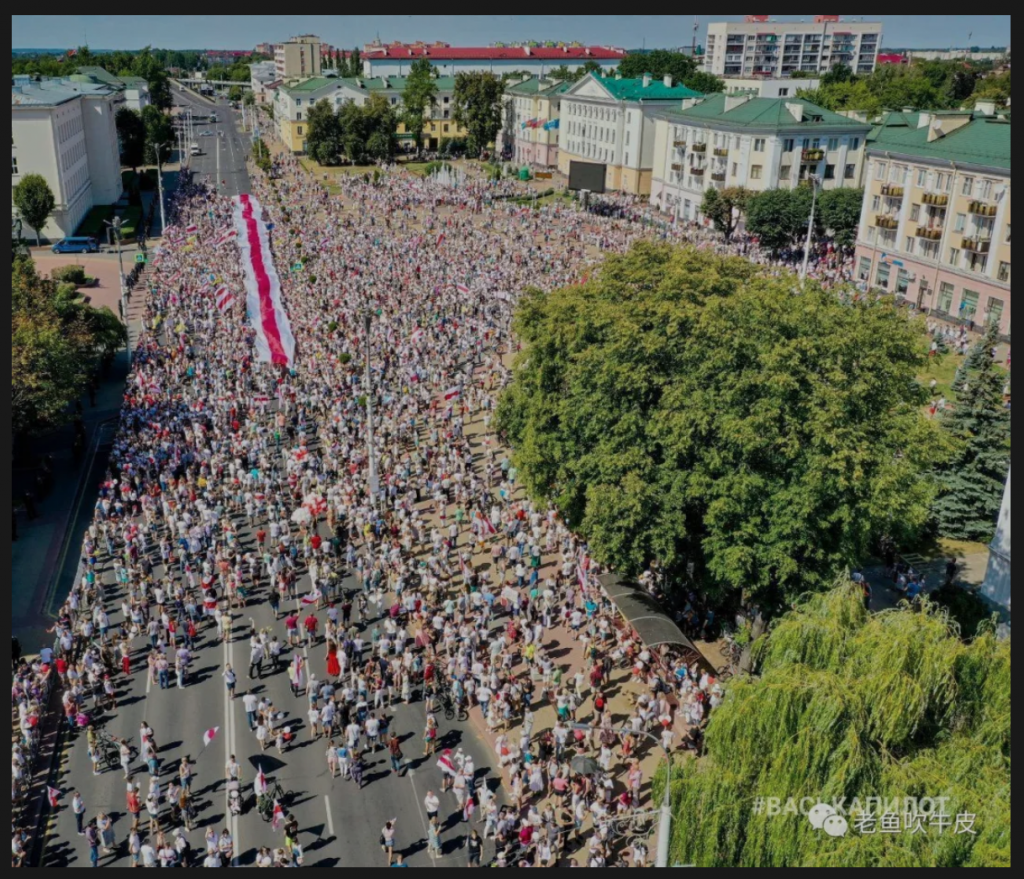
The article does not directly criticize China Central Television for its clearly misleading suggestion this week that “huge street demonstrations are held in Minsk in support of the government.” It does, however, offer a knowing wink to the reader as it shows rather convincingly on the basis of photographic evidence that the pro-Lukashenko rally over the weekend was dwarfed by opposition demonstrations.
Turning to Shanghai’s Dragon Television, operated by the state-owned Shanghai Media Group, the post is more direct, noting that the network even mis-identified footage of opposition demonstrations in Minsk as showing pro-government demonstrators.
In recent days, Belarusian citizens have taken to the streets in protest because they are dissatisfied with the results of the recent election and suspect that Lukashenko falsified [the ballots]. Meanwhile, Lukashenko has been very busy these days, asking his old pal Putin for assistance, and then calling his own supporters out onto the streets.
In order to better understand the background, you can read my previous article, “Is Putin’s Close Buddy Finished?”
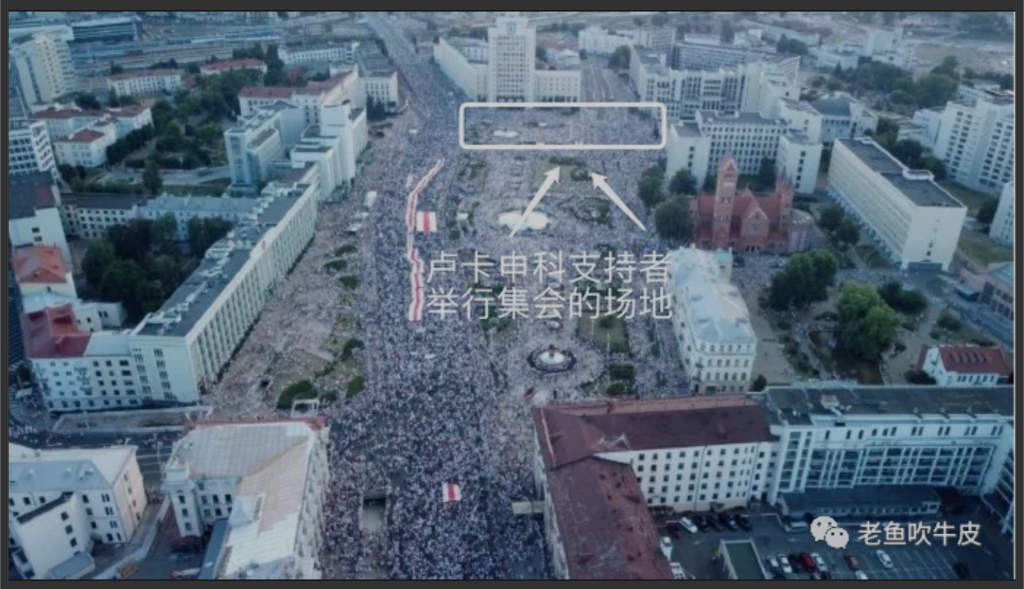
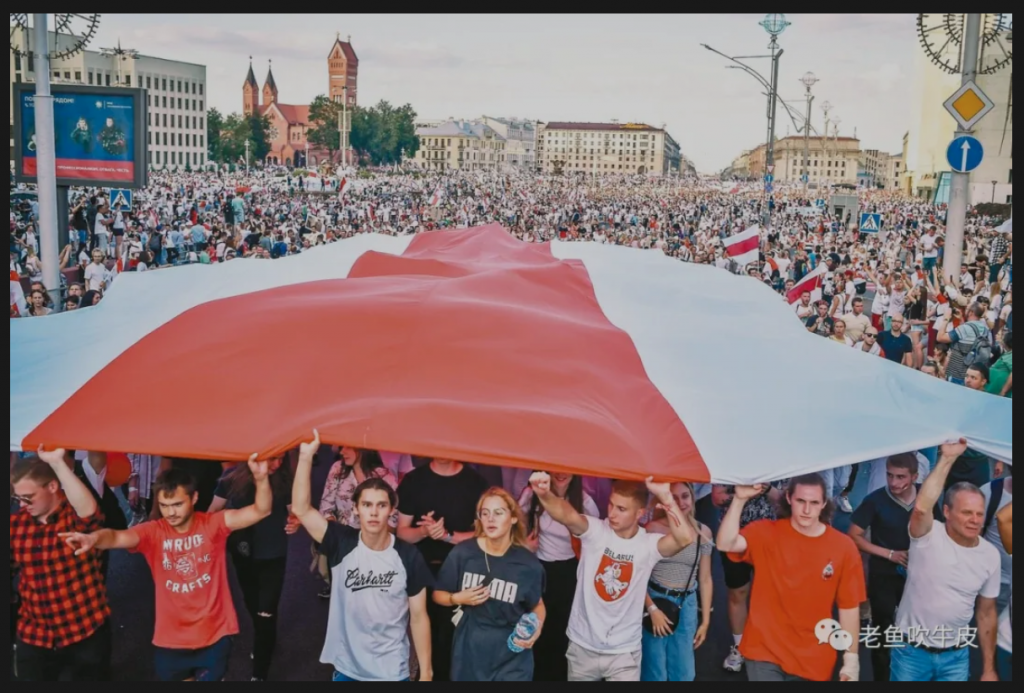
But an awkward picture has emerged as massive crowds have taken to the main square in Minsk, the capital of Belarus, to oppose Lukashenko, contrasting with sparse groups in support of the leader. The awkward picture looks essentially like this:
An image of a pro-Lukashenko rally, marked with arrows by the Chinese author, being dwarfed by opposition demonstrators who vastly outnumber them.
Some might wish to ask how I can tell from the image which are crowds opposing Lukashenko, and which are supporting him? Never fear, we will come back to this in time.
Even though the nation of Belarus is quite far from us [in China], our country’s media must of course report on such a major story when it unfolds. And so yesterday we had this news from a number of television stations.
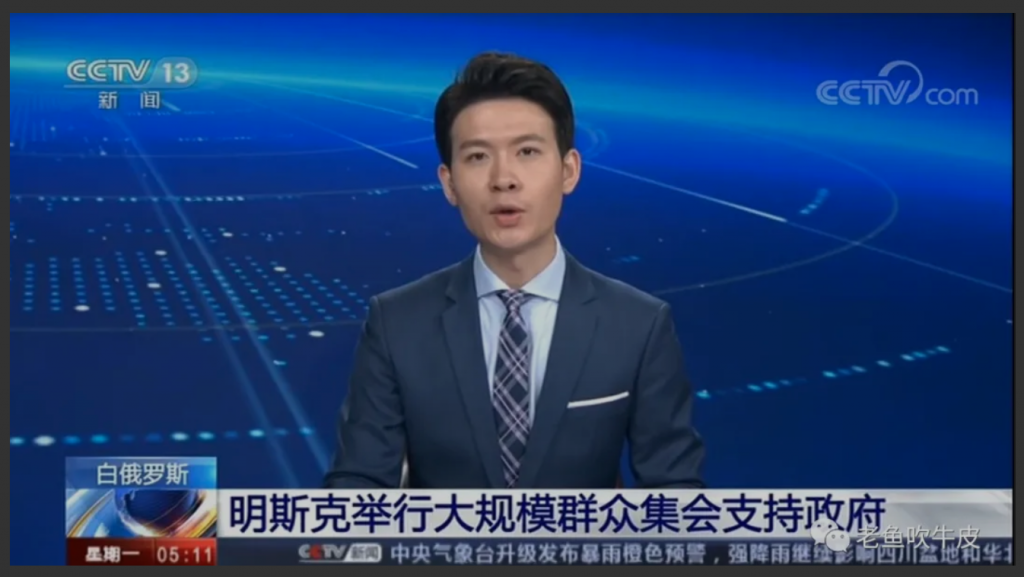
First, from China Central Television:
A broadcast on CCTV 13 reports that “huge street demonstrations are held in Minsk in support of the government.”
Hmm. Many people no doubt saw this. In fact, there is some truth to what CCTV says here. In fact there were street demonstrations in support of Lukashenko, though the idea of using “street demonstrations” to voice support for leaders is a somewhat strange concept.[CMP NOTE: What the author neglects to note, likely as a means of not obviously crossing the line with content monitors, is that CCTV is in fact misleading viewers by mentioning only demonstrations in support of the government. It is not technically untrue that there were such demonstrations, but anti-government rallies and their overwhelming size are a more sensitive matter in China.]
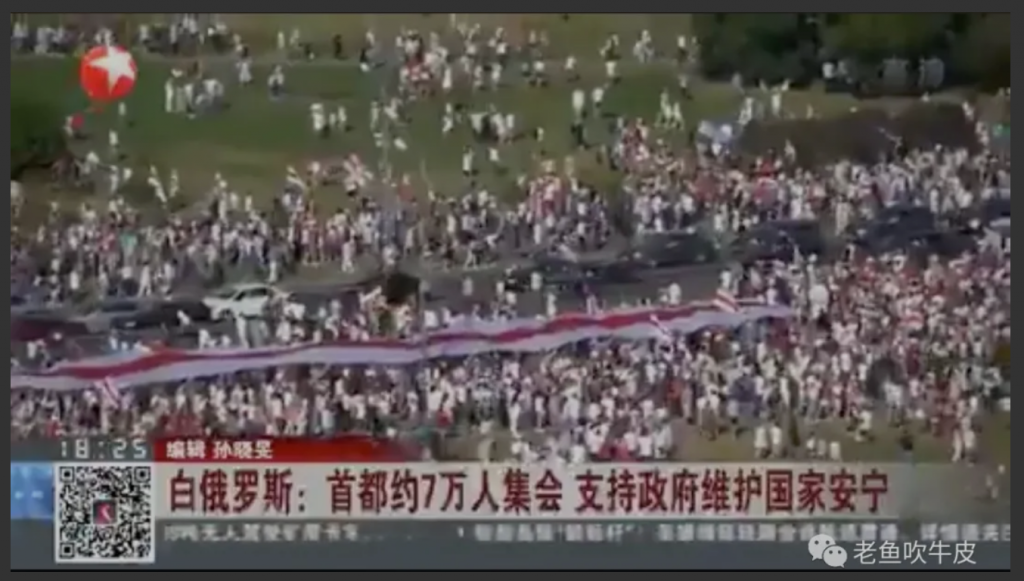
Next we have this image from [Shanghai’s] Dragon Television (东方卫视):
A report by Shanghai’s Dragon TV reads: “Belarus: Around 70,000 people gather in the capital to support the government and preserve peace and stability.”
Now this is interesting. The scenes following on the channel include a few close-up shots of groups of demonstrators, but anyone who understands a bit of Belarusian could easily detect the problem.
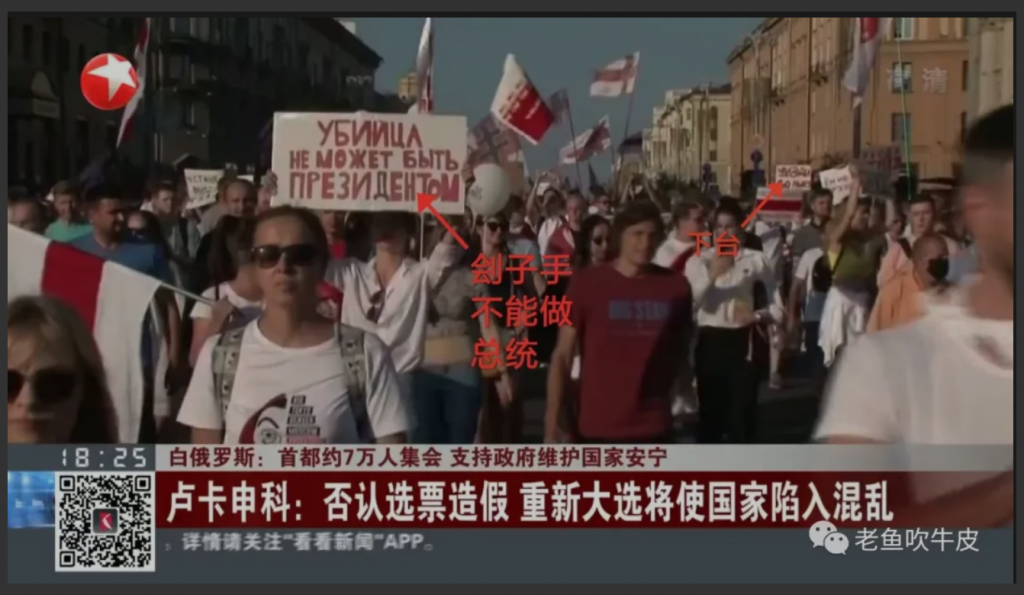
Footage of demonstrations shown on Shanghai’s Dragon TV as pro-Lukashenko include a sign that reads: “A murderer cannot be president.” In the back, labelled by the author, is another sign that reads: “Step down!”
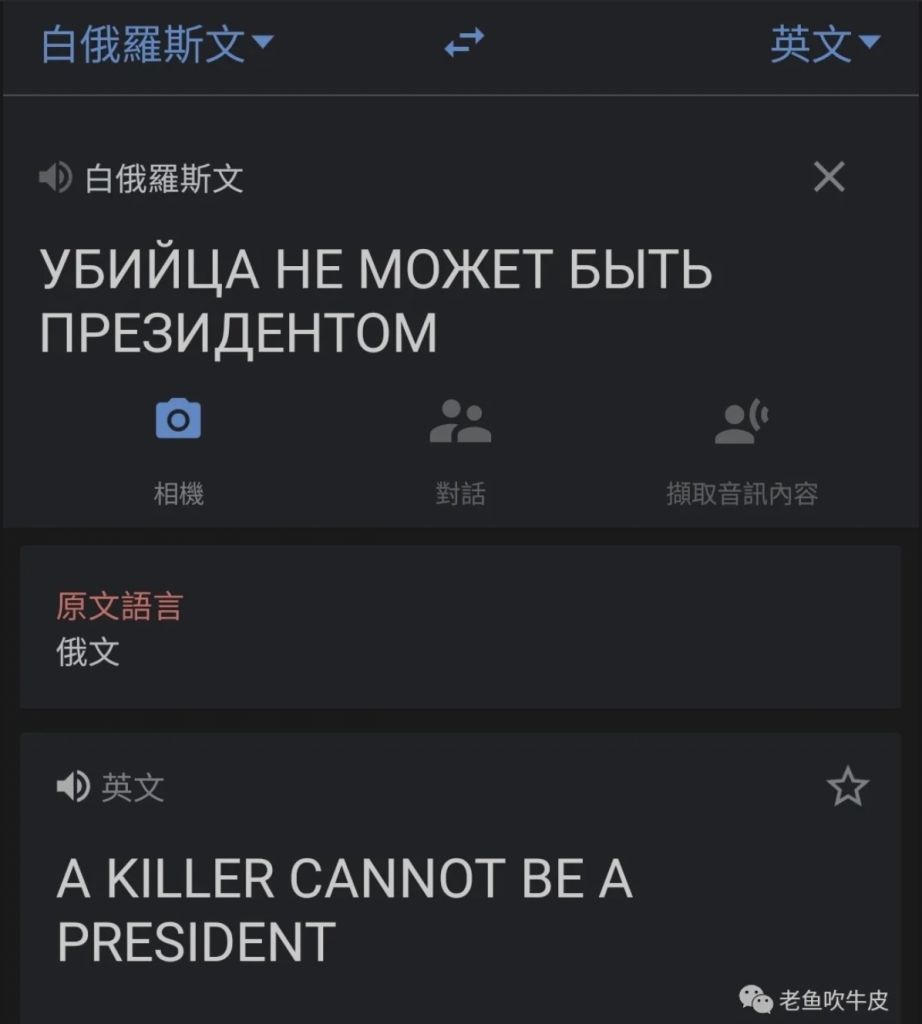
Are these [placards] not criticisms of Emperor Lukashenko? They refer to him as a “murderer.” And they call on him to step down. Mao Zedong once said that in this world, conscientiousness is to be feared. I have a good friend who went and checked [on these slogans] through translation software.
We can give thanks to the power of the internet:
Clearly then, this is a harsh criticism of him [Lukashenko].
SO, Dragon Television has taken footage of the opposition and made it out to be that of the crowd supporting Lukashenko. I would imagine that the editor here, an expert on international news, isn’t without knowledge of foreign languages – so he is certainly pulling the wool over the eyes of those of us who don’t understand Belarusian.
In fact, there is an even easier way to make out which are the Belarusian demonstrators opposing Lukashenko, and which are the ones supporting Lukashenko. And that is to look at the flags they are waving.
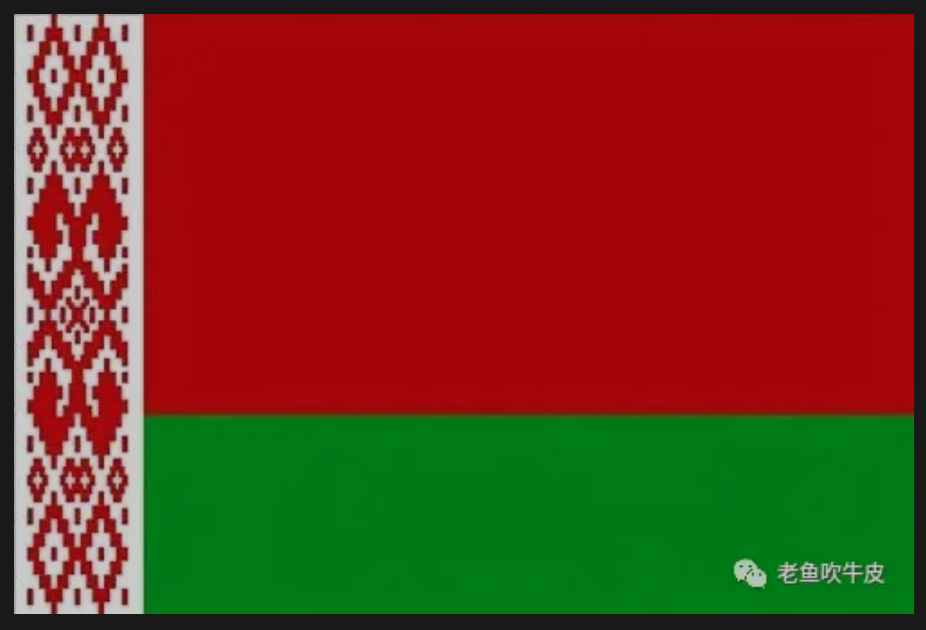
For example, those supporting Lukashenko wave this sort of flag:
This is the national flag of Belarus, with its classic pattern and bands of red and green. The flag was originally designed in this way to show that the Belarusians are descendants of nomadic Scythians, who later migrated to the Eastern European plains. [NOTE: Readers can find out more about Belarusian flags here].
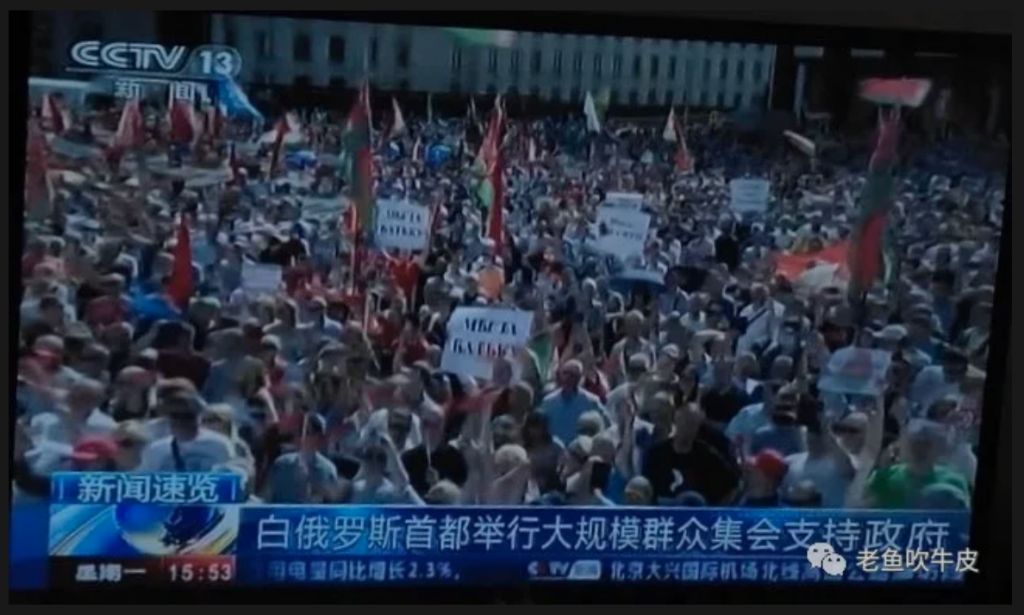
And so the footage shown on CCTV was also correct:
Screenshot shared by the author of coverage of Belarus on CCTV 13. The text in the crawler reads: “Large-scale demonstrations in support of the government held in Belarusian capital.”
The people in this image [from CCTV] are all hoisting the red-and-green flag, which is the current national flag of Belarus.
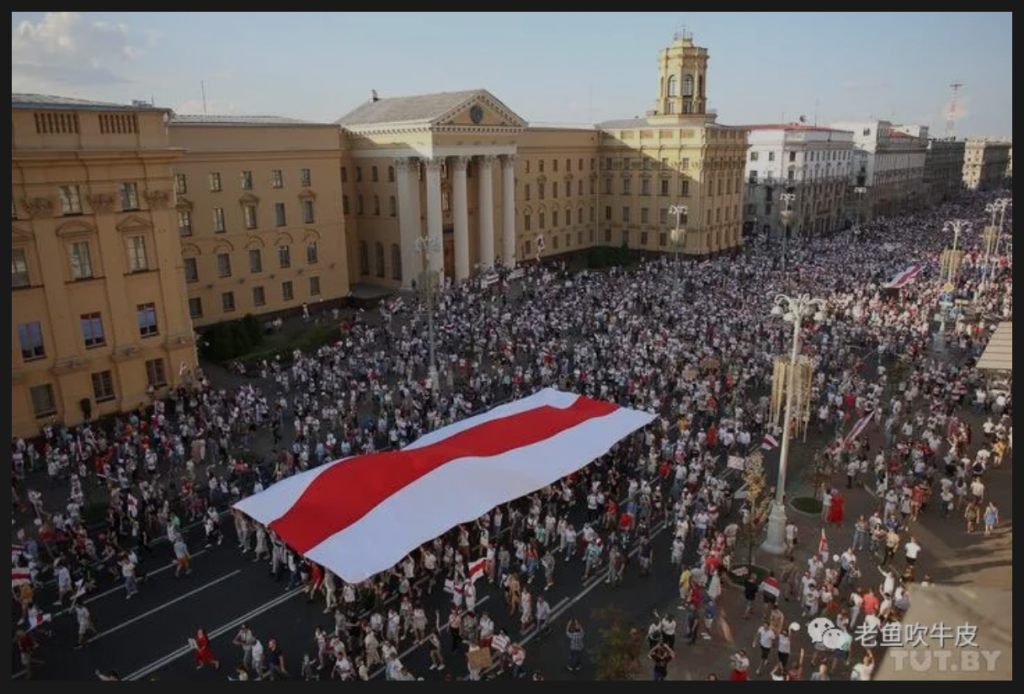
The opposition, however, are flying a flag with two white bands and one red, like this:
This is the flag of the short-lived Belarusian Democratic Republic of 1918 and the First World War. These colors derive from the historical Grand Duchy of Lithuania, mirroring the current national flag of Lithuania, which is also white and red – because Belarus was once part of the Grand Duchy of Lithuania.
After the Soviet Union collapsed in 1991, this flag was used for a short time by Belarus. The current national flag dates back to 1995, used only after Lukashenko became president. The opposition side uses this [white-red-white] flag to express its rejection of today’s leaders.
Therefore, from the images above, we can see that Dragon TV has things entirely turned around in its explanation of its footage. It just doesn’t match up [with the facts].
Oh, Dragon TV, you can support Lukashenko if you wish. But as a television station, when you make programs can you not at least show a bit of honesty? Don’t cheat those of us who can’t understand foreign languages. If you continue this way, people might mistakenly think that you are trying for underhanded criticism (高级黑).
Facing the current situation, Lukashenko has remained firm. He has said that the election is already a done deal, and [the opposition] cannot just refuse to accept it. There won’t be new elections “until you kill me,” he said.
The people of Belarus, it seems, are not to be cowed.
As the situation develops, he is now saying he would be prepared to entertain new elections and hand over power if there was a constitutional referendum.
In recent months,
as tensions have risen in Belarus in the run-up to the disputed re-election
victory of Alexander Lukashenko, amid opposition arrests and detentions, China’s
party-state media have consistently voiced support for the beleaguered Belarusian
president.
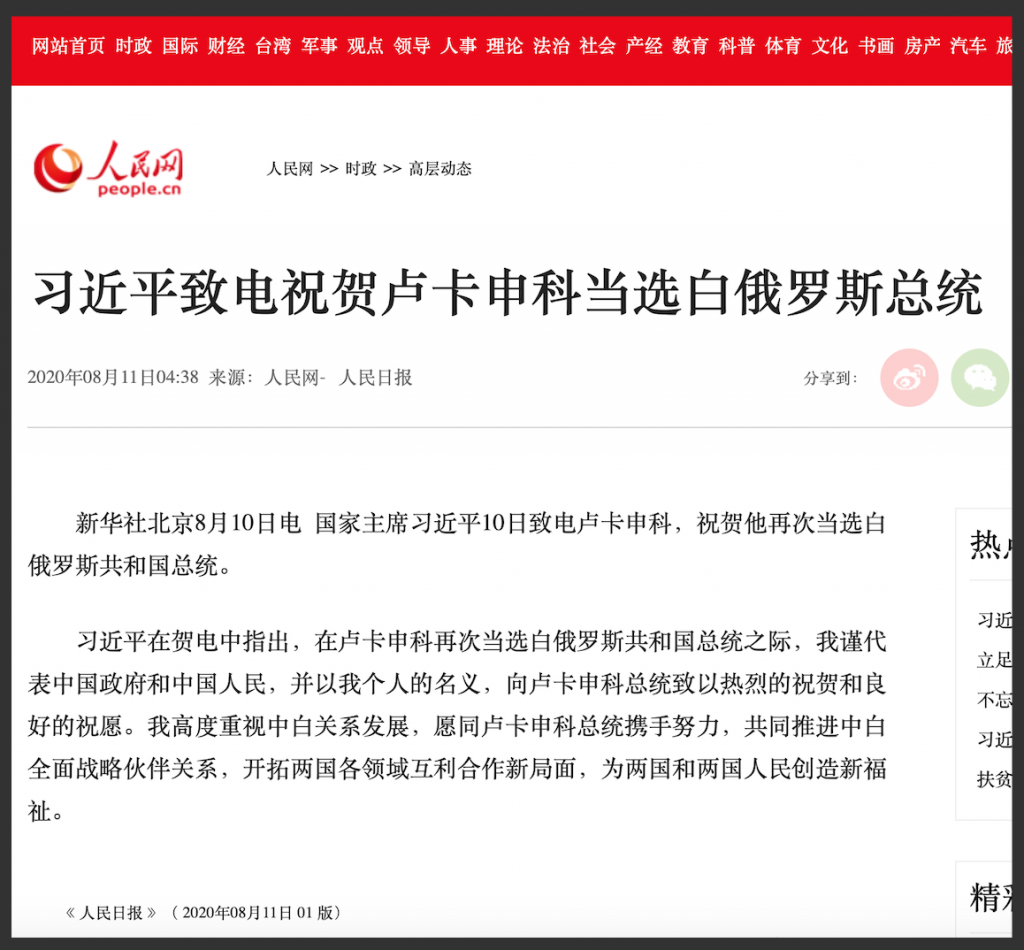
Back in June, the official Xinhua News Agency said Lukashenko and Xi Jinping had discussed deepening economic cooperation in a late night phone call, and that Xi had praised his counterpart’s handling of COVID-19, expressing his belief “that under Lukashenko’s strong leadership, the Belarusian people will be able to defeat the epidemic as soon as possible.” On August 10, as widespread protests erupted in Belarus amid allegations that Lukashenko’s landslide re-election was a naked power grab, Xinhua noted simply that Xi Jinping had sent Lukashenko a congratulatory message and that the two sides were ready to “jointly push forward [the] China-Belarus comprehensive strategic partnership.”
China’s official
support for Lukashenko, and its characterization of protests against the leader
as a source of unrest and chaos, becomes clear when you look at Xinhua’s
reporting of events in Belarus yesterday, August 16, against international
coverage.
As the BBC and other news outlets noted yesterday, a gathering in the Belarusian capital of Minsk to support Lukashenko, at which the leader addressed his supporters, was dwarfed by opposition protests, attended by an estimated 200,000 people who demanded Lukashenko’s resignation. In stark contrast to the anti-Lukashenko demonstrations, the gathering in support of the leader drew a “smaller crowd of several thousand,” according to the BBC. A Reuters reporter on the scene estimated the pro-Lukashenko crowed at “around 5,000 people,” while the Belarusian Interior Ministry, run by a Lukashenko appointee and ally, put the number at 65,000.
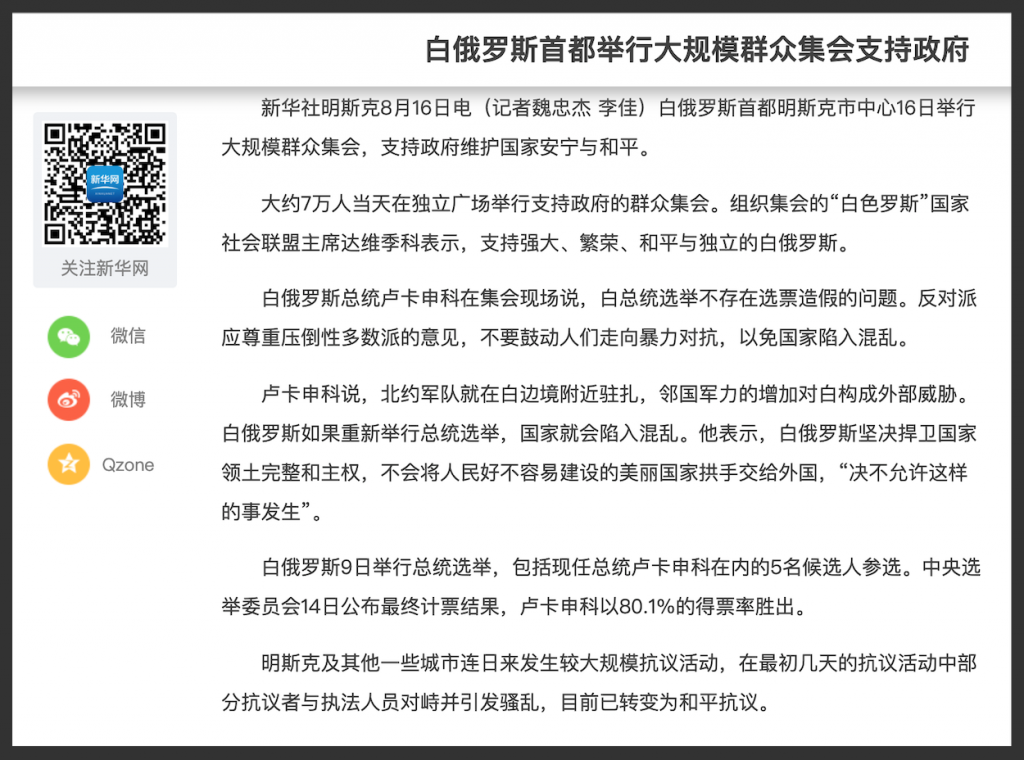
How have Chinese state media reported the story of the two rallies? Not surprisingly, readers are told only about one rally – that in support of Lukashenko. The headline today reads: “Large-scale rallies held in Belarusian capital to support the government.”
The following is a
translation of the Xinhua story. The name of the quoted chairman of the “Belarusian
National Social Union” is approximated, as reference to the pro-government
organization could not be found outside the Chinese language.
Xinhua News Agency,
Minsk, August 16 dispatch (reporters We Zhongjie and Li Jia) — Large-scale
demonstrations were held on August 16th in the Belarusian capital of Minsk,
supporting the government in preserving national tranquility and peace.
Around 70,000
people gathered in Independence Square that day in support of the government.
Davydiko [sp?], chairman of the “Belarusian National Social Union”
that organized the rally, said he supports a strong, prosperous, peaceful and
independent Belarus.
Belarusian President Lukashenko said at the rally that the ballots in the [recent] election had not been rigged. The opposition should respect the opinions of the overwhelming majority, and must not encourage people to move toward violent confrontation, lest the country fall into chaos.
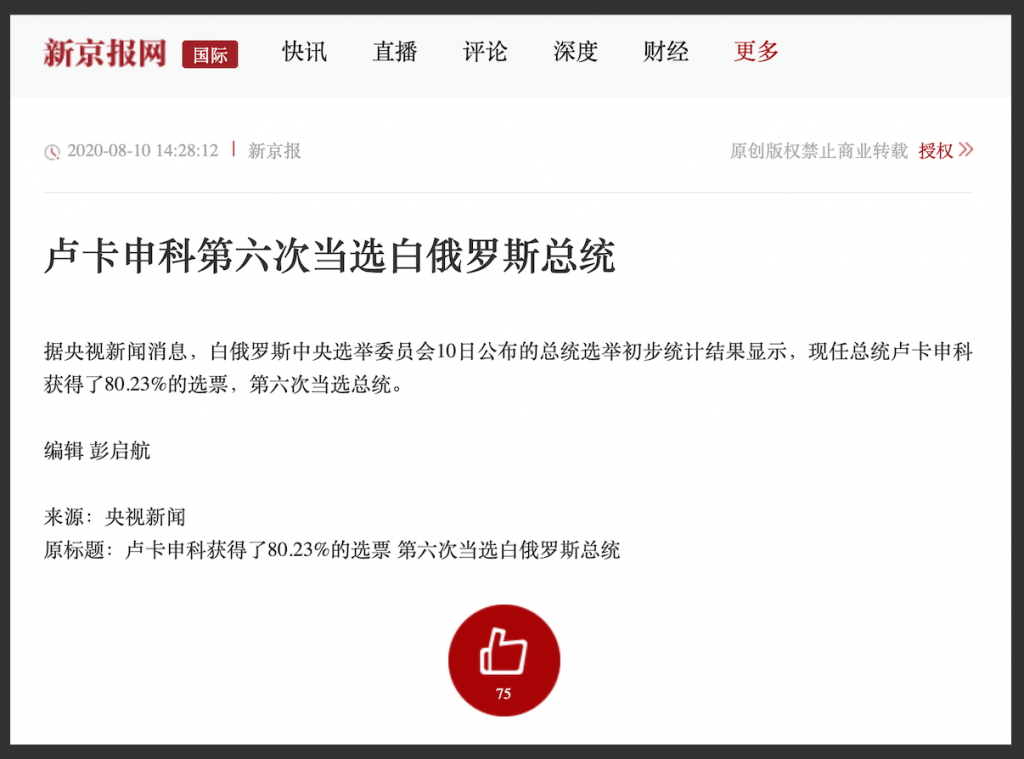
News of Lukashenko’s landslide victory in the August 10 election was reported without nuance or complicating facts in China’s party-state media. Here, for example, is a report from CCTV re-published by The Beijing News. It notes only Lukashenko’s victory, his sixth, and that he won 80.23% of the votes.
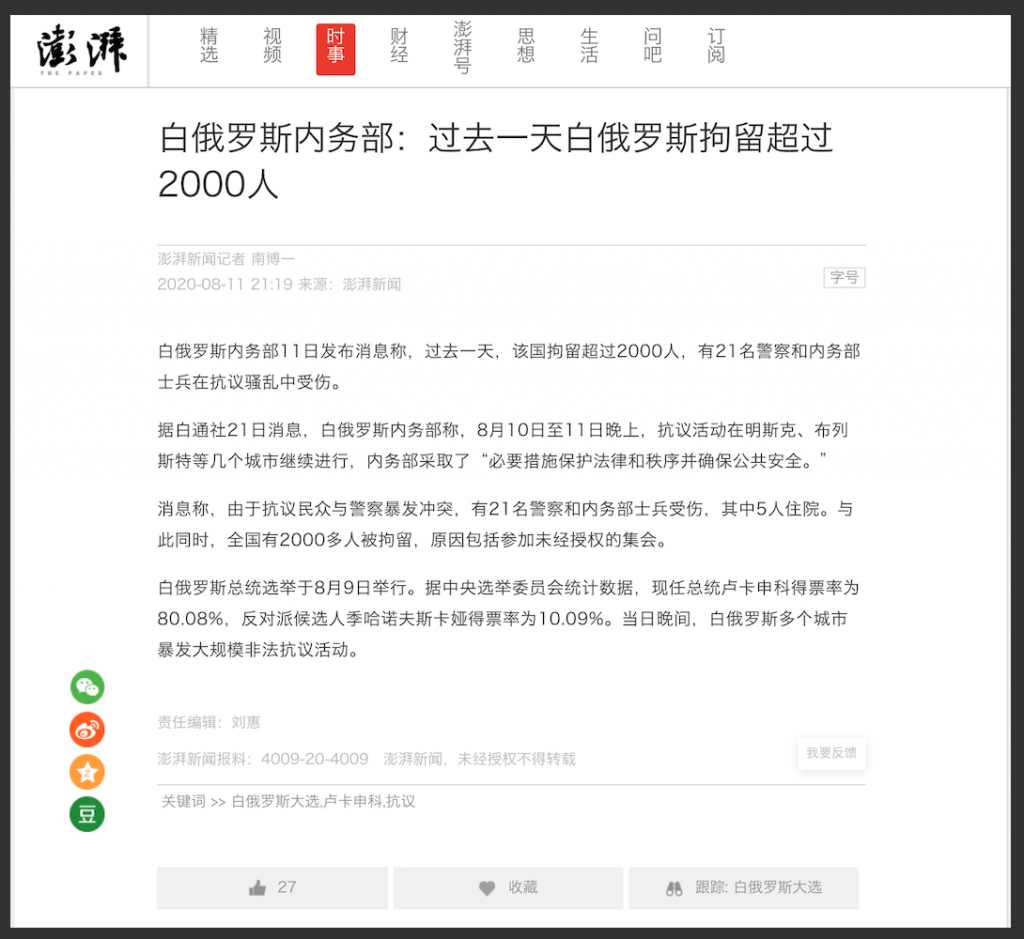
The Paper, a digital news site by the state-owned Shanghai United Media Group, ran a report on August 11, the day after the elections, whose sole source was the Belarusian Interior Ministry — the same government office claiming yesterday that the pro-Lukashenko rally had 65,000 supporters. The report said that authorities in Belarus had arrested more than 2,000 people in the midst of opposition events, and cited the Interior Ministry as saying it had taken “necessary measures to protect law and order and ensure public safety.” The report at The Paper repeated the election results, noting that Lukashenko had received 80.08% of the votes.
[Featured Image: Protests in Minsk on August 16, 2020, to oppose the August 10 election results. Image from Wikimedia Commons available under CC license.]
One of the privileges of being the “core” leader of the Chinese
Communist Party is that history can be rewritten to place you right at the center.
So it is this week with thinking on environmental policy in China.
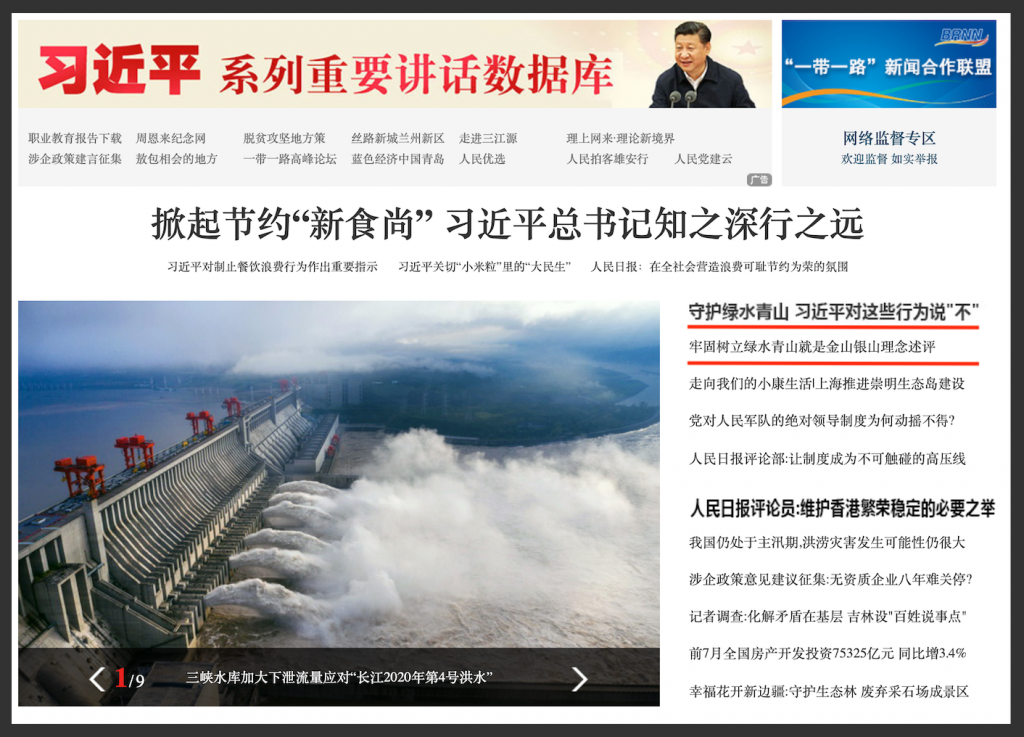
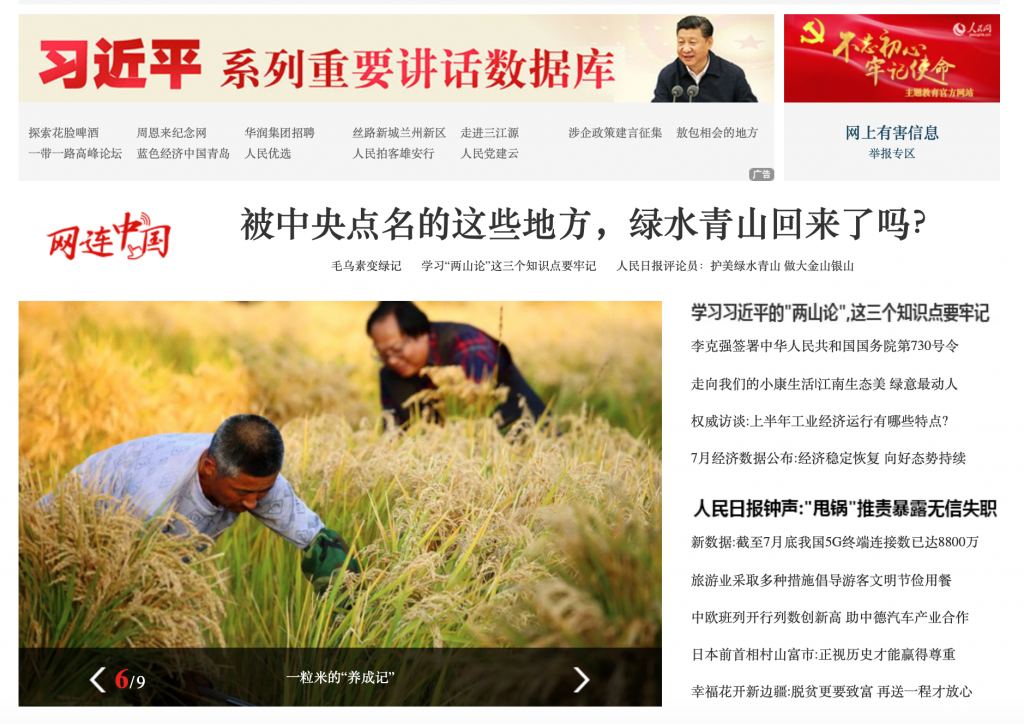
People’s Daily Online today features two articles on the so-called “two mountains theory,” or liangshanlun (两山论), the three-character phrase meant to stand for what elsewhere has been called “Xi Jinping Thought on Ecological Civilization” (习近平生态文明思想), essentially the top leader’s claim to China’s record on sustainable development.
But this is not really about sustainable development – or not primarily. It is, like so much in the “new era,” about elevating the power and personality of Xi Jinping. And that requires mythmaking, and a very creative view of history.
The phrase “two mountains theory” emerged, as CMP wrote back in June, from a longer phrase, rather repetitive and roundabout in English, that is traced to Xi’s September 7, 2013, speech at Nazarbayev University in Kazakhstan: “We want green waters and green mountains, but we also want gold mountains and silver mountains. It is better to have green waters and green mountains than gold mountains and silver mountains – and green waters and the green mountains are gold mountains and silver mountains.” This is Xi’s way of saying, with his usual fondness for metaphor, that while economic development is a priority, the environment cannot be sacrificed for the sake of growth.
According to the newly-minted creation myth of the “two mountains theory,” Xi Jinping actually hatched this idea about sustainable development 15 years ago during a visit to a village in rural Zhejiang. The date was August 15, 2005, which means that tomorrow party-state media will be loudly proclaiming the 15th anniversary of the “two mountains theory,” giving Xi Jinping bragging rights over the ideological underpinnings of two decades official environmental policy in China (just as he has had bragging rights too this week over the revolutionary idea that people shouldn’t waste food).
One of the abovementioned articles at People’s Daily Online today – a propaganda piece that apparently took four reporters to write – credits Xi Jinping with the “two mountains theory,” which subsequently became the consensus, and then action, and then “had a profound and long-standing impact.” But as CMP has shown, the idea is not Xi’s, not by a long shot. A look through the media archives shows that very similar phrasing was used as early as 1995, well back into the Jiang Zemin era. And almost identical phrasing was used in the People’s Daily newspaper on October 24, 2003, uttered by then director of the Ministry of Environmental Protection (MEP), Xie Zhenhua (解振华).
The “two mountains theory” is not Xi’s theory at all. This much is clear from the Party’s own press history. But in the effort to consolidate the power of the “core,” legacies can ride roughshod over histories — and anniversaries be celebrated for moments that never were.
And People’s Daily Online has topped the headlines with the anniversary too.
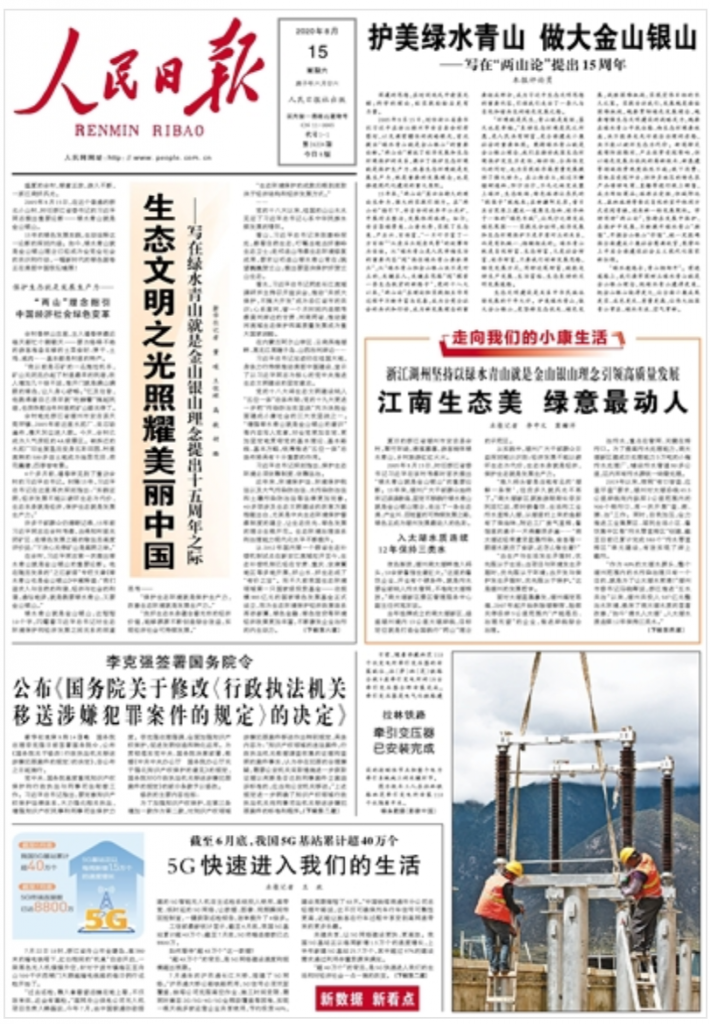
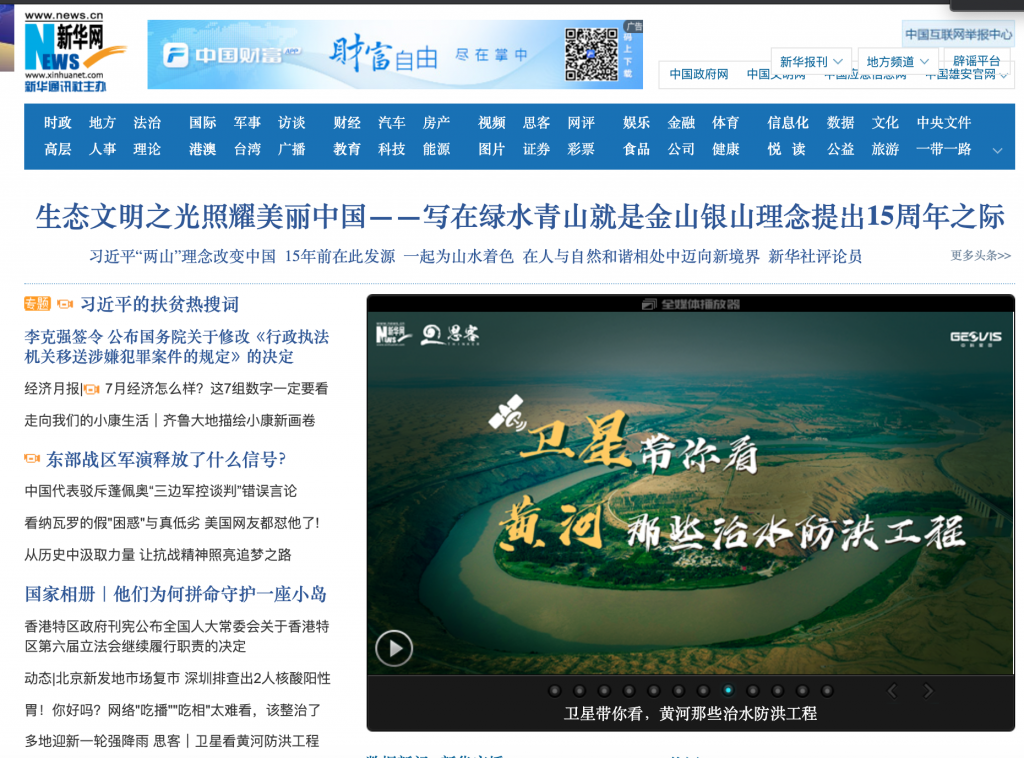
Xinhua News Agency? Naturally. Its top story, it says, is “written on the occasion of the 15th anniversary of the mention of the gold mountain, silver mountain concept” (写在绿水青山就是金山银山理念提出15周年之际).
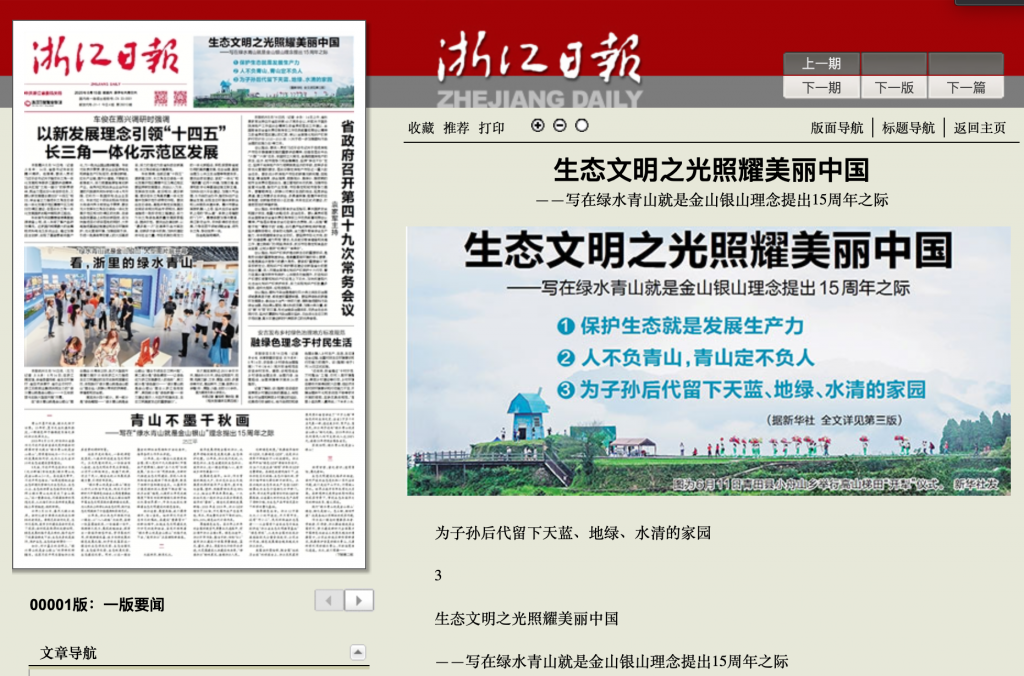
And here is Zhejiang Daily, the CCP mouthpiece in Zhejiang province, where Xi is reputed to have invented the concept. The “anniversary” is the top piece right next to the masthead.
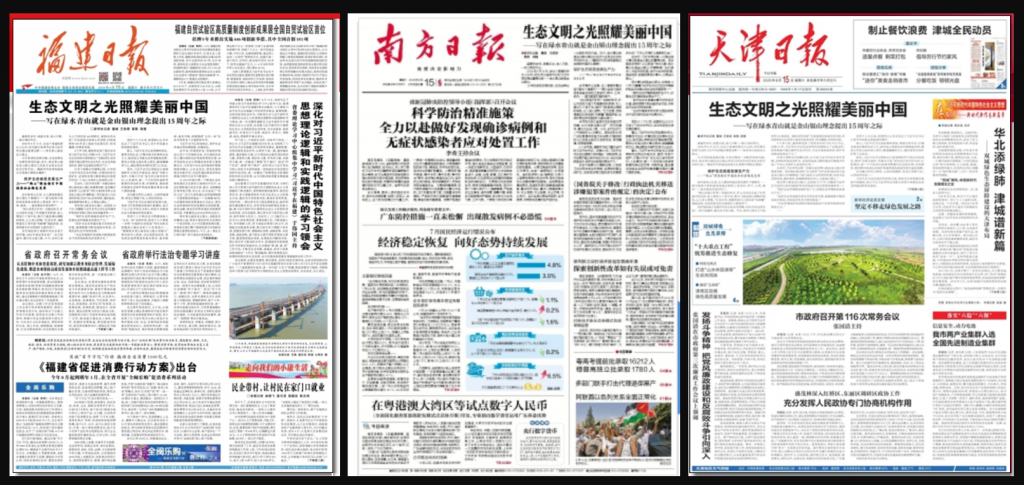
All provincial and city newspapers seem to be running the same exact piece on the front page today, helping to build the historical legacy in reverse.
In early March, as countries across the world rushed to respond to the COVID-19 pandemic, Xi Jinping made an official tour of the city of Wuhan to declare China’s decisive victory over the virus. Since that time, Chinese state media have strongly pushed this narrative of victory, even suggesting that evident successes in fighting the disease point to the clear “superiority of China’s system.” This push in the media at home has been coupled with a strong campaign of external propaganda and misinformation.
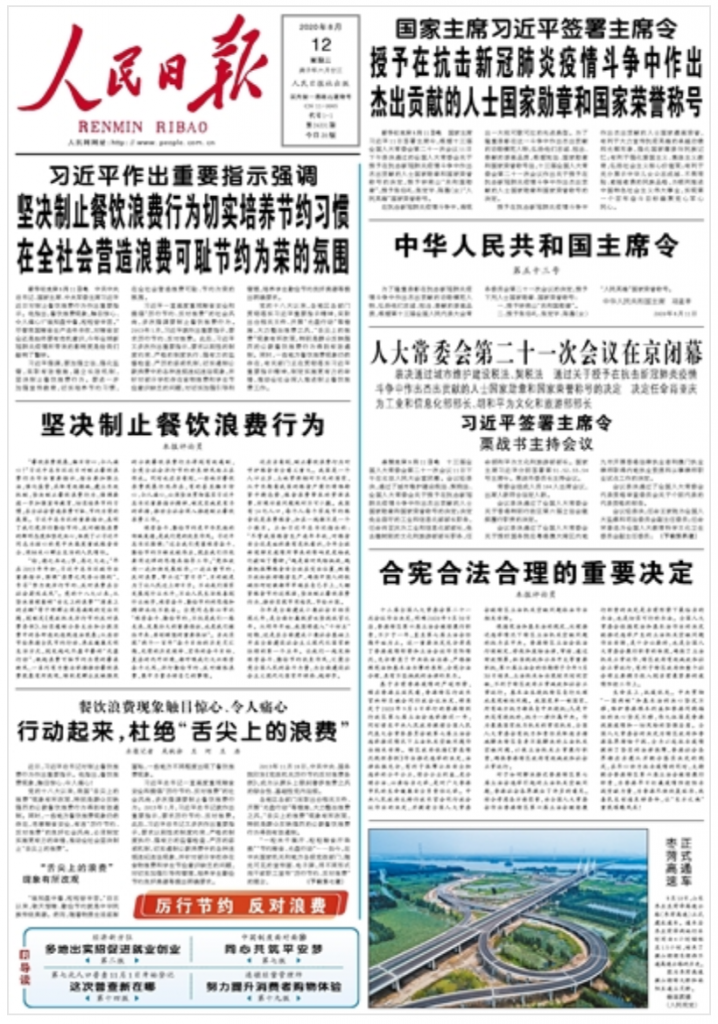
COVID-19 continues to be a propaganda boon at home for the Chinese Communist Party, particularly in light of the poor response in the US and other countries. Today the top story on the front page of today’s official People’s Daily is the news that Xi Jinping has signed a “presidential decree” (主席令) awarding Dr. Zhong Nanshan (钟南山) with the “Order of the Republic,” and honoring physician Zhang Boli (张伯礼), Hubei health official Zhang Dingyu (张定宇) and epidemiologist Chen Wei (陈薇) as “people’s heroes” for their efforts to fight COVID-19.
According to the Peoples’ Daily article: “In the midst of the struggle against COVID-19, a great number of advanced models emerged who are worthy of songs and tears.” Honors were being given, it said, “in order to commend the exemplary figures who made outstanding contributions in the struggle,” and to “vigorously promote the outstanding achievements and glorious image of [China’s] anti-epidemic heroes.”
The honors, the paper said, would be “beneficial to the strengthening of patriotism,” would encourage “education in the collective spirit” (集体主义教育), and would “promote socialist core values.”
Dr. Zhong, who became a globally recognized figure in 2003 as he spoke out openly on the seriousness of the SARS outbreak, prompting a stronger government approach, has been a key figure this year in the leadership’s response to COVID-19. He stepped out in late January to become the public face of the official response, seeking to ease public nerves about the crisis. Against clear evidence of early attempts to restrain the release of information about the disease in Wuhan, Zhong insisted in January that the government had been “transparent” in its response.
Zhang Boli, currently president
of the Tianjin University of Traditional Chinese Medicine, was a member of the “Central
Guidance Team” sent to the city of Wuhan on January 27, shortly after Xi
Jinping signalled a national response to the epidemic. He has since been an outspoken
advocate of the efficacy of traditional Chinese medicine (TCM) in fighting
COVID-19.
Zhang Dingyu is the president of
Wuhan’s Jinyintan Hospital and one of the most senior health officials in Hubei
province, the origin of the outbreak. In repeated interviews with Chinese state
media, Zhang insisted – despite the well-documented fact that there were weeks
of delay during which political meetings in Wuhan and Hubei went forward
without dealing with the question of the outbreak – that there had not been a cover-up
in the epidemic’s early stages. Rather, he said, it had been a “process
of understanding the disease.”
Chen Wei is a researcher at the Academy of Military Medical Sciences. She is a key member of the team at the academy’s Institute of Biotechnology that in March this year registered an experimental COVID-19 vaccine for initial trials. State media reported in May that the vaccine trials showed “promising results.”
[Featured Image: Doctor Zhong Nanshan, honored by Chinese leader Xi Jinping this week with the “Order of the Republic” for his role in leading China’s efforts to contain COVID-19. Image from Wikimedia Commons available under CC license.]
We use cookies and similar technologies to improve your experience on our website.
Read our Privacy Policy.