China’s Ministry of Foreign Affairs today announced what it called “countermeasures” against actions by the Trump administration last month to designate five state-run Chinese media organizations in the United States as “foreign missions.” The measures announced by MOFA, which could seriously escalate tensions between the two countries, make clear that reporters in China for the New York Times, the Wall Street Journal and the Washington Post will no longer be permitted to work in China after March 22.
The measures also specify that “the China-based branches of Voice of America, the New York Times, the Wall Street Journal, the Washington Post and Time declare in written form information about their staff, finance, operation and real estate in China.” It is not clear exactly what such declarations would mean. Also unclear is the full import of language in the announcement specifying the the expelled reporters from the New York Times, the Wall Street Journal and the Washington Post will not be permitted to work as journalists for these media in Hong Kong and Macau.
So far there are few responses or other coverage in the Chinese media. The Global Times, however, posted a report including interviews with two Chinese experts at 2:06AM, suggesting the paper had prepared the report in advance of the MOFA announcement.
A partial translation of the Global Times piece follows.
_______________
“Friendship cannot stand always on one side.” Shen Yi, an assistant professor in the School of International Relations and Public Affairs at Fudan University, told the Global Times in an interview that the measures taken this time by Chinese side toward American media were entirely reciprocal in terms of the number of media affected and the concrete measures taken. This shows that in relations between nations, while it is important to maintain a friendly attitude, friendship must be built on a foundation of reciprocity, not on one-sided forbearance. “If the United States makes things such that it is impossible to play according to the normal rules of the game, then China will also in the future play according to the new rules of the game set by the United States.”
Shen Yi also said that compared to past Chinese responses, this response shows greater confidence on China’s part, and shows greater bluntness and directness. “This tells us that US-China relations have already entered a new phase: China will no longer accept compromise. If the United States is willing to move in the opposite direction, this would be good, but if the United States obstructs China, it will certainly fight back.”
Li Haidong (李海东), a professor at the Institute for International Relations at China Foreign Affairs University, said to the Global Times that China’s response does not seek to make new trouble, but rather hopes through these actions to warn the United States that its own actions are inappropriate, and to press the US to make amends. Only in this way can media dialogue between China and United States be smooth and normal. “This move is also a reminder to the United States that US-China exchanges cannot be made ideological, and cannot be viewed and handled with Cold War thinking.”
He said at the same time that this matter would not obstruct China’s opening to the world, including its opening toward the US. The space for US-China exchanges still exists, and in fact is extremely broad. The two sides should do everything in their power to create conditions, strengthen communication and promote cooperation.
China’s headlines are full of triumph
today. The country’s pending victory in the war against the coronavirus
epidemic, they say, is a testament to the decisive leadership of Xi Jinping and
the Chinese Communist Party, and to the strength and unity of the people. Xi’s
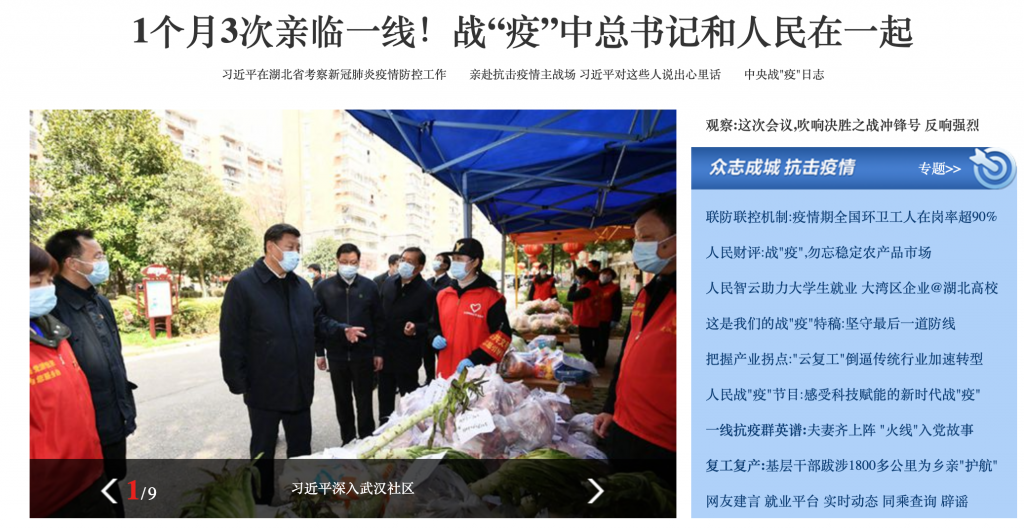
presence in Wuhan yesterday, his first
visit to the center of the epidemic, was reportedly met with euphoria. The
piece at the top of the official People’s Daily, which chronicles Xi’s
tour through a residential community, finishes emotively:
As he left the community, the voices echoed for a long time in the spring sun: “Greetings, General Secretary!” “Go China!” “Go Wuhan!”
A report
featured at the top of the newspaper’s website elevates Xi with the word “leader,”
or lingxiu (领袖), an appellation dredged
up from the shadows of China’s Maoist past: “The Party and the people are
as one, the leader’s heart touches the hearts of the people.”
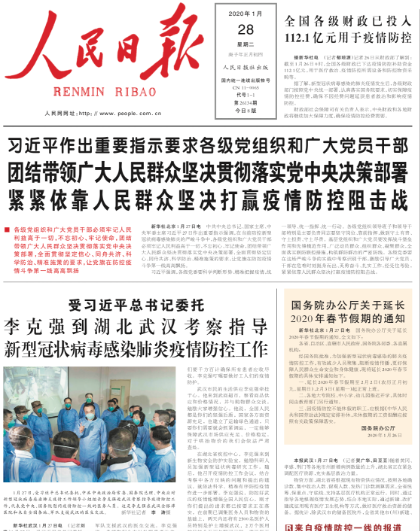
People’s Daily Online today. The top headline: “In 1 Month 3 Visits to the Frontlines! The General Secretary is With the People in the War Against the ‘Epidemic.'”
But beneath this towering wave of
propaganda and positivity, another war has unfolded—a guerrilla war for greater
openness, honesty and reflection about the tragic events of the past two
months.
As Xi Jinping toured through Wuhan yesterday, a bombshell feature story by reporter Gong Jingqi (龚菁琦) in the latest edition of China’s People (人物) magazine made the rounds on social media. The story was based on an interview with Ai Fen, the director of the emergency department at Wuhan Central Hospital, one of the hospitals most directly affected by the epidemic in the provincial capital.
In her account Ai talks about her decision on December 30 last year to share with another health professional an image of a diagnostic report for a patient showing that they had “SARS coronavirus.” It was this image, passed between doctors in Wuhan, that resulted in eight doctors, including the now-deceased Li Wenliang, enduring harsh reprimands from local police. At the time, Ai was herself called in by the Disciplinary Office of her hospital and accused of “manufacturing rumors.”
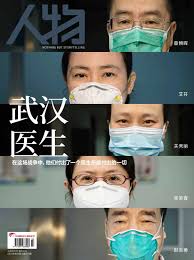
The cover of the most recent edition of People magazine, the main story on “The Doctors of Wuhan.”
Ai shares her sense of regret now that
she did not choose to speak up loudly and repeatedly, most of all for the sake
of her colleagues, several of whom have now died as a result of the virus.
The Gong Jingqi piece is one of the strongest to appear to date in the Chinese media, and it paints a damning picture of how the signs were wilfully ignored by officials at the start of the outbreak, when more might have been done. During her reprimand, Ai Fen is told by the hospital disciplinary official: “When we go out to take part in meetings we can’t even raise our heads. This or that director criticizes us and talks about how our hospital has that Ai Fen. As the head of the emergency unit at Wuhan Central Hospital you are a professional. How can you go and stir up a rumor like this without reason, without any organizational discipline?”
The story was called, “The One Who Handed Out the Whistles,” a reference to Ai Fen’s insistence in her interview that she is not a “whistleblower,” but that her sharing of the original diagnostic report had enabled others, including Li Wenliang, to blow the whistle.
But of course the publication of Gong’s piece was just the beginning of its own story. The article was shared feverishly on social media, and just as feverishly expunged by the authorities. For such a report to circulate on the day of Xi Jinping’s “front-line” visit to Wuhan was of course unacceptable.
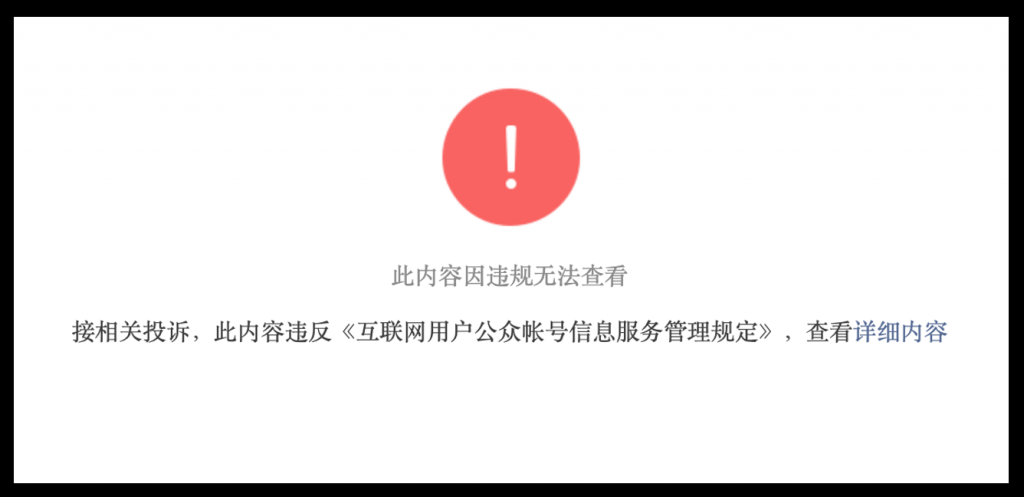
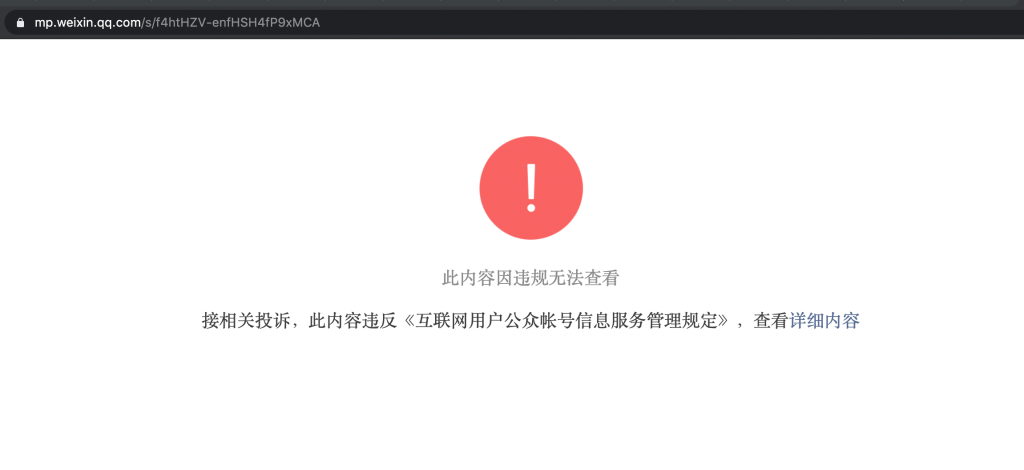
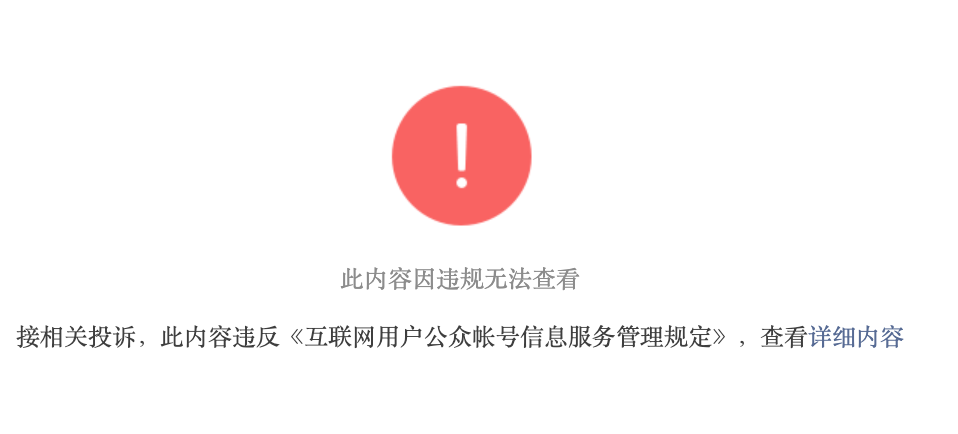
A notice on WeChat announces that a post on the People magazine feature story has been removed.
The authorities pushed. And Chinese
pushed back on social media, with a level of creative defiance that was all at
once ingenious, mystifying, heartening and sad. For reference, here is the
opening paragraph of the story, translated with the original Chinese.
It was at 5AM on March 1 that I received a text message from Ai Fen, the director of the emergency department of Wuhan Central Hospital, agreeing to an interview. About half an hour later, at 5:32AM on March 1, her colleague Jiang Xueqing, director of the Breast and Thyroid Center, passed away, having contracted Covid-19. Two days later came the death of Mei Zhongming, her hospital’s deputy director of ophthalmology. He and Li Wenliang had been in the same department.
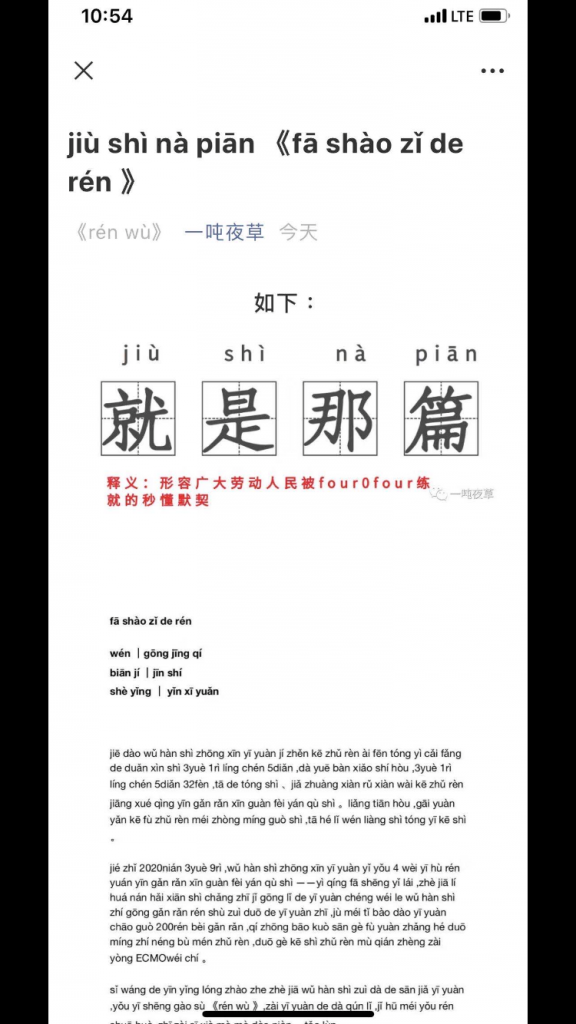
And here is one attempt a user made to
share Gong Jingqi’s story as the original versions were being taken down one after
the other. The top of the post reads: “That piece, ‘The One Who Handed Out the
Whistles.’” But this is not in Chinese characters, readable by automated filters.
Rather, it is in pinyin, a Chinese romanization system, with tonal marks over
the words.
In this form, Gong’s article is of course still readable. A method like this may work for a period of time before censors grow wise and remove it, often when it is seen to attract a critical mass of attention.
And when this fails? What then? How do
you share “that piece,” the one everyone is talking about, the one that makes a farce of state
propaganda?
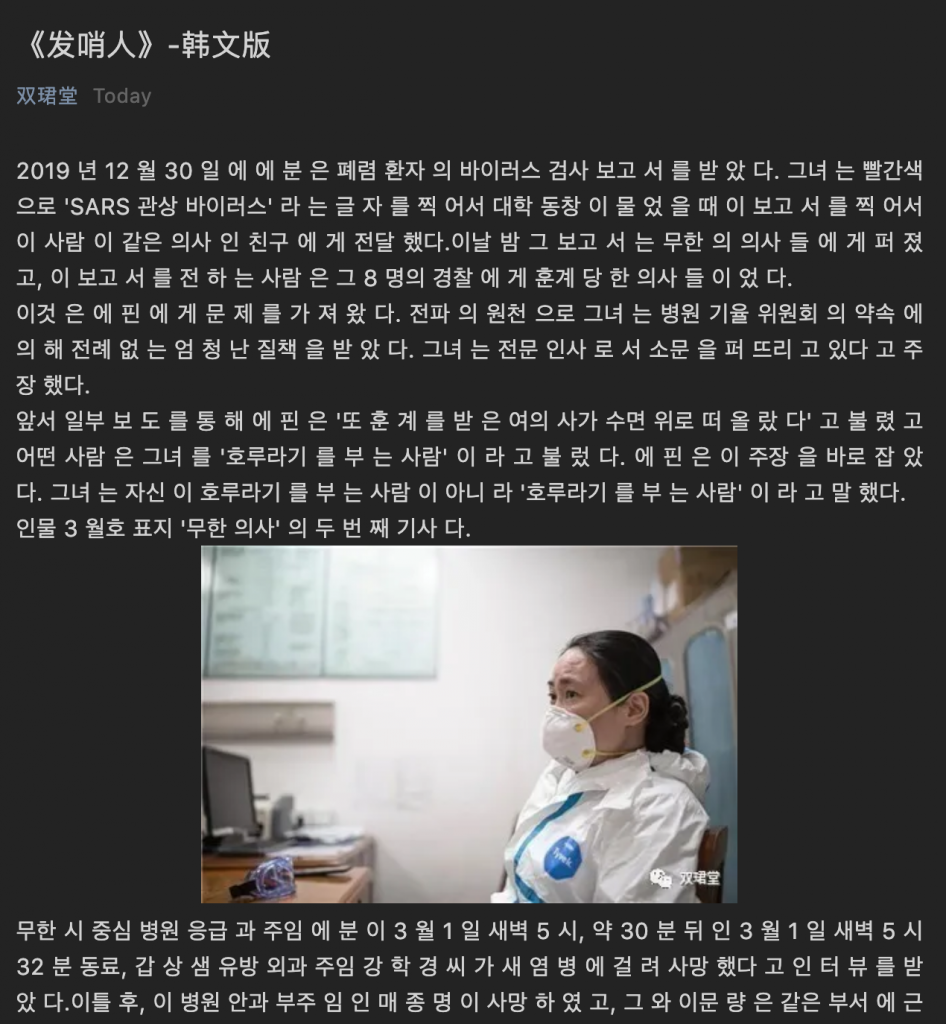
Another internet user answered this challenge by posting the entire article in Korean, a language not recognized or prioritized by online censors. The story could then be copied by readers and put through a translation engine.
Gong Jingqi’s feature story is shared in Korean to evade censorship.
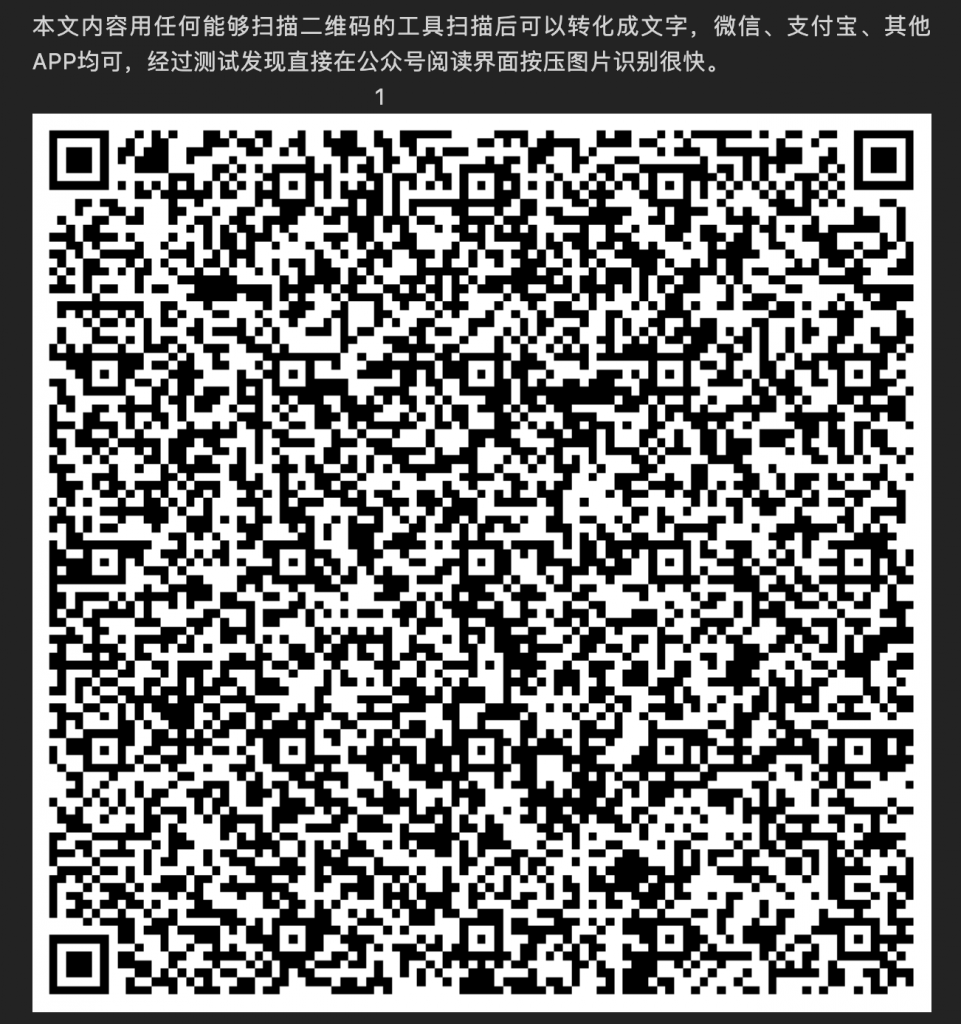
If Korean fails, the article can also be shared paragraph by paragraph through a series of QR codes. Try scanning this and you should see the story’s lede.
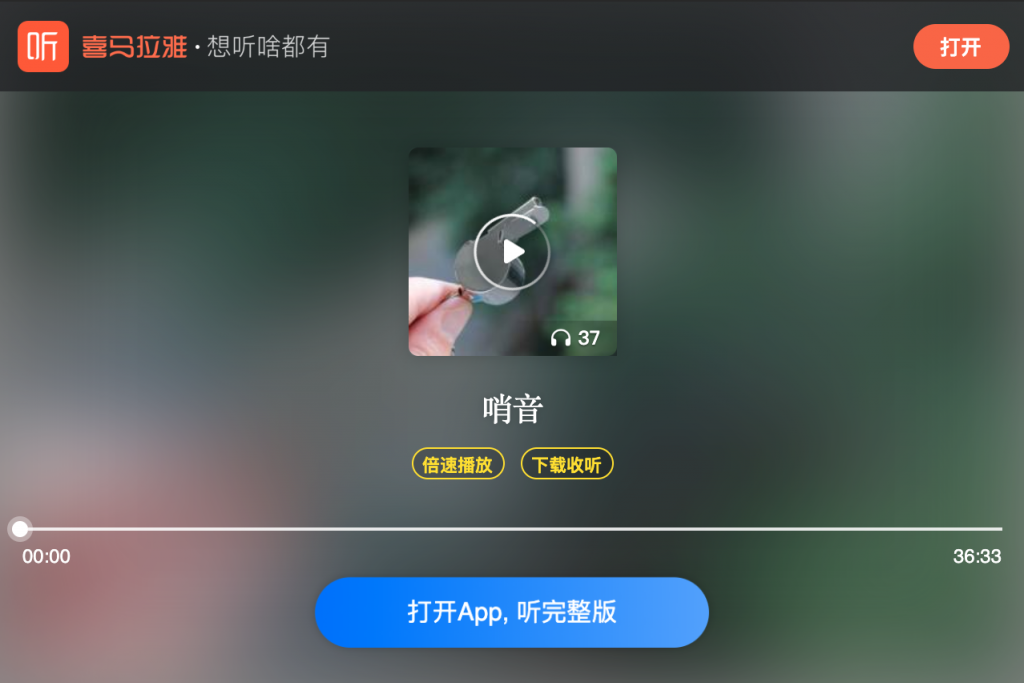
Still another reader chose to share and preserve this important story by reading it aloud in its entirely and recording it, then posting it to the audio site Ximalaya. He prefaces the piece by saying simply: “In this way I’ll voice my views and record history.”
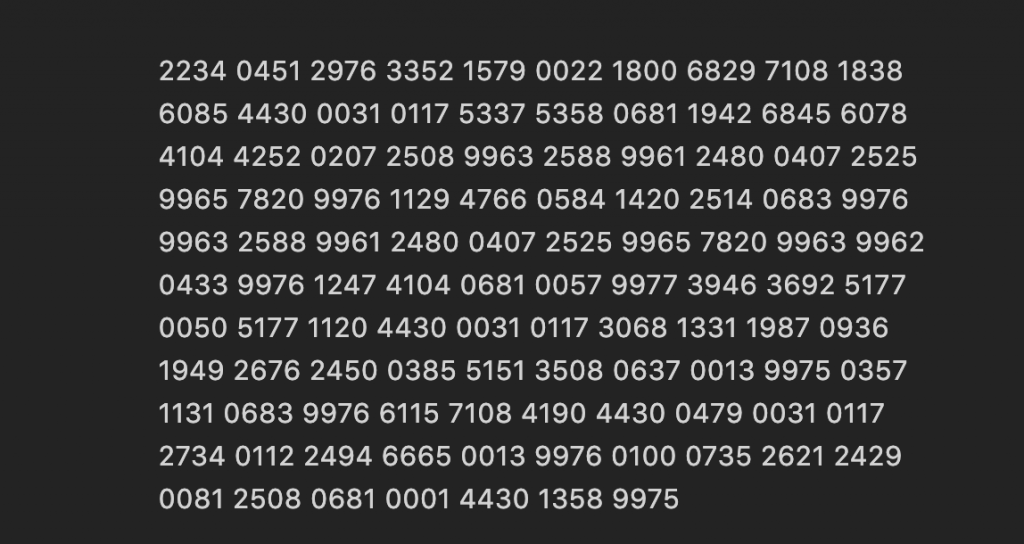
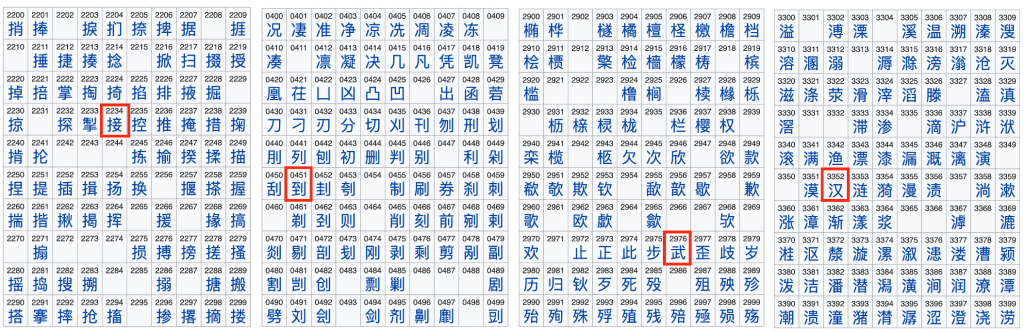
But the prize for creativity goes perhaps to a WeChat post that reached back into the history of communication to find new inspiration. The post explains to readers what a telegram is, and its history in China, in which unique four-digit numbers were assigned to Chinese characters (list here), which could then be decrypted. The post follows with a long list of four-digit numbers:
What does this say when you decode it? The
first four sets of characters spell out the beginning of Gong Jingqi’s story as
provided above. Here are the codes highlighted with their corresponding Chinese
characters.
This is just a taste of the ingenious workarounds that appeared this morning, and which still continue. Taken together they mark a determination not to be silenced, not to allow the truth to be swept away on Xi Jinping’s tide of “positive energy.”
A very brief portion of the People
feature story is translated below, followed by the Chinese original in its
entirety.
______________
It was at 5AM on March 1 that I received
a text message from Ai Fen, the director of the emergency department of Wuhan
Central Hospital, agreeing to an interview. About half an hour later, at 5:32AM
on March 1, her colleague Jiang Xueqing, director of the Breast and Thyroid
Center, passed away, having contracted Covid-19. Two days later came the death
of Mei Zhongming, her hospital’s deputy director of ophthalmology. He and Li
Wenliang had been in the same department.
As of March 9, 2020, four medical staff
at the Wuhan Central Hospital had died of Covid-19. Since the coronavirus
outbreak, this hospital, located just a few kilometers away from the Huanan
Seafood Market, has become one of the hospitals in Wuhan with the largest
number of medical staff to become infected by the virus. According to media
reports, more than 200 people from the hospital have been infected, including
three deputy hospital directors and multiple directors of various departments.
Many department directors are currently undergoing ECMO treatment [for acute
lung failure].
The shadow of death hangs over this, the
largest of Wuhan’s three primary hospitals. One doctor tells People that almost
no one among the medical staff speaks. They only mourn quietly and discuss
privately.
There was at the start an opportunity to
avoid this tragedy. On December 30, 2019, Ai Fen received a diagnostic report
from a patient with an unknown form of pneumonia, and she drew a red circle
around the words “SARS coronavirus.” When she was asked about the
case by a college classmate, she took a photograph of the report and sent it to
the fellow doctor. That night, this report made its way among doctors in Wuhan,
and among those to share the report were the 8 doctors later taken in for
questioning by the police.
This created problems for Ai Fen. As the
source of the communication, she was called in for a chat with the Disciplinary
Office of the hospital and received a “harsh and unprecedented
reprimand,” told that she was manufacturing rumors as a professional.
On the afternoon of March 2, Ai Fen was
interviewed by People at the Wuhan Central Hospital wing on Nanjing Road. She
sat on her own in the emergency room office, and the emergency room that had
over the past day received more than 1,500 [coronavirus] patients had now
become quiet, with just a single vagrant loitering in the waiting room.
A number of previous reports have said,
referring to Ai Fen, that “another female doctor who was questioned has
surfaced.” And some have called her a “whistleblower.” Ai Fen
corrects these accounts, insisting that she is not a whistleblower — rather,
she is the “one who handed out the whistles.” In her interview, Ai
Fen used the word “regret” many times. She regrets that after she was
reprimanded that first time she did not continue to blow the whistle,
especially for those colleagues who have already passed on. “Had I known
this day would come, I would have cared nothing for their criticism, but would
have spoken up wherever I could, right?”
CMP reported yesterday on the firestorm that ensued online in
China as news circulated that Wuhan’s top official, Wang Zhonglin (王忠林), said during an internal meeting
that the city needed to “carry out gratitude education among the citizens of
the whole city” so that they thank Xi Jinping and the Communist Party of China
for the response to the coronavirus epidemic.
Internal directives from press control officials now suggest this
has been a full-blown public opinion crisis for the Party, and that the wound
was self-inflicted. Media have been ordered not to share the original article,
publish commentaries, or otherwise address the issue at all. The report on Wang’s
remarks by Wuhan’s official Changjiang Daily has been withdrawn, but remains
available online
from certain sources.
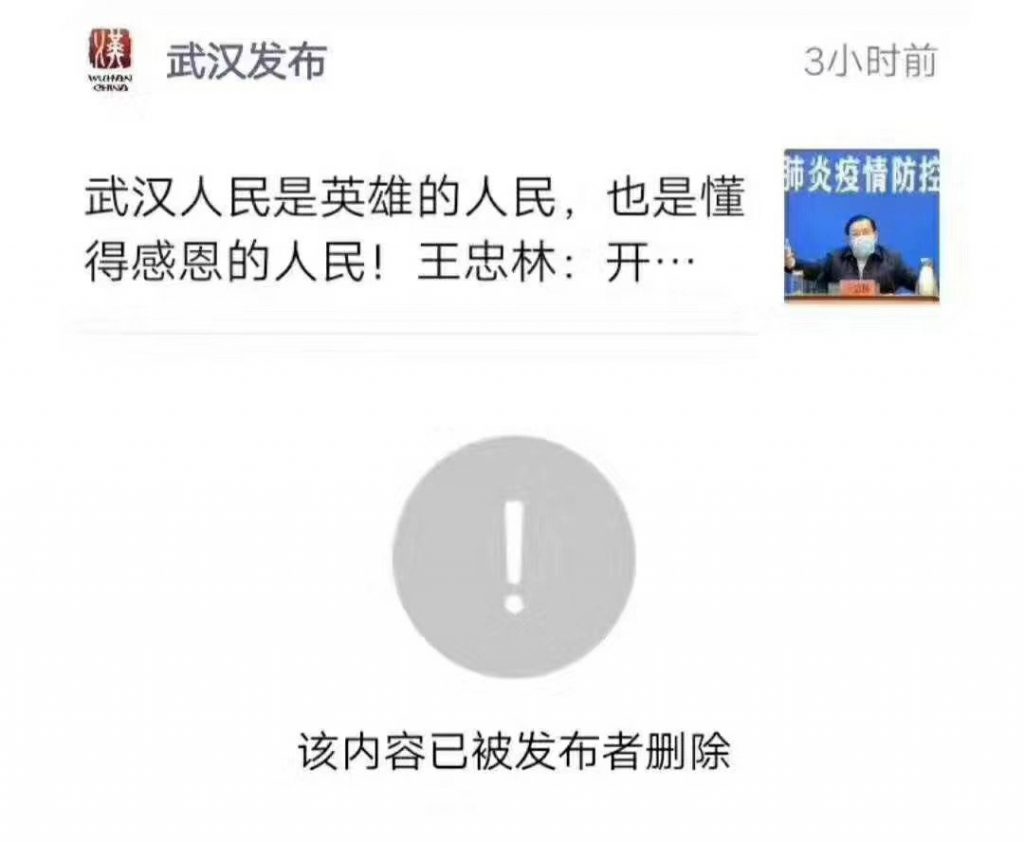
A March 7 WeChat post on Wang Zhonglin’s “gratitude education” remarks has now been removed.
Below is CMP’s translation of an announcement for an internal
propaganda meeting held last night, with required attendance from key central
Party media and local propaganda offices. The announcement clearly says that
what it now calls the “’gratitude education’ incident” invited “raging public
opinion,” and that it was comparable as a “public opinion incident” to the uproar
that followed the death of Dr. Li Wenliang.
The coronavirus epidemic has been a serious
test of the Chinese Communist Party’s capacity to “guide public opinion,” a
phrase it uses to describe the work of controlling and redirecting information
in order to maintain political stability and the Party’s legitimacy in the eyes
of the public. Efforts by an often rigid and unresponsive Party-state media system
to turn the tide of criticism away from the government have often backfired,
encouraging anger and resentment with the leadership’s apparent interest in managing
appearances over acknowledging and grappling with problems.
One of the most obvious cases in point
came last Friday as footage
emerged online and on social media of residents in Wuhan shouting from
their high-rise apartments during an inspection visit by vice-premier Sun
Chunlan: “Fake! Fake! Everything is fake!” It was possibly this embarrassing
episode that prompted Wang Zhonglin, who was appointed in
February to replace Ma Guoqiang (马国强) as
Wuhan’s Party secretary in a leadership shake-up, to suggest the necessity of a
campaign of “gratitude education.”
The internal announcement on the “’gratitude education’ incident”
urges all media to “consider the feelings of the people of Wuhan” in news and
propaganda reports. But the focus remains, unsurprisingly, on the end goal of “easing
the emotions of the people”—as though public opinion itself is the primary challenge.
The announcement stresses the importance, in this regard, of a special series
called “Entering Communities, Listening to People’s Voices, Alleviating People’s
Concerns” (进社区,
听民声, 解民忧).
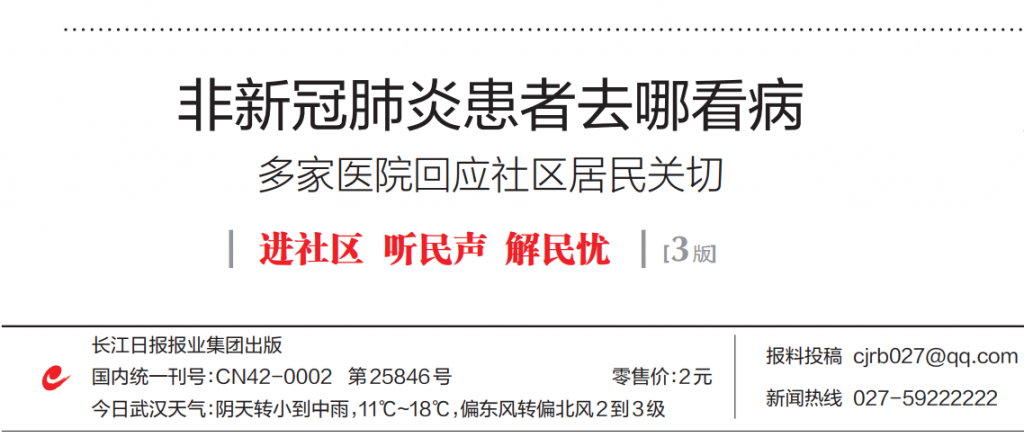
We can find this phrase
being deployed already in Wuhan, and it appears on the front page of today’s
Changjiang Daily. The following image is from the lower right-hand
corner, pointing readers to page 3.
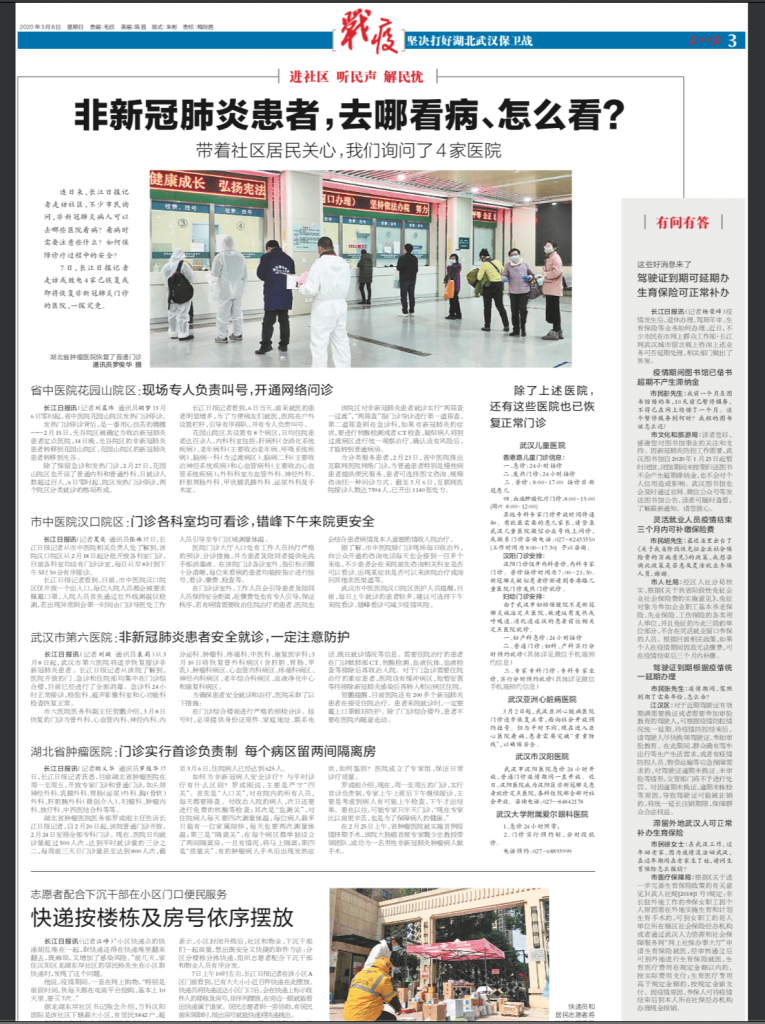
Page 3 is a full page of more informational content about the coronavirus epidemic in the city, under the headline: “Where Do Non-Coronavirus Patients Seek Medical Care, and How.” The subhead seems almost pleading in light of the insistence in the internal announcement (below) that media focus on alleviating the concerns of the public: “Bearing Concern for Community Residents, We Asked 4 Hospitals.”
A series of articles follows on the left-hand side explaining the
situation at various local hospitals. Vertically across the right-hand side are
questions from readers that are answered by the newspaper. One reader asks, for
example, what to do if his annual vehicle inspection for his driver’s license
is due but not possible owing to suspension of such services. The response
explains that drivers in this situation will not be fined by transport authorities
for such violations during the quarantine period.
These are certainly interesting times to observe the mechanics of
press control and “public opinion guidance” in China.
____________
March 7, 2020
21:15-21:50
Host: State Council
Information Office
Principal Participating Units:People’s
Daily, Xinhua News Agency, Guangming Daily, China Central
Television, The Paper, Economic Daily, China Youth Daily,
Guangdong Propaganda Department, Hubei Propaganda Department, Propaganda
Department of Wuhan City, and others.
1.Notice on the situation concerning the “gratitude
education” incident, providing an internal grasp
Today Changjiang Daily’s report on “gratitude
education” invited raging public opinion (舆情汹通), the intensity of the public opinion response being similar to
that following the death of a certain doctor. Through communications between
provincial and city leaders, and after a request to central authorities it was
agreed: Changjiang Daily, [the WeChat account] Wuhan China (武汉发布)
and Wuhan Television will remove the article at its source, and no other
media will be permitted to follow-up with reports or commentaries!
This matter is a classic case of public opinion created by our own
work (自身工作), in particular an insufficiently
strict hold at Changjiang Daily, and[we] must draw lessons from this,
and reflect back seriously.
On this matter, Minister [Huang] Kunming (黄坤明) [of the Central Propaganda Department] especially made a phone
call to stress: This matter fully shows that with Wuhan now having been shut
down for more than 40 days, the lives of the ordinary people have been affected
to such an extent that there is resentment and anger, and all reports must
consider the feelings of the people of Wuhan. This matter also sounds a warning
to all of our media, that they must definitely consider the particular
situation facing Wuhan and the feelings of the people.
The immense reaction created by this incident again shows the
significance and importance of our running the special series “Entering
Communities, Listening to People’s Voices, Alleviating People’s Concerns,”easing
the emotions of the people – not to teach the people gratitude, but to
alleviate their concerns.
Here we warn particularly: all media, regardless of whether in internal reporting (内宣) or external propaganda (外宣), regardless of whether they are central or local media, regardless of whether they are online or offline, must heed the calls [of the CCP], must all be strategically aligned in their consciousness, forming a coordinated unit of struggle (战斗部队), and must not fight independently.
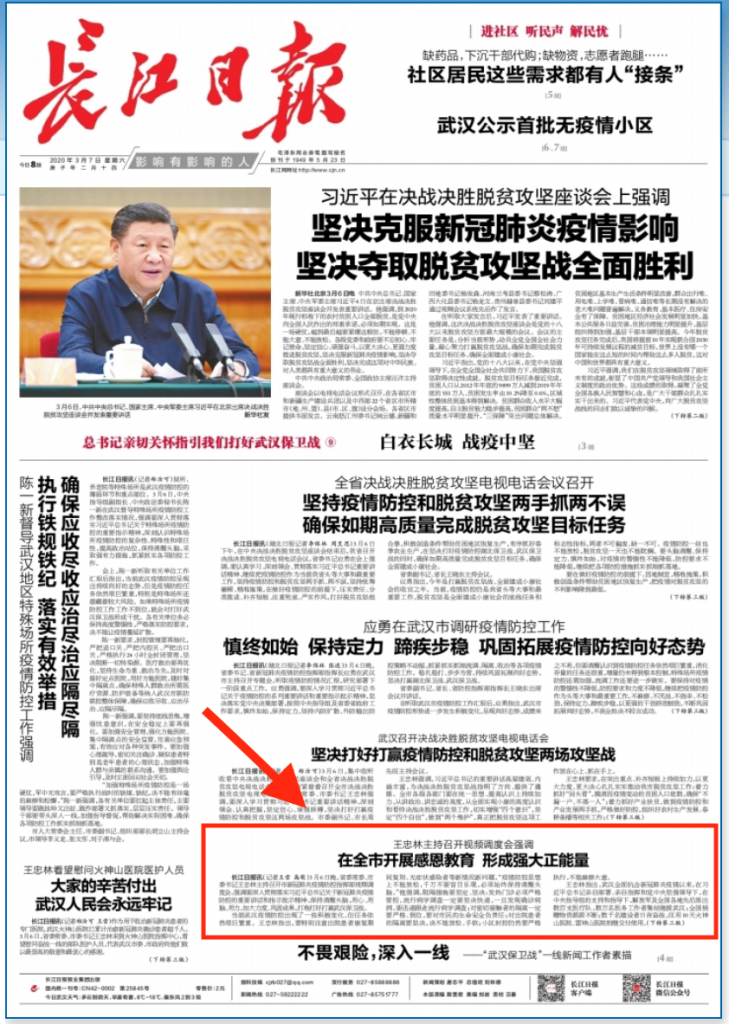
Anger simmered on social media in China today as state media reported remarks made by Wang Zhonglin (王忠林), Wuhan’s new top official, during a video conference on the city’s response to the coronavirus epidemic. Wang, who was appointed in February to replace Ma Guoqiang (马国强) as Wuhan’s Party secretary, reportedly said that it was necessary to “carry out gratitude education among the citizens of the whole city, so that they thank the General Secretary [Xi Jinping], thank the Chinese Communist Party, heed the Party, walk with the Party, and create strong positive energy.”
A release reporting Wang’s speech reiterated Xi Jinping’s words earlier this month,
in which he said, “Wuhan is a heroic city, and the people of Hubei, the people
of Wuhan, are heroic people.” Xi referred to Wuhan as a key “battleground” in
the “war” against the coronavirus, in keeping with the central propaganda
themes the Chinese Communist Party has emphasized since February – of fierce
struggle, personal sacrifice and unity, all under the stolid leadership of the
CCP.
Wang Zhonglin said in his speech that the Party must employ various forms of propaganda and education campaigns to carry out “gratitude education” among the population of Wuhan. Echoing Xi, he said: “The people of Wuhan are heroic people, and they are also thankful people.” The story was reported in Changjiang Daily, the official newspaper under Wuhan’s Party committee, but was shared widely across social media.
The remarks, coming at a time when there is widespread concern about the real implications of the coronavirus epidemic and lingering anger over the government response, generated fury online, and were viewed by many Chinese as tasteless and disgusting. News of the remarks cameless than a day after video emerged online from Wuhan in which residents in a cluster of high-rise apartment buildings can be heard shouting, “Fake! Fake! Everything is fake!” as China’s vice-premier Sun Chunlan (孙春兰) makes a tour of the area.
In a post to WeChat called “Have a Bit of Conscience: It’s Not Time to Ask the People of Wuhan for their Thanks,” journalist Chu Zhaoxin (褚朝新) remarked on the release yesterday of the video taken during Sun Chunlan’s neighborhood tour, and suggested Wang Zhonglin’s timing was insensitive. “This is public opinion, this is reality,” Chu wrote of the video. “People who are not blind or deaf can see and hear, and those who are not blind can feel it.”
Chu did not know, he said, whether Wang Zhonglin’s words were a direct response to yesterday’s heckling of the inspection group led by the vice-premier, but in any case the suggestion that the Wuhan people required “gratitude education” was misplaced. “If this is Wang Zhonglin’s idea, I think he needs to educate himself. You are a public servant, and your job is to serve the people. Now the people you serve are broken, the dead are still cold, and the tears of the living have not yet dried. The sick have not yet recovered, and much of their dissatisfaction is completely reasonable. Rather than blaming the people in Wuhan you serve for not being grateful, you should reflect and be ashamed because you and your team are not working properly.”
Chu’s post was deleted by late morning on Saturday. But we have archived a version below.
[UPDATE: 8PM Hong Kong time]
A WeChat post on Wang Zhonglin’s remarks from the official account of the city of Wuhan, “Wuhan China” (武汉发布), has now been deleted. Clearly, there has been huge blowback on this, and the government fears a creating wave of negative opinion.
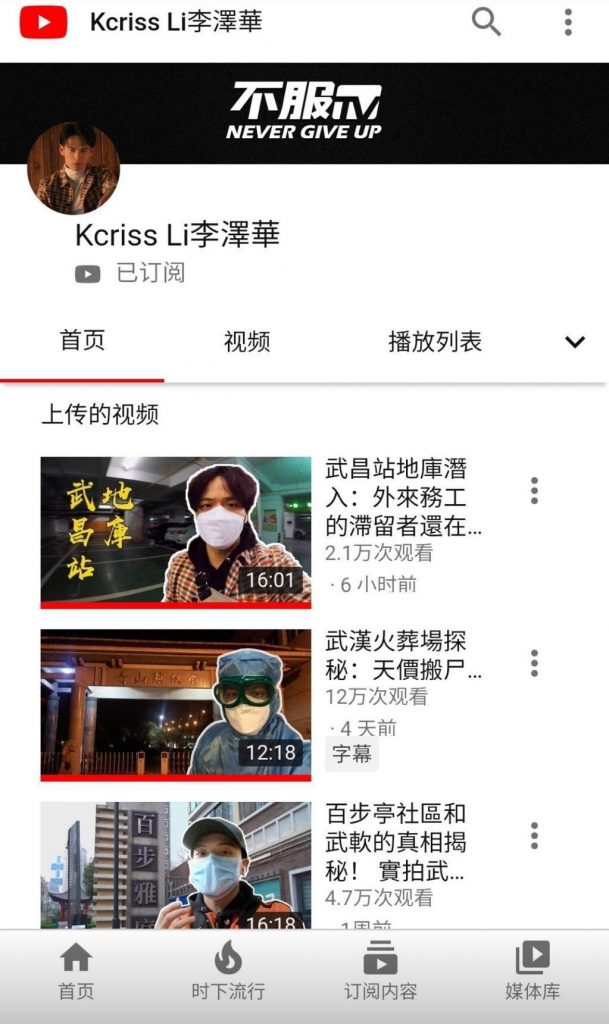
On Wednesday this week, Li Zehua (李泽华), a journalist who recently resigned
from his job as a news anchor at China’s state-run China Central Television to report
as a citizen reporter on the front lines of the epidemic in Wuhan, was apparently
detained
by officers from state security. His whereabouts are currently unknown.
Li, who had managed to livestream his dispatches, and who
also reported continued harassment from local police and security guards, arrived
at Wuhan’s Baibuting Community, an area hit particularly hard by the epidemic,
on February 16. He livestreamed a story on February 18 from a crematorium in the
city about how porters were being hired at high wages in order to transport
corpses. On February 25, he did a report in which he interviewed migrant
workers who were forced to set up camp in the underground parking garage at
Wuchang Railway Station.
Li’s citizen journalism in Wuhan followed in the footsteps
of two other journalists, Fang Bin and Chen Qiushi, both of whom are now
missing.
As state security officers caught up with him and prepared to detain him Wednesday, Li Zehua recorded a final message speaking to the men outside his door.
In this message, he talks about his belief in the importance of speaking up and the inspiration he took from Chai Jing (柴静), the celebrity CCTV anchor whose documentary “Under the Dome,” about serious air pollution in China, drew more than 300 million views online before being deleted by authorities.
Our
translation of Li Zehua’s message follows.
_____________
OK, I’m getting ready to open the door. Can I say a few
things?
First of all, I admire those of you who have hunted me
down. I admire the diverse methods you employed under the light of day to track
down my position so accurately. The way too that you managed to pressure my
friends XX to come over.
Secondly, from the time I first arrived in Wuhan
everything I have done has been in accord with the Constitution of the People’s
Republic of China and with its laws. I had full protective gear for all of the
places I visited that were designated as danger areas – a protective jacket, goggles,
disposable gloves, disinfectant. I had plenty of all of these things, a full
supply of materials. This 3M mask, this was bought for me by a friend who
supported me. So right now I’m physically fine. My body is strong and healthy.
If you say I have a temperature, this can only be because it’s too stuffy
inside all of this gear.
Of course, the third thing is that I realize at this
point that it’s highly unlikely I won’t be taken away and won’t be quarantined.
I just want to make it known, thought, that I have a clear conscience toward
myself, a clear conscience toward my parents, a clear conscience toward my
family, and also a clear conscience toward the Communication University of
China from which I graduated, and toward the journalism field in which I did my
studies. I also have a clear conscience toward my country, and I have done
nothing to harm it. I, Li Zehua, 25
years of age, had hoped I could, like Chai Jing [the former CCTV
journalist who made the documentary “Under the Dome”], work on the
front lines, that I could make a film like the one she did in the environment
of 2004 about the fight against SARS in Beijing. Or like “Under the
Dome” in 2016, the one that was completely blocked online.
I think
if you big guys outside the door went to middle school, which of course you
did, and if your memories are good, you’ll definitely remember the essay we all
had to read by Lu Xun, the one called, “Has China Lost It’s Confidence?”
There’s a line I’ve always found inspiring where Lu Xun says: “In this
China of ours there have always been those who speak for the people, who fight
tenaciously, who abandon their bodies in search of the truth . . . . In these
people we discover China’s spine.”
I’m not
willing to disguise my voice, nor am I willing to shut my eyes and close my
ears. That doesn’t mean that I can’t live a happy and comfortable life with a
wife and kids. Of course I can do that. But why did I resign from CCTV? The
reason is because – I hope more young people, more people like me, can stand
up!
But this
isn’t for the sake of uprising or anything like that, that’s not what I mean.
It’s not as though we oppose the Party simply by saying a few words. I know
that our idealism was already annihilated in spring and summer that year
[1989], and sitting quietly [in protest] no longer accomplishes anything.
Today’s
youth, who go onto Bilibili, Kuaishou and Douyin and swipe their way through
social media, probably have no idea at all what happened in our past. They
think the history they have now is the one they deserve.
I think
everyone is like Truman, and when they discover that strange radio frequency, and
when they find the exit door, they walk out and feel they can never go back.
The last
thing I’ll say is, I’m sorry.
I’ll
just say, I really understand you guys outside the door. I understand the
mission you’ve been given. But I also sympathize with you, because when you support,
without conditions and without reason, such a cruel order, the day will come
when the same cruel order falls on your own heads.
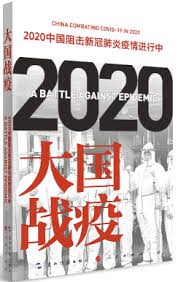
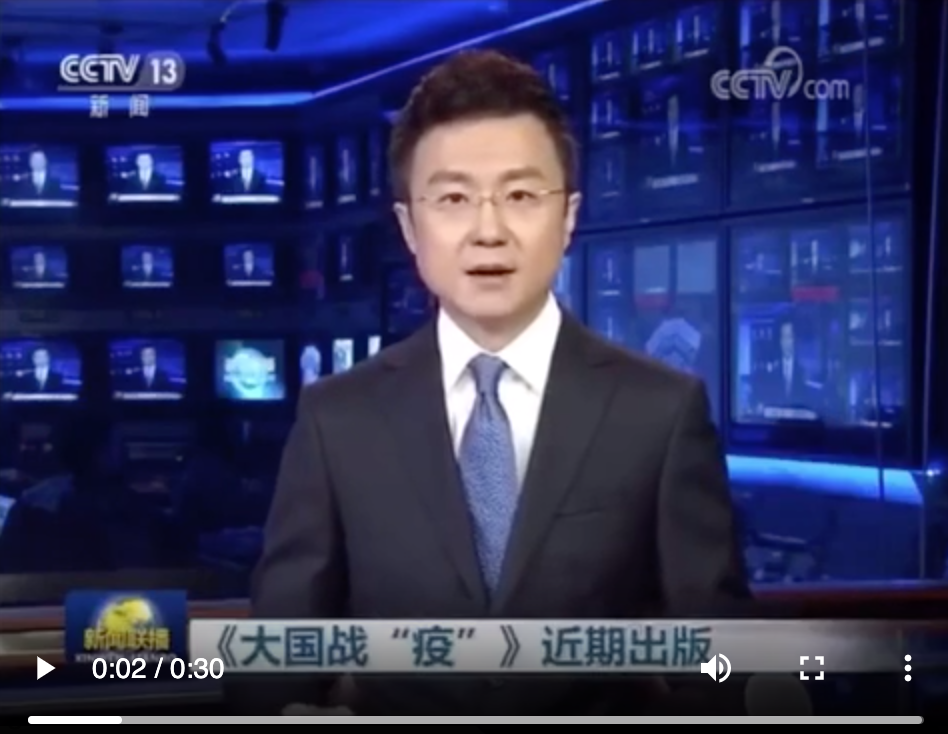
How do you ensure a story has a fairy tale ending? You write the ending yourself of course. In recent days, official state media in China have celebrated the publication of A Battle Against Epidemic: China Combatting Covid-19 in 2020, a book that compiles writing by official state media to paint a portrait of leadership resolve in the face of a major challenge.
So it seems that while we all wait to see how the Covid-19 fares in the rest of the world, the verdict is already out on the epidemic as a major show of resolve on the part of the Chinese Communist Party. The story has already been written.
According to the Xinhua News Agency release on the book, it “collectively reflects General Secretary Xi Jinping’s commitment to the people, his sense of mission, his far-reaching strategic vision and outstanding leadership as the leader of a major power.”
This is a narrative being pushed insistently in the People’s Daily
and other Party-state media in recent days. The idea that the Chinese Communist
Party, despite all evidence to the contrary, and despite the broad undercurrent
of popular anger on Chinese social media, has faced the epidemic with great wisdom
and effectiveness from the start.
Just look at page three of today’s People’s Daily, on which an article with the headline, “’China Has Shown Stunning Collective Action and Cooperative Spirit,’” is accompanied by another called, “How Has America Done in the Face of the Epidemic?” While the former, manipulating the remarks of the WHO’s Bruce Aylward, praises China’s readiness and speed of response, the latter accuses the U.S. of being more focused on anti-China smear tactics than on action to prevent the spread of the virus. This piece even manages to justify China’s recent decision to expel reporters from the Wall Street Journal: “They must be made aware that the dignity of the Chinese people must not be compromised, and China’s bottom line must not be touched. A few days ago, the Chinese Ministry of Foreign Affairs announced the suspension of the credentials of three journalists from the Wall Street Journal, delivering a loud slap.”
Yesterday, too, the newspaper ran a prominent front-page piece on China’s epidemic response that characterized the entire crisis as a “test” that the country and its leadership had essentially passed with flying colors: “The results obtained in the epidemic control and response work are no small feat,” it read, “and many sides have undertaken many arduous asks, putting in great efforts, once again making clear the obvious superiority of the leadership of the Chinese Communist Party and the system of socialism with Chinese characteristics.”
China’s official nightly newscast Xinwen Lianbo reports on February 26 about the launch of the new book about Xi Jinping’s response to the epidemic.
CMP co-director Qian Gang wrote
recently about the puzzling and infuriating tone-deafness of the People’s
Daily through January and much of this month, how they were committed to
the point of absurdity to pre-arranged propaganda themes about the greatness of
Xi Jinping and the realization of a “moderately wealthy society.” He described
this inability to shift focus to the most clearly urgent matter at hand, the coronavirus
epidemic, as systemic. “The system of the CCP is like a great big elephant,” he
wrote. “It is difficult for the sudden and unexpected to force any change to
its huge and lumbering gait.”
The elephant has now changed directions. It plods confidently forward with a revisionist narrative of competence and collective victory. And these themes can now return us to familiar tropes, like the notion that China offers an inspirational political model that can better instruct the world. So the Xinhua release reports that A Battle Against Epidemic will be published in English, French, Spanish, Russian and Arabic editions, “the first book to date both domestically and overseas to follow and introduce China’s epidemic prevention and control work.”
Where is this nonsense coming from? The book is published, we are told,
by the Central Propaganda Department, the Information Office of the State Council
and the China Intercontinental Communication Center (CICC). In fact, these
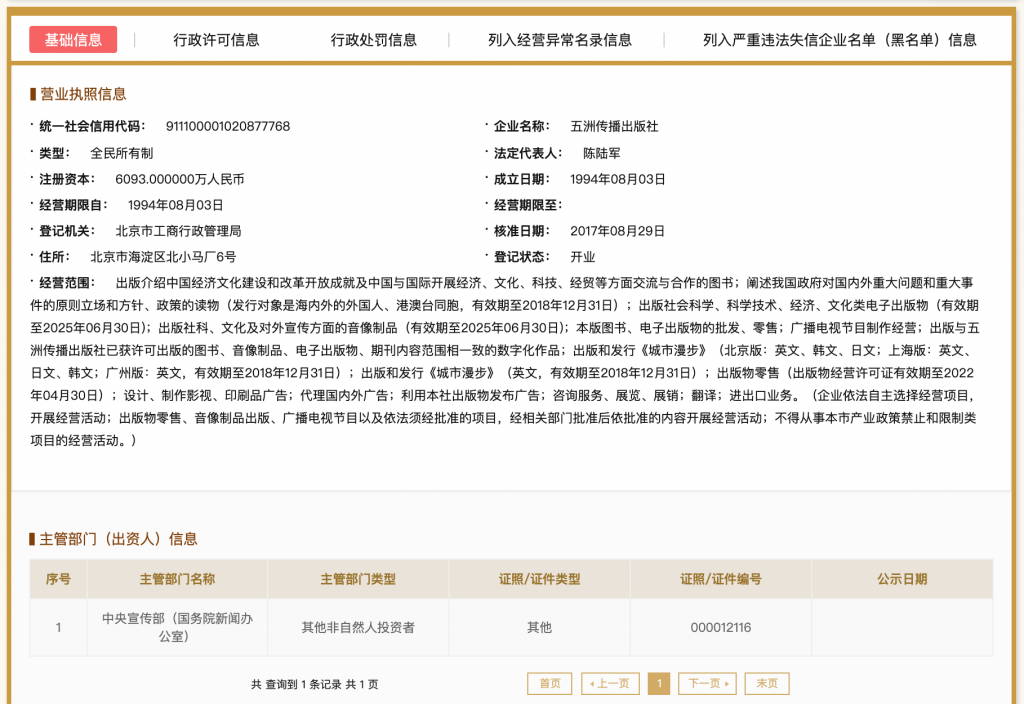
three partners are essentially a single party. Trace CICC in China’s national enterprise credit system
and you find that it is listed as being fully run by the “Central Propaganda
Department (Information Office of the State Council).”
So of course, no surprise, this was a scheme that must have developed at the top of China’s propaganda apparatus at least a number of weeks ago, possibly from shortly after Xi commented publicly for the first time on the coronavirus epidemic.
Will this nonsense work? China has managed many times in the past to simply move on, brushing uncomfortable facts and even immense tragedies under the rug, and changing the topic of conversation. But there is still a great deal of anger being directed toward leaders, judging from activity on social media, and efforts like this new book to distract and redirect can themselves feed the embers.
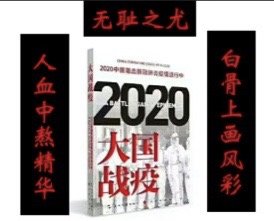
Here is one image making the rounds today on WeChat, in which the cover of A Battle Against Epidemic is hemmed in on all sides by Chinese banners that read:
Shameless to the extreme.
Painting fine pictures on the bones of the dead.
Distilling essence from human blood.
Certainly, some Chinese may move on from this crisis and think it better to forget and to say nothing. Others, however, will no doubt remember the very real lives sacrificed for the sake of these political slogans, and these glorious fairy tales.
Czech writer Milan Kundera once wrote: “Kitsch causes two tears to flow in quick succession. The first tear says: How nice to see children running on the grass! The second tear says: How nice to be moved, together with all mankind, by children running on the grass.” Facing the enormous task of controlling and directing public opinion in the midst of widespread anger over the handling of the coronavirus epidemic, and serious questions about the priorities of the leadership, China’s Party-state media have turned to a tried-and-true formula: turning on the kitsch.
Kundera, as scholar Robert Solomon writes, is “concerned with a particular kind of political propaganda that intentionally eclipses harsh realities with emotion and uses sweet sentiments to preclude criticism.” This exploitation of human emotion, which strips it of the immediacy of felt experience and abstracts it as collective pathos, is an ancient art practiced by dictators. “In politics,” writes Thorsten Botz-Bornstein, “most dictators have attempted to reinforce their authority with the help of kitsch propaganda.”
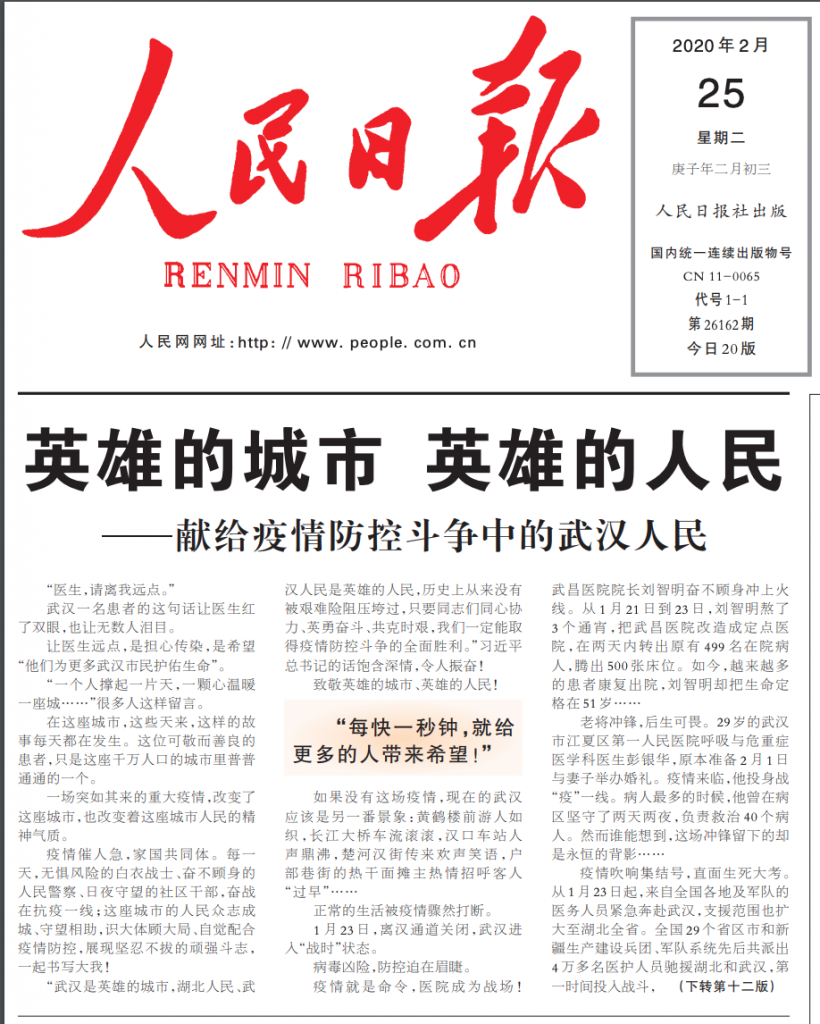
In yesterday’s People’s Daily we can find a consummate piece of kitsch propaganda given position of prominence right below the masthead. The article, “Heroic City, Heroic People,” is an emotional hymn dedicated to front-line medical workers, officials and ordinary people. But the real objective of the article is to underscore the Chinese Communist Party as the enabler of miraculous human feats.
This is classic propaganda kitsch, and Kundera’s tears flow from
the very first lines.
“Doctor, please deep further away from
me.”
This
statement from a [coronavirus] patient in Wuhan reddened the eyes of the
doctor, and it brings tears to the eyes of countless people.
Even
as Chinese medical workers from the epicentre of the crisis in Wuhan issued
a call in one of the world’s most respected medical journals, The Lancet,
for urgent assistance from colleagues around the world as they face physical and
psychological exhaustion, the Party’s flagship newspaper transforms misery and
desperation into tear-inducing sacrifice. Look, for example, at its description
of Peng Yinhua, a 29 year-old doctor who died on February 20:
.
. . . 29 year-old Peng Yinhua, a doctor in the Division of Pulmonary Care and
Critical Medicine at the First People’s Hospital in Wuhan’s Jiangxia District, had
originally prepared for a wedding with his wife on February 1. When the
epidemic came, he threw himself onto the front lines. When the patients were
greatest in number, this meant working two days and two nights straight, taking
responsibility for as many as 40 patients. But who could imagine that this charge
into battle would lead to his eternal departure . . . .
In this passage the very human Peng seems not to die with real humanity, but rather to fade, as though he is exiting the stage in a drama.
And
of course kitsch propaganda must anneal the softness of personal tragedy into
the hard steel of sacrifice. So we are told that “more than
40,000 medical staff from 29 provinces, autonomous regions and cities . . . . were
deployed to assist Hubei and Wuhan,” that they “entered the battle as soon as
possible, racing against time, testing their strength against the demon of
disease, all to continue the relay of life!”
“In the history of the world’s fight against epidemic disease, to gather 40,000 medical personnel in one city over a few short days – this is to generate a miracle!”
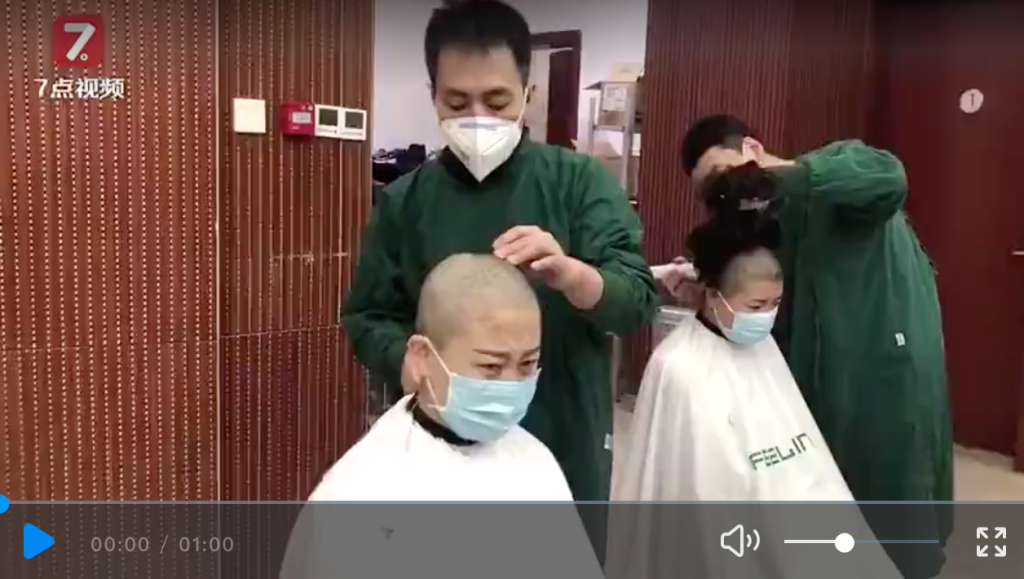
But kitsch propaganda can backfire in the face of a public that is digitally connected, and far more savvy than in the past about the tropes used by the state-run media. Earlier this month, internet users responded with irritation to a video posted by the official Gansu Daily newspaper that showed nurses weeping as their heads were shaved before their deployment to treat patients in Hubei province. The video described the female nurses as “most beautiful warriors,” and made emotional fodder of their sacrifice.
As reported
by Quartz, a writer named Chen Mashu remarked in a WeChat post since
removed by authorities: “The coverage made me think: Why does our media
always like to use the sacrifices females make as a tool for propaganda? …for
women who don’t cut their hair, aren’t pregnant and are healthy, do they not
deserve to be mentioned?”
Chen clearly does not appreciate the finer points of kitsch.
_______________
[partial translation]
Heroic City, Heroic People:
Dedicated to the People of Wuhan in the Midst of the Struggle for Epidemic Prevention and Control
People’s
Daily
February
25, 2020
“Doctor,
please deep further away from me.”
This
statement from a [coronavirus] patient in Wuhan reddened the eyes of the
doctor, and it brings tears to the eyes of countless people.
Keeping
the doctor away is about the concern they might be infected, and it is the hope
that “they can protect the lives of more Wuhan citizens.“
“A
person holds up the sky, a heart warms a city . . . . “ Many people have left
messages like this.
In
this city, over these days, this kind of story has unfolded every day. This kind
and respectable patient is just one of millions of ordinary people in this
city.
An
epidemic that suddenly came has changed this city, and it is changing the spirit
of the people in this city.
This
outbreak with such urgency, has made of the country one community (疫情催人急,家国共同体).
Every day, white-clad and fearless warriors, the undaunted people’s police,
community officials keeping watch day and night, all are fighting on the front
lines; the people of this city come together as a city, keeping watch and
rendering mutual aid, seeing the overall situation facing all, conscientiously
cooperating with epidemic prevention and control [measures], showing perseverance
and a stolid fighting spirit, all writing together a chapter of great unity!
We
salute a heroic city, and a heroic people!
“Every
second brings hope to more people!”
Were
it not for this epidemic, the scene in Wuhan would be a different: Tourists weaving
their way toward the Yellow
Crane Tower, cars rushing across the Yangtze Bridge, busy scenes at the
Hankou Station, laughter and applause rising from Chu River and Han
Street, and bosses at the noodle shops along Hubu Lane greeting customers
with a “Good Morning!”
Normal
life has suddenly been interrupted by this epidemic.
On
January 23, Wuhan’s streets were closed, and the city of Wuhan entered “wartime.”
This
Virus is Dangerous, But Containment is Imminent
The
epidemic is a command, and our hospitals have become the battlefield!
Liu
Zhiming (刘智明), head of Wuchang Hospital in Wuhan, rushed to the fire. From January
21, to January 23, Liu Zhiming worked three consecutive nights transforming the
Wuchang Hospital into a designated hospital, transferring the 499 patients originally
under care there within just two days, and making 500 beds available. Today, more and more patients are being discharged from the hospital, but Liu
Zhiming’s life has been fixed at 51 years of age. [NOTE: Liu Zhiming passed
away from the coronavirus on February 17.]
. . . . 29 year-old Peng Yinhua (彭银华), a doctor in the Division of Pulmonary Care and Critical Medicine at the First People’s Hospital in Wuhan’s Jiangxia District, had originally prepared for a wedding with his wife on February 1. When the epidemic came, he threw himself onto the front lines. When the patients were greatest in number, this meant working two days and two nights straight, taking responsibility for as many as 40 patients. But who could imagine that this charge into battle would lead to his eternal departure . . . . [NOTE: Peng Yinhua passed away on February 20.]
The
epidemic sounded a rally call for all to face a test of life and death. From
January 23, medical staff from all over the country and from the army rushed to
Wuhan, and the scope of support expanded to the whole of Hubei province. More
than 40,000 medical staff from 29 provinces, autonomous regions and cities, as
well as from the Xinjiang Production and Construction Corps and the entire military
system were deployed to assist Hubei and Wuhan. They entered the battle as soon
as possible, racing against time, testing their strength against the demon of
disease, all to continue the relay of life!
In
order to not impact the flow of their work, some doctors and nurses wore adult
diapers. In order to save protective gear [which can only be worn once], some extended
their shifts from 4 hours to 6 . . . . Their white outfits are war fatigues,
and they are the most beautiful resisters, the most adorable people of the New
Era!
In the history of the world’s fight against epidemic disease, to gather 40,000 medical personnel in one city over a few short days – this is to generate a miracle!
No one
who knows the People’s
Daily, the official newspaper of the Central Committee of the Chinese
Communist Party, would turn through its pages expecting to find exclusive reporting
on breaking stories, or to find incisive analysis. As the flag bearer of the
top leadership, the paper points the way for all official media in following
the Party line and achieving so-called “public opinion guidance.”
Over the past
two months, however, as China has faced a health crisis of immense proportions,
and as debate has raged over the role suppression of information played in the
early stages of the coronavirus outbreak, the People’s Daily has managed
astonishing feats of tone deafness, focusing on content so remote from public
concerns that the result is a kind of dissonance that can only impact
negatively on the Party’s image.
I’m talking
specifically of the paper’s insistence on giving repeated prominence, even over
major developments in the epidemic, to a special propaganda series called “The General
Secretary Came to My Home” (总书记来过我的家). This
series, with its feel-good reminiscences aggrandizing Xi Jinping as a man of
the people, stands as a historical record of propaganda ugliness that cannot be
whitewashed away.
Let us begin by backing up just a bit. We should remember
that during the first 20 days of January, as the outbreak quietly raged, the People’s
Daily reported not a single word about the crisis (which leaders had not yet
properly recognized as such). It was only after Xi Jinping delivered his “important
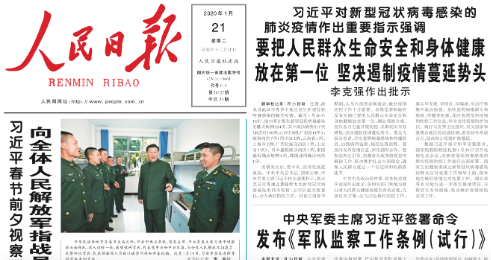
directions” (重要指示) concerning
the epidemic on January 20 that coverage finally appeared on the front page of the
next day’s edition. You can see an image of that page below. Look carefully at
how the newspaper has visualized the Party’s priorities.
The news of Xi’s instructions on the epidemic appear on
the right-hand side, next to the masthead, in the small space we refer to as
the “newspaper eye,” or baoyan (报眼). But the news that gets the greatest emphasis, with
a larger headline and a prominent image, is below the masthead, about Xi
Jinping meeting with People’s Liberation Army soldiers during an inspection
tour.
One might expect this sort of downplaying and sidelining
of the epidemic to fade as the full seriousness sinks in for the Party
leadership. But this is not in fact what happened.
From January 22
to January 25, for four straight days, the People’s Daily again had no
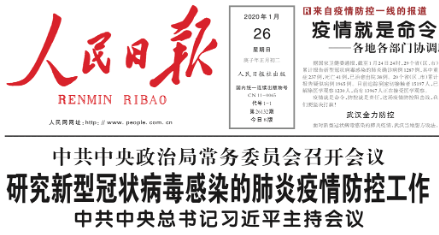
front pages dealing with the epidemic. It was only on January 26, with the news
that the Politburo Standing Committee had held a meeting on the epidemic, that related
news took the most prominent position in the newspaper.
At this point, we might expect news and announcements
on the epidemic to remain in primary position. After all, there was no doubt
whatsoever by January 26 that the coronavirus was the most urgent and important
matter for the country, that it would take long and concerted effort to deal
with, and that it was the focus of public concern.
Generally speaking, when we the announcement of a
major Party meeting on a crucial matter of policy or emergency, as we have in
the front page above, we can anticipate the next day’s front page in the People’s
Daily. One a central command (中央号令) has been
issued by the Party leadership, it should lead in all official media, taking
precedence over all other stories. In the People’s Daily, that would mean
placement under the masthead, with a bold headline.
But is this what happened on January 27, the day after
the meeting? No, in fact.
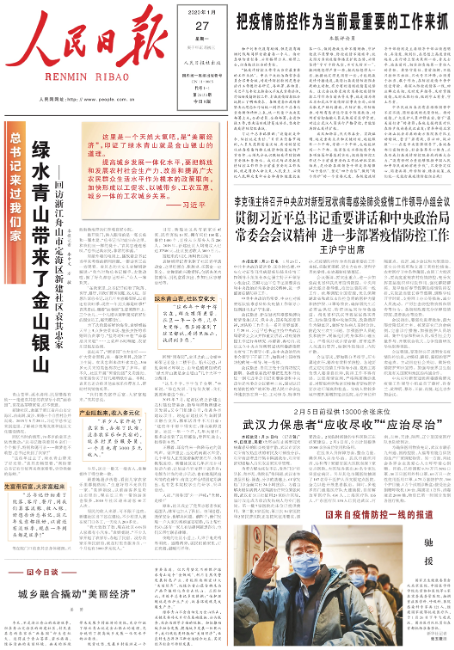
Here is the January 27 edition of the People’s
Daily, on which news of the Politburo meeting and other news related to the
epidemic appears on the right-hand side, again in the “eye” and the space
below, with slightly smaller headlines than the main story. The main story, as
the reader may guess, was something entirely unrelated – the pre-planned special
series, “The General Secretary Came to My Home.”
By this point,
the special series was nothing new. It had been running through January as the
epidemic quietly raged in Wuhan. The first article in this series actually appeared
on January 5, and there were five front pages dominated by the series up to
January 20, the day that marked a key turning point in the epidemic with Xi
Jinping’s first major statement on China’s response.
From a purely design standpoint, the series is unappealing.
Every installment is designed in exactly the same way, with the series title
against an orange banner, a bold vertical headline, and a gold-shaded box at
the top including an inspirational quote from Xi. The series is pushed so
densely and regularly it seems it can only fatigue the reader. But of course
the more serious problem is that the series has little newsworthiness whatsoever
– at a time when everyone knows there is plenty to report, plenty to talk about,
plenty to decide and act upon.
“The General Secretary Came to My Home” is a retrospective
series in which journalists look back on Xi Jinping’s visits with ordinary
Chinese in their homes since coming to office at the end of 2012, the most recent
visit dating to September 2019. The “retrospective,” or huifang (回访), means going back and digging out old news coverage
by the paper, so in this case the focus is on digging out the instances where
Xi visited various homes, and then highlighting the aspects of this dealing
with key propaganda points – particularly the theme of prosperity and the
realization of “moderately wealthy lifestyles.”
Is this really
news? If we allow that it is news, is this really news that people should be
focusing on? Or, brushing aside these questions and looking just at the CCP members
likely to pick up copies of the People’s Daily, we might ask: Is this the
news that the 90 million members of the CCP most care about at this moment?
If we look at the
priorities of China’s leaders over past weeks, to say nothing of the crisis
that has engulfed all Chinese, we know that the obvious answer is that the epidemic
is what everyone cares about. Since January, the Politburo Standing Committee
has held three meetings to deal with the epidemic – on January 25, February 3
and February 12. Even if nothing else did, this would tell us all too clearly
that the epidemic has become a serious crisis for the leadership. And not
surprisingly, all three of these Politburo meetings made the front page of the People’s
Daily. Xi Jinping’s various directives on the epidemic, his speeches and
his inspection tours, were all given fairly prominent positions on the front
page of the newspaper.
But through this entire period, as the whole country
has been engulfed by the crisis, only one story has reigned supreme above all
others in the People’s Daily: “The General Secretary Came to My Home.”
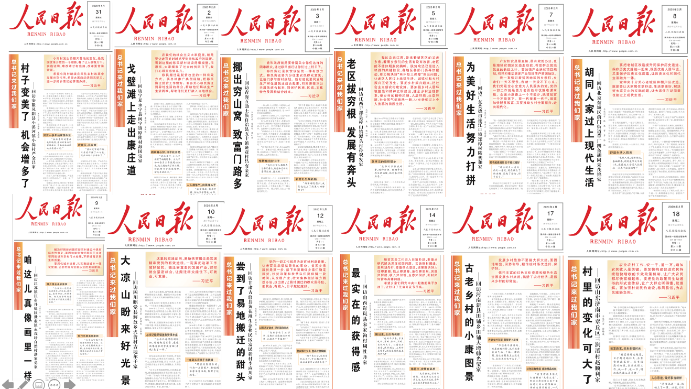
The following are the People’s Daily front
pages from January 31, February 2, February 3, February 5, February 7, February
8, February 9, February 10, February 12, February 14, February 17 and February
18. All are dominated by virtually identical treatment of variations of the
same story about home visit by Xi Jinping.
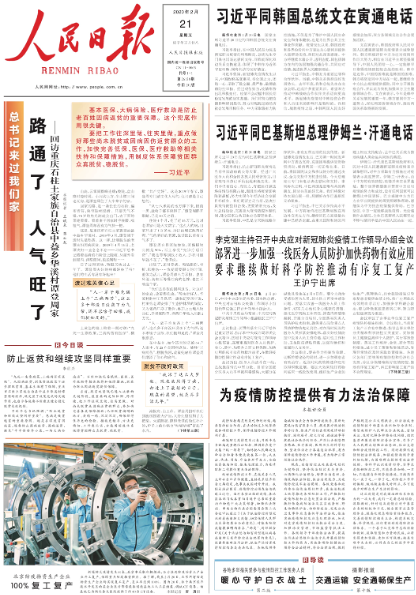
Let’s take a look at another, more recent, front page,
from last Friday, February 21. Notice how this page, like all the other pages included
above, are structured around the same series, “The General Secretary Came to My
Home,” with identical treatment and layout on the front page of the newspaper.
In the month since January 21, there have been 14 front
pages dominated by the series, nearly one front page every other day.
Again, I would ask: Is this news? Do people care? But
in fact, we don’t even need to judge these front page choices by the standards
of journalistic professionalism. We can judge them instead on the basis of the
mission and responsibility of the People’s Daily as defined by the CCP itself.
This series, “The General Secretary Came to My Home,”
has clearly been in the works for some time. Very likely, the vast majority of
these articles were written and prepared before the outbreak of the coronavirus.
In my analysis
of Party media coverage in January, I pointed out that 2020 has been
defined as the year for China’s full realization of a “moderately wealthy
society,” or xiaokang shehui (小康社会), and that
this is a propaganda theme that Xi Jinping meant to trumpet loudly from the start
of the year. The series on Xi Jinping’s home visits was clearly intended as a
tribute to 2020 as the year of xiaokang achievement.
It’s not really important whether the families profiled
in these stories from various regions in China are really representative of the
lives of Chinese people (and all would undoubtedly have received special treatment
and attention from local governments in preparation). The important takeaway of
all the reports in the series is Xi Jinping’s presence, and his attentiveness
to the needs and development of all Chinese. Careful preparation of this
signature 2020 series was clearly a central political task of the Party media
from late 2019.
The problem now is context. In the light of the
present context, these propaganda reports appear ugly and callous.
Since
the meeting of the Politburo took place on January 25, 2020, we have seen two very
different Xi Jinping’s in the People’s Daily. The first is Xi Jinping personally
leading the fight against the coronavirus epidemic, a crisis with a very
tangible impact on people’s well-being and prosperity. The second is Xi Jinping
busy harvesting the glorious results of xiaokang, and of China’s battle
against poverty.
Since
the official turnabout on January 20, when Xi Jinping signaled new public
seriousness about the crisis, and throughout February, the epidemic situation in
China has been extremely serious. The situation is now compounded by the economic
impact of delays in getting people back to work after the Spring Festival, and
so on. There can be no doubt that the overriding political task of the People’s
Daily is to turn up the volume on propaganda about the leadership’s battle
against the epidemic. We might suppose the paper would devote more headlines to
the coronavirus epidemic given Xi’s emphasis
on this as the Party’s “top task.”
So, let’s
look at how the news was reported in the People’s Daily over a number of
days, and what the newspaper’s front pages looked like.
The January 25
meeting of the Politburo Standing Committee decided to form a “central-level
small leading group” on the response to the epidemic, and this “small leading group”
was meant to provide unified direction of the epidemic response. On January 26,
the head of the group, Premier Li Keqiang, led its first meeting, which quickly
released an “important decision” (重要决策). Absent new
instruction or activities by Xi Jinping to fight the epidemic, the news of the
meeting led by Li Keqiang would be the undisputed choice for the top headline
on the front page. The day after the meeting, however, news of the meeting was
placed in the middle of the front page and to the right.
Which story
gets top billing? Well, of course: “The General Secretary Came to My Home.” The
moral of this particular article, which of course showcases Xi’s visit, is that
sound environmental policies help to combat poverty.
This was not,
however, a choice by the People’s Daily that we saw mirrored in other
Party publications. The flagship newspaper was entirely unique in its choice of
emphasis, and the situation was quite different in other Party newspapers. In
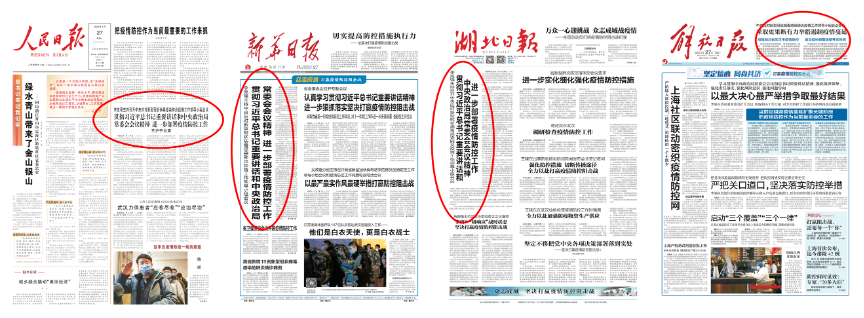
the image below you can see the People’s Daily on the far left, with the
Li Keqiang story at the middle-right, followed by Xinhua Daily, Hubei
Daily and Liberation Daily. In all three of the latter cases, the Li
Keqiang story is given precedence – not shoved aside by the home visit story.
The news on the front pages of all three of these newspapers is dominated by reports
about the coronavirus epidemic.
From
the standpoint of CCP norms, this handling of the news by the People’s Daily
should be hugely inappropriate. Here we have a small leading group that is
serving at the Central Committee’s anti-epidemic command center. As head of the
small leading group, Premier Li Keqiang is implementing the spirit of Xi
Jinping’s directives on the epidemic from the Politburo Standing Committee
meeting. How is this not the top story?
On January 30,
Li Keqiang made an inspection tour of the Chinese Center for Disease Control
and Prevention (CCDC), issuing instructions on a range of areas from
investigating the origin of the outbreak to stepping of vaccine development and
improving diagnosis and treatment. The importance of these instructions goes
without saying, and the People’s Daily should have an obligation to put
this news in the most important position. But in the next day’s edition of the newspaper,
this story once again is placed in the middle of the right-hand side. Which
story gets top billing? You guessed it: “The General Secretary Came to My Home.”
The story focuses on Xi’s visit, with a subtext about agricultural reforms.
On February 1,
Li Keqiang made another important inspection tour of epidemic response facilities.
The news again appeared in the middle of the right-hand side. The lead story
was another in the home visit series, this time about a family visited by Xi
Jinping that had been relocated due to ecological reasons, but was now doing
well, the youngest son buying a car, and the oldest now earning a salary of
6,000 yuan a month – solidly xiaokang.
On February 2,
there were two important news stories. The first was the
opening of a new hospital in Wuhan with 1,400 military medical staff.
The second was Li Keqiang’s leading of another meeting of the small leading
group on increasing material support for prevention and treatment. The next
day, the People’s Daily put the first story in the “eye” at the upper right-hand
corner of the front page, and the second on the right-hand side below. The story
given the most prominent treatment, however, was again about Xi Jinping and
part of the home visits series. It was about a family that became rich after
opening a brewery.
On February 3,
the small leading group held its third meeting, which dealt with measures to raise
the level of treatments in Wuhan and lower infection rates. The story appeared
on the right-hand side the next day. The main story that day? It was called, “Pulling
Out the Roots of Poverty, Achieving Rapid Development,” yet another story in
the series on home visits by General Secretary Xi Jinping. One choice line in
the article said that “the general secretary has prioritized a toilet revolution,”
this referring to a campaign to improve sanitary conditions.
On February 6,
the small leading group issued orders on the orderly return of production and guaranteeing
supplies – dealing, in other words, with getting China’s economy up and running.
Once again, this story was slotted to the side in favor of “Work Hard for a
Better Life,” a story in the home visits series on a child from the countryside
who had managed to attend university.
The fifth
meeting of the small leading group was held on February 13, Li Keqiang again
presiding. This dealt with changes to disease classification, and with other
measures for the effective prevention and control of the epidemic. The classification
issue was related to the “policy precision” requested by Xi Jinping. It was
again the most important CCP news of the moment. But neither this story, nor
another news item about the army ordering another 2,400 medical personnel to Wuhan,
could compete with the marquis story: “The General Secretary Came to My Home.”
As the Spring
Festival holiday came to an end, the key priorities remained the response to
the epidemic and the return of people to work. The small leading group held its
7th and 8th meetings on February 17 and February 20. But
the top front-page headlines on the days following these meetings were virtual
copies of previous front pages. Pride of position was given on February 18 to a
report in the home visit series called “The Change in Our Village is Huge,” and
on February 21 to a home visit report called “The Road is Open and the People
are Flowing.” This latter report, which dealt with the health of ordinary
people in China, quoted Xi Jinping’s statement that “basic medical
insurance, critical illness insurance, and medical assistance are important
guarantees to prevent ordinary people from returning to poverty due to illness.”
One wonders, if
the health of the people was indeed the top priority, why was news of the epidemic
not given more prominent positioning?
Throughout the
period I just covered, the focus in provincial and local-level Party newspapers
was consistently on the epidemic, the front pages dominated by central-level
policies and directives, local decisions and actions, and reports from local reporters.
From January 27 to February 22, Beijing Daily, the local mouthpiece of
the Beijing city leadership, ran 11 of its own reports on the epidemic. During
the same period, we can find unique reports in a number of other central-level
publications as well: eight in China Youth Daily; 11 in the Economic
Daily; 12 in Guangming Daily. In fact, the People’s Daily sent
a rather sizable reporting team to the front lines in Wuhan. Between January 27
and January 22, the paper ran close to a hundred reports. And yet, only one of
these made the newspaper’s front page.
The conclusion
we come to when reading through the pages of the CCP’s official People’s Daily
is that no news on the ongoing epidemic, whether this means the decisions of the
leading small group, or reporting on the epidemic by the paper’s own reporters
(though much of this “coverage” is of course actually propaganda lauding the actions
of the leadership), is more important than the series of propaganda articles on
Xi Jinping’s visits to people’s homes.
Reports on Li
Keqiang at the People’s Daily also appear to have been restrained by
unspoken rules. After the January 25 meeting of the Politburo Standing Committee,
Li Keqiang traveled to Wuhan, arriving there on the 26th. This was a
news story on which millions upon millions of people were focused. On January
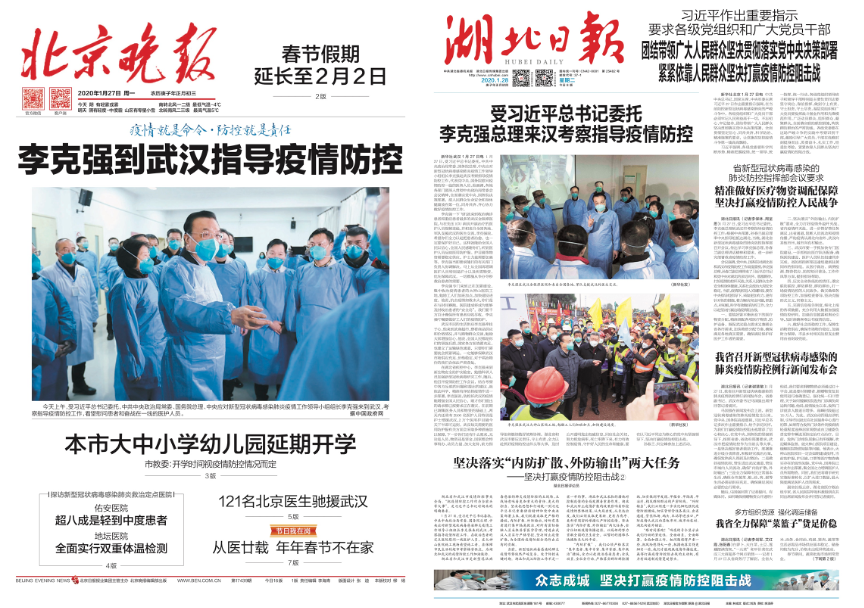
27, the Beijing Evening Post, a commercial paper under Beijing Daily,
placed this major news about Li Keqiang’s trip in the most prominent position
on its front page, as did Hubei Daily, the official Party mouthpiece of
Hubei province.
On the same
day that Li Keqiang arrived in Wuhan, Xi Jinping issued another directive on
the epidemic. His talk of “firming up confidence, helping one another, taking a
scientific approach to prevention and control, and applying policy precisely”
was actually a repeating of what had already been reported in the newspapers
after the January 25 Standing Committee meeting. But as Xi cannot be surpassed
in the People’s Daily headlines, the big news about the premier could
only take second place – and the premier’s important visit in Hubei had to come
with mention that he was “entrusted by General Secretary Xi Jinping.”
The
arrangements we see on front pages like that on January 28 page above, such as
the need to emphasize Xi Jinping first among Politburo Standing Committee members,
are not decisions that can be made at the discretion of the editor-in-chief of
the People’s Daily or his staff.
But the
choices being made at the newspaper in regard to this series on the general
secretary visiting people’s homes are incomprehensible to all – and perhaps even
more so to those who understand how the Party’s approach to the news works. It’s
difficult to imagine that this completely un-newsworthy series, so unsightly against
the backdrop of the epidemic, is something Xi Jinping himself has insisted upon.
After all, for weeks now as the country has faced a major health crisis, Xi
Jinping has emphasized that “[we] must make the safety and physical health of
the masses the top priority,” and that “[we] must define epidemic prevention
and control as the most important work.”
Are the
editors at the People’s Daily just not hearing it?
Of course we
can’t be naïve in our expectations of the People’s Daily. Xi Jinping has
stressed that the Party media “must be surnamed Party,” that they must serve
the Party’s agenda alone. It would be unrealistic to imagine that the People’s
Daily will simply change course and start doing investigative reporting, or
look back critically on the handling of the epidemic. But at the very least, at
such a difficult time, couldn’t the People’s Daily emphasize the
epidemic, even if this only means shouting slogans?
For whatever
reason, this has not been possible. “The General Secretary Came to My Home” has
dominated 14 front pages of the People’s Daily in just over a month
since January 25, with its tone triumphant and pleasant at turns, conveying a
fulsome sense of happiness and gain. The tone deafness of the series is really
quite incredible, treating Xi Jinping’s every step as a miracle.
Do the editors
not understand that these choices will actually have an adverse impact on the
image of the CCP and the image of Xi Jinping? Are they, to a fault, true
believers? Are they simply confused?
I wish I knew
the answer.
[Featured Image: A scanning electron microscope image of SARS-CoV-2, also known as 2019-nCoV, the virus that causes COVID-19. Image from NIAID available at Flickr.com under CC license.]
The death of Wuhan doctor Li Wenliang (李文亮) earlier this month set off a wave of anger in China that has presented a major challenge to the leadership in its efforts to control public opinion. In coverage from Party-state media we have seen sometimes sharply contrasting visions of Li Wenliang and how his story relates to the question information control — a central point of contention for many Chinese commenting on social media.
Li, the ophthalmologist from Wuhan Central Hospital (武汉市中心医院) who was infected with the coronavirus while dealing with patients on the front lines of the epidemic, was questioned by his hospital and by police several weeks earlier for warning through social media about the emergence in Wuhan of cases of atypical pneumonia. Add to this the fact that Dr. Li was young, by all accounts amiable, well-educated and enthusiastic about life, and his death becomes for many Chinese, and particularly the networked middle-class, a highly relatable tragedy. On top of all of this, details about the circumstances facing Dr. Li’s family in the wake of his death have again prompted public concern.
Li Wenliang’s death was closely tied with many of the aspects of the treatment of the coronavirus epidemic by the authorities that have left people infuriated: lack of transparency of information, slowness in revealing the situation to the public, and the neglectful treatment of medical personnel. The young doctor’s death came as a shock to many Chinese.
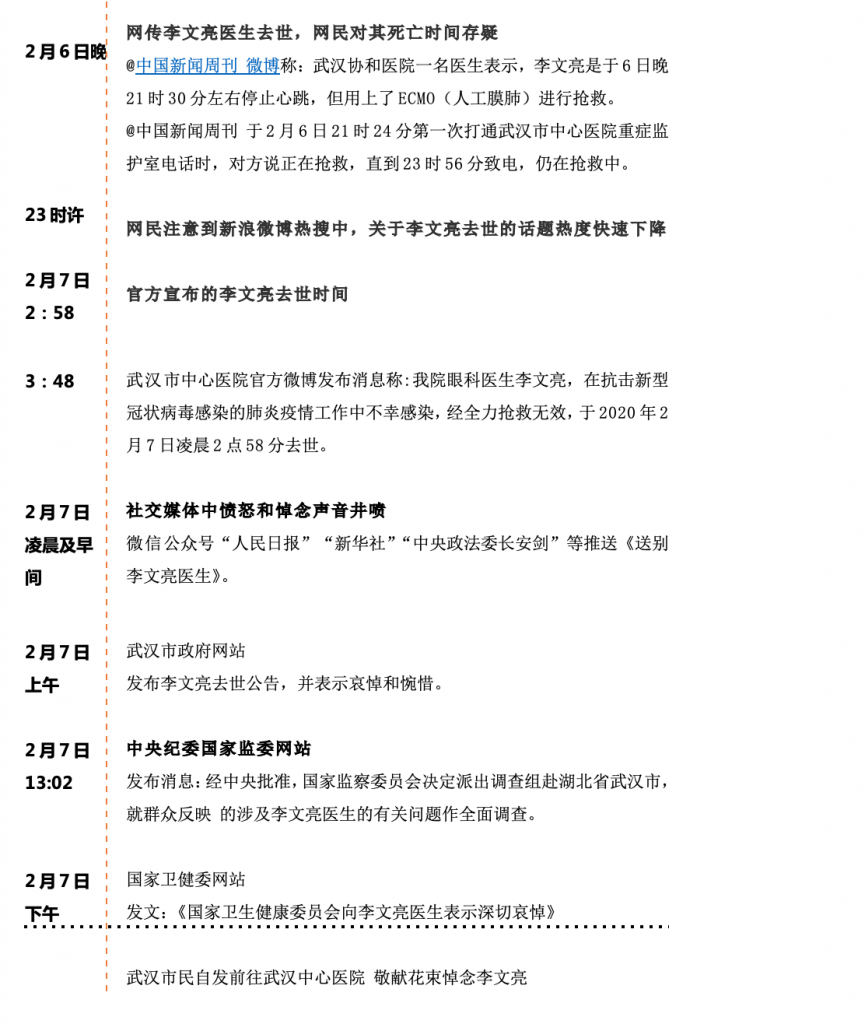
Li Wenliang Timeline
On the night of February
6, a doctor at Wuhan Union Hospital broke
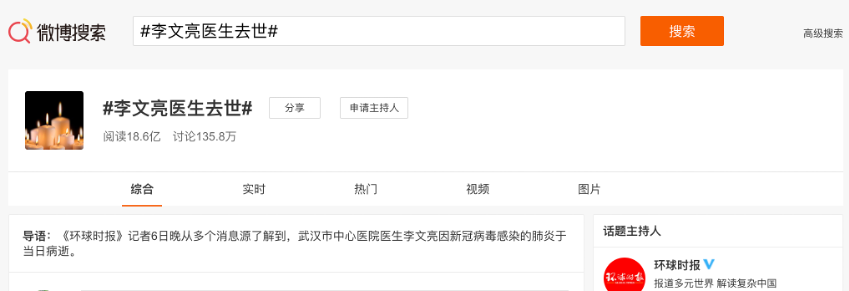
the news of Li Wenliang’s death on Weibo. Shortly after, the hashtag “DrLiWenliangPasses”
(#李文亮医生去世#) was
created on Weibo by the official account of the Global Times, a newspaper
published under the umbrella of the People’s Daily. The account offered
the following introduction:
A Global Times
journalist learned on the night of February 6 from numerous information sources
that Wuhan Central Hospital doctor Li Wenliang has passed away from pneumonia
resulting from the coronavirus.
After this, there
were purported refutations of the news, suggesting it was a rumor and that Li
Wenliang was still being urgently treated. The exact time of Li Wenliang’s
death became a topic hotly discussed by internet users, again prompted deep and
widespread distrust of official Party and government information channels.
On the afternoon of February 7, the National Supervisory Commission, the country’s top anti-corruption body, announced its decision to dispatch a special investigative team to Wuhan, with approval from the Central Committee, to “conduct a full investigation into public complaints about problem relating to Dr. Li Wenliang.” This announcement, essentially signaling that the central leadership was aware of the serious repercussions of Li’s death, effectively gave Chinese news media a “protective amulet” (护身符) that would allow for related coverage, at least for a brief window of time.
The following is a basic timeline of the breaking of the news of Li Wenliang’s death and the official media response.
As Anger Rises, Central and Provincial Party Media Follow Suit
Looking at coverage
of the death of Li Wenliang in newspapers across the country from February 7 to
9, we can find the following central Party media reporting on Li’s death: People’s
Daily, People’s Daily (Overseas Edition), the Chinese People’s
Political Consultative Conference Journal, Economic Daily, Legal Daily,
Procuratorate Daily, China Discipline Inspection Journal and Xinhua
Daily Telegraph.
The story was not reported
by People’s Liberation Army Daily or by Guangming Daily, the
former published under the Political Department of the PLA and the latter by
the CCP’s Central Propaganda Department.
Looking then at
provincial-level CCP newspapers, those published directly by the Party
committees of various provinces, we find most papers reporting in some way on
the Li Wenliang story, with the exception of Shanxi Daily, Xinjiang
Daily and Tibet Daily. The following table shows all provincial and
municipal-level newspapers and their commercial spin-offs, including only those
that did report the story of Li Wenliang’s death.
Much coverage of Li
Wenliang molded his story into the normative CCP narrative of heroism and
personal sacrifice, sidestepping the uncomfortable issue of his mistreatment by
local authorities, and the fact that his openness in addressing the coronavirus
epidemic contrasted sharply with the Party’s own whitewashing of the story
through much of January.
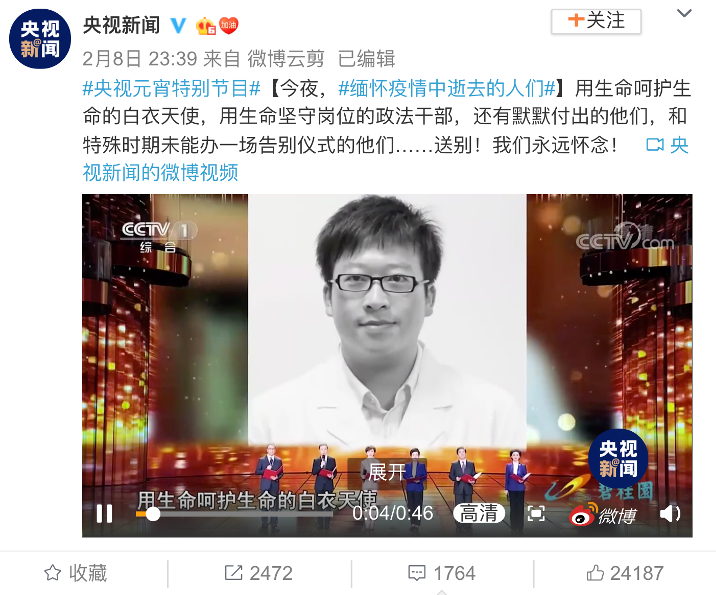
On February 8, CCTV-1
broadcast its “2020 Lantern Festival Special Program” (2020年元宵节特别节目) corresponding with
the final day of the annual Spring Festival. As the anchor narrated a segment
called “What You Look Like” (你的样子),
the following black-and-white image of Dr. Li Wenliang’s flashed by on the
screen, treated as a “white angel of sacrifice” laying down his life for the
lives of others.
On February 10, the People’s
Daily, Xinhua Daily Telegraph and Guangming Daily all ran the
same review of the CCTV-1 program two days earlier, mentioning that “Li
Wenliang, Song Yingjie and other doctors, and the heroic group portrait of
police officers such as He Jianhua, Li Xian, Cheng Jianyang, Yin Zuchuan and
Liu Daqing . . . had flashed across the big screen, bringing countless audience
members to tears.”
Outstanding Pages and
Commentaries
But there were also notable
articles and page designs that put Li Wenliang’s story in a different light,
stressing his role as a “whistleblower,” and his remarks about the need for
diverse voices in a healthy society.
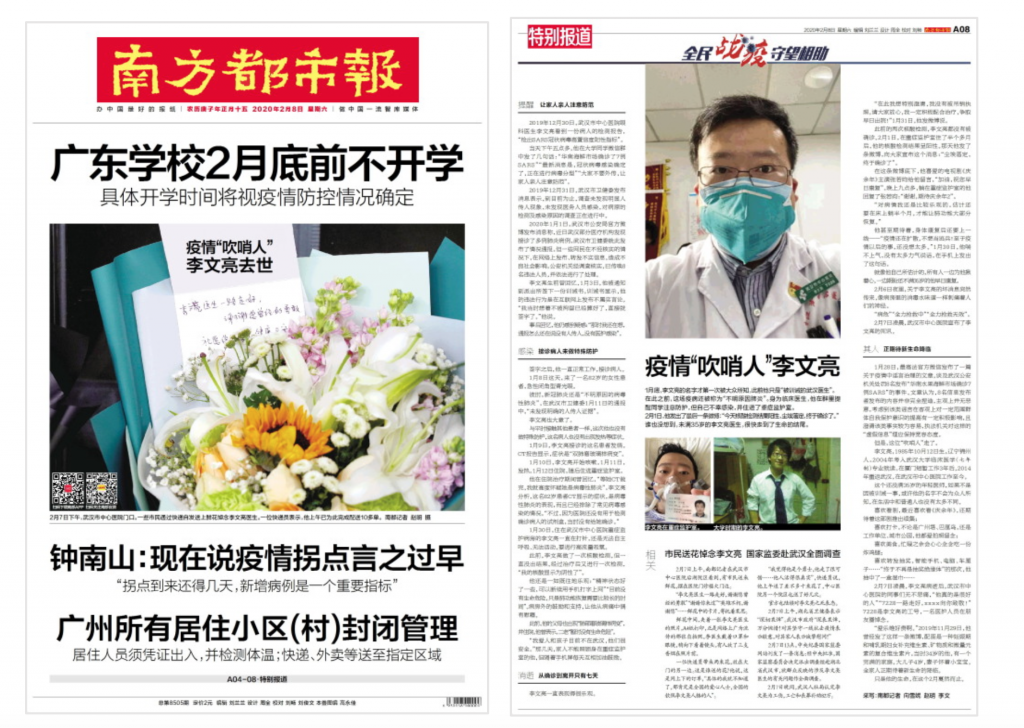
Below is a “special
report” that appeared in the February 8 edition of Guangzhou’s Southern
Metropolis Daily, a commercial spin-off of the official Nanfang Daily
newspaper. The cover includes a central image of flowers left in memory of Li,
with a headline that read, alluding to Dr. Li’s posting on WeChat about the
epidemic in early January: “Epidemic ‘Whistleblower’ Li Wenliang Passes Away.”
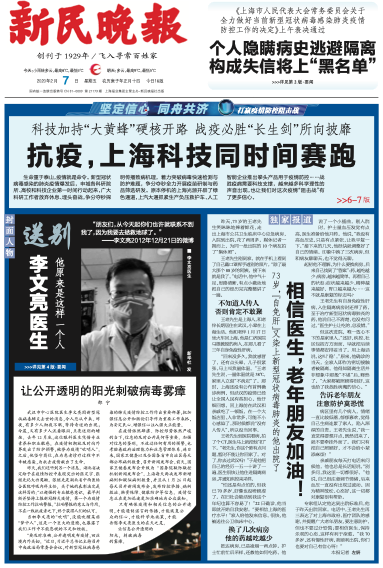
A number of front pages included the now famous image of Dr. Li wearing a protective
face mask and staring straight into the camera. The February 7 front page of
the Xinmin Evening News, a newspaper published in Shanghai under the state-owned
Shanghai United Media Group (SUMG), included this photo in a black frame box,
with the headline: “Farewell, Dr. Li Wenliang: So This is the Kind of Person He
Was.” A commentary below, designed with commemorative burning candles below,
was called, “Letting Openness, Transparency and Sunshine Break Through the Fog
of Disease.”
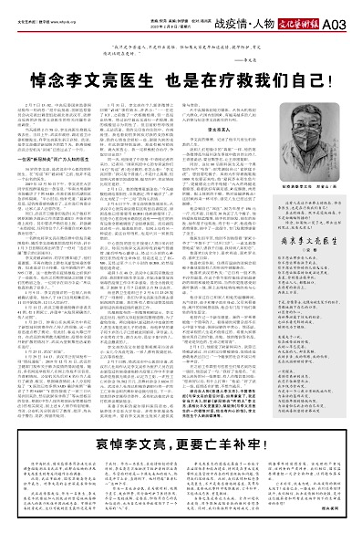
A commentary
in the Arts and Culture Journal (文化艺术报), “Remembering Dr. Li Wenliang is to Give Treatment to Ourselves,” included
a pencil sketch of Dr. Li shared to various social media platforms in China. The
commentary dealt directly with the issue of openness of information as a key
component of a healthy society, even including a quote from Li Wenliang during
a February 1 interview with Caixin Online: “A healthy society cannot have just
one voice” (个健康的社会不该只有一种声音).
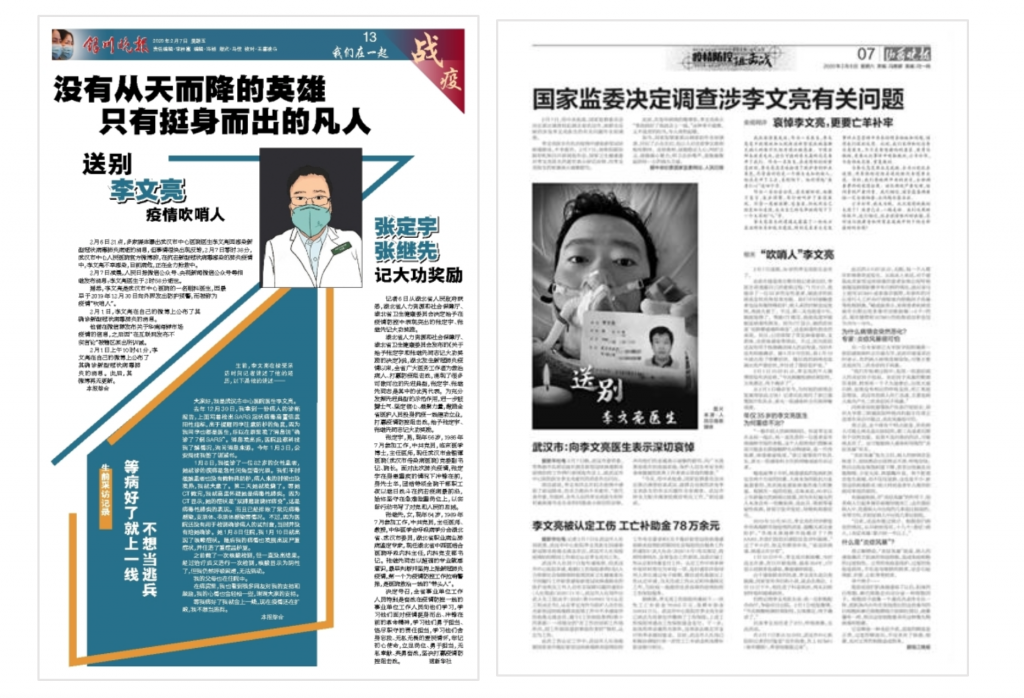
The
following are pages from Yinchuan Evening News (银川晚报) and Shanxi Evening News (山西晚报). At left, the Yinchuan Evening News story is quite explicit in is
rejection of overwrought notions of heroism, and emphasis on the “ordinary
person.” The large headline reads: “There are No Heroes Who Drop Out of the
Sky, Only Ordinary People Who Step Up.” Li is referred to on both pages as a “whistleblower,”
or “’whistleblower’ Li Wenliang.”
The very notion here of the “whistleblower” – particularly in contrast to heroic narratives – is a slight provocation, a recognition that in order to uphold his professional responsibilities and basic conscience Li Wenliang had to act against the impulses of a system that worked to keep him quiet.
But
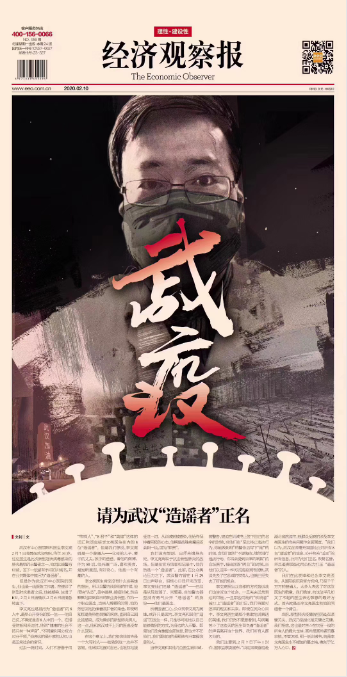
one of the most evocative front pages came from the Economic Observer, a
prominent business newspaper. The page was dominated by a dark image of Li Wenliang,
rendered in grey and earthy tones, with a pair of bold, martial arts inspired
characters that read: “Battling the Epidemic.” The sense was of Li as a popular
hero, as opposed to the abstracted sacrificial character of CCP propaganda. The
headline of the text below the image, against an oval design resembling the
coronavirus, read: “Please Clear
the Name of Wuhan’s ‘Rumor-Monger’”.
The article referred
to the now infamous
letter of admonishment that Li Wenliang was forced to sign by local police
in Wuhan confessing the error of his decision to shared information about the
dangers of the coronavirus outbreak. The Economic Observer again shared the
Li Wenliang quote from Caixin Online: “A healthy
society cannot have just one voice.”
The
following are translated portions of several articles, including the papers in
which they appeared. They provide an interesting, if sometimes subtle,
criticism of official narratives of abstracted “heroism” against genuine
respect and protection of flesh-and-blood human beings committing simple acts
of conscience.
“Forever Bearing in Mind the Weight of the World ‘People’” (永远牢记“人民”二字的分量)
Liberation Daily (Shanghai),
February 8, 2020
Remembering Li
Wenliang means a full and thorough investigation to respond to the most direct concerns
and confusions of the public, letting
the truth open the fog, using actions to provide answers – this is a consolation
to Li Wenliang, and a consolation to all the good people who care for him and
grieve for him. Remembering Li Wenliang also means respecting and protecting
more Li Wenliangs, offering thanks and respect to the countless Li Wenliangs.
This is not necessarily a tribute to “heroes,” but a tribute to the “people.”
Looking back now, his
acts, whether from a medical perspective or from the standpoint of the interest
of society, were doubtless acts of responsibility, warning signs given out of
professionalism. He is a true hero. As a number of experts have said: “Commenting
after the fact, we can give them the highest marks.” . . . . “The facts have shown
that faced with an unknown and complicated epidemic disease, it is more
responsible to treat small seedlings with an attitude of respect.”
“The ‘Whistleblower’ Has Gone: The Truth Should Remain” (“吹哨人”走了 真相应永驻)
Yangcheng Evening
News,
February 8, 2020
Those who embrace the public should not be left to freeze in the snow. Those who hold up a candle for the world should not be allowed to disappear into the night. Speaking truthfully, this is the basic ethics of any normally functioning society, and the cornerstone of maintaining fairness and justice. In the face of this epidemic, questions cannot be addressed only to this or that individual, or to certain [government] departments – we must all face them. In the swipe of the mobile era, grief and oblivion seem to come and go so quickly. But I hope we always remember him: Li Wenliang, the doctor and ‘whistleblower’ struck down so unfortunately by the epidemic.”
Two Embassies, Varying Opinions
The attitude toward the death of Li Wenliang in official circles, as glimpsed through media coverage on February 10, remained deeply divided, with an admixture of pragmatism.
On February 10, Shanghai’s Wenhui Daily ran a piece called, “Chinese Ambassador to the U.S. Introduces China’s Epidemic Fight on PBS News Program, Says ‘This is a Tough Struggle We Are Confident We Will Win” (similar foreign ministry release). Perhaps with a thought to accommodate the feelings of his American audience, Cui Tiankai was actually quite moderate during his interview toward Dr. Li Wenliang, saying that “we encourage speaking the truth.” The story read at one point:
Cui Tiankai emphasized
that we encourage speaking the truth. Perhaps at the start not everyone
understands and accepts these people who speak the truth, and such things could
happen in any place, but we encourage people to speak the truth, and to face
challenges head on. Only those who don’t speak the truth and who don’t face
challenges head on will be punished.
Cui Tiankai’s remarks,
however, were quite different in tone to a piece released on February 9 through
official WeChat account “Chinese Embassy In France.” The piece, called “Using
Unity and Victory to Say Goodbye to Dr. Li Wenliang” (用团结和胜利告慰李文亮医生), was
quite stern in its words for Chinese living in France who were voicing
opposition in the wake of Li’s death. It said:
There are certain people with ulterior motives (别有用心的人) using the memory of Li Wenliang as an excuse to agitate overseas Chinese and overseas students in France who care about the epidemic and organize a so-called “Tonight, We Whistleblow for Truth” (今夜,我为真相吹哨) event. Everyone must know that “whistleblower” (吹哨者) was originally a derogatory term meaning someone who is an informer or undercover. When they use this word to describe Li Wenliang, this attaches to him a political label, with bad intentions, the goal being to divide Chinese opinion, and this spoils the reputation of Dr. Li Wenliang and it is immoral. . . . At this time, we need to think and decide cool-headedly, clearly separating those voices truly made out of a sense of justice and conscience, and those that are using our feelings of pity to obscure the facts and incite anger and hate in order to sow chaos in people’s hearts and destabilize the overall situation. Before our great enemies, we must prioritize the overall situation and not be self-defeating . . .
On February 10, the Study Times journal published a commentary called “Public Opinion Phenomenon of Skidding After Snow Deserves Study” (舆论雪后打滑现象值得研究), which expressed the view that the turbulent public opinion following Li Wenliang’s death was a treacherous (like an icy path) battle of ideas. It echoed the view expressed by the Chinese Embassy in France that unified calls around Li Wenliang’s death were a conspiracy to confuse and sow chaos:
In the battle for public opinion, the situation is far more complex, the
enemy is often not even visible, and the front-lines cannot be made out
clearly. If we do not maintain clear positions and rational thinking . . . . it
will be difficult to avoid being engulfed in public opinion, becoming the passenger
on the public bus skidding after the snow.
On social media, the talk of conspiracy was often even clearer. The views of a purported officer within the Public Security Bureau posted to WeChat (of unclear origin) and shared widely suggested that in view of the urgency of the epidemic and other problems facing China, public opinion had to be controlled, and sources of information must be centralized:
Right
now the country faces an extremely complicated and severe situation, whether
this is about facing domestic pressures or external pressures, or about facing
the pressure in terms of the epidemic, production, food, supplies, public
opinion, economy, finance, diplomacy, the military . . . . and so on. We can
say the pressure is on all levels, and if any link experiences a problem this could
have a serious chain reaction, creating a domino effect, and the consequences
would be unimaginable! National security is the interest of the people. . . . .
The world is not so peaceful and
harmonious as ordinary people generally think, and the more the country faces
danger the more rumors fly, because the precision public opinion attacks from
external forces begin, just as we’ve seen in Hong Kong. If the government loses
its credibility and discourse power then it has taken irreversibly to the road
of national decline! Why does public opinion choose Dr. Li? Because he is
young, handsome, motivated and kind, and he is all the more capable of inspiring
the sympathies of ordinary people, and more capable of stirring up public opinion
. . . .
This post expressed concern at the intense criticism facing the police as a result of Li Wenliang’s treatment by police in Wuhan, and speculated that this could become a source of broader instability incited by vague “external forces”:
Fingers
are now pointing at the Public Security Bureau over the epidemic, with criticism
everywhere . . . . If they [the police] lose heart and forfeit their ability to
maintain control, it is conceivable that the external forces will conduct their
precision attacks with the intention of replicating the Hong Kong model!
These diverging views are of course not at all unfamiliar. On the one hand, the view that information openness is a crucial aspect in any society, and that the voices of professionals, journalists and all manner of ordinary people must be heard as a matter of basic health and social well-being. On the other hand, the view that public opinion is a toxic and destabilizing force, manipulated by hostile “external forces,” that must be controlled as an urgent matter of national security (overlaid, of course, with the question of regime security). The same divergence of views within the leadership and within official media emerged in the midst of the 2003 SARS epidemic.
In the light of the Li Wenliang case, many Chinese have noted the frustrating familiarities. It has been 17 years since the SARS epidemic, which at that time prompted soul-searching about the role of openness and information in dealing with issues of immediate public concern. And yet, some ask, have the costs of information secrecy and public opinion control changed?
One Chinese internet
user commented on the frustrating lack of apparent progress between 2003 and
2020 by sharing side-by-side two covers of China Newsweekly, a leading
news magazine. The first, dating back to 2003, bore the cover story: “SARS: What
Price Must We Still Pay?” The second, from this month, bore the almost identical
title: “Coronavirus: What Price Must We Pay?”
Xi Jinping’s train of titles seems to grow longer and longer. In an article posted earlier this week to an official WeChat account of the National Radio and Television Administration, the CCP’s general secretary was lauded with the phrase “proletarian revolutionary” (无产阶级革命家).
What is this phrase? Where does it come from?
Here is a screenshot of the post dealing with the response to the
coronavirus epidemic, which is headlined: “Following the Example of General
Secretary Xi Jinping, For a Loyal and Heroic Struggle for Early Victory.”
The post begins by talking about events six years ago in February 2014, when Xi Jinping’s “imposing figure” appeared in Nanluoguxiang, a well-known alley in Beijing, at a time when dangerously smoggy air was a hot topic across the country. The stunt was meant to signal to the public at the time that their leader was human and accessible, ready to breathe the same air. Yesterday’s post reads: “He did not wear a face mask that time. The news at the time said, ‘The smog has not dissipated, but the general secretary has already emerged.’”
The post includes a photo of Xi Jinping wearing a face mask during a tour of a Beijing neighborhood on Monday, part of a series of visits meant to show that he is present on the front lines of the fight against the coronavirus.
The phrase in question, which I’ve highlighted above, comes a bit further down in the post. “Great proletarian revolutionaries are always filled to the brim with the optimistic revolutionary spirit,” it reads.
Since the People’s Daily newspaper was launched on May 15, 1946, 40
people have been described in this way, which may seem to suggest the term is
not so exceptional. However, we should note that aside from Mao Zedong and Deng
Xiaoping, all of those mentioned as “proletarian revolutionaries” were labelled
as such only after their deaths, and often in official obituaries.
It is exceptional to be designated a “proletarian revolutionary” during
one’s lifetime.
The label was used early on and with some regularity for Mao Zedong, accounting
for the majority of instances we find in the People’s Daily. For Deng
Xiaoping, the title came only after his resignation as chairman of the Central
Military Commission in 1989.
As for the others, here is a taste of the distinguished group:
Karl Marx Friedrich Engels Former Soviet leader Vladimir Lenin Former Soviet leader Josef Stalin Former Yugoslav leader Josip Broz Tito The novelist Lu Xun Revolutionary-era figures Peng Pai, Fang Zhimin and Chen Tanqiu German Communist Party founder Rosa Luxemburg Liu Shaoqi Zhou Enlai Zhu De Li Xiannian Zhang Wentian Ye Jianying Peng Zhen Deng Yingchao (a rare woman on the list) Hu Yaobang
The group also includes Xi Jinping’s father, Xi Zhongxun, who after his
death was praised as an “excellent proletarian revolutionary” (杰出的无产阶级革命家).
But the reference to Xi Jinping as a “great proletarian revolutionary” faced
a quick death online. The post was removed within 24 hours, yielding the
following error notice reading: “This message is not viewable as it violates
regulations.”
This is an interesting turn of events. A post made to WeChat by one of the
chief regulators in the information terrain, the National Radio and Television
Administration, is deemed to be in violation of regulations.
According to its public
description, the account, “National Radio and Television Archive” (国家广电智库) is operated by the Development Research Center of the
National Radio and Television Administration” (国家广播电视总局发展研究中心), and works to “explain policies in the
radio and television sector in a timely manner, posting leadership speeches, industry
news, development plans, radio and television laws and regulations, research reports
and so on.”
But in this case, the account’s praise for Xi Jinping appears to have gone too far. It was very likely regarded as an embarrassing case of “high sarcasm,” or gaojihei (高级黑), damning through the act of praise.
We use cookies and similar technologies to improve your experience on our website.
Read our Privacy Policy.