In a rare post yesterday, a user on China’s WeChat platform offered a thoughtful — and cutting — assessment of the state of the country’s news environment. Responding to a recent wave of notices from newspapers about pending closures, the essay countered the idea that this trend stems from the growing irrelevance of traditional print media in an era defined by digital media and AI.
The author’s core argument was that traditional newspapers and magazines in China, which from the early 2000s through the early 2010s carved out a space of relative vibrance, have not just shifted to digital — but have, more importantly, abandoned any pretense of reporting news or doing journalism.
“I have a perspective that may be a bit tougher to hear,” the post read. “That it was the newspapers that first lost their capacity to produce content, and that it was they in fact who took the initiative in abandoning their readers.”
Well worth a read, the post is an excellent complement to several recent stories we have written here at the China Media Project, including Dalia Parete’s look at the collapse of local broadcasters across China, our piece over at Tian Jian (田间), translated here, about the extreme challenges facing journalists in China today, and my own post about the gleeful uptake of AI by official state media, who have little need in a climate saturated by propaganda for the soul-searching one finds among journalists elsewhere in the world.
Despite the fact that this post made no directly correlation between the worsening journalism space and the unbending media and information control policies of Chinese leader Xi Jinping, it was removed from WeChat sometime earlier today, yielding a message that it was in violation of “relevant laws.”
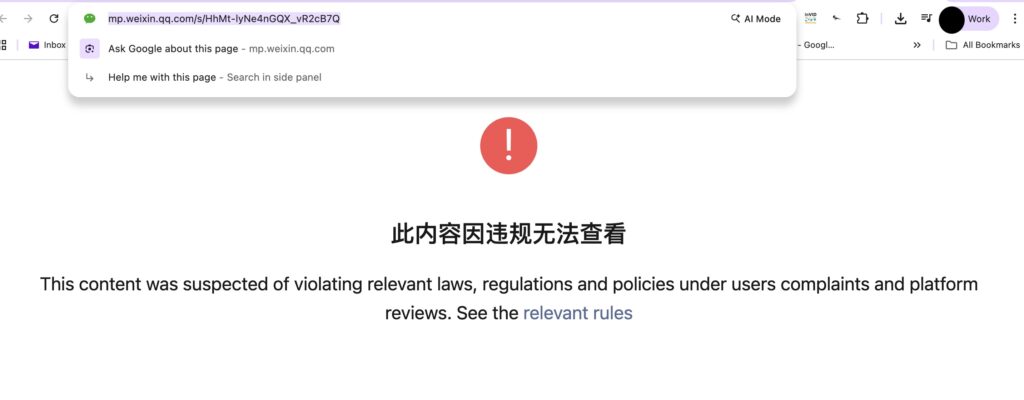
A translation of the first two sections of the WeChat post follow, and we also provide a downloadable PDF down below for those who wish to read the original.
____________________
Since the outset of this year, at least 14 newspapers have announced they are closing shop. Thing about this for just a moment and you realize that notices of this kind are no longer news. By now, we should be long accustomed to the long winter of print. Some point to the frenetic pace of modern life — people are just too unsettled to sit back and read the newspaper. Others say that newspapers have simply been forsaken by the times.
I have a perspective that may be a bit tougher to hear. That it was the newspapers that first lost their capacity to produce content, and that it was they in fact who took the initiative in abandoning their readers.
01
Have you guys noticed that it’s not just newspaper readership that has cratered? It’s also the case that fewer people are watching television. These days, craving news or gossip, we turn first to Weibo, to the push notifications we received from news apps, to Douyin, to WeChat public accounts, or to Toutiao and scores of other such channels.
Print and television media no longer have the news that people need.
According to the Blue Book of Data Journalism (2024), 831 separate news website domains are operated by newspapers in our country, as well as 852 mobile apps and 9,393 WeChat public accounts. The total number of users of new media has passed 10 billion, and total revenue from the new media operations of traditional print newspapers reached 6.22 billion RMB, up 3.4 percent from 2023.
So, we can see that traditional print media have not simply been sitting around and waiting to die. They have been transforming.
The form has changed without a doubt. But to what end? Our mobile screens are filled with “shocking” headlines, with “plot twists” and “flowing tears.” Click in to have a look and you’ll find that the six most basic elements of any news story are nowhere to be found. The headline is just meant to grab your eyeballs (吸引眼球), but the content it incomplete from top to bottom, and at the end nothing is clear — or maybe there’s just borderline content tossed in to log an instant of traffic.
One example from a story I saw just yesterday. The headline: “US Military Official: American Forces Consumed 7.6 Million Cups of Coffee During Strikes on Iran.” The outlet that published it is one of the country’s leading domestic media outlets.
A video report from the official China News Service on Facebook shows the remark from US General Caine about the amount of coffee consumed by the US military amid strikes on Iran.
I couldn’t help but ask myself — what is the point of posting this sort of thing? Is this something that can raise public awareness, or something that can advance social progress?
In the meantime, things of genuine social concern go unreported, and stories from the grassroots go unreported. Most alarmingly, this mode of news that does not look like news (这种新闻不像新闻的模式) has already become the industry mainstream.
02
What is the role of the media? In the view of the West, media are “public instruments,” or a “Fourth Estate.”
You’ll find today that many reports bear bylines like “reporter so-and-so.” But read the entire report and you’ll find yourself asking: Where is this reporter exactly? Perhaps they are scrolling through Weibo or lying in wait in the comment sections, or they are waiting for official notices to come out. Whatever the case, they are anywhere but at the scene where news is happening.
When media no longer have the capacity to verify or produce information, but rather become the frontline consumers of information, the truth jostled about amid the flood and frenzy of public attention and traffic often proves too delicate to withstand it.
Back in January, one case in Taizhou, in Zhejiang province, went through three iterations involving a husband and wife and food safety. First, the pair claimed to have been “poisoned” after eating baby cabbage ordered online. Next, the story was that “the seller wrapped the vegetables in toxic newspaper.” Then, finally, it was that “the husband poisoned his wife.” Finally, the authorities announced that “the couple had colluded to poison themselves and fraudulently claim compensation.”
Early in the story, some outlets ran stories based on the couples’ own account that conclude that “the seller used toxic newspaper to wrap the vegetables.” As the story developed, some media spread the claim, without any clear or credible sourcing, that “the husband had poisoned his wife.” When the truth finally dawned and police disclosed that the couple was suspected of extortion and blackmail, some of the outlets that had leapt on the story from the start quietly pulled their posts offline, draining their last dregs of credibility.
The root cause here is that media have become like headless flies that buzz off toward the stench of traffic.
When media no longer provide [the public] with exclusives, no longer offer depth, no longer offer truth, what can possibly induce readers to stay? If media have been abandoned, they have only themselves to blame.
For those who wish to read on, we are posting a full archived version of the post below.