During a press conference on May 12, 2026, China’s Ministry of Foreign Affairs urged the countries of Asia to “have their eyes wide open, and unite in resisting the stirring of Japan’s ‘neo-militarism.’” The remarks came following successive months during which use of the phrase, which associates recent increases in Japanese military spending with historical aggressions during the first half of the 20th century, increased markedly in China’s state-run media.
While “neo-militarism” has a deeper history within Chinese Communist Party (CCP) discourse, and has cropped up periodically during the Xi Jinping era, the more recent precipitating incident in Sino-Japanese relations appears to have been a statement by Japanese Prime Minister Sanae Takaichi to the National Diet, the country’s legislature, on November 7, 2025, saying that Japan would face an “existential crisis” in the event of a Chinese attack on Taiwan. Takaichi’s remarks set off a diplomatic feud between the countries that quickly escalated into military posturing and a series of other actions, including warnings from China against tourists traveling to Japan.
Takaichi’s November 7 language was closely followed by a report in the popular daily newspaper Sankei Shimbun that said the government was pushing to change the class names of Japan’s nominally non-military Self-Defense Forces to military designations, a move Chief Cabinet Secretary Minoru Geira called merely an “international standardization.” Within days, Chinese state media had begun to frame both developments within a single narrative of Japanese remilitarization.
On November 17, the Hong Kong-based Wen Wei Po (文汇报), published by China’s central government Liaison Office, ran a feature warning of the revival of “militarism” in Japan. The next day, the Global Times (环球时报), a commercial spin-off of the CCP’s official People’s Daily newspaper, ran a roundtable discussion under the headline: “If Takaichi Clings to Her Obsession with ‘Neo-Militarism’ This Will Only Lead Her Astray.” Three Chinese academics argued that Takaichi represented a dangerous trend for the region, with echoes in history. “While the current process of remaking Japan as a military power is different in form from the naked aggression and expansion of the period before the [Second World War], its ideological roots and political driving forces are of one continuous line with prewar militarism,” Xiang Haoyu (项昊宇), a researcher at the China Institute of International Studies, was quoted as saying.
By December, use of the term had risen noticeably across a range of official Chinese media and party-linked institutions. On December 4, the CCP Central Party History and Literature Research Institute published a theoretical essay arguing that Japan had never truly eradicated militarism after 1945, describing “new militarism” as a “dangerous mutation” disguised in the rhetoric of “proactive pacifism.” On December 24, People’s Daily Online (人民网) carried a lengthy policy piece describing Takaichi as “the spokesperson for Japan’s new militarism trend of thought.” By then the frame had also spread to more commercially oriented party-run outlets. On December 1, Shangguan News (上观新闻), the digital outlet of Shanghai’s Liberation Daily group, ran a feature on “new militarism’s dangerous turn.” Two days after the People’s Daily Online piece, MFA spokesman Lin Jian declared at his regular press conference that China would work with “all peace-loving nations” to check “any dangerous acts of reviving militarism and shaping ‘new militarism,'” with the state-run broadcaster CCTV amplifying the remarks the same day.
The next month, as a new year dawned, there was a wave of attention to “new militarism” in the official Party-state media in China, a clear sign that the frame was shaping up to be a cornerstone of Party propaganda on Sino-Japanese relations in 2026. On January 9, the People’s Daily published the first of two commentaries under the penname “Zhong Sheng” (钟声), a homophone for “voice of China” reserved for weighty foreign-policy pronouncements. The piece warned that Japan’s right wing was “going further and further down the dangerous road of ‘new militarism.'”
The official Xinhua News Agency followed on January 15 with a report urging the international community to “see through the mask of the ‘peaceful nation'” behind which it said Japan’s right wing was hiding. On January 27, a second “Zhong Sheng” commentary declared that Japan’s “new militarism” was “no longer just a dangerous tendency but a real threat.” Guangming Daily, a newspaper published by the CCP’s Central Propaganda Department, added its voice on January 28. In its “Mingdi” (鸣镝) column on foreign affairs, it warned that Japan’s “new militarism” risked becoming “a source of calamity for the region” (地区祸源). In Hong Kong, meanwhile, the Chinese government-run Ta Kung Pao (大公報) ran a multipart series under the headline “The Ghost of Militarism Still Haunts Us.”
Japan Responds
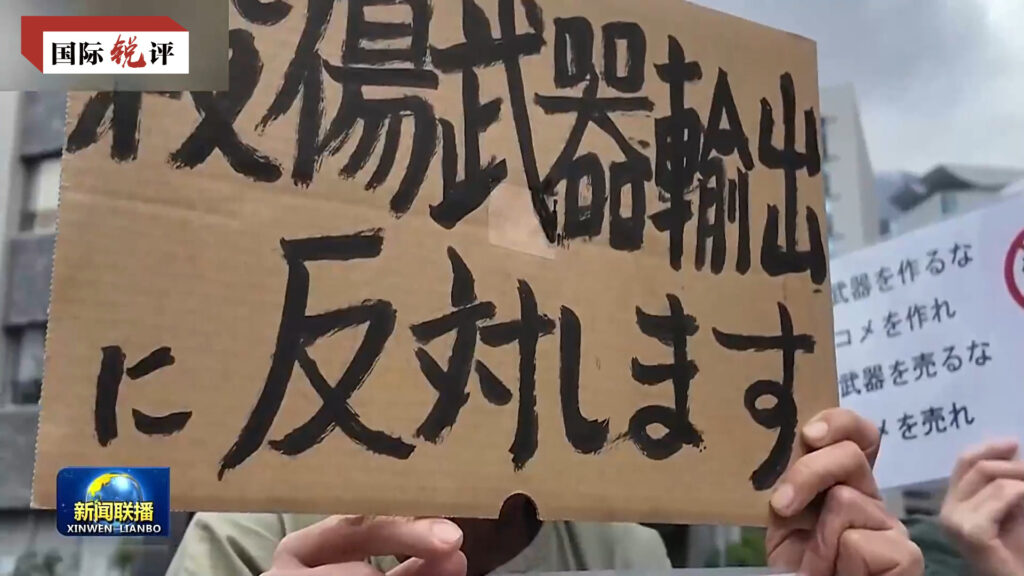
As China escalated its official propaganda about Japan’s alleged “new militarism” through the spring of 2026, and as further defense-related moves by Japan have prompted Chinese outrage, Japanese commentators fired back. In late April, as Takaichi’s government scrapped decades-old limitations on military equipment transfers and China again fulminated about “new militarism,” Japanese argued that the restrictions had simply been “out of step with the times” given China’s military rise in the Indo-Pacific region. “China’s repeated allegations of Japanese ‘neo-militarism’ are unfounded and unpersuasive and little more than government propaganda,” wrote Kunihiko Miyake, president of Japan’s Foreign Policy Institute, in The Japan Times in April 2026.
The back and forth culminated at the Shangri-La Dialogue on May 31, 2026, in Singapore, where Japan’s defense minister, Shinjiro Koizumi, issued the sharpest rebuttal to date on the “neo-militarism” framing. “Think about it,” he said. “There’s a country that has a huge arsenal of nuclear weapons and strategic bombers. Japan has neither of such weapons, and yet Japan is labelled ‘new militarism’?” At the same forum, a Chinese general countered that Japan was not qualified to speak on defense cooperation because it had “not thoroughly eradicated the toxic legacy of militarism.”
It should be noted that the rising trend in Japanese defense spending is real — a response in large part to China’s military buildup and increasingly aggressive posture in the region, as well as to the uncertainty of American support. The country’s defense budget grew from around 5.4 trillion yen in fiscal 2022 to approximately 11 trillion yen in fiscal 2025, according to SIPRI, a Stockholm-based arms research institute, hitting the 2 percent of GDP target two years ahead of the schedule set by the previous Kishida administration. The above-mentioned lifting of Japan’s weapons export ban in April 2026 also followed the deployment in late March 2026 of long-range missiles capable of reaching China to Kumamoto Prefecture on the southwestern island of Kyushu.
