
Sweeping the Ancestors Aside
Early Sunday morning, as China’s national anthem, “March of the Volunteers,” blared across the granite plaza of Longhua Martyrs Cemetery in Shanghai, honor guards marched in lockstep toward a tomb commemorating Communist martyrs executed nearly a century ago. Nearby, a group of Young Pioneers, the Chinese Communist Party organization for primary school-aged children, recited “Ode to the Green Pine,” a lyric poem standard at Party youth events, its imagery of pines standing unbowed through the cold of winter a tribute, borrowed from ancient aesthetic traditions, to the unyielding spirit of revolutionary martyrs — and to the Party’s unbending resolve.
The ceremony in Shanghai was echoed across the country over the weekend in celebrations that honored the multi-generational legacy of the Party. At the Shenyang cemetery for martyrs of the 1950–53 war on the Korean peninsula, students from Liaoning University climbed the steps to lay flowers before a martyr’s tombstone. “As I walk through the cemetery, the martyrs’ stories I once read in the textbooks feel more real,” physics student Yang Xinli (杨兴立) was quoted as saying in the official People’s Daily. The rest of his quote was a perfect roadmap pointing the way from remembrance to obligation. “As young people of the new era, we will forever remember the contributions of the revolutionary martyrs, deepen our love for the homeland, study diligently and put our learning into practice, and make the contributions necessary to our generation.”
In the headlines and public ceremonies, the martyrs to the cause of the Chinese Communist Party were honored in place of family ancestors, the mythology of sacrifice and struggle overlaid on Qingming — also known as “Tomb Sweeping Day” — one of the oldest folk observances in Chinese culture.
In its traditional form, the holiday is largely a family affair. Descendants gather at ancestral graves to clear away weeds, burn incense, and lay offerings of food. In places like Taiwan, visiting family members may cast divination blocks to learn whether their forebears have eaten their fill. The day is, at its heart, an opportunity for the reunion of the living and the dead. It is intimate, family-focused, and rooted in Confucian traditions of filial piety that predate the Communist era by more than two millennia.
In the version that played out in official media in China this weekend, such heartfelt family affairs were consigned to a space outside the headlines. Emotion, such a powerful tool, was reserved for the Party itself.
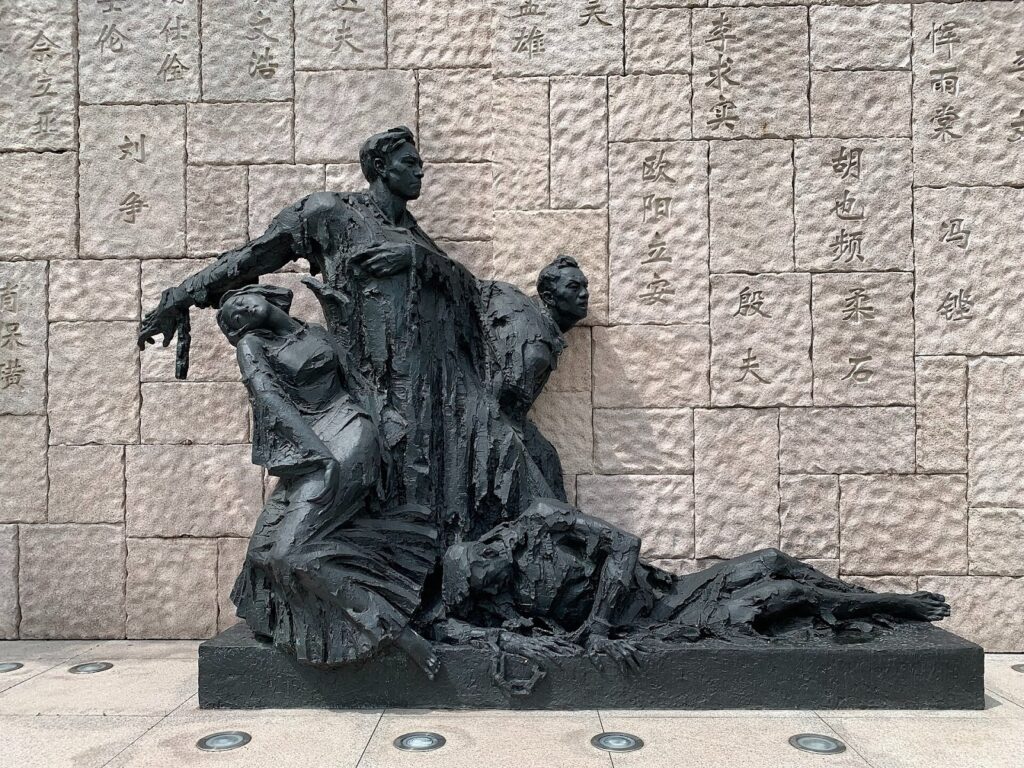
Across China on Sunday, the People’s Daily reported this week, “cadres and the masses” traveled not to family graves but to revolutionary sites, martyrs’ cemeteries, and red heritage zones, where they “drew on the strength of faith” and “carried forward the spirit of martyrs.” The piece was republished across Party-state media, including on the website of CCTV, China’s official state broadcaster.
The Ministry of National Defense website carried its own Qingming special, publishing a report from China National Defense News that dispatched reporters to sites along the route of the Communist Party’s much-mythologized “Long March” (1934–35), a trek during which they retreated to escape Nationalist forces under Chiang Kai-shek (蔣介石). The journey across rugged terrain has since been enshrined as a core founding myth of the Party’s rise to power. In Huining, in western Gansu province, at the point where three Red Army columns are said to have converged to mark the march’s end in 1936, tens of thousands of students across seven sites filed into formation and took oaths via livestream.
In perhaps the most vivid illustration of the interbraiding of Party legacy and family obligation, the China National Defense News piece told the story of a Hubei family that had tended the grave of an unnamed Red Army soldier for five generations. The family had handed this volunteer tradition down from father to son since 1936, the paper reported.
To the critical eye, such a story seems too good to be true, a perfect patrilineal line binding successive generations in an unbroken chain of duty. True or not, the license with which such details are delivered in the Party-run press has become an annual Qingming tradition in China, a ritual of displacement in which private and poignant commemorations of the dead are substituted with political mythmaking.
For eight decades now, such propaganda has been inseverable from China’s Tomb Sweeping tradition.
Revolutionary Ancestries
In April 1949, months before the PRC was formally proclaimed, the People’s Daily reported that Baoding, a city in Hebei province just southwest of Beijing, had organized public gatherings to commemorate the saints of the revolution during Qingming. Thousands reportedly attended the ceremonies, in which local officials pledged to carry forward the “unfinished work of the martyrs.”
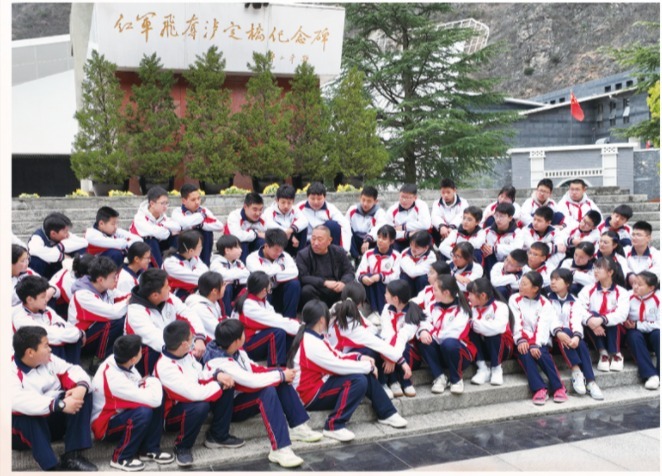
By 1964, the People’s Daily reported that an estimated 50,000 people had visited graves at Babaoshan Revolutionary Cemetery in Beijing alone, and that Young Pioneers — in a historical echo of ceremonies this past week — had held induction ceremonies at the feet of martyrs’ tombs in cities from Nanjing to Guangzhou. The report even noted that more than 10,000 people in Fushun had swept the grave of Lei Feng (雷锋) — the model soldier whose martyrdom had been manufactured by propaganda teams just the year before.
The only significant interruption to the march of martyr celebrations on Tomb Sweeping Day came in 1976, as the Gang of Four, the radical clique that dominated Chinese politics in the waning years of the Mao era, dismissed Qingming as “a ghost festival.” The day was to be rooted out as a superstitious example of Mao’s “Four Olds” — outdated ideas, culture, customs, and habits. That year, according to an account published in the People’s Daily two years later, a young bulldozer driver named Han Zhixiong (韩志雄) had been arrested by plainclothes police for mourning the death of Premier Zhou Enlai (周恩来) and posting a satirical essay at the Monument to the People’s Heroes in the center of Tiananmen Square. Han was imprisoned for more than a year along with other conscientious mourners, but by November 1978 had been rehabilitated.
By April 1981, the Gang of Four tried and convicted and the historical resolution just two months away that would criticize the Cultural Revolution as an “error comprehensive in magnitude and protracted in duration,” the People’s Daily was again running Qingming coverage. Far from being an outmoded and superstitious tradition, the day was again a celebration of martyrs past that pointed the way to the Party’s enduring future.
The Cultural Revolution had only interrupted what had already, by all official accounts, become tradition. In Qingming that year, 750 Young Pioneers from a Beijing primary school gathered before the Monument to the People’s Heroes. Beneath a national flag “undulating in the wind,” they recited in unison a poem called “Treading in the Footsteps of the Revolutionary Martyrs,” and inducted 37 new members into the mass organization intended to bear the Party’s legacy of rule into the future like the “blazing red flags” they held aloft.
Interviewed by the People’s Daily, the head teacher from Shuncheng Street No. 1 Primary School was quoted as saying that Qingming remembrance of revolutionary martyrs was “our school’s longstanding tradition.” Just a few short decades after intimate tributes to the family had been supplanted in public life by grandiose gestures to the revolutionary heroes, things had always been this way.

