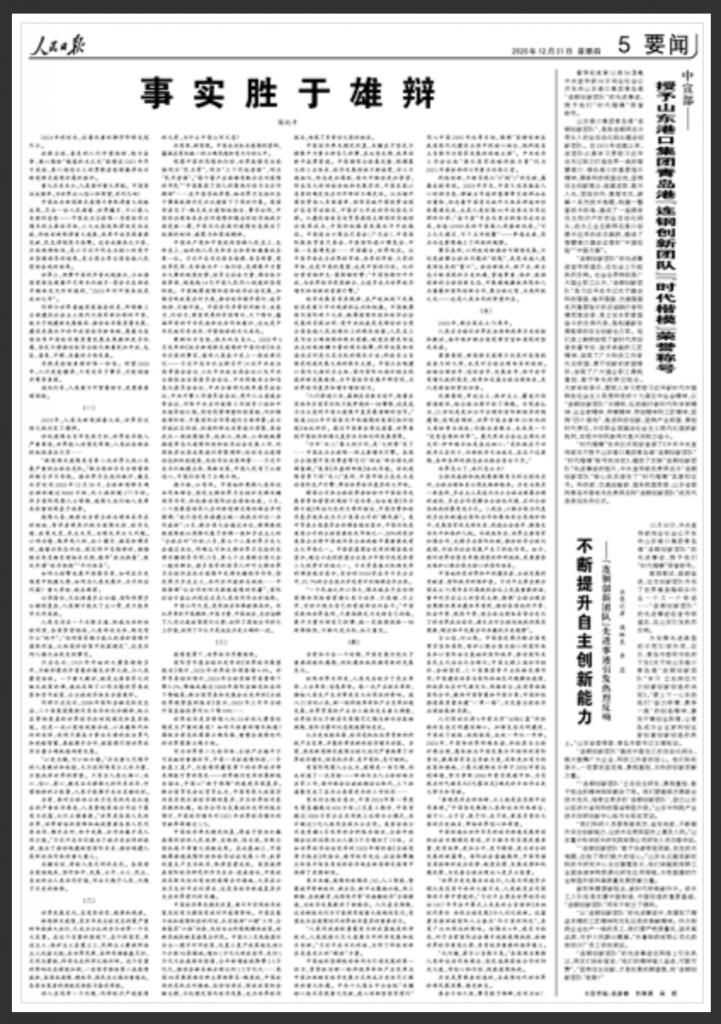
On page five of today’s official People’s Daily newspaper, a commentary by Guo Jiping (国纪平) – short for “important commentary on international affairs,” or you guan guoji de zhongyao pinglun (有关国际的重要评论) – offers a full-scale account of China’s year in 2020. It will surprise no one that this account is entirely positive, full of unambiguous superlatives about China’s achievements and how, most importantly, these can all be chalked up to the superb leadership of Xi Jinping and the Chinese Communist Party.
The commentary, “Facts
Speak Louder Than Rhetoric” (事实胜于雄辩),
is a sprawling page of rhetoric – about the “community of common destiny for mankind” (人类命运共同体),
about “Six
Stabilities” (六稳)
and the “Six Guarantees” (六保),
about the “miracle of China’s rapid economic growth,” and so on.
If there is any question about how the Chinese Communist Party will choose, officially, to remember 2020, all questions are answered in the soaring rhetoric of the Guo Jiping piece.
The summary sentence at the start:
At a major historical juncture, mankind faced a major
test. China showed its report card, and injected confidence and hope into the
world. How extraordinary!
And here is the basic assessment of the year:
China achieved major strategic results in the fight
against Covid-19, delivering a response that satisfied the people, turned the eyes
of the world, and is to be recorded in the annals of history. China has become
the only major economy in the world to achieve positive economic growth, and it
made major breakthroughs on the Three Major Struggles [of preventing and resolving major risks, achieving
poverty alleviation, and preventing pollution] as well as major progress on
science and innovation, on major breakthroughs in reform and opening, and on strong
guarantees for the peoples’ livelihood. These achievements did not come easily,
but came through hardship and obstacles, and they result from the resolute leadership
of the Chinese Communist Party with Comrade Xi Jinping as the core, and result
from the united struggle of the whole Party, the whole army, and people of all
ethnic groups throughout the country.
There are many voices in the world praising China one
after another. As the former foreign minister of and deputy chancellor of Germany
Joschka Fischer declared in the Spanish media that “2020 is a successful year
for China.”
There is no mention, of course, that while Fischer did write earlier this month that “2020 proved to be a highly successful year for China,” particularly noting failures of leadership elsewhere in the world, he also was very clear that “[serious] failures by Chinese authorities permitted that outbreak to grow into a pandemic that has now killed almost 1.5 million people and brought the global economy to a standstill.”
But the Party and its flagship newspaper know only too well that rhetoric can speak louder than the facts.
The key
message to emerge from the most recent “collective study session” of the CCP Politburo
was a simple one: security. At the session, held on December 12, Xi Jinping stressed
that a renewed emphasis on security was mandated
by “the historical position of our country’s development and the situation and
tasks facing national security.” This, he said, followed the “Decision”
released by the Fifth Plenum in October,
which marked the first time that “integrating
development and security” (统筹发展和安全) had been included in a five-year plan
for economic development.
The Chinese Communist Party has long been obsessed with security, and all forms of security are closely tied to maintaining the stability and legitimacy of the regime itself. But we seem, midway through Xi Jinping’s second term, to be in the midst of a heightened period of security consciousness.
Among the burst of security related catchphrases emerging from the
December 12 session, we find “building a big security structure”
(构建大安全格局), “adhering to the organic unity of
political security, people’s security, and the supremacy of national interests”
(坚持政治安全, 人民安全, 国家利益至上有机统一), and “fully using the national
security policy toolbox” (用好国家安全政策工具箱). Taken together, they suggest that Chinese leaders are viewing policy
concerns across the board in China through the lens of national security – premised,
perhaps, on a deepening sense of insecurity.
As the leadership pursues its broadening definition of national security, one integral part of the security toolbox is certainly the use of big data and technology, including such tools as facial recognition. But this renewed emphasis on security also comes at a moment when there has been more engagement with the issue of personal data security within Chinese society.
A landmark case in November, coming just two months after the “largely overlooked” release in September of a new Draft Data Security Law, ruled that it was illegal for the zoo in the city of Hangzhou to collect facial biometric data from visitors without their consent. And there has recently been an uptick in stories from Chinese media about the widespread and unwarranted application of technologies like facial recognition. The news in late November that real estate companies had secretly been collecting information on clients using facial recognition sparked widespread anger.
Several cities, including
Tianjin and Nanjing, have already ordered curbs on public applications of
facial recognition technology, responding to growing public concern. In a survey
released a year ago by Guangzhou’s Southern Metropolis Daily
newspaper, more than 70 percent of respondents expressed concern that personal
biometric data gathered through facial recognition technology in public places
could be leaked and abused.
One of the most absurd recent cases to gain attention in the Chinese media recently was a viral video posted earlier this month in which a man enters a real estate exhibition wearing a motorcycle helmet with a visor in order to evade facial recognition cameras. But the discussion over security and the application of new technologies reached new heights of absurdity this past week as a number of Chinese media reported that facial recognition technology is being used even to regulate the use of toilet paper in public toilets across the country – in train stations, in malls, and at tourist attractions.
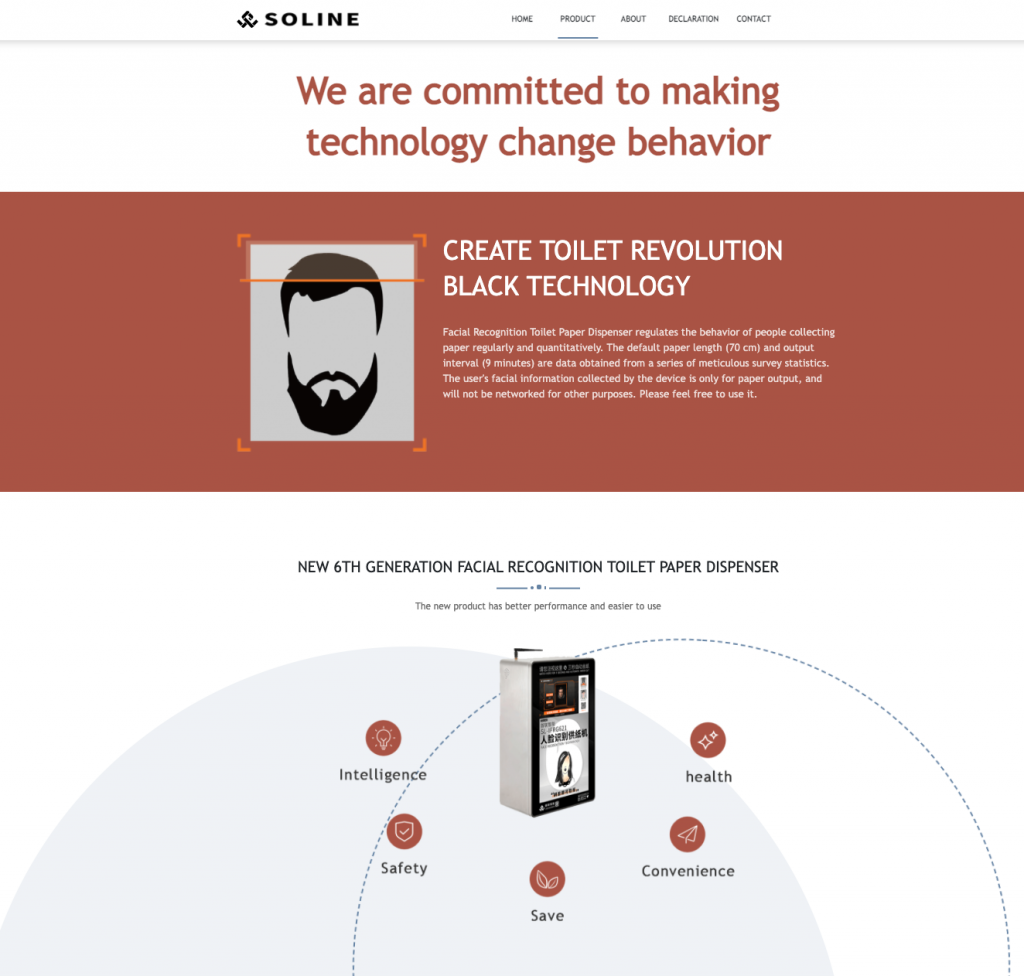
Interestingly, one of the key suppliers nationally of facial recognition toilet paper dispensers is SoLine Technologies Co., Ltd., a “high-tech enterprise specializing in biometrics” that is now selling its sixth-generation facial recognition toilet paper dispenser – but is based in Tianjin, a city that recently introduced restrictions on such uses.
Screenshot of the “Products” section of the Soline website.
As new technologies have been integral to CCP thinking about a range of issues concerning regime security, including the adoption of “convergence” to reconsolidate controls over the media, the intersection of security objectives and data privacy concerns in China will be a key issue to continue watching.
In the meantime, the following is CMP’s translation of a recent report on facial recognition toilet dispensers from the Qianjiang Evening News (钱江晚报), a spin-off of Zhejiang’s official Zhejiang Daily. Similar reports across China have provoked a response, and the city of Dongguan recently announced that it was ending use of the machines.
_________________
Facial Recognition
Also Used for Toilet Paper in Public Toilets? Hangzhou East Railway Station Responds:
[Data] Deleted Automatically After 10 Minutes
December 17, 2020
Facial recognition is already being widely used in our
lives. From the level of smart cities (智慧城市) down to the
level of unlocking our mobile phones, we readily see the shadow of facial
recognition technology.
However, while this new product of the internet era
brings people convenience, it also prompts new uneasiness – there are more
channels by which users’ faces, physical movement and other sensitive
information can be leaked.
Recently, owing to the fact that some property owners
were using facial recognition for [residential] community access, there was a
great deal of attention in society [to the issue of privacy], and this became a
hot topic. Subsequently, reporters for the News Hour column at Qianjiang
Evening News carried out investigations and visits on the application of
facial recognition technology in many contexts in the city of Hangzhou – including
over the question of whether there might be risks in the storage and management
of facial recognition data in the back-end of these applications.
Over the past two days, many netizens have reported to
News Hour: “It’s not only out in the community,” [they have said.] “Now,
you even have to submit to a facial scan to use toilet paper!”
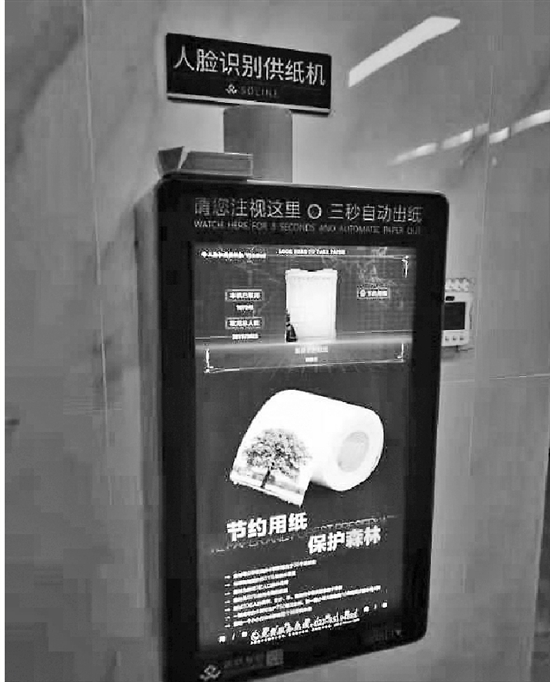
The photo sent by one netizen showed a “facial
recognition toilet paper dispenser” (人脸识别供纸机) at the entrance to the public toilet at Hangzhou East
Railway Station. The Qianjiang Evening News reporter decided to head to
the scene to find out more.
The Reporter’s Observations
At the entrance to many public toilets at the Hangzhou East
Railway Station, the reporter saw the “facial recognition toilet paper dispensers”
to which the netizen had referred.
These machines were generally placed in less conspicuous
positions on the walls outside the entrances to public toilets.
The reporter observed that there were only a small number
of people who came by to use the machines. Waiting near one of these machines
for about 15 minutes, there were just two people who came up to use them – and it
should be understood that the public toilets in the Hangzhou East Railway
Station are get very high use.
The process of getting toilet paper is quite easy. Users
show their face to the screen on the machine, standing still for three seconds,
and a ribbon of tissue from 60 to 100 cm in length, about 8-10 squares, is dispensed
from the machine. According to design, if the same user attempts within a few
minutes to scan their face again, the toilet tissue will not be dispensed.
This is the a core feature of the machine – that it can
save on the amount of paper dispensed within a short period of time, and in
this way conserve paper.
One woman who went through the facial scan and received
her toilet tissue told the reporter: “I do have this question of whether my
facial information, once its inside, will somehow be misused.”
But there are also other voices.
Among the cleaning ladies working in the station, quite a
few say they use the facial recognition dispenser to get toilet paper. One of them
said to the reporter: “This is really convenient! Where is my facial
information? I don’t know, but I don’t really care!”
Mr. Liu, a traveller, said he was not eager to try out
the machine: “Where does the facial recognition data go?” he asked. “Will
it be stolen?”
East Railway Station Employee: The Original Idea Came
from a Netizen, and Was Intended to Save Paper
Next, the reporter
interviewed an employee for the East Railway Station.
The employee told the
reporter that these facial recognition toilet paper dispensers were installed
two years ago with the renovation of public toilets in the station.
Why were they installed? This was the process . . .
Originally, Hangzhou East Railway Station provided toilet
tissue free of charge. After this approach was implemented for a time, the station
discovered that the tissue was being used at an astonishing rate, in some cases
a large roll of tissue not lasting more than 10 minutes before it was “entirely
used up.” In many cases, the paper was not just used in the toilet, but was
carried away by people. Moreover, there was no way for the station to stop the
practice, considering that [the tissue] was taken from toilet stalls.
However, if the station chose not to provide toilet
tissue, this might be a great inconvenience to travellers.
So finally, on Weibo, one traveller made a suggestion to
Hangzhou East Railway Station, that they might install coin-operated toilet
tissue dispensers. After considering this, the station felt that as their role
was to serve everyone, this approach using a coin-pay system was too
commercial. Another suggestion was to use the facial recognition machines
instead.
The facial recognition toilet paper dispensers currently
installed in Hangzhou East Railway Station are all manufactured by Tianjin’s Soline (天津首联). Station staff
told the reporter that Soline said the machines did not collect facial
information, and the information collected was not connected to the internet.
Product Manufacturer: Facial Recognition Dispensers Use ‘Short-Term
Recognition’, and Deletion is Made Within a Limited Period
Immediately, the reporter contacted Soline. Staff there said
that the capture of facial information by their machines works by recognition only
of a few facial points. Once the scan is made, [the data] is stored in memory
for a short time. When a user scans their face again, the machine compares
these data points, and if repetition is found the machine will not dispense
paper again within 9 minutes (a factory setting). After 10
minutes the machine will delete previously stored facial data. Moreover, the
company also pledges that it will not consider storing the personal facial data
of users in the future.
Staff at the company said Soline had entered Hangzhou in
2018, first installing its machines in public toilets around Lingyin. To date,
in addition to public toilets in scenic areas and railway stations, the company’s
facial recognition machines can be found in shopping malls.
The reporter was also able to locate the inspection report
from the Ministry of Public Security that Hangzhou East Railway Station had mentioned.
The inspection report issued by the Ministry of Public
Security’s Electronic Product Quality Inspection Center for the toilet tissue
dispenser noted that the prototype had a facial data collection function and could
automatically delete data storage within a set time. The inspection result
found that the machine met requirements.
Despite this, when it comes to the collection of
bioinformation, the
law clearly stipulates that this adhere to the principles of legality,
propriety and necessity.
How do you view the use of facial recognition for toilet paper dispense? You’re welcome to scan the QR code and join the conversation at News Hour.
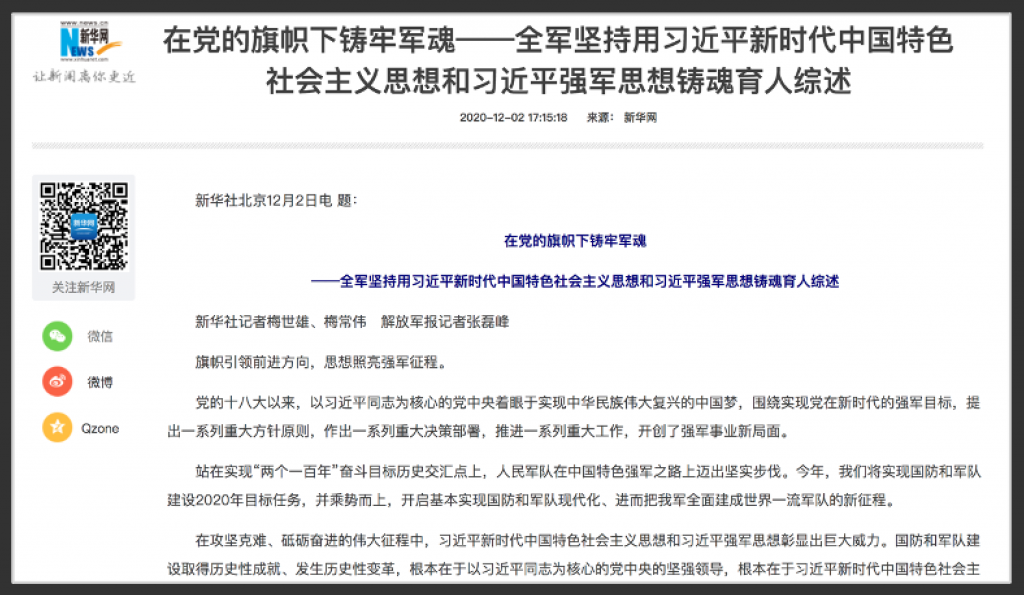
On December 2, Xinhua News Agency
issued a lengthy official news release with a ponderous headline that included
two Chinese Communist Party buzzwords meant to signal the power of General
Secretary Xi Jinping. But there was a problem.
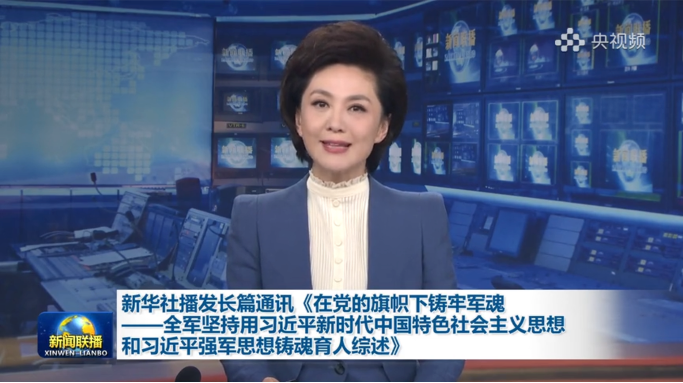
The headline,
seen in the screen capture below, read in full: “Casting the Soul of the Army
Under the Banner of the Party: A General Narrative of the Entire Army Supporting
the Use of Xi Jinping Thought on Socialism with Chinese Characteristics for a
New Era and Xi Jinping Thought on a Strong Military to Shape the Soul [of the Army]
and Educate [Soldiers].”
Last night, the Xinhua article was given further prominence as it was summarized on the nightly official news cast, Xinwen Lianbo (新闻联播). This was a clear sign of official support for the article, which outlined Xi Jinping’s ideas about the importance of “realizing the Party’s goal of building a strong military in the new era.” The Xinwen Lianbo report included the full headline of the article onscreen.
The December 2 edition of Xinwen Lianbo covers the Xinhua article on “Xi Jinping Thought on a Strong Military.”
In all, the Xinhua release
mentioned the phrase “Xi Jinping Thought on a Strong Military” (习近平强军思想) eight times. Of these, five uses combined the phrase
with Xi’s banner term (旗帜语), the political
catchphrase meant to subsume all of his ideas and stand as the monument to his
legacy. Like the headline of the article itself, these five instances talked
about “Xi Jinping Thought on Socialism with Chinese Characteristics for a New
Era and Xi Jinping Thought on a Strong Military” (习近平新时代中国特色社会主义思想和习近平强军思想).
By the laws of CCP discourse – remembering that in the formulation of language at the highest levels, nothing is taken lightly – this should be a serious error on the part of Xinhua, and then again on the part of CCTV.
As we
have previously written, Xi’s banner term, “Xi Jinping Thought on Socialism
with Chinese Characteristics for a New Era” (习近平新时代中国特色社会主义思想),
which first appeared in October 2017 at the 19th National Congress of the CCP, is
on a winding path toward formalization as the shortened and more potent “Xi
Jinping Thought” (习近平思想), putting Xi on par with
Mao Zedong. Despite some rather careless and premature references
in academic literature and mainstream news reports outside China to “Xi Jinping
Thought,” it is worth remembering that “Xi Jinping Thought” has in fact not yet
emerged, not formally, and this is a distinction that certainly has not escaped
Xi and his acolytes at senior levels, who are busy trying to achieve this
transformation.
“Xi Jinping Thought” is the
end game, and when we see the emergence of a host of subordinate permutations
of Xi thoughts in various policy areas, including “Xi Jinping Thought on a
Strong Military” and “Xi Jinping Thought on Diplomacy” (习近平外交思想), these are meant to help pave the way toward “Xi
Jinping Thought.” Think of it as a rhetorical game of crossing the river by
feeling the stones. In 2018, at least 10 such sub-forms of Xi thought appeared
in official sources.
But the point of Xi Jinping’s
banner term is to subsume all of Xi’s ideas. There is meant to be one
banner, the umbrella phrase under which all lesser banners fly. And any suggestion
of equivalence between the lesser thoughts and their parent phrase would serve
to diminish the gravity of “Xi Jinping Thought on Socialism with Chinese
Characteristics for a New Era.” This is the serious problem in the Xinhua
article, the “and” drawing an equivalence between Xi’s banner term and “Xi
Jinping Thought on a Strong Military.”
The term “Xi Jinping Thought on a Strong Military” appears in military-related sources, such as the People’s Liberation Army Daily, but is generally marked as being subordinate to the overarching banner term. When Party media in China reported on the release last month of the “People’s Liberation of China Joint Operation Outline (中国人民解放军联合作战纲要), they stressed that “the ‘Outline’ is guided by Xi Jinping Thought on Socialism With Chinese Characteristics for the New Era, and thoroughly implements Xi Jinping Thought on a Strong Military.”
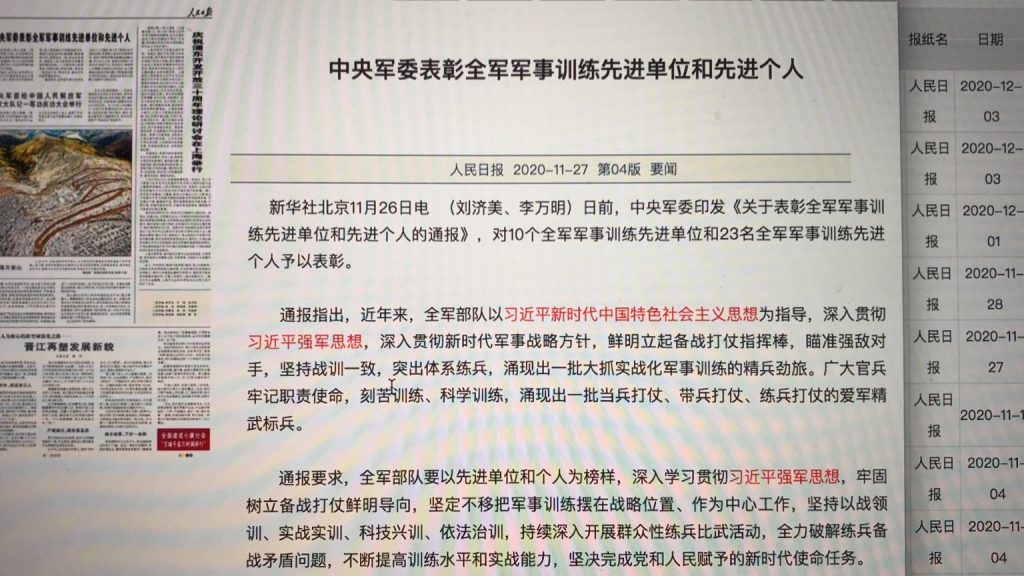
A November 27, 2020, news release from Xinhua clearly shows use of “Xi Jinping Thought on a Strong Military” given secondary emphasis following “Xi Jinping Thought on Socialism With Chinese Characteristics for the New Era.”
The proper juxtaposition of these two phrases should have been something more like: “ . . . with Xi Jinping Thought on Socialism with Chinese Characteristics for a New Era as the guide, thoroughly implementing Xi Jinping Thought on a Strong Military” (以习近平新时代中国特色社会主义思想为指导, 深入贯彻习近平强军思想).
How did this low-level error happen at Xinhua? How was it perpetuated on the official nightly news program? This is difficult to know. But how these terms appear together in the future will be something to continue watching.
Anyone could be forgiven for entirely ignoring last week’s China New Media Conference (中国新媒体大会), held over two days in the city of Changsha. Attended by propaganda officials, journalists, internet company representatives and communications scholars from across China, the event dealt with the insipid theme, hardly enlivened by official news releases, of “media convergence.”
How could this conference possibly be relevant outside the drab echo chamber of elite Chinese politics and communication, much less outside China? Beyond the usual parade of official news in Chinese, only Hong Kong’s South China Morning Post paid the event any heed at all.
But hold on just a minute. This year’s conference, which opened with an address from Xu Lin (徐麟), director of the State Council Information Office and a deputy propaganda minister, was an illuminating and deeply important look at media policy in China – with implications domestically and internationally. It essentially outlined how the Chinese Communist Party intends to leverage transformations in global communication, both at home and abroad (though the latter is more implied), to sustain the regime and increase its influence internationally.
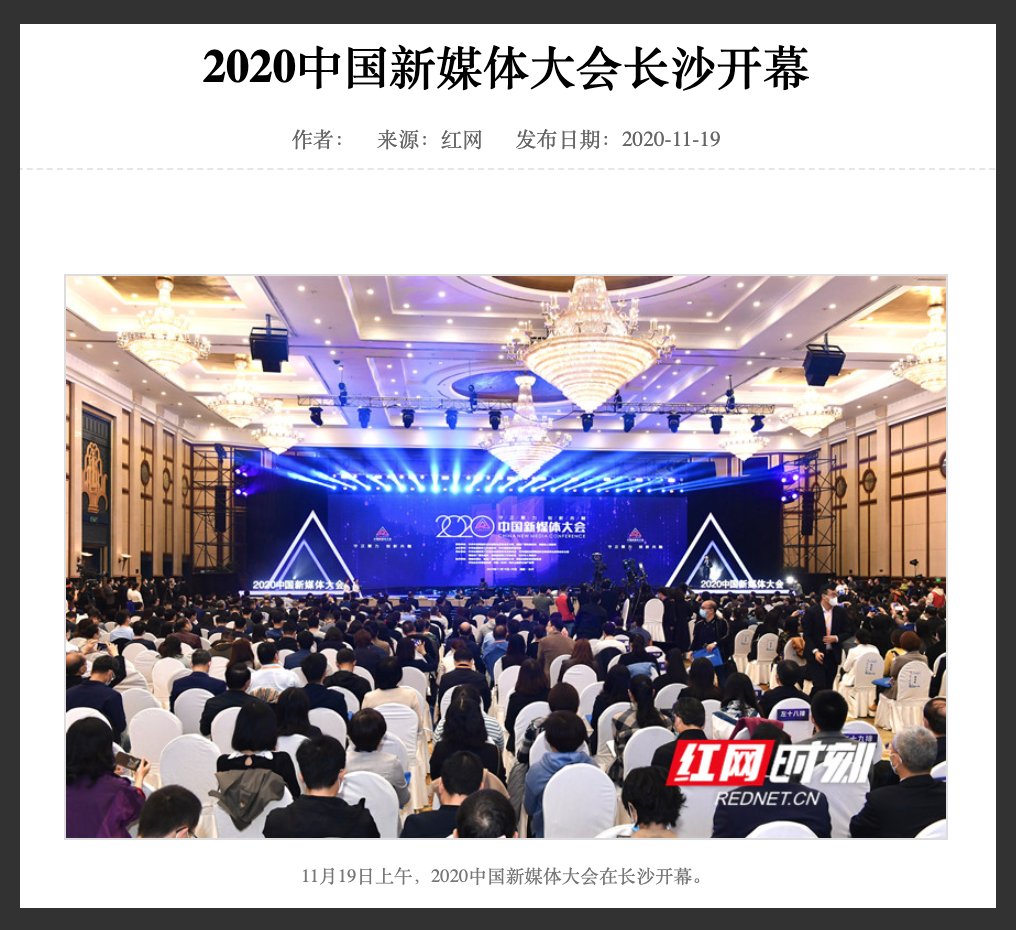
Screenshot of a report by Hunan province’s official rednet.cn website on the 2020 China New Media Conference.
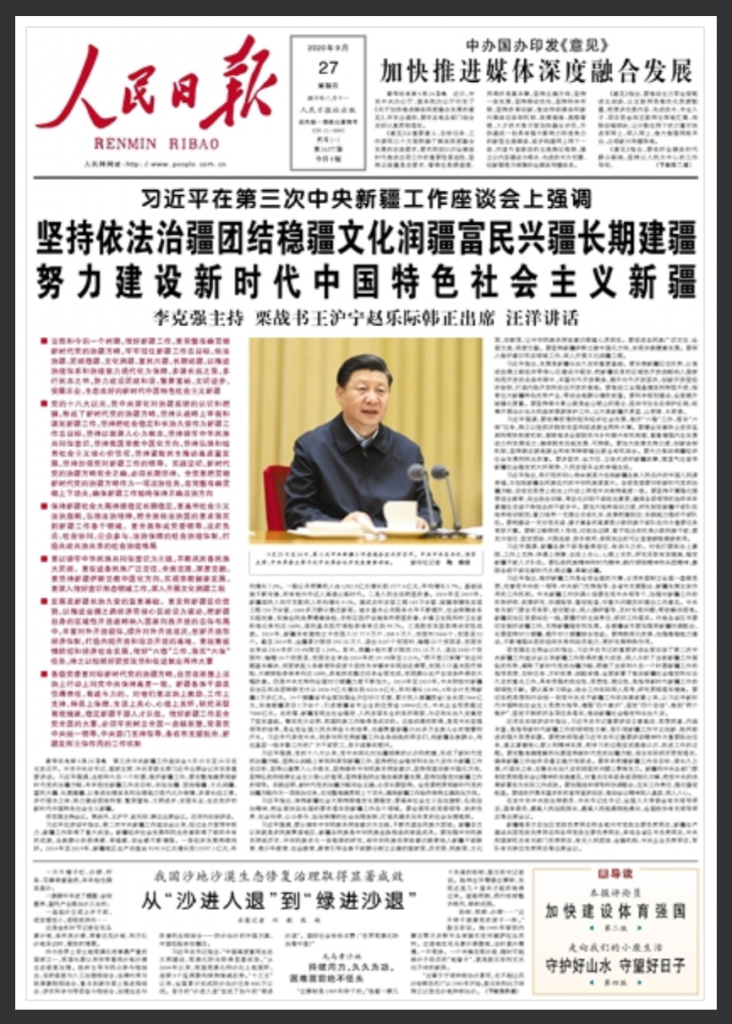
The event followed the September release of Opinions on Accelerating
the Promotion of Deep and Integrated Media Development (关于加快推进媒体深度融合发展的意见), which was important
enough to make the space just to the right of the masthead in the September 27 edition of the CCP’s official People’s
Daily newspaper. The Opinion spelled out a range of
actions to be implemented at all levels and at all departments in China in
order to create “an omnimedia communication system with assurances provided by
innovative management” (创新管理为保障的全媒体传播体系). The meaning of this will become clearer as we proceed.
The front page of the September 27 edition of the CCP’s official People’s Daily newspaper, the report next to the masthead about accelerating the development of media convergence.
Broadly speaking, media convergence in any context is about the
integration of information and communications technologies, various forms of
media content, and computer networks – for which some
scholars now use the shorthand
“Three C’s” (communication, computing and content). This may sound
like a fringe concern, something to be hemmed and hawed over by communications
scholars at some afternoon panel, but in this context media convergence is
about so much more.
One of the key messages in Xu’s address to the conference was simple.
“[We] must resolutely prevent the weakening of the Party’s leadership in the
name of convergence,” he said, “and must resolutely prevent the risk of capital
controlling public opinion.” For the Chinese Communist Party, media convergence
is really about harnessing of the digital media revolution – which in any case
is happening – to serve and preserve the Party’s political dominance. The
stakes are large, and China’s leaders want to get this right, which is why it
has become, as Xu said, a “national strategy.”
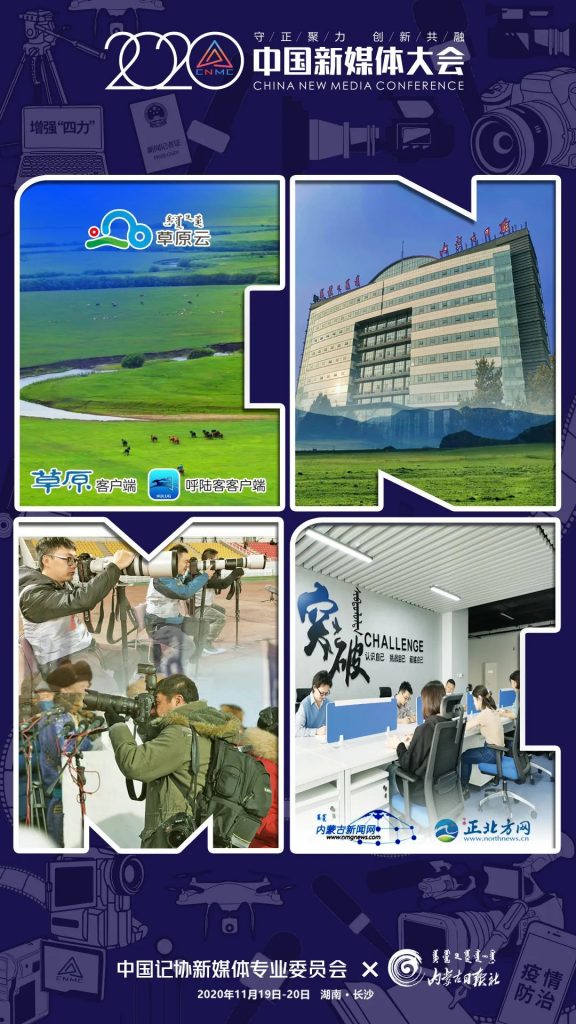
Promotional brochure for the China New Media Conference, hosted in Changsha on November 19 and 20.
At its most fundamental, media convergence (媒体融合) in China is about resolving the dilemma
facing the so-called “mainstream” media of the Chinese Communist Party –
namely, that they no longer appeal to wider audiences in an era of digital
media proliferation. The challenge is to
ensure that the CCP’s dominant ideology, wrapped up in the affirmation and
consolidation of its own legitimacy, can permeate throughout social media and
commercial websites and accounts.
Xu Lin spoke in his address to the conference of the goal in the last five-year plan to “build up a new mainstream media” (新型主流媒体), and to build up “strong county-level media convergence centers (县级融媒体中心). The project, in other words, involves a deep-level and nationwide transformation and re-building of the CCP media system. It seizes the moment of digital transformation, a trend shared across the globe, to re-insert the Party at the center of media development – after what has since the 1990s essentially been an increasing process of Party media marginalization.
Battling in the Belly of Princess Iron Fan
Concern over the possible, perhaps impending (or so is
the fear), loss of dominance over public opinion is a constant theme for the CCP
leadership, still enshrined in the central propaganda notion, dating to the
brutal crackdown on pro-democracy protests in June 1989, that “guidance of
public opinion” (now synonymous with media control) is essential to preserving
regime stability. Throughout the Hu Jintao era, and the latter part of the
Jiang Zemin era that preceded it, the project of “guidance” was in tension
with the trend of media commercialization, the emergence of a vibrant
internet space, and the rise of a sometimes restive core of professionally-minded
journalists, and an increasingly curious and consumption-oriented population
with an appetite for information but also for entertainment.
In August 2013, in his first
major speech on ideology
after coming to power, Xi Jinping outlined the context of the Party’s struggle
against dissent. “As for propaganda and ideological positions, if we do not
occupy them, others will,” he warned his audience of propaganda apparatchiks.
He talked about “three zones” existing in the field of public opinion and
ideology. The first was the “red zone,” or hongse didai (红色地带), which consists primarily of “mainstream
media,” meaning her Party-controlled media, and “positive forces online.” This
zone, said Xi, “must be held, and absolutely cannot be lost.”
The second zone was the “black zone,” or heise didai
(黑色地带), which was principally
comprised of “negative language” online and in society, but which according to
Xi “also includes the speech manufactured by various hostile forces” – this
being a catchall term for the CCP’s internal and external enemies, though it is
often understood to refer to unspecified acts of infiltration by foreign
sources with hostile intent. “This is not the mainstream,” Xi said of the black
zone, “but its influence must not be underestimated.”
The third zone was
the “grey zone,” or huise didai (灰色地带),
“existing between the red zone and the black zone.” In dealing with these
various zones, Xi proposed differentiated strategies. For the red zone, the
focus should be on “consolidation and expansion, steadily enlarging its social
influence,” said Xi. But his characterization of the strategies for the grey
and black zones was most interesting, and perhaps chilling:
For the black zone,
we must courageously enter it, like [Sun Wukong] entering the belly of Princess
Iron Fan to do battle, steadily promoting its red transformation. As for the
grey zone, we must carry out large-scale work, accelerating its transformation
into the red zone, preventing its metamorphosis into a black zone. This work
must be firmly grasped, and with perseverance it will obtain results.
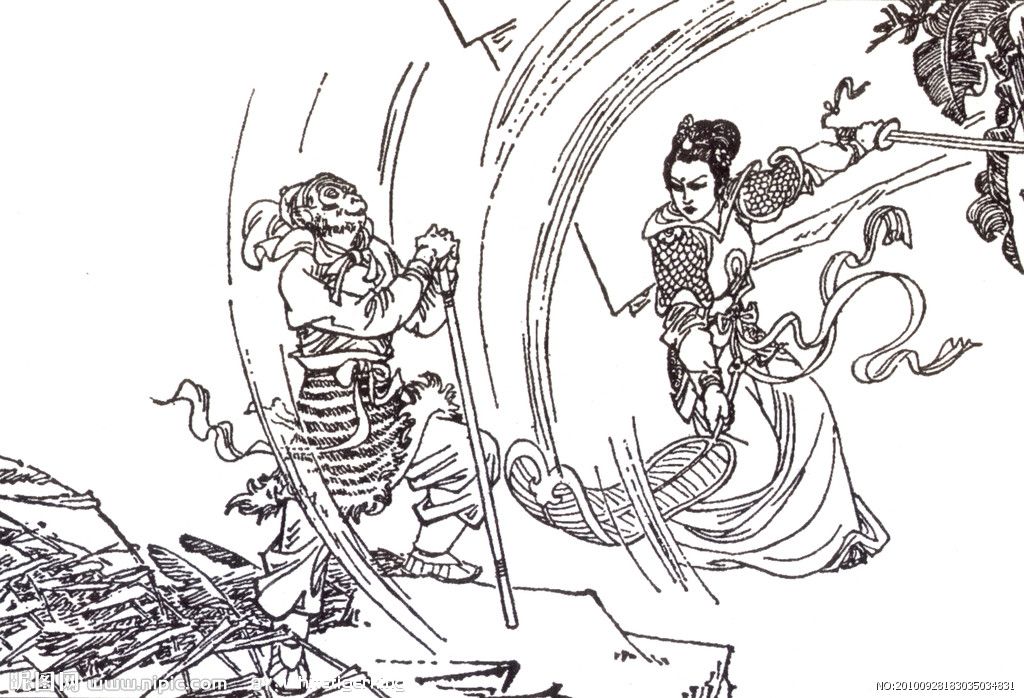
Xi is known to have a fondness for colorful language and historical and literary references, and his mention in this passage of “entering the belly of Princess Iron Fan to do battle” can be understood as a colorfully oblique reference to the larger project of co-optation, not just of alternative or potentially competing messages inside China, but of critical voices globally.
The reference comes
from the 16th century Chinese classic Journey to the West, in
which at one point the main protagonist, the Monkey King, or “Sun Wukong” (孙悟空), possessing a magical staff
that enables him to shrink down to the size of a needle, does battle with
Princess Iron Fan (铁扇公主), the
wife of the Bull Demon Kong, by morphing into a fly, entering her mouth and
flying down into her gut. Once inside Princess Iron Fan’s soft belly, the
Monkey King punches and kicks her into submission.
Sun Wukong and Princess Iron Fan do battle.
Xi Jinping’s colorful literary allusion, along with his identification of three public opinion zones, tells us a great deal about the CCP’s objective in harnessing the digital revolution. The point is to ensure that the Party’s political frames permeate the public opinion space domestically, consolidating the “red” hold over grey zones, and transforming, through a process of deep internal struggle, black zones into red strongholds. This can be accomplished only if the Party has a strong, and also pliable and innovative, grasp of “media convergence,” of the entire process of content creation, distribution and demand.
In his speech to the China New Media Conference, Xu Lin addresses six key aspects of the CCP’s “national strategy,” which I include below with commentary and context.
Accelerating the full construction of an omnimedia communication system (全媒传播体系)
Xu Lin outlines the creation of an comprehensive national system at four levels, from the center to the province, city and country, that integrates content production and distribution through “advanced [communication] technologies” (先进技术) – and is “resource intensive” (资源集约) with a “high-level of coordination” (协同高效). Xu characterizes the internet as the “principle battleground” (主战场) and recognizes that mobile-based and video content is a more and more dominant trend. Talking aabout the relative roles of Party media (those directly overseen by Party Committees) and commercial media (commercially operating spin-offs overseen by Party or government bodies, and for-profit online media), Xu says that while Party media will set the tone of “mainstream public opinion” (主流舆论), meaning Party-led messaging, “commercial platforms will principally serve as channels, their technological and other advantages aiding the transmission of mainstream public opinion.”
Adhering throughout to correct guidance of public opinion (始终坚守正确方向导向)
As I mentioned earlier, “correct guidance of public opinion” remains a
key term denoting the central prerogative of information control to achieve
regime stability. “The guidance and value orientation of public opinion is the
soul of news and public opinion work,” says Xu in this section. And he states
the overarching priority of media control in the midst of technological
transformation more clearly here than we have perhaps seen in some time. He
says: “The development of convergence may bring a change in the forms of the
media, but regardless of what kind of media, regardless of whether these are
mainstream [CCP] media or commercial platforms, regardless of whether they are
online or offline, regardless of whether they are small-screen or large-screen,
in terms of guidance there is only once standard. There is no land outside the
law, and there are no public opinion enclaves.” While convergence is a priority
in consolidating the Party’s control over the message, Xu is very clear here
that “we must resolutely prevent the weakening of the Party’s leadership in the
name of convergence, and must resolutely prevent the risk of capital
controlling public opinion.”
These two points are the real heart of information policy, and the most
important aspect of Xu’s remarks, reflecting what has been called “Xi Jinping
Thought on
the News”(习近平新闻思想).
Beyond this fundamentals, the leadership understands that there is
demand for information that it is effective and appeals. Today’s propaganda
cannot be yesterday’s propaganda, and it must not seem so to increasingly savvy
Chinese audiences. Moreover, it must accommodate if not lead the global
standard in terms of technology, so that China reaps the economic and political
benefits. And so:
Focus on expanding the production capacity of high-quality content (着力扩大优质内容产能)
Xu says that in the current information environment, what we see is “the
proliferation of information, and feel that quality content is scarce.”
“Whether or not we can attract the masses, and whether or not we can lead
public opinion, and building consensus, is ultimately up to whether or not our
content is good.”
As George Orwell wrote, “Doublethink means the power of holding two
contradictory beliefs in one’s mind simultaneously, and accepting both of
them.” And here, in Xu’s third aspect, we can glimpse the doublethink at the
heart of the CCP’s conception of media development and control – that you can
have a vibrant media space, commercially viable and creatively responding to
audiences, even as you dominate and control it. In the simplest sense, the
media revolution that unfolded in China from the 1990s, even as Jiang Zemin
spoke of the “Three Closenesses” (三贴近),
essentially the idea that control and commercialization could proceed side by
side, exposed the flaws of this doublethink. One important result was the
emergence of a professional and often restive commercial media space that
fought to greater space and air to breathe – and had a deep imprint too on the
internet and early social media spaces in China as fields that complicated the
Party’s project of “guidance.”
Media policy under Xi Jinping
comes at a time when the CCP seems to have much greater hope that the
technological tide is in their favor, as the tools of creation and distribution
can also now be tools of restraint, repression and surveillance.
In this section too, Xu talks
about the need to create a flood of information the spreads “positive energy” (正能量), another specialized media
terminology under Xi Jinping that essentially is a makeover of an older term of
the Jiang and Hu eras, the need to “emphasize positive propaganda.” Imagine a
world of colorful, uplifting and entertaining media products, none of which
turn thoughts to the unfortunate aspects of life, society or politics.
Actively seizing the high ground of communication technology (积极抢占传播技术高地)
Media convergence, says Xu, is a “media transformation brought on by
technological innovation.” Technologies like 5G had driven transformation, and
to stay on top in terms of guiding public opinion and ensuring the dominance of
the Party as “mainstream,” the leadership must ensure that it is not just
leading technological trends, but also leading in terms of the means of
harnessing and controlling them.
In the past, perhaps, Chinese leaders were unprepared for various forms
of media transformation, including media commercialization –coming ahead of
China’s World Trade Organization membership in the late 1990s and greater
integration with the global economy – and the rapid rise of social media
platforms like Weibo. This time, they are determined to be prepared. “We must
strengthen forward-looking research and the application of relevant new
technologies in the field of news and communication,” Xu said, “and we
absolutely must not simply look on and take a
passive approach to dealing with them.”
Advancing and controlling the media transformation from a technical
perspective is of course not enough. The priorities outlined in the first two
aspects that Xu addresses will require the CCP also to remake the human
mechanisms of media development and control. It will no longer be sufficient,
for example, to have one leader on the traditional media side and another on
the new media side, what Xu calls a “two skins” approach. Patchwork approaches
and temporary fixes must give way instead to more comprehensive solutions on
the management side, which involves of course both content
production/distribution and the policing of “correct guidance.”
Xu’s final aspect is about the people who will staff and implement this
new vision of the Party-led media system.
Fully stimulating the vitality of talent teams (充分激发人才队伍活力)
“The core competitive strength of the media lies in its people, and talent, the unit, is critical to achieving convergence,” Xu says. He talks here about developing the proper human resource and training programs, and also “scientific systems of examination and assessment.”
China’s Story Converges
The “national strategy” of media convergence, Party-led digital transformation, or whatever else one wishes to call it, is an ambitious project with far-reaching implications not just for speech and information inside China, but for the global conversation on a range of issues touching on China’s ever-broadening interests — from security to 5G, from diplomacy to trade and investment, from health to human rights and democracy.
Xi Jinping has emphasized that China must expand its “discourse power” internationally by “telling China’s story well,” which essentially means shifting global narratives to suit the objectives of the CCP, with regime preservation topping the list. Just as it is key to the transformation of domestic media control, media convergence is at the heart of the re-envisioning of external propaganda and influence. In 2016, an article appearing in the People’s Daily and addressing the creation of “a new mainstream media” said that “innovative expression, and telling China’s story well, require promoting the integrated development of traditional media and emerging media, not losing any opportunity.”
In a study published last year, Chinese communication scholars Jia Wenshan (贾文山) and Zhao Limin (赵立敏) wrote for the China Social Sciences Daily (中国社会科学报) — in an article exploring the expansion of China’s “international discourse power” (国际话语权) against a dominant West — that “[how] the media tells Chinese stories well and enhances the dissemination capacity of China’s international discourse raises new expectations for media convergence.”
Understanding the international dimensions of the national strategy of what might also be called China’s “red convergence” will unfortunately require a great deal more attention to insipid events like last week’s China New Media Conference, and to equally insipid documents like the September Opinions on Accelerating the Promotion of Deep and Integrated Media Development. For Xi Jinping’s CCP, global cyberspace is a map of black, grey and red, and it is not at all an exaggeration to say that media convergence is a battle cry.
According to a report from local Hunan media, a top China Media Group executive attending the China New Media Conference, Liu Xiaolong (刘晓龙), said that “mainstream” CCP media must “persist in using offense as defense in transmitting China’s voice.” They must strive, he said, to increase the territory they occupy in the field of international communication, fighting with a “combined punch” (组合拳) in what he referred to, echoing Maoist language Xi Jinping has re-introduced to policy-making on communication, as a “public opinion struggle.”
This
month, China’s party-state media have been increasingly vocal in criticizing
the “Clean Network” initiative introduced by the Trump administration, a global digital alliance of now almost 50
countries and 170 telecoms firms that aims to deter use of Chinese technologies
Washington regards as insecure owing to their possible manipulation by the
Chinese Communist Party. Introducing the program back in April, Secretary of
State Mike Pompeo said it was essential “to protect America’s critical
telecommunications and technology infrastructure.”
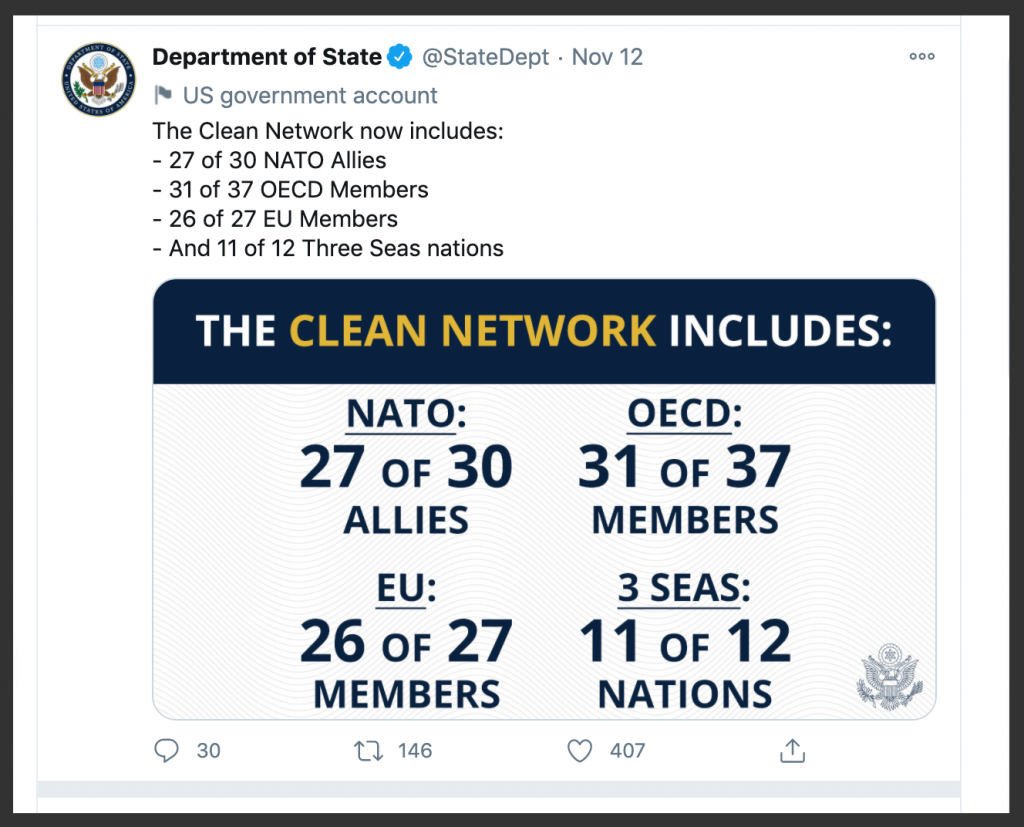
China may now be feeling the pressure more keenly in the midst of an ongoing tech cold war with the US, the State Department reporting in a tweet late last week that 27 of 30 NATO allies, 31 of 37 OECD members, and 26 of 27 European Union member states have signed on to the initiative. Just two countries, Pakistan and Syria, have so far voiced support for China’s would-be competing proposal, the “Global Initiative on Data Security,” though Chinese government sources also claim to have secured pledges of support from Laos and Cambodia.
Last week, CMP noted that the People’s Daily, the CCP’s flagship newspaper, had become more vocal in attacking the “Clean Network” initiative. In a commentary by Lu Chuanying, secretary-general and researcher at China’s Cyberspace International Governance Research Center, the paper accused the United States of conducting “network surveillance” in the name of cybersecurity. The US, said Lu, referencing the cyberpunk film franchise, is “the only real ‘Matrix.’”
“The Matrix” sci-fi action franchise, which recently wrapped up filming in Berlin for a fourth film due for release in December 2021, now appears to be a favored metaphor used by Chinese authorities and state media to criticize the US in the midst of a global rift over cybersecurity.
Over the weekend, the People’s Daily ran another commentary, this time under the “Zhong Sheng” (钟声) byline, reserved for important official statements on international affairs, called “Carrying Out Network Surveillance, Endangering Global Data Security” (实施网络监控,威胁全球数据安全). The commentary again sought to hammer home the argument that the US is the predominant threat to global cybersecurity even as it employs the rhetoric of security and openness.
“The ‘Matrix’ is proficient at network manipulation,” the People’s Daily commentary began, substituting the film’s title (which translated “Hacker Empire” in Chinese) for the US. “If it is allowed to break free from moral constraints and engage in network technology hegemony, continuously dispatching ‘rumor-bots’ to wander the world like ghosts, disrupting the cyber order, this world will inevitably face severe challenges.”
The
commentary likens “certain US politicians” to “rumor-bots dispatched by the Matrix,
which seek to “tirelessly discredit China on the 5G issue, suppressing specific
Chinese companies, and trying to coerce other countries to choose sides in the
name of building a so-called ‘Clean Network.’” These “rumor-bots,” it argues,
cannot change the fact that “the US threatens global cybersecurity.”
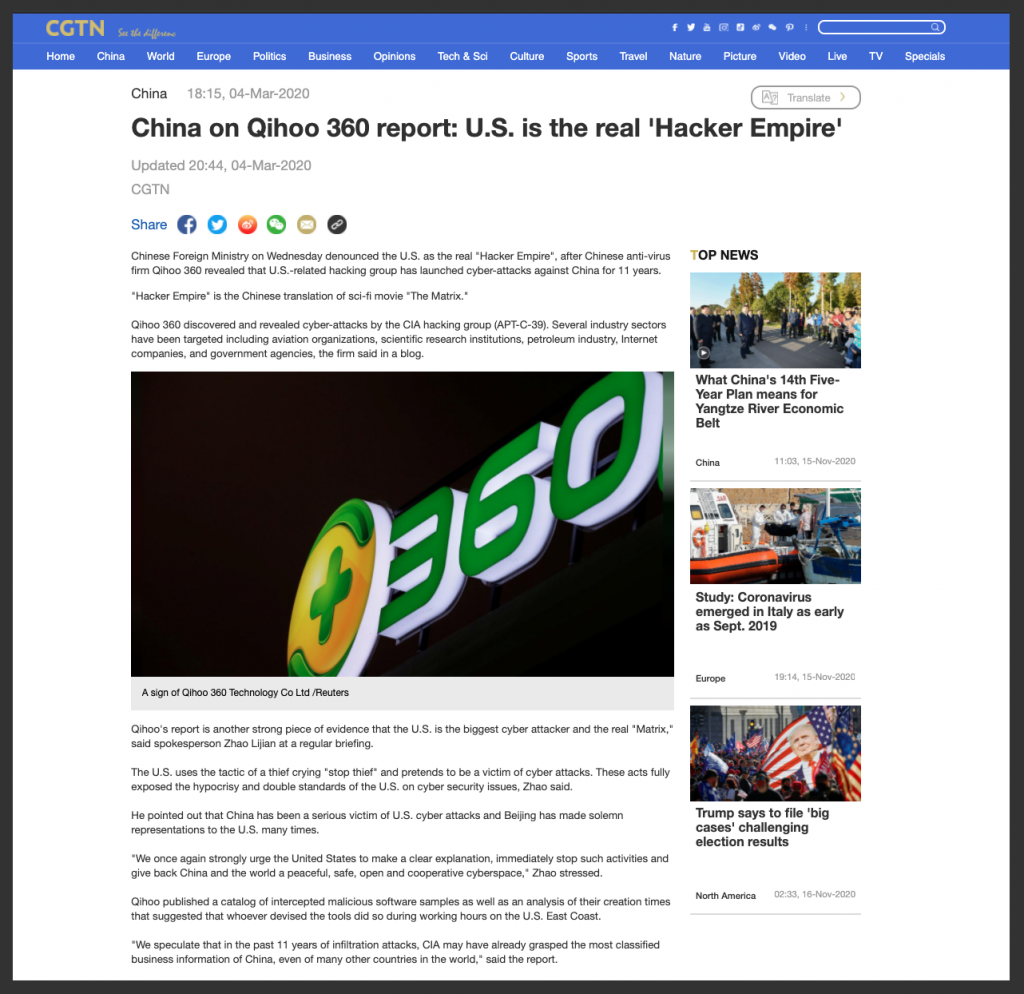
For months, China and the US have been exchanging barbs over hacking and cybersecurity. In May, the US accused China of exploiting the pandemic, attempting to hack academic and private laboratories to steal COVID-19 vaccine research. This followed the release in March of a report from Qihoo, China’s largest cybersecurity firm, that accused the US Central Intelligence Agency (CIA) of hacking attacks against Chinese companies and government agencies. After the report’s release, the Ministry of Foreign Affairs demanded a “clear explanation,” and spokesman Zhao Lijian (赵立坚) – a diplomat prone to provocative and colorful statements – was the first to raise the “Hacker Empire” (“Matrix”) comparison. “The facts have shown that the United States is the world’s largest cyber attacker, a veritable ‘Matrix,’” said Zhao.
Zhao Lijian repeated his “Matrix” language at a press conference in mid-August, after a journalist from China’s state media network, China Media Group (CMG), lobbed him a question about Pompeo’s trip to Central Europe:
According to reports, during his visit to Slovenia, Secretary of State Pompeo signed a joint declaration on 5G network security with the Slovenian Foreign Minister. Pompeo tweeted that this reflects ‘our common commitment to protecting the privacy and personal freedom of citizens.’ Pompeo also talked about jointly building a ‘Clean Network” in the Czech Republic. What is China’s comment?
Referring to programs such as Prism and the Equation group, and suggesting that the US carried out “around-the-clock surveillance of mobile phones and online computers,” Zhao Lijian responded: “These are obviously the exploits of the ‘Matrix’ [Hacker Empire]. The US is already covered in scars over cyber theft, but its secretary of state has the gall to propose a so-called ‘Clean network,’ which is absurd and ridiculous.”
The “Zhong Sheng” commentary in the People’s Daily marks the continued formalization of the Matrix/Hacker Empire accusation against the US in the context of the ongoing tech war, and also offers the latest example of how language from China’s increasingly combative foreign ministry — the so-called “wolf-warrior diplomats” — has migrated into China’s so-called “mainstream” media (meaning Party-controlled media), including central-level media like the People’s Daily.
In April this year, US Secretary of State Mike Pompeo announced the launch of the “Clean Network” program, which he called “the Trump Administration’s comprehensive approach to guarding our citizens’ privacy and our companies’ most sensitive information from aggressive intrusions by malign actors, such as the Chinese Communist Party (CCP).” The announcement followed months of strong lobbying by Pompeo and other US officials for allies in Europe and elsewhere to exclude “high-risk actors” from their 5G networks. Translation: Out with Huawei.
In September, China responded in kind with its “Global Initiative on Data Security,” a program Foreign Minister Wang Yi (王毅) portrayed as more multilateral than the US approach, taking into account the views of other countries. “Some individual countries are aggressively pursuing unilateralism, throwing dirty water on other countries under the pretext of ‘cleanliness,’ and conducting global hunts on leading companies of other countries under the pretext of security,” Wang said, implying but not openly mentioning the US. “This is naked bullying and should be opposed and rejected.”
So far, however, there is little indication in global coverage of the Chinese initiative, including from Chinese state-run media, that it is gaining support.
Just two countries, Pakistan and Syria, seem to have voiced support for the “Global Initiative on Data Security.” Pakistan announced its support on September 15, The Nation newspaper quoting Foreign Office spokesperson Zahif Hafeez Chaudhri as saying that the proposal is “both relevant and timely.” Chinese state media enthusiastically relayed the news, reporting Pakistan’s DNA News Agency as saying that “Pakistan stands solidly with Iron Brother China after Beijing announced the Global Initiative on Data Security.” In late September, official outlets including Xinhua News Agency, the China Daily newspaper and CGTN reported that the Syrian government had “expressed support for the China-proposed Global Initiative on Data Security.” The news was also carried in the English-language Syria Times, affiliated with Syria’s Ministry of Information.
Support for the initiative from two other countries, Cambodia and Laos, has been reported only by China’s Ministry of Foreign Affairs on its official website, in strikingly identical accounts of visits by Wang Yi to both countries. The Cambodia-related release reads: “Cambodia appreciates and supports the Global Initiative on Data Security proposed by China, and will continue to cooperate with China in international affairs, and jointly maintain common interests, and safeguard regional and global peace and stability.” Meanwhile, the release on Wang’s visit to Laos noted simply: “Laos also supports the Global Initiative on Data Security proposed by China.”
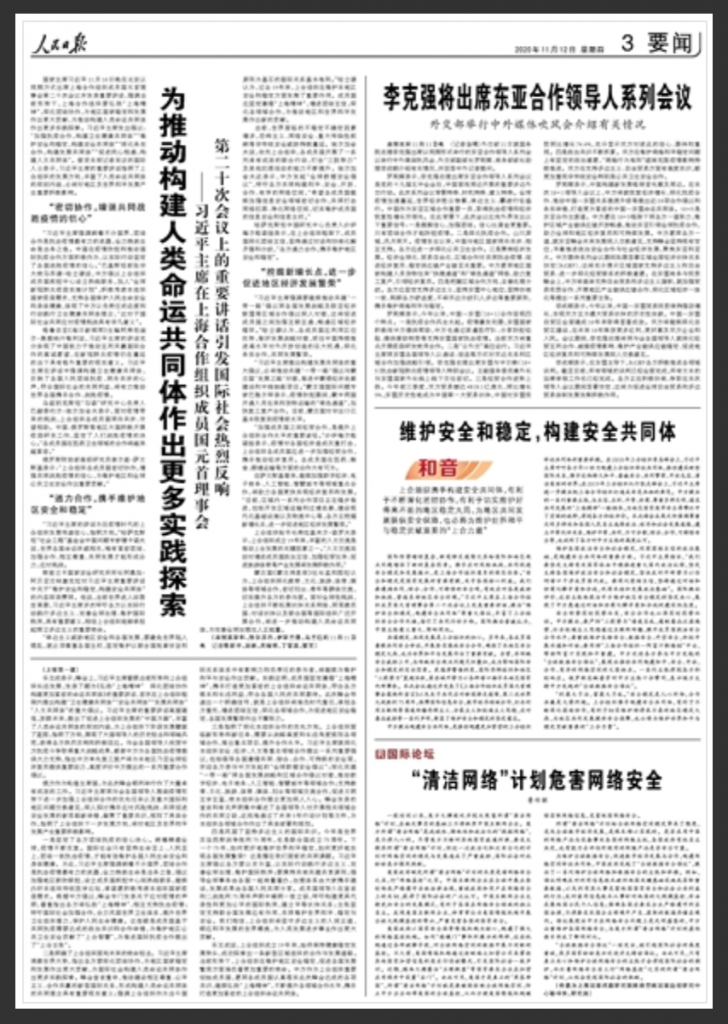
Today, the face-off between
the US “Clean Network” program and China’s “Global Initiative on Data Security”
makes page three of the CCP’s official People’s Daily newspaper. The editorial is written by Lu Chuanying (鲁传颖), secretary-general and researcher at the Cyberspace International
Governance Research Center (网络空间国际治理研究中心) of the Shanghai
Institutes for International Studies (SIIS), one of China’s most important government-affiliated
think tanks on foreign policy. As David
Shambaugh has explained, SIIS, like many government institutions dealing
with international affairs, performs a “dual function,” both projecting Chinese
talking points (as part of a general “soft power” push) and “[collecting] views
and intelligence from foreign experts and officials.”
The Cyberspace International Governance Research Center is a relatively recent addition to the SIIS family, having been formed in 2018, its role apparently to respond on international policy issues related to cyber-governance and cybersecurity.
In his editorial, Lu
suggests that the “Clean Network” program proposed by the United States is a
naked attempt to “carry out ‘cyber surveillance’
in the name of network security.” Raising the issue of past revelations of US-conducted
surveillance, including the “Prism” program, Lu suggests that “Clean Network”
would make global cyberspace a less secure place – the implication being that China’s
proposal is the only means to a multilateral cybersecurity solution.
“The initiative demonstrates that China is open and candid on
the question of cybersecurity, and that it prioritizes maintaining the cybersecurity
of all countries, this being in stark contrast to the hypocrisy of the United States
and its so-called ‘Clean Network’ plan,” Lu writes.
A full translation of Lu Chuanying’s page three article in the People’s Daily follows.
The ‘Clean Network” Plan Damages Cybersecurity (“清洁网络”计划危害网络安全)
By Lu Chuanying
For some time now, the United States has everywhere trumpeted and peddled its so-called “Clean Network” plan, seeking to discredit Chinese Internet companies without any foundation in fact. The so-called US “Clean Network” is a discriminatory, exclusive and politicized “filthy network,” and it cannot enjoy popular support. Even as the US continues to issue threat and promises to other countries, demanding they support this so-called “Clean Network” plan, this hyper-politicized and hyper-securitized plan poses a serious threat to the stability and development of cyberspace – and the international community has registered strong concern and opposition.
The essence of the US government’s so-called “Clean Network” plan is to carry out “cyber surveillance” in the name of network security. Chinese internet companies have always strictly abided by local laws and regulations when conducting business around the world, and they have prioritized the concerns of [local] governments and users when it comes to network security. This has been widely recognized by the international community. Chinese internet companies are in support of a more secure development model, benefiting the independence of countries in terms of cybersecurity. American internet companies, on the other hand, are often complicit in large-scale global surveillance conducted by US intelligence agencies, seriously endangering the national security of all countries.
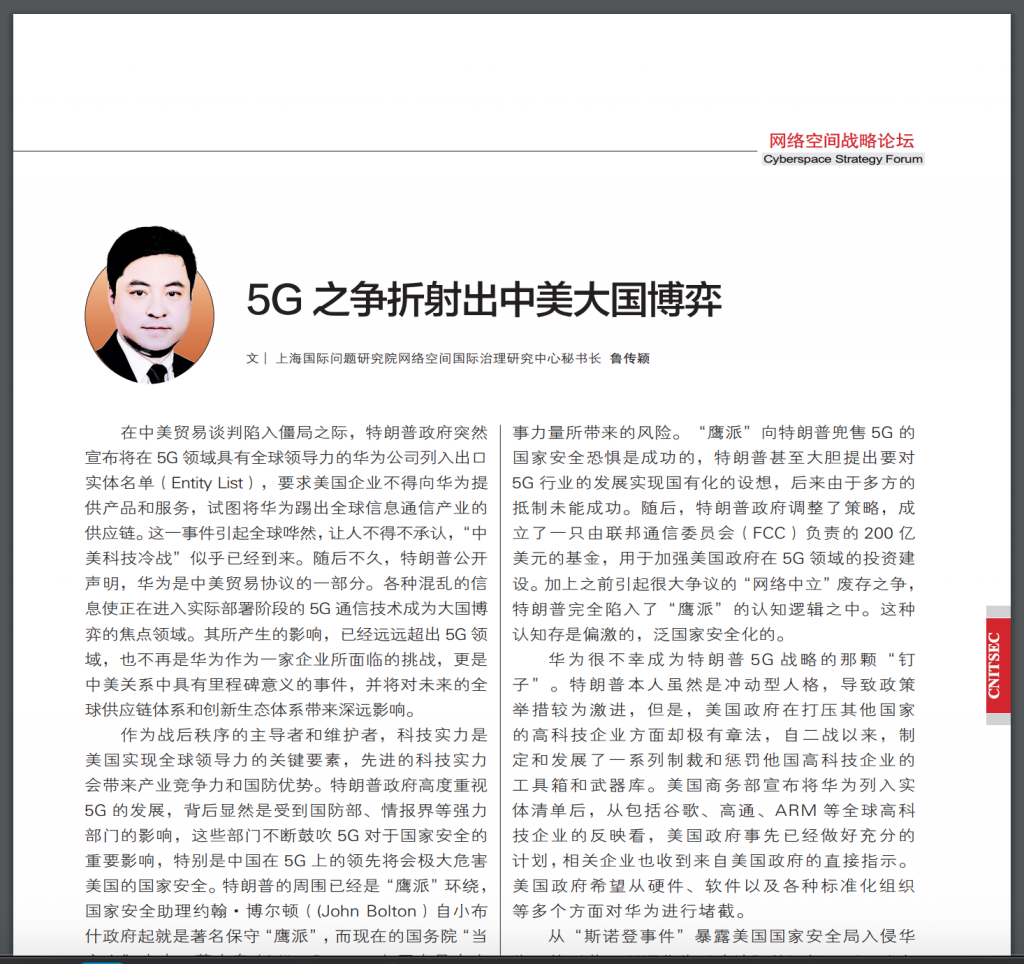
The June 2019 edition of China’s Cyberspace Strategy Forum features an article from Lu Chuanying. In the article Lu argues that the US “attack” on Huawei is solely about challenging Chinese 5G dominance and winning the “Sino-US technology Cold War.”
The US government has built a powerful cyber surveillance apparatus, with agencies such as the National Security Agency at its core. As incidents such as “Prism Gate” have demonstrated, these institutions use various cracking methods to continuously monitor data in global cyberspace. Not long ago, the reprehensible actions of US intelligence agencies in using control of a Swiss encryption company to obtain encrypted information from other countries was exposed, prompting the unanimous condemnation of the international community. Recently, the media revealed that “Five Eyes” countries demanded that companies set up “backdoors” in encrypted applications. These [cases] demonstrate that the United States is the only real “Matrix.” The so-called “Clean Network” plan is about perpetuating the control of global cyberspace and preventing Chinese companies from obstructing US global surveillance – thereby aiding US intelligence agencies in the continued theft of online information and endangerment of cybersecurity in other countries.
The so-called “Clean Network” plan endangers the stability of global cyberspace and imperils the development of the global digital economy, goals that are fundamentally difficult to achieve. The question of whether to use Chinese network products and equipment concerns the cyber-sovereignty of all nations, and governments have a right to make their own decisions, and also the capability to determine whether or not the network products they use are safe and reliable.
In order to maintain global data security, promote the development and cooperation of the digital economy, and build a community of common destiny in cyberspace (网络空间命运共同体), the Chinese government has launched its “Global Data Security Initiative” (全球数据安全倡议) and advanced a series of measures and proposals for maintaining global network and data security. For example, the initiative clearly opposes the use of information technology to damage the critical infrastructure of other countries or steal important data, or its use to engage in acts endangering the national security or public interest of other countries. It opposes the abuse of information technology to engage in large-scale surveillance against other countries or illegally collect the personal data of individual citizen in other countries. [The initiative] emphasizes that all countries should require companies to strictly abide by the laws of the countries in which they operate (所在国法律), and must not force domestic companies to store data generated or collected overseas in their own country. The initiative demonstrates that China is open and candid on the question of cybersecurity, and that it prioritizes maintaining the cybersecurity of all countries – this being in stark contrast to the hypocrisy of the United States and its so-called “Clean Network” plan.
As soon as the “Global Data Security Initiative” was announced it attracted widespread attention from the international community, and many countries welcomed and supported the initiative. We can see clearly from this that only a proposition that genuinely cares about and preserves global cybersecurity will gain the support of the international community, and the so-called “Clean Network” plan, which conducts “network surveillance” in the name of cybersecurity, will inevitably meet resistance from the international community.
Despite the
strong political and ideological controls placed upon them, social media platforms
in China can provide valuable space for the discussion of a range of issues. Last
week, Tsinghua Law Professor Lao Dongyan (劳东燕), who serves as deputy director
of the Legal Policy Research Office of the Supreme
People’s Procuratorate, posted an article to her
WeChat public account exploring the enormous pressures facing women in
China under social norms that stress both traditional roles centered on the
family and modern ideas of professional achievement.
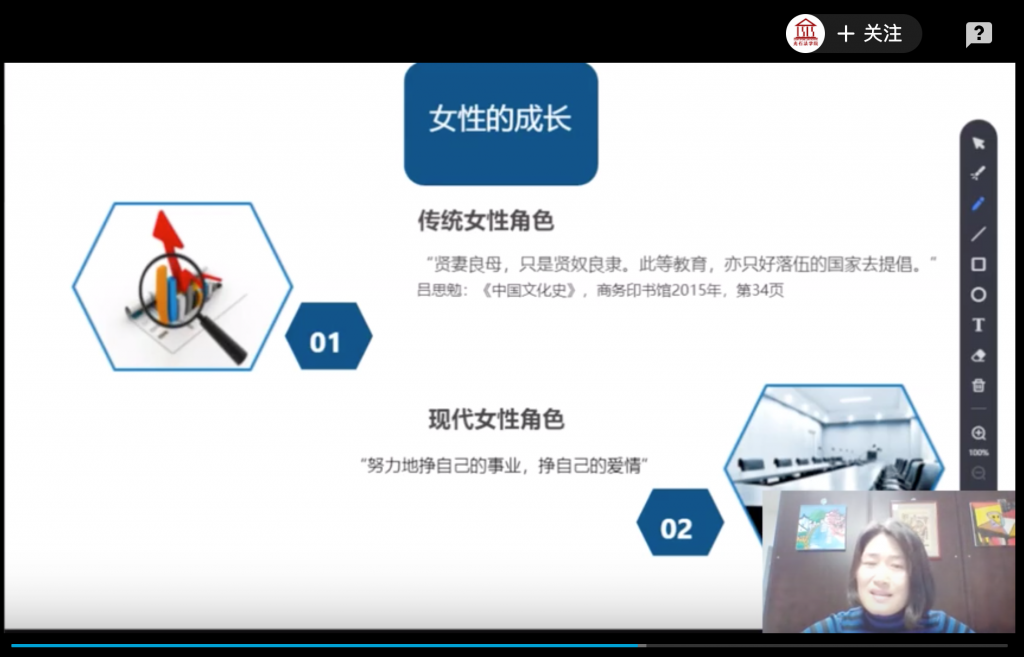
Lao’s post has so far attracted hundreds of thousands of views, underscoring the resonance of the points she raises. The post is derived from a video talk she previously delivered at the “Light Stone Law School,” a legal studies platform that regularly hosts teaching videos and lectures at Bilibili, a Chinese video-sharing website based in Shanghai – though Lao makes clear at the outset of the post that it underwent “substantial revision.”
Screenshot of Lao Dongyan’s video chat at Bilibili. The slide deals with the two competing roles defined for women, the “traditional female role” and the “modern female role.”
Interestingly, despite Lao’s extensive legal expertise, she
does not grapple directly in her article with the implications of laws and
policies, including China’s Marriage Law, which leaves women at a distinct
disadvantage. These issues are laid out in some detail in this
recent article by feminist scholar Joan Lee. Instead, Lao focusses on the “social
mores” and attitudes that persist in China, and present women with impossible
choices.
On balancing career and family, Lao writes: “The answer is that these are impossible to balance. If you invest more in your career, this necessarily means investing less in your family. And if you must invest in both, then you will ultimately be exhausted and anxious. After all, women are not made of iron.”
A translation of the first section of Lao’s post follows.
“On Modern Women: The Challenge of Balancing Career and Family” (关于现代女性:事业与家庭难以平衡)
By Lao Dongyan (劳东燕)
In traditional society, the role of females is to be a good wife and a loving mother. For a woman, the most important identity was to be a wife to someone, and a mother to someone, not to exist as an independent individual. Even down to the present day, there are certain social norms for women that stubbornly cling [to these ideas].
In most families, if both husband and wife are busy with work, one of them must make sacrifices for the sake of raising children. And in China it is essentially women to make this sacrifice to take care of the family. Such sacrifices are often seen as having been voluntary on the part of the woman, but in how many cases is it actually so? In most cases, they are either compelled or simply accept it.
In modern society, therefore, requirements such as good wives and mothers remain the primary expectations in society and in families for the role of women. These expectations create immense pressure for women. If these role expectations are not met, these women will possibly face condemnation from their families and society.
Through long immersion in this social environment, as external expectations become internalized, women can easily tend to have an attitude of self-blame. When they focus on work, they are bound to feel that they are inadequate as mothers and wives.
At the same time, under the influence of individualism in modern society, there is a sense among women and in society that they should be independent, that they should support themselves, that they should have their own careers.
And so the ideal modern woman in people’s minds must not only achieve in her own career, but must also be capable of caring for her family. To paraphrase the popular expression, she must be as beautiful as a flower, able to make money to support the family, and also must be able to work and raise a child.
For ordinary women, however, this is fundamentally a difficult task to achieve. Even in a modern society, then, there is a rather sizable gap between the ideal woman and the real woman. And the position for women at the bottom of society is even more difficult.
The requirements for women in our society at present are: on the one hand, to work hard to achieve in one’s own career; on the other hand, to be a good wife and mother, able to take care wholeheartedly for your children, running your family with color and vibrance. This is the reason why professional women are constantly asked the question: How do you balance family and career? Have men ever been asked such a question in the workplace?
The answer is that these are impossible to balance. If you invest more in your career, this necessarily means investing less in your family. And if you must invest in both, then you will ultimately be exhausted and anxious. After all, women are not made of iron. The expression, “Women are weak, but the mother is strong,” is chiefly used to kidnap women psychologically. I can’t stand expressions like this, which on the surface purport to support women, praising their glory and selflessness, but which actually suppress women and transfer pressure onto their backs.
When all is said and done, there is no way to balance career and family. The more time and energy is invested in one’s career, the less it can be invested in one’s family. Many families choose to have their women give in unconditionally and relinquish their normal social intercourse for the sake of the family – something that is greatly unfair to women. This is not to say that they shouldn’t invest in their families, but just to ask: Why is it always the woman who must sacrifice?
When women must sacrifice themselves, they are not the only ones who pay the price. We often ignore the fact that the poor condition facing women means that the effect they have on children, on the family and on society is counter-productive. A woman’s wholesale return to the family not only narrows her world substantially, but so-called ‘widowed parenting’ (丧偶式的育儿) – is disadvantageous to the raising of children. The father’s relative absence in the development of the child notwithstanding, how can a woman surviving in a narrow world cultivate children with broader visions [of the world]? In such a situation, we can suppose that it is difficult to ensure the physical and mental health of children is difficult to achieve.
. . . .
In family life, both partners need to make concessions or negotiate. At some stage, one party may invest more in the upkeep of the family, while at another stage, the other steps in, taking on more or sharing the family responsibilities together. Women should not be required to devote their full effort [to their families], or to invest more [than their partners].
Located in Xi’an, Da Ci’en Temple (大慈恩寺) is one of Chinese oldest Buddhist sites, its history stretching back 1,360 years. The temple is home to the Great Wild Goose Pagoda, a five-story structure built in the 600s to house religious texts and artifacts brought to China from India by Xuanzang, a scholar and pilgrim who departed from the ancient Tang imperial capital of Chang’an (Xi’an) in 629 AD to make a colorful journey of Buddhist study that lasted almost 17 years and covered scores of kingdoms in Central Asia and India.
Having
distinguished himself in India for his scholarship, Xuanzang eventually
returned with great fanfare to the imperial capital. As abbot of Da Ci’en
Temple – declining Emperor Taizong’s offer of an official position – he devoted
the rest of his life to the translation
of core works of Buddhism from sanskrit, including the most essential
Mahayana scriptures. Xuanzang’s return to China marked a new era
for translation, a time of immense cultural exchange. Centuries later, the monk’s
legendary pilgrimage would inspire one of the great classical novels of Chinese
literature, Wu Cheng’en’s Journey
to the West.
What role does Da Ci’en Temple play in China today? It remains an active center of Buddhist study, and it is of course a major tourist attraction, granted UNESCO World Heritage status in 2014. In the midst of now worsening relations between China and India, Da Ci’en Temple also remains a symbol of friendship and cultural exchange between the two countries. When Indian Prime Minister Narendra Modi made an official visit to China in May 2015, he paid a visit to the temple.
But Da Ci’en Temple can also be understood as a symbol today of just how deeply the politics and ideology of the Chinese Communist Party have permeated all aspects of Chinese life, including religion.
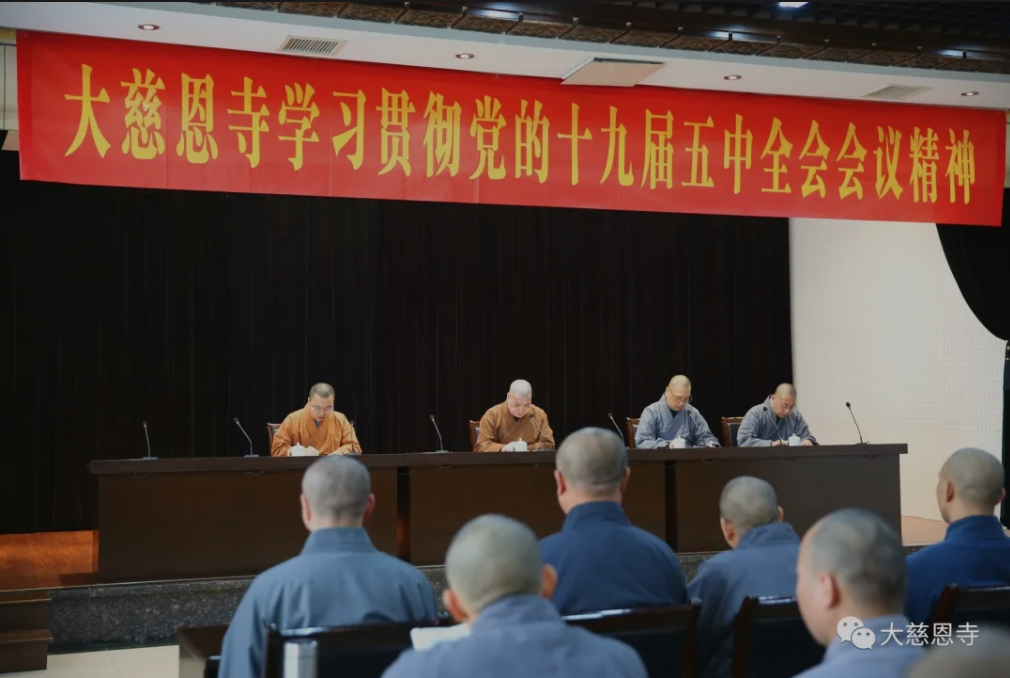
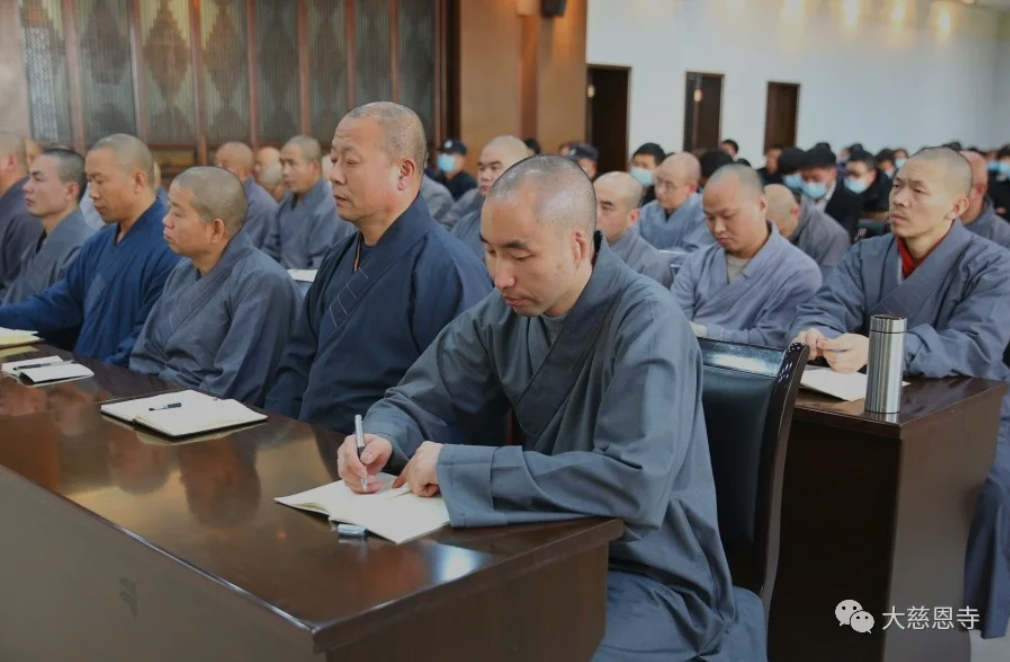
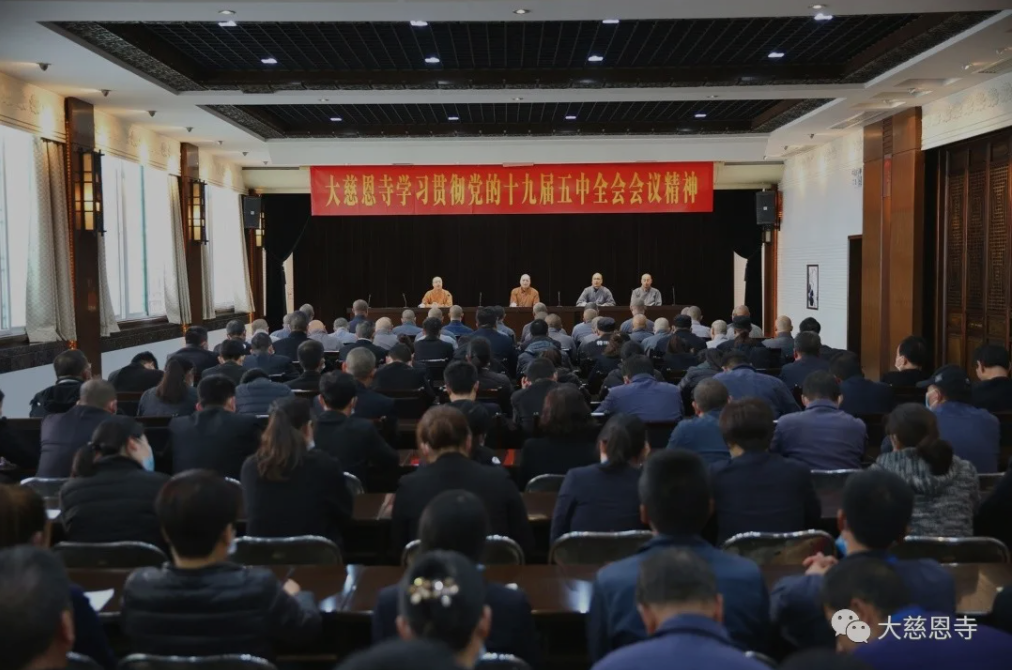
A red banner hanging over the master of Da Ci’en Temple on November 6 reads: “Da Ci’en Temple Studies and Implements the Spirit of the Fifth Plenum of the 19th Central Committee of the CCP.”
A summary of the study session posted to the official WeChat account of the Da Ci’en Temple on November 6 quoted the temple’s master (大和尚) as saying that “the Fifth Plenum was an important and comprehensive meeting with historical significance that will usher our country into a new stage of development, at a critical moment in the realization of the great rejuvenation of the Chinese people.”
The master
demanded, according to the post, that “everyone must mobilize all positive
factors, grasping the essence of the plenary session, unifying thought and
action around the spirit of General Secretary Xi Jinping’s important speech,
and continuing to use the spirit of the plenary session in carrying out work
and guiding practice.”
The next section of the report mentions the need to “further enhance” the “Four Consciousnesses,” “Four Confidences” and “Two Protections.” The “Four Consciousnesses” and “Four Confidences” are phrases critical to the consolidation of Xi Jinping’s personal power as leader of the CCP. The former refers to 1) the need to maintain political integrity, 2) think in big-picture terms, 3) uphold the leadership core (meaning Xi Jinping and his inner circle), and 4) keep in alignment with the CCP’s central leadership. The latter refers to: 1) confidence in the path of socialism with Chinese characteristics, 2) confidence in the theories of the CCP, 3) confidence in the system (meaning the system of governance of the CCP), and 4) confidence in China’s unique civilization.
Together with the “Two Confidences” – which point to the need to 1) protect the core status of General Secretary Xi Jinping, and 2) protect the central, unified leadership of the Central Committee of the CCP – these phrases form the so-called “442” formula now used to signal loyalty to Xi Jinping and his leadership of the CCP.
Revealingly, the 442 formula is linked in the post directly with the need to “make steady progress in promoting the Sinicization of Buddhism” (稳步推进佛教中国化进程).
Da Ci’en
Temple is a prime example in point of how Buddhism has undergone a process of Sinicization
since the end of the Han dynasty in the second century AD, and Xuanzang was of course
himself a central figure in this process. Unmistakably, however, this latest
phase of “Sinicization” is about the re-framing of Buddhism around the
political imperatives of the Chinese Communist Party.
It is the CCP’s hope that Buddhism continue to thrive as a key aspect of China’s resplendent traditional culture — so long as Xi Jinping is securely at its core.
[Featured Image: Da Ci’en Temple photographed in 2009. Photo by Kevin Poh available at Flickr.com under CC license.]
“Canberra only has itself to blame,” read an commentary yesterday from the China Daily, the newspaper published by the Information Office of China’s State Council, the administrative office in charge of its external propaganda. The commentary came amid news that China plans to suspend seven types of Australian exports, including wine and coal, a decision that has caused an uproar in Australia.
Observers outside China noted that the unilateral restrictions, coming amid dramatically worsening relations, underscore China’s willingness to leverage economic pressure to oppose countries that challenge its interests. But there is another curious dimension to this latest move – the striking lack of coverage of the restrictions in China’s own media.
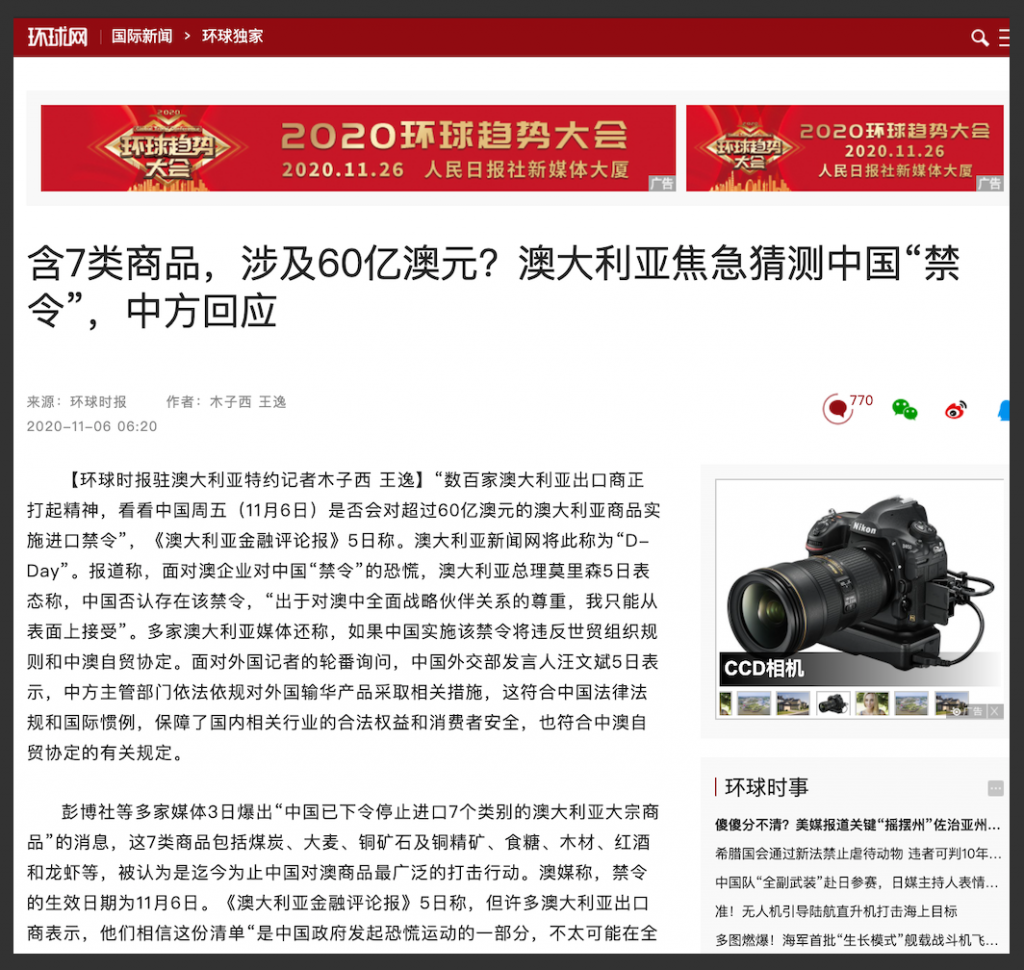
As ABC Australia reported yesterday, news of the export suspensions was relayed not by China’s government directly, but by the tabloid Global Times, a commercial spin-off (known for its nationalistic saber-rattling) of the Chinese Communist Party’s flagship People’s Daily newspaper. While the Foreign Trade Department of China’s Ministry of Commerce reportedly summoned Chinese importers earlier in the week to notify them of the changes, no public announcement was made by the ministry.
China’s only official acknowledgement so far came yesterday in a press conference held by the Ministry of Foreign Affairs. Asked about the Australian restrictions by a reporter from Bloomberg, spokesperson Wang Wenbin responded:
As for the Australian exports to China that you asked about, we responded to similar questions on multiple occasions. The Chinese competent authorities’ measures on foreign imports are in line with Chinese laws and regulations and international customary practices. They protect the safety of consumers and the legitimate rights and interests of domestic industries, and are consistent with the free trade agreement between China and Australia.
But how has this major trade story – seeing as it concerns, as Wang said, “the safety of consumers and the legitimate rights and interests of domestic industries” – been reported inside China? This is where things become curious, and revealing.
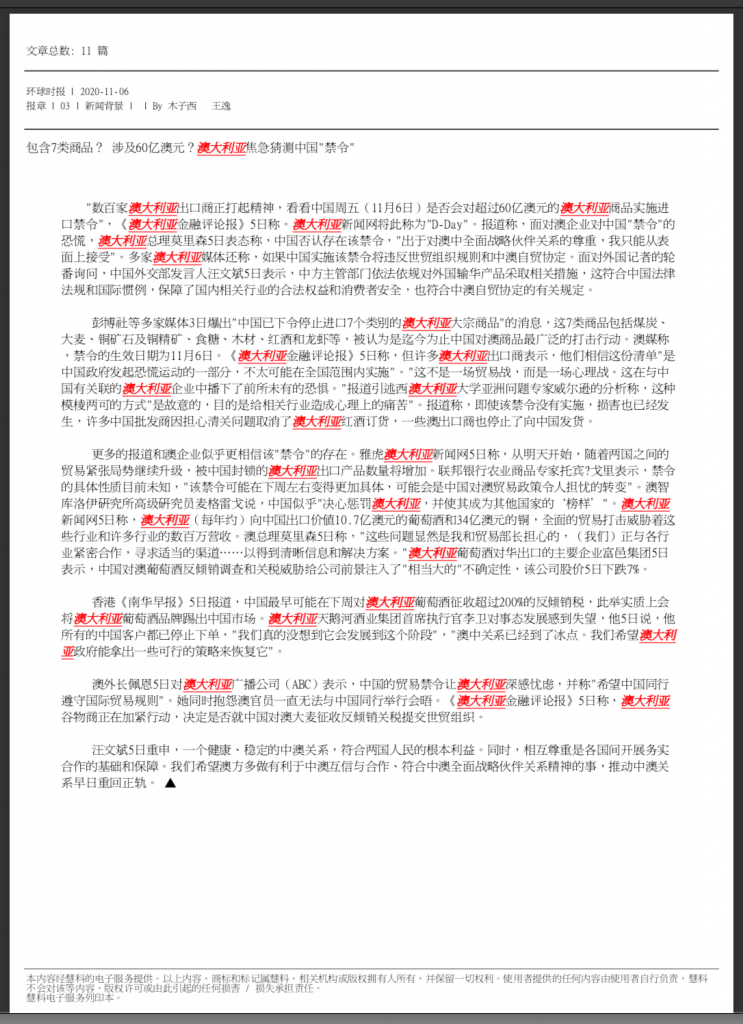
Presumably, restrictions impacting billions of dollars of imports with a major trading partner would at the very least make business headlines. But a search of news archives since November 1 using the keyword “Australia,“ covering several hundred mainland Chinese newspapers, turns up just 10 news articles dealing with the unilateral restrictions.
One of just two Chinese-language articles from the Global Times, the only two articles appearing on the Australia-China trade issue in a search of hundreds of Chinese newspapers.
Of these 10 articles, 7 are directly from the English (5) and Chinese (2) editions of the Global Times. The remaining three articles, it turns out, are also from the Global Times, but are re-published at the website of Ningxia Daily, the official CCP flagship paper in Ningxia, at Shenzhen Special Zone Daily (深圳特区报), an official CCP daily in the Shenzhen SEZ, and Newspaper Digest (报刊文摘), a publication of Shanghai’s official Liberation Daily. Meanwhile, searches of keywords like “Australia” and “7 products” on Google turn up overseas results in Chinese about the restrictions, but nothing in major or minor publications inside China, including speciality business-related websites.
The most recent news report on the bilateral trade row, appearing today in the Global Times, is a play-by-play account of accounts in the Australian and other media outside mainland China – in the Australian Financial Review, in Hong Kong’s South China Morning Post, at ABC Australia.
How do we account for this strangely unilateral media conversation? Why is this major trade story, understandably sparking concern in Australia and beyond, the exclusive prerogative inside China of a single newspaper, the sole exception being English-language coverage in the official newspaper (China Daily) of the government department dedicated to external propaganda?
Despite Wang Wenbin’s suggestion that China’s aim in imposing these unilateral restrictions is to “protect the safety of consumers and the legitimate rights and interests of domestic industries,” the palpable silence in China’s own media, and the fact that the bulk of what little “coverage” is available is in English and directed at foreign readers, clearly suggests this is a naked act of retaliation. The lack of coverage would also seem to suggest that Chinese leaders do not wish to encourage public comment or controversy over the decision, or to air out the sensitive details behind the ongoing bilateral disagreement — involving as it does allegations of Chinese spying and overseas influence operations in Australia.
In the bulletin emerging last week from the Fifth Plenum of the 19th Central Committee of the Chinese Communist Party (CCP), Xi Jinping was praised as the “pilot at the helm,” or lǐngháng zhǎngduò (领航掌舵), a reference with strong echoes of China’s Maoist past. The relevant text in the bulletin read:
“With Comrade Xi Jinping as the core
of the Central Committee of the CCP, and the pilot at the helm at the core,
with the whole Party and full unity of people of all ethnic groups in the country,
tenaciously struggling, we will surely be able to overcome the various
difficulties and obstacles that appear on the road forward, and we will surely
be able to energetically advance the forward progress of socialism with Chinese
characteristics in the new era.”
The invocation of Mao-like status, even if oblique, was unmistakable, and it was noted in coverage outside China. In recent days, the “pilot at the helm” phrase has popped up repeatedly in the official media and on official government websites.
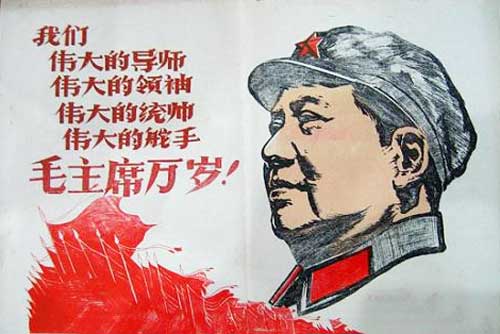
Among his several laudatory sobriquets, Mao Zedong was referred to as the “great helmsman,” or wěidà de duòshǒu (伟大的舵手). But Mao Zedong was not in fact the first leader in China to be honored in this way, with terms like “helm master” (舵师) or “helmsman” (舵手).
A poster from the Cultural Revolution (1966-1976) reads: “Our . . . Great Guide, Great Leader, Great Commander, Great Helmsman . . . Long Live Mao Zedong!”
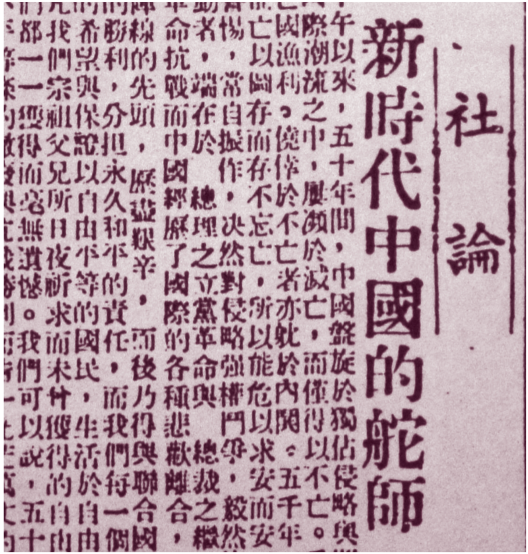
The image below is an official commentary from the May 18, 1945, edition
of the Central Daily News, the flagship propaganda organ of the Kuomintang,
or the Nationalist Party of China. The headline reads: “The Helms Master of China’s
New Era” (新时代中国的舵师). This refers, naturally, not to Xi Jinping
– the helmsman of China’s 21st century “new era” – but rather to Chiang
Kai-shek (蒋介石), the Republic
of China’s top leader, and Mao’s bitterest enemy.
The term used here for Chiang Kai-shek is “helms
master,” or duoshi (舵师). But the nearly identical honorific “helmsman,” or duoshou (舵手), so closely
associated now with Mao Zedong, was also used for Chiang.
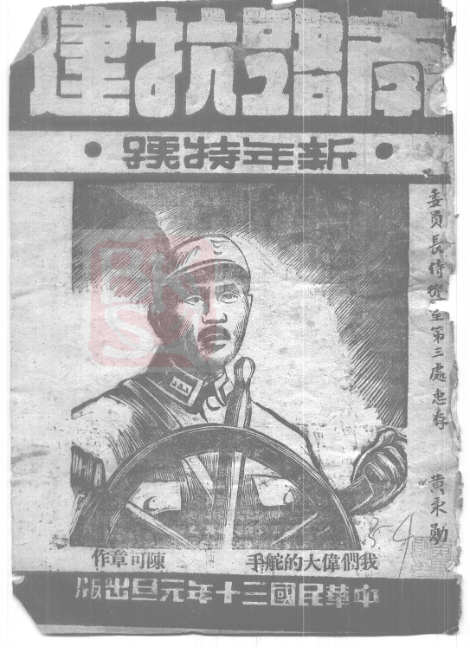
The image below is from a magazine cover in 1941,
the same year the Allies declared war on Japan. The text directly below the
illustration, which shows Chiang literally at the helm of a ship (something
rarely seen), reads: “Our Great Helmsman” (我们伟大的舵手). The language here,
as we can note from the propaganda image from the Cultural Revolution further
above, is already identical to that eventually used for Mao.
In the late 1940s, as the Chinese Communist Party
emerged victorious over the forces of the Kuomintang, there was a popular song
praising the CCP that was called, “You Are The Beacon” (你是灯塔). The lyrics went: “You
are the beacon, shining on the ocean before dawn. You are the helmsman,
piloting us forward.” These words, which of course refer to Mao Zedong, are
some of the earliest to use helmsman in reference to China’s revolutionary
leader.
But Mao was not in fact the only helmsman at that
time. If we search the archives of the People’s Daily, which was
launched in 1946, we find that “helmsman” appeared quite early. Lenin was
referred to as the helmsman. Stalin too was the helmsman. And Mao was the
helmsman. In all instances they were referred to as the duoshou (舵手).
On the eve of the founding of the People’s Republic
of China, we can find reference to Mao as both the “great leader” (伟大的领袖) and the “helmsman,”
as in one article appearing in the People’s Daily on September 26, 1949:
“Great leader, guide, and helmsman, Comrade Mao Zedong! When we say your name,
we feel glory and pride, and we find courage and strength.”
Just days later, however, the honorific “helmsman”
is used in the paper to refer not just to Mao but to the Party’s senior
leadership group. The news item, dispatched from Nanjing by Xinhua News Agency,
read: “Nanjing, once the center of the Kuomintang’s reactionary rule, rejoiced
last night and unanimously supported the helmsmen of the people – the elected Mao
Zedong, chairman of the Central People’s Government of the People’s Republic of
China, Vice-Chairman Zhu De, Liu Shaoqi, Song Qingling, Li Jishen, Zhang Lan,
and Gao Gang.”
Several months later, on February 21, 1950, the People’s Daily published a verse by the poet Tian Jian (田间) that praised both Stalin and Mao. Written in a time of deep friendship between the CCP and the Soviet Union, the poem was called: “Two Good Helmsmen, in the Same Boat” (两位好舵手,同御一条船).
By the beginning of 1956, the Sino-Soviet friendship
had turned cold, as Mao bitterly opposed the de-Stalinization
of the USSR. At the 8th National Congress of the CCP, held in
September that year, Liu Shaoqi praised Mao Zedong, saying that he had “served
an important role as the great helmsman in our revolutionary cause.”
Ten years later, at the outset of the Cultural Revolution,
the term “great helmsman” became inseparable from the figure of Mao Zedong, beginning
with the Eleventh Plenum of the 8th Central Committee. It was at this meeting
that Liu Shaoqi and Deng Xiaoping were sidelined, criticized as the “bourgeois
headquarters” within the Central Committee. The Cultural Revolution from this
point went into full swing, accompanied by the revolutionary song, ““Sailing
the Seas Depends on the Helmsman” (大海航行靠舵手), written by Wang Shuangyin in 1964.
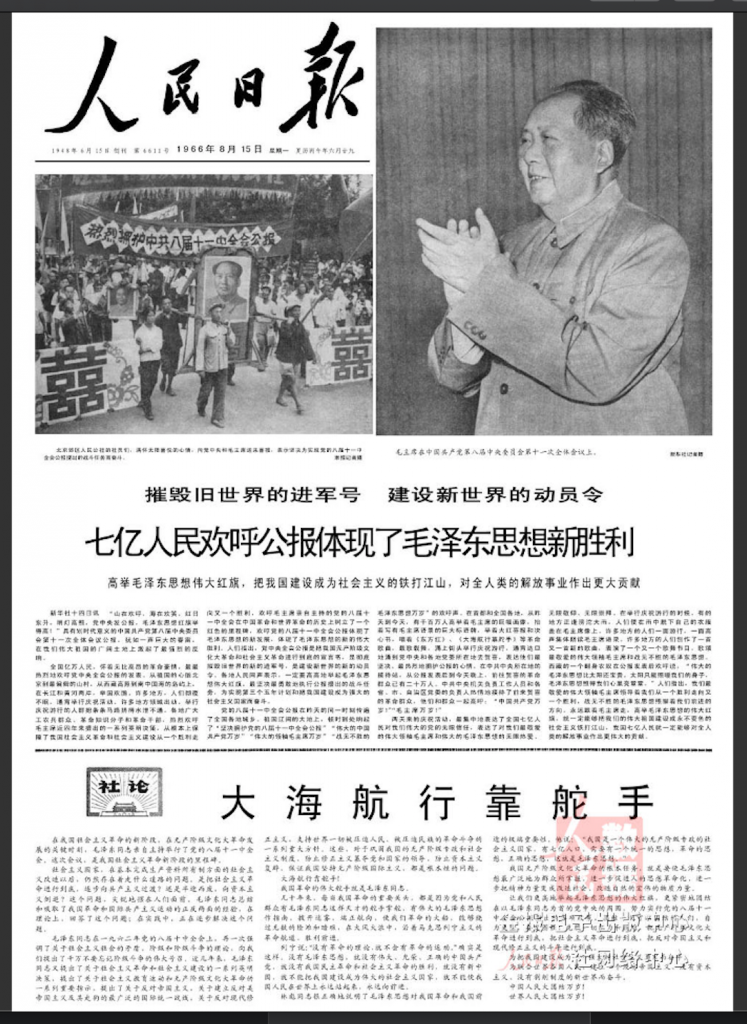
Below is the front page of the August 15, 1966,
edition of the People’s Daily. The lead commentary under the image of Mao
Zedong bears the title of Wang Shuangyin’s anthem: “Sailing the Seas Depends on
the Helmsman.”
“Great helmsman” became one of the “Four Greats,” the
standard set of honorifics for Chairman Mao: “Great Guide, Great Leader, Great
Commander, Great Helmsman.”
For many, many years after Mao Zedong’s death in September 1976, no Chinese leader claimed the helmsman honorific for himself. In fact, there was just one instance of the word’s use for a senior leader, and this came after Deng Xiaoping’s death in February 1997. A report about Deng’s sea burial mentioned that in “the Spring of 1992, Deng Xiaoping again came to the seaside, and like a helmsman, again pointed the direction of the voyage for China’s reform and opening and modernization.”
Jiang Zemin never sought the honorific for himself.
Nor did Hu Jintao. Both governed in times of growing collective leadership, during which “the legitimacy of the
general secretary has progressively become based more on rational authority
than charismatic authority.”
The equations have changed in Xi Jinping’s “new era.”
In November 2016, at the
Sixth Plenum of the 18th Central Committee, Xi was first honored
as the “core” (核心) of the CCP. In
January of the next year, months ahead of the formal
removal of presidential term limits at the NPC, the People’s Dailyran a
piece called, “The Choice of History, the Expectations of the People: Comments
on National Governance with Comrade Xi Jinping as the Core Since the 18th
National Congress of the CCP.” The article included this passage: “In moving
forward toward our dream, the first priority is the helm; to overcome
difficulties, we need more leadership.” And this one: “This leader, which
America’s Time magazine called ‘the central figure in China’s new round
of transformation,’ is like a helmsman who has resolutely declared it is
‘time for reform,’ and is leading this reform in every detail.”
It was from this point, we can say, that Xi Jinping became China’s new “helms master” (舵师), “helmsman” (舵手) and “pilot at the helm” (掌舵人).
We use cookies and similar technologies to improve your experience on our website.
Read our Privacy Policy.