When an official news program on state-run Hunan Economic Television took to the air on May 6, the tension between artificiality and authenticity was on full display. As two AI-generated anchors, Sheng Sheng and Shuang Shuang, read out the news, a message appeared in the corner of the screen: “content not [AI] generated” (不生成內容).
The disclaimer in the May 6 broadcast was an about-face from the broadcast two days earlier, when the AI-generated anchors had debuted with a simple “AI generated” (AI生成) label that unleashed a torrent of public criticism. Online commentators were outraged at the thought that the news content too had been crunched with AI. Were human journalists being replaced entirely?
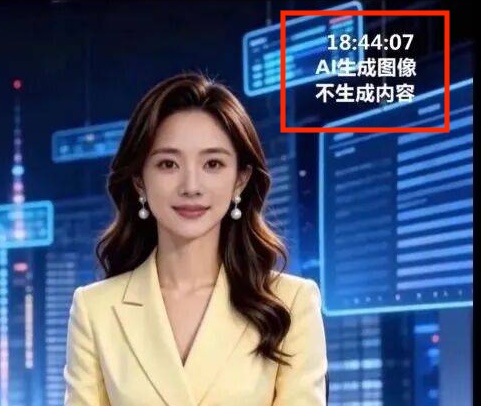
The apparent misunderstanding prompted the broadcaster to add the new language, clarifying that while the anchors’ images were AI-generated, all reporting, writing, and editing remained in human hands.
An important caveat absent from related news reports: those human hands are under strict propaganda controls from Party-state authorities in Hunan. According to registry documents, Hunan Economic Television is a subsidiary of Hunan Radio, Film and Television Group (湖南廣播影視集團有限公司), which is wholly controlled by the Propaganda Office of the Hunan Provincial Committee of the CCP (中共湖南省委宣傳部).
Nevertheless, the episode reflects a tension running through China’s state media landscape, where authorities have enthusiastically promoted AI as a tool of modernization while leaving largely unaddressed the public’s quiet anxieties: that a news culture already distrusted for its proximity to power may now outsource even the appearance of human judgment to machines — and that human journalists, whether or not they are doing real journalism, will pay the price.
In related news promoted this month alongside the Hunan Economic Television case, a court in the city of Hangzhou recently ruled that a financial technology firm had acted illegally when it demoted and ultimately dismissed a 35-year-old AI quality-control supervisor on the grounds that his work could be performed by AI, ordering the company to pay over 260,000 yuan in compensation. A commentary published by Dahe Online (大河網), a news portal overseen by the Propaganda Office of the Henan Provincial Committee of the CCP, said the ruling “punctures the myth of AI omnipotence.”