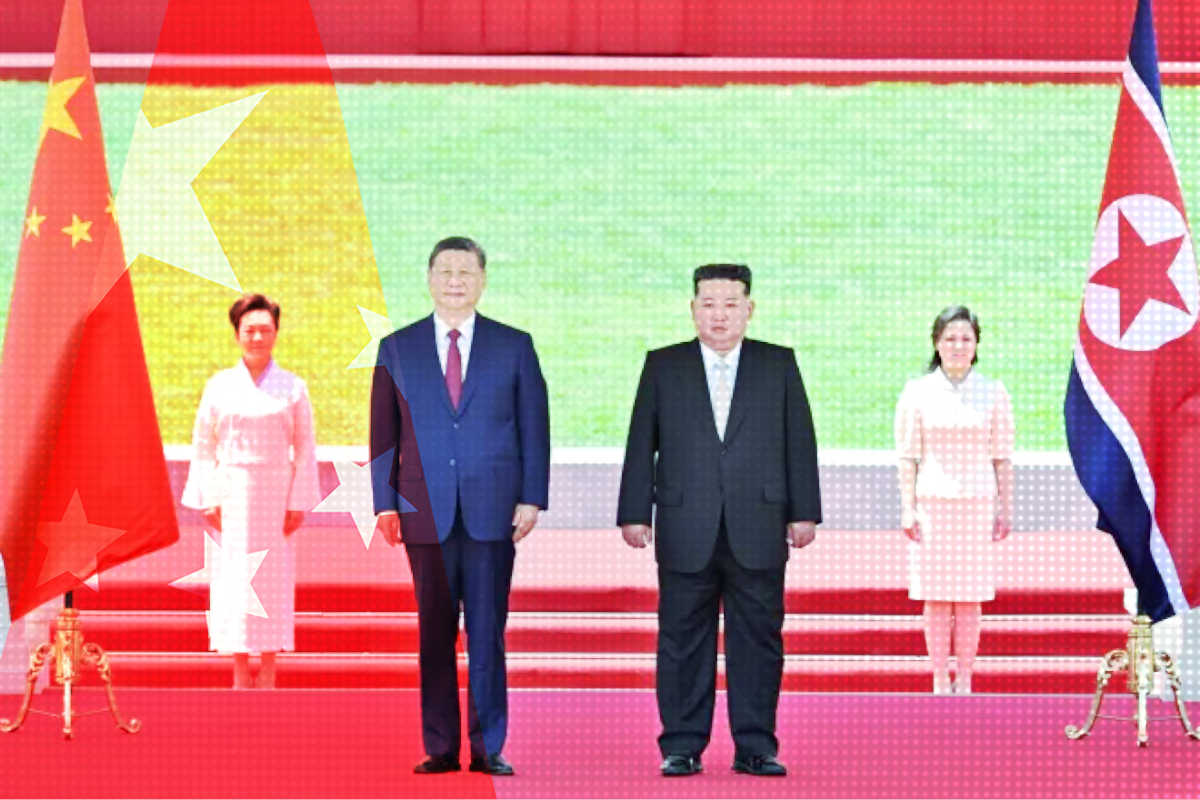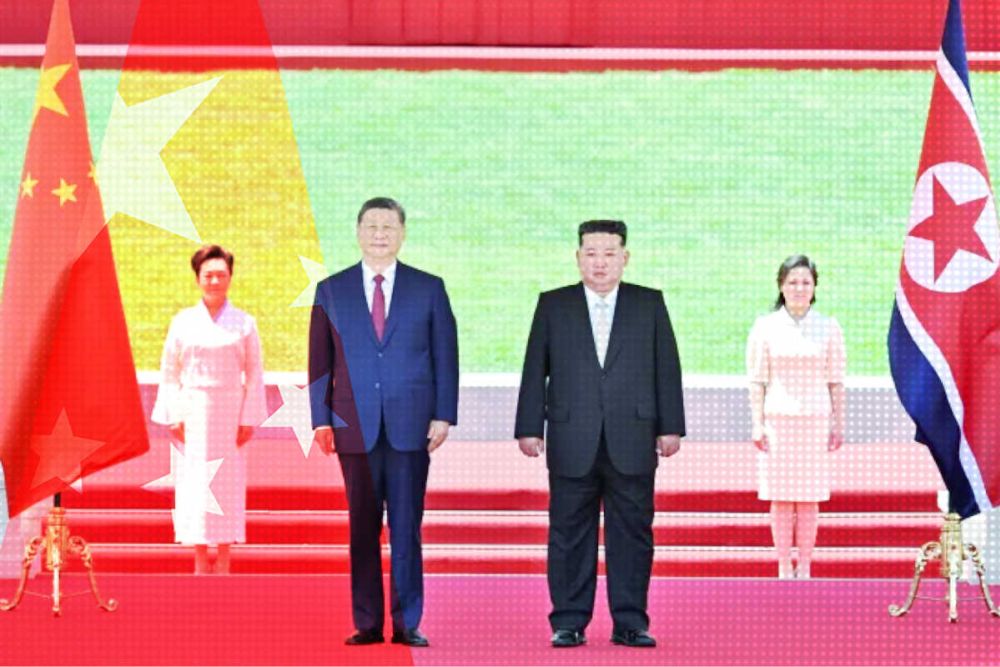
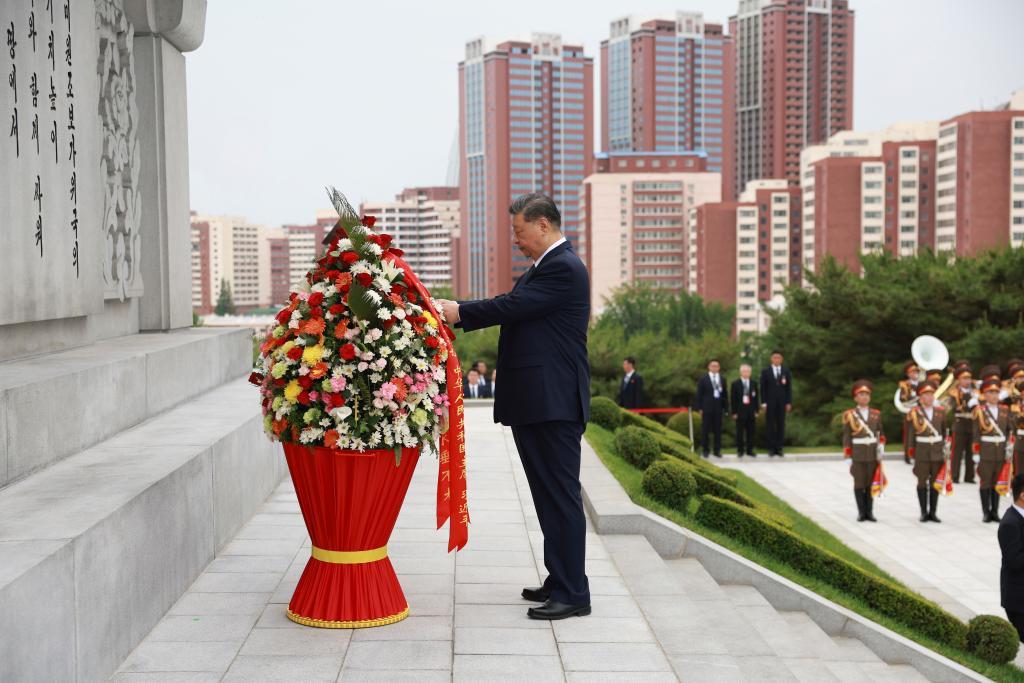
At noon on Monday, Xi Jinping arrived in Pyongyang for talks with North Korean leader Kim Jong-un, his first official visit since 2019. Analysts and news media outside China plumbed the newsworthy undercurrents, noting that China’s top leader was keen, in light of North Korea’s ever closer relations with Russia, to remind Kim who really calls the shots. Across the heavily militarized border in South Korea, some media turned in a search for substance to the minute symbolism of Xi’s arrival, and the “eerie decalcomania” of the visual solidarity the two countries projected to the world.
In the People’s Daily on Tuesday, this obsessively decorative approach to diplomacy was on garish display — and it was, you could say, entirely the point. Xi’s visit to Pyongyang, in fact, provides the perfect opportunity to revisit the mystifying mechanics of China’s Party-run media, and how they package and perform power.
It goes without saying that the People’s Daily, which the CCP unapologetically terms a “mouthpiece” (喉舌), does not report news of the Pyongyang meeting. What it does, through every choreographed image and carefully chose phrase, is frame the moment like a perfect picture of “friendship” (友谊).
This seemingly simple word, “friendship,” is in fact one of the core terms to parse in the midst of these proceedings. It appears no fewer than nine times in the title article under the masthead alone, and elsewhere on today’s front page 17 more times. The article we are told Xi penned for North Korean media, also published on the front page, is called “Writing a New Chapter in the Traditional Friendship Between China and North Korea.” The previous night’s festivities, we are told, closed with a soaring performance of an anthem called “The Korea-China Friendship: Green Across the Ages” (朝中友谊万古长青). The next day, spoiler alert, a visit to the China-DPRK Friendship Tower will be on the agenda.
When the BBC asked in its own headline on Monday whether Xi’s visit is about friendship or leverage, it was missing something rudimentary about how the CCP deploys the language and symbolism of friendship as leverage.
The basic reading of the visit’s significance in the foreign news media this week has been more or less accurate. This is about consolidating the bilateral relationship — the word “strengthening” is everywhere too — and sending Kim Jong-un a clear message about the terms of the relationship. Russia, the United States and Japan are certainly looming in the shadows. And because the People’s Daily is not a newspaper, not really, it’s important to focus primarily not on what it said textually, but on how it said, packaged and portrayed.
So let’s take a closer look at the surreality Tuesday (the word “decalcomania” is an apt choice) of China’s most important official “newspaper.”
Stop Reading, Start Observing
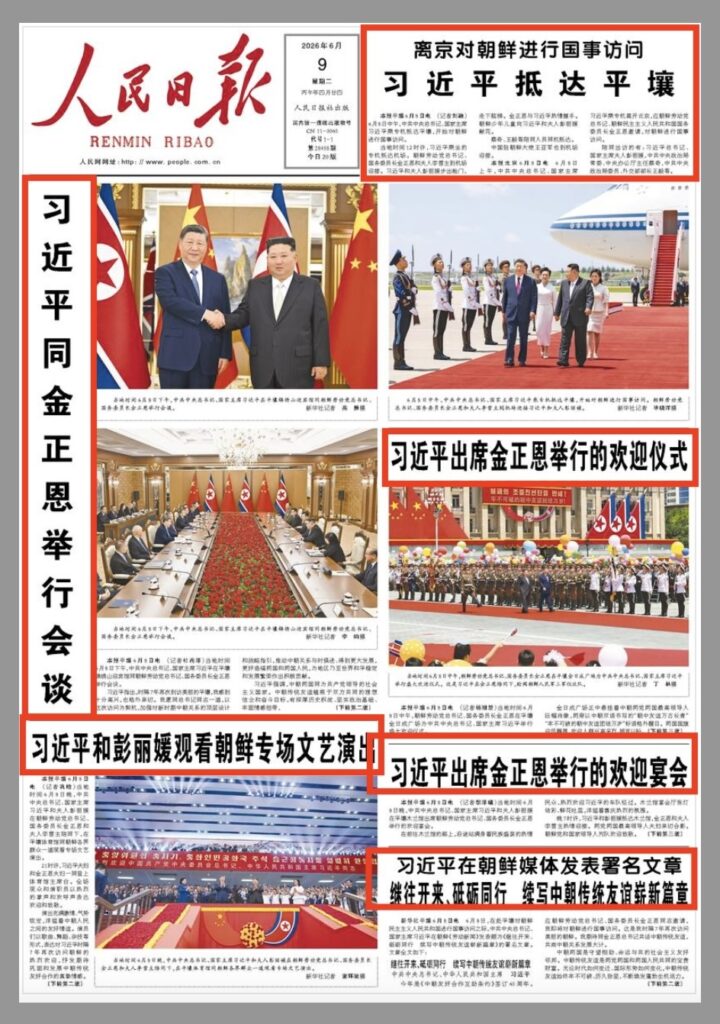
Immediately, beyond the red carpets, the red flags, the military pageantry, and the literal theatrics — all quite intentional visual repetitions of pomp and ceremony — we may note that every single one of the headlines on the front page leads with “Xi Jinping.”
This idiosyncratic touch, and it is crucial to remind ourselves just how bizarre it really is, would be allowed by no self-respecting newspaper editor anywhere in the world. In any normal press context, where one’s business is the news, such a treatment would be monstrous.
A single headline like the one to the right of the masthead on this page, in the space known in Chinese media language as the “newspaper eye” (报眼), would be more than sufficient. “Xi Jinping Arrives in Pyongyang.” So why is it not?
Apart from the facts of this bilateral engagement, the ritual incantation of Xi’s name in this Party mouthpiece is precisely the point. When it comes to political “news,” Xi Jinping is always the subject of the sentence. Even if China’s premier is presiding and speaking at an event, as with Li Qiang (李强) on page two of yesterday’s edition about a constitutional oath ceremony for newly appointed department and agency officials, the piece is front-weighted with language about Xi and adhering to “Xi Jinping Thought.”
Xi Jinping’s name is the drumbeat that sustains the monotonous rhythm of the entire political system.
When we turn to the People’s Daily readout on the talks, we find an equally ritualistic presentation of what happened. The item comes directly below the masthead, marking its place of importance as a report — using that word cautiously — of the real import of the serious, high-level discussions.
As we read such official language, we must remain alert to its ideological packaging. In China’s political culture, as was the case in the political cultures of the Soviet Union and the former Soviet Bloc, language is always meta-language. Text, images and acts should be understood as what Vaclav Havel called, in his 1978 essay Power of the Powerless, “ritual communication within the system of power.” This is half the secret of properly reading any Party text, and Havel’s essay remains, as I only half-jokingly told an audience in Taipei last week, the most perceptive work on Chinese political discourse in the 21st century.
One rudimentary structural aspect of yesterday’s signature article, “Xi Jinping Holds Talks with Kim Jong Un” (习近平同金正恩举行会谈), is its hierarchy of “Xi Jinping pointed out” (习近平指出), “Xi Jinping stressed” (习近平强调), and “Kim Jong-un said” (金正恩表示), language that starts out each paragraph in succession (again, authoritarian rhythm). After a simple line about the fact that the two sides “held talks,” we have Xi Jinping holding forth and setting out, with authority, the basic terms of the relationship.
Xi “points out” from his position of authority that this visit will “strengthen the top-level design and strategic guidance of China-North Korea relations in the new era.” Our eyes may glaze over, but the basic meaning here is that China is in the driving seat, taking the lead in defining the relationship, which not at all incidentally is temporally situated also in Xi’s “New Era.”
The next paragraph follows with the tonally stronger “Xi Jinping stressed” (习近平强调), which signals weight and urgency. Here, Xi “stresses” three unchangeable principles in the relationship, which are the “traditional friendship,” the commitment to Kim’s leadership of “the North Korean socialist project,” and the commitment to preserving mutual interests and a “favorable strategic environment.”
As with all CCP official discourse, there is a lot to unpack in this notion of a “favorable strategic environment” (良好战略环境), the third aspect of what in recent days state media have termed, with the usual penchant for the neat packaging of formulas, the “Three Unchangings” (三个不会改变), or the “Three Will Not Changes.” As we parse official discourse in China, the formulas and framings, or tifa (提法), are like keys that unlock one another.
That may sound mysterious, but it need not be overly so.
The key approach to unlocking tifa like the “Three Unchangings” is to seek out complementary analysis and explication within the official discourse, such as in theoretical journals like Seeking Truth (求是). This is what I sometimes call “taking the side doors.” It is a time-consuming process — and, no, AI cannot do it for you — but the keys are all there. Fair warning: there are no magic eureka moments. You do not open chests and discover discursive treasure. You are not reading tea leaves. But you can see how the building blocks of this peculiar political discourse system, the language of power, fit together — and sometimes, how they might be shifting.
Not surprisingly, there are a number of side rooms this week in the state media dealing with the “Three Unchangings.” A related article in Guangdong’s official Nanfang Daily on Tuesday, republished by Seeking Truth, purported to “read” the significance of the phrase. There are limits to what it elucidates, but it does make clear that the “favorable strategic environment” mentioned in the readout above means opposing what the article calls “hegemonism and power politics,” a standard CCP formulation referring to the United States, and also “the revival of militarism” — a clear reference to Japan, which China has in recent months loudly accused of “neo-militarism.”
To a large extent, we can read this as an oblique reference to the strategic considerations that make the iron-clad “friendship” between China and North Korea so crucial from China’s perspective. Another reading published by Xinhua today, and (over-)promising a “blueprint,” tells us that “Xi Jinping emphasized China’s consistent commitment to developing China-DPRK relations with the ‘Three Unchangings.'” Unpacking the meaning of this returns us — perhaps without satisfaction — to China’s strategic framing of “friendship”:
Against the backdrop of a rapidly evolving era marked by profound historical changes, the “Three Unchangings” underscore that, despite the passage of time and shifting circumstances, the traditional friendship between China and North Korea remains unbreakable and grows stronger with time.
Once again, there are few revelations to be had, once we have cleared away the framing and pompous pageantry. But the ritual of the discourse is more than half the point. China’s state-run press this week is a banquet of symbolism insisting again and again on the unbreakable nature of the friendship between China and North Korea, surpassing (Take that, Putin!) all other bilateral relationships.
Meanwhile, Down in the Provinces
It should not surprise us that the ritualistic approach to Xi’s Pyongyang visit was replayed in the official CCP media at the provincial level. Once again, the entire story was a ritual of conditional “friendship” as unconditionally strong. The layouts at the provincial and even the city level are effectively identical to that of the People’s Daily.
But because one of the most important functions of political discourse in the system is the ritual signaling of consensus as defined by the center, the communication in this case has a further layer of messaging — directed upward. The echo says, much like the sign the green grocer hangs in the shop window in Havel’s Power of the Powerless: We leaders in _____ province have fallen in line, and communicated the line to our cadres.
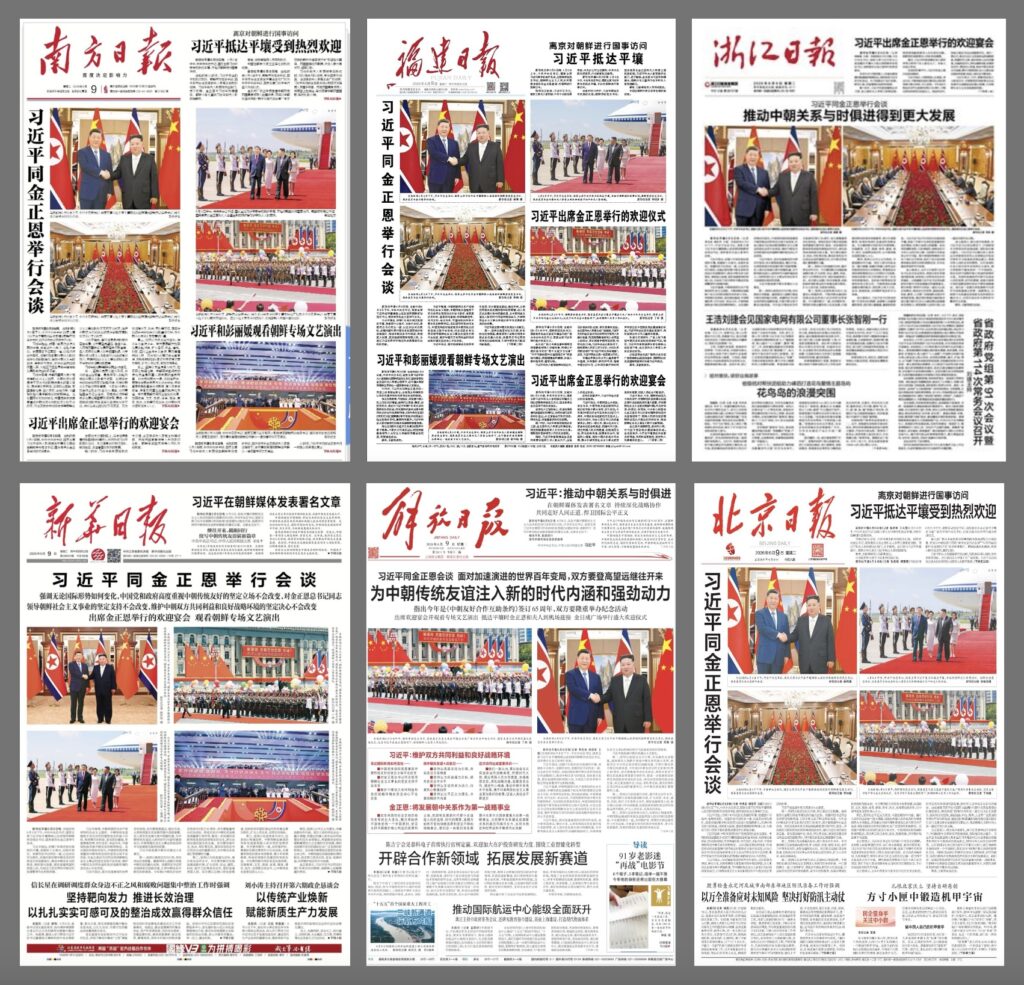
The echo is like a ritual bow. And to consistent but varying extents every single day, all Party media follow this formula. If they differ from the People’s Daily at all, it is only in how they balance messaging from the central leadership with messaging downward and outward within the province — as well as upward on province related matters, because in the world of political point-making, they are also trying to be seen.
This balancing act is the only thing that makes these pages remotely interesting in terms of variance from the center. The layouts yesterday are an excellent case in point. Above are six Party papers, all at the provincial level: Guangdong, Fujian, Zhejiang, Jiangsu, Shanghai and Beijing. Interestingly, the papers in this group that most closely echo the People’s Daily are Guangdong’s Nanfang Daily, which was once among the more adventurous media groups but was brought to heel early in the Xi Jinping era, and Fujian Daily. Both have the same pattern of Xi headlines on the Pyongyang visit — and nothing whatsoever else.
All six of these papers lead with the story of the “talks” in Pyongyang, the top story under the masthead in the People’s Daily, though there is slight variance in choice on content for the “newspaper eye.” Zhejiang focuses on the banquet story, while Jiangsu and Shanghai fill the space with the story about Xi Jinping’s article appearing in North Korea’s Rodong Sinmun, its equivalent to the People’s Daily.
The papers from Zhejiang, Jiangsu, Shanghai and Beijing manage to squeeze provincial-level messaging onto the front page in the bottom one-third or one-fourth of the space. In Shanghai, CCP Secretary Chen Jining (陈吉宁), is meeting with an executive from the American tech company TE Connectivity, a manufacturer of electrical and electronic components; and Mayor Gong Zheng (龚正) is chairing a meeting with city leaders on its modern logistics system. In Jiangsu, CCP Secretary Xin Changxing (信长星) is traveling across the province, urging other Party leaders to heed the words of Xi Jinping on anti-corruption.
In keeping with the nature of China’s wooden political discourse, and the signaling role of the CCP’s press system, these treatments are more performative than informative. Secretary Xin, echoing language at the top, says cadres in Jiangsu must “thoroughly study and implement the important directives of General Secretary Xi Jinping and the decisions and plans of the CCP Central Committee.”
None of this is anything, as we say, to write home about. But it is important to recognize how language is working, at the provincial level and below, in exactly the same way as it is above. The deft use of this power discourse is a key aspect of political performance, which is why, talk as they might about the dangers of “formalism” (形式主义) — going through the motions without doing real things — the Chinese Communist Party cannot root out such behavior. Even treatises on “speaking the truth” descend rapidly into chasms of ideological nonsense.
in a China-watching world increasingly geared toward quick takes and AI slop sinology (including daily “readings” of the People’s Daily), it’s crucial to remain conscious and conscientious about the language and logic of China’s system — which for all of its signboard obviousness can too often be taken for granted. December this year marks the 90th anniversary of the birth of Vaclav Havel, the playwright and statesman who was not just a leading proponent of human rights and the dignity of the individual, but who also understood and elucidated so well the terrible strangeness of political bureaucracy and its dominance of society in a post-totalitarian system.
Next time you sit down with a sleep-inducing missive from the Chinese Communist Party, or report on an extravagantly choreographed state visit, try first jolting yourself into clear-mindedness by reciting the first line from Section III of Havel’s Power of the Powerless:
The manager of a fruit-and-vegetable shop places in his window, among the onions and carrots, the slogan: “Workers of the world, unite!” Why does he do it? What is he trying to communicate to the world?