Tag: censorship

Scripting the Source

“Many of our interviews aren’t done on the spot these days,” says Wu Ting, a journalist who works in television news production at Jiangxi Television, a provincial-level state broadcaster in China. “Instead, higher-ups set the direction for us in meetings ahead of time, and we just complete the filming on-site.” This may seem a surprising admission from a working journalist, but it is not an isolated phenomenon, Wu told Tian Jian. 

In recent years, the way some media outlets in China conduct interviews has changed. No longer do interviews need to unfold before the camera lens. Rather, their basic framework can often be set before the recording ever begins. At some television stations and for documentary-style feature segments, interviewees receive talking points before taping and some are even required to recite lines prepared for them. The interview, in other words, is no longer something generated on the spot. It is a programmed output.

The trend is expanding across many kinds of programming, says Wu, including current affairs reporting, segments on social issues and profile interviews. “If we can find someone who is willing to go on camera and say things the way we want, all the better,” she says. “We go back to them again and again, and give them a few hundred yuan for travel expenses as compensation.”

To explore this trend, Tian Jian interviewed several media professionals who have worked at Chinese television stations. For reasons of personal safety and to protect their employment, all interviewees in this article except Su Yutong and Liu Dongmei have been identified by pseudonyms.

Huang Miao, director of the news features department at Zhejiang Television, who has also worked on documentary-style programs, said that since the pandemic, public frustration has been growing under pressures like unemployment and mortgage payments. Yet the content, settings and structure of feature interviews must still follow official rules, so what gets said in an interview is often decided ahead of time. “That includes the dialogue between reporters and interviewees,” she said. “Content that once came out of live interaction has been moved up to the planning stage. The on-camera question-and-answer has become more a visual rendering of a set narrative than a process of producing information.”

Because hers is a state-run outlet, Huang said, its reporting must meet the requirements of the propaganda department. “What they want to see is that we ‘sing the main melody’ (唱好主旋律), guide the audience and spread ‘correct thinking,’” she said, referring to Chinese Communist Party language for ideological control. “That means we have to tell interviewees what to say. Some interviewees are given a few fairly standard lines, and they can’t really stray far from them.” 

“You can change the tone, but you can’t change the meaning,” she adds.  

Risk Management First

Behind this change lies a shift toward what these journalists call “risk management.” In the past, the risks a news story posed in China were dealt with during editing and publication, when stories could be reviewed, revised or rewritten. Today, some of those risks are neutralized before reporting even begins, so that content meets set requirements from the moment it is created.

Su Yutong, a former reporter for Beijing Radio who now lives in Germany, said the practice reflects the climate of public opinion in recent years. “Some interviewees are prone to grumbling and complaining, so sometimes the script is written in advance. The interviewee reads it over first, and then reads it out word for word.”

Such practices are not uncommon in news work, she said. “Sometimes people dig up footage or photos and find they’re several years old. That kind of thing we could see coming. But now even interviews have been reduced to reading from a script. It has reached an extreme.”

Four editors and reporters in Zhejiang, Shaanxi, Beijing and elsewhere told Tian Jian that interviews based on pre-prepared scripts are fairly common. This up-front control can include supplying the range of questions in advance, limiting the direction of answers, setting up frameworks to steer around sensitive topics and, in some cases, handing interviewees ready-made lines. What they say is confined within boundaries drawn beforehand.

Gu Le, an insider at Shanghai Oriental Television, said that controlling what interviewees say has become part of news censorship, with programs going through multiple rounds of review before broadcast. “The most important thing now is to keep anything uncontrollable from appearing. Rather than deleting it later, it’s better to prevent it from appearing in the first place,” Gu said. 

Gu pointed to a recent viral interview with motorcycle entrepreneur Zhang Xue as an example. Zhang founded the brand ZXMOTO in 2024, and its bikes won two straight races at the World Superbike Championship round in Portugal in March 2026. In a post-race interview, when a reporter prompted him to thank the Chongqing government for its support, he replied, “Not a single penny.” When another reporter, from the Chongqing Communist Youth League, asked what drove him, he replied, “Why don’t you just tell me what to say, and I’ll say it?” Social media users passed the clip around as a rare case of an interviewee going off script.

According to Pan Yi, a veteran Chinese journalist, this shift has also changed the source of journalists’ professional anxiety. Where they once worried about whether a story would get published, they now worry about whether trouble will follow “the moment words come out of [an interviewee’s] mouth.”

“This kind of pressure has warped journalists’ professional instincts, shifting their focus from uncovering stories to assessing risks,” said Pan. “Today’s journalists are less ‘looking for people’ than ‘looking for characters.’ Our function has been drastically watered down. We’ve been reduced to casting directors for a grand narrative, responsible only for finding interviewees who fit neatly into a predetermined script. As for the risks behind the content, editors-in-chief and media platforms hedge against them through rigorous self-censorship.”

Dai An, a communication scholar at the Communication University of China, said the goal is to head off risks in advance and keep problems from arising during interviews. By filtering out uncertainty at the very start of the process, news production becomes highly “controllable.” “This approach completely stifles the room for authentic expression,” he said. “Complex truths that might otherwise have sparked debate in the newsroom are shut out of view the moment the shutter clicks or the recorder switches on.”

Under this approach, reporters are no longer focused on providing information, but on avoiding statements that deviate from expectations. What can and cannot be said is often settled before the interview begins, and whether a segment airs smoothly depends on whether it stays within those boundaries.

“Scripting” the Editorial Process

As pre-interview controls have tightened, the role of interviewees in Chinese news has also changed. Once seen as sources of information and voices for different viewpoints, they have been folded into predetermined narratives, and their room for expression has noticeably narrowed.

The shift has not gone unnoticed by news consumers. Despite the government’s professed crackdown on fake news, suspicions that reporting and editing are “scripted” have persisted, frequently drawing the attention of the public and international media.

On April 16, 2022, for example, CCTV’s flagship evening newscast, “Xinwen Lianbo,” reported that some supermarkets in Shanghai had reopened during the city’s Covid-19 lockdown, with “ample goods and normal stock.” Internet users later questioned whether the footage had been staged. The next day, the Shanghai Municipal Party Committee’s propaganda office released an official response stating that the footage had been shot on April 15 in Jinshan District, which was “nearing zero-Covid” status. But a photographer using the name “Fei Diwen” (費迪聞) later claimed on WeChat that he had shot the footage himself on March 31 at an RT-Mart supermarket in Yangpu District, and that CCTV had used it without permission.

Such controversies are not isolated. On December 10, 2025, CCTV-4’s program “National Memory” (國家記憶) aired the first episode of “The Call of the Times” (時代呼喚), a documentary series about China’s high-speed rail. Some scenes of railway construction bore a “Doubao AI” (豆包) watermark in the lower right corner, the mark of ByteDance’s AI assistant. Railway enthusiasts online noticed that the construction footage “defied common sense.” The episode was then taken down from CCTV’s website — and when it was reposted, the footage had been replaced.
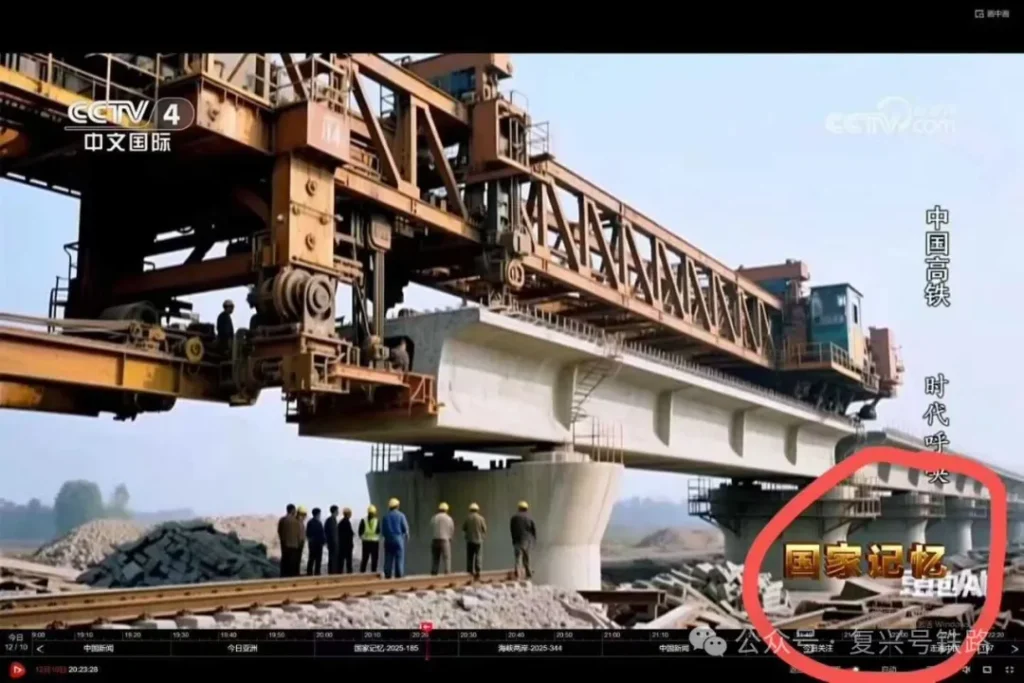
Screenshot from the original episode of the CCTV documentary series “Chinese High Speed Rail: The Call of the Times” with AI-generated images. Via 复兴号铁路 on WeChat.

Guo Yajun, a scholar at Peking University’s School of Journalism and Communication, said the phenomenon reflects an adjustment in how news is produced as a whole. “When an interviewee’s statements are controlled in advance, the interview is no longer a process of gathering information, but the confirmation of a predetermined narrative.” 

“The media no longer generate content on the spot,” he said. “Instead, they move the uncertainty to the stage before the interview begins.”

Guo said that while this mechanism helps contain public opinion risks in the short term, it will undermine the basic function of news in the long run. “News has traditionally relied on bringing different pieces of information together in pursuit of the truth. Once expression is uniformly restricted, audiences no longer confront reality itself, only a single, filtered version of it. As the public keeps noticing this gap, trust will gradually erode, and the media’s credibility will fall further.”

The Changing Role of Journalists

Faced with preemptive control and predetermined narrative frameworks, journalists are no longer in the business of uncovering information and building narratives. Their job has become managing risk.

Liu Dongmei, a former reporter at Hefei Radio in Anhui province, said that beginning in 2023, the first question before an interview was no longer “what to ask,” but “what not to ask.”

“The station instructed us that preparing for an interview wasn’t just about collecting information and drafting questions, but also about assessing the potential risks posed by the interviewee,” Liu said. “In the end, I could only find interviewees through classmates’ referrals or by approaching people I knew. Since we were on good terms, they would just say, ‘Tell me what you want me to say, and I’ll go along with it.’ I actually felt pretty awkward about it.”
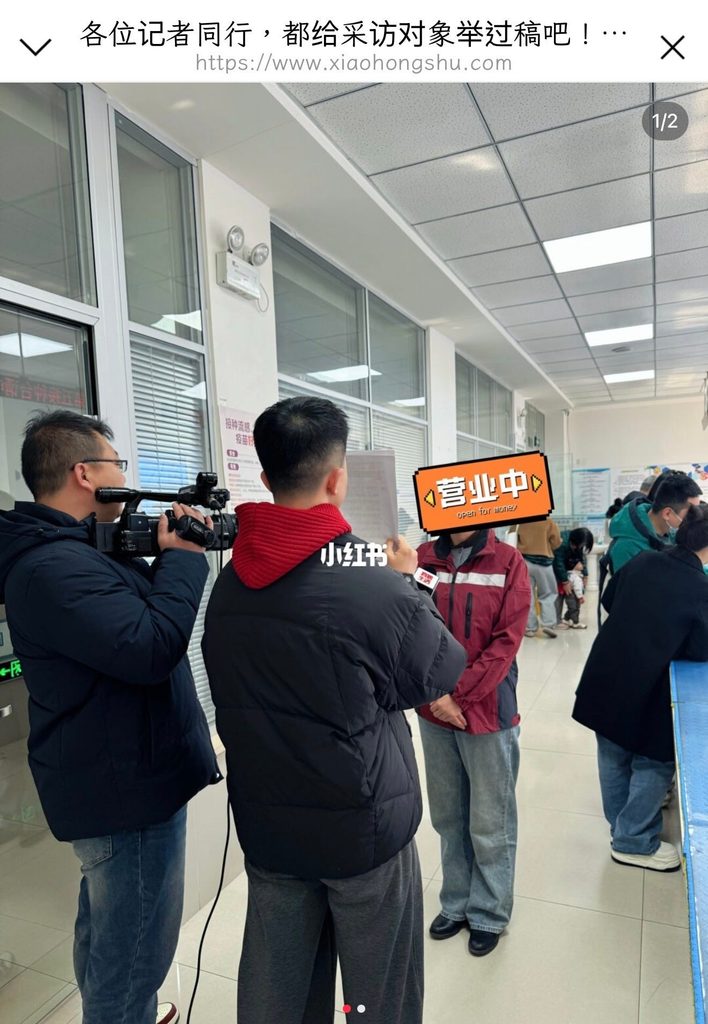
A Chinese reporter stands nearby, holding a script for the interviewee to read from. (Screenshot from Xiaohongshu)

Liu found it hard to adapt. Three months into the job, she quit reporting and moved to another industry. She said that by the time she realized her work was shifting from “identifying questions” to “managing risks,” she had already decided to leave. “Where else — in foreign media, Hong Kong or Taiwan — is news reported like this? You focus only on the risks a story might pose to the station, never on its news value.”

As censorship permeates the day-to-day operations of every media outlet, journalists’ professional roles are being reshaped — from a focus on content to a focus on structure. In the process, journalists are no longer just reporters. They have also become regulatory checkpoints within the news system. Their work is not only to present reality but to ensure that expression stays within the bounds the authorities deem acceptable.

Shifting Boundaries

With the move toward pre-interview preparation and the changing role of journalists, the nature of news storytelling itself has begun to change. Content no longer comes primarily from on-site interaction but is increasingly built on a prearranged framework, producing a more uniform overall presentation.

The Chinese journalists, journalism instructors and media professionals interviewed for this story all described a similar situation in their workplaces: the information that reaches readers often already carries a clear stance and bias, making it hard for some readers to grasp the full course of events in stories about mass incidents or so-called “revenge against society,” a phrase used for random acts of violence. 

Liu said that for news and programming, propaganda departments typically draw up a plan in advance that the media must follow. “The ‘preset structure’ of news has been around a long time, and many people have grown used to working this way. Whether they are fresh out of journalism school or reporters with years of experience, they all work within the same framework. That includes the questions and answers, which are settled before the interview takes place. The interview itself is largely just a supplement to what’s already there.”

When the content of an interview is prepared before recording, the way news is produced changes, too. Much of the information no longer comes from the scene, and exchanges between reporters and interviewees often amount to repeating predetermined lines. What audiences ultimately see is often nothing more than a selection of pre-approved statements.

Tian Yu is a freelance journalist covering Chinese-language current affairs and social issues, with a focus on China’s media landscape and public governance. This article originally appeared in Chinese at Tian Jian (田間).

How China’s Press Abandoned Its Readers

In a rare post yesterday, a user on China’s WeChat platform offered a thoughtful — and cutting — assessment of the state of the country’s news environment. Responding to a recent wave of notices from newspapers about pending closures, the essay countered the idea that this trend stems from the growing irrelevance of traditional print media in an era defined by digital media and AI.

The author’s core argument was that traditional newspapers and magazines in China, which from the early 2000s through the early 2010s carved out a space of relative vibrance, have not just shifted to digital — but have, more importantly, abandoned any pretense of reporting news or doing journalism.

“I have a perspective that may be a bit tougher to hear,” the post read. “That it was the newspapers that first lost their capacity to produce content, and that it was they in fact who took the initiative in abandoning their readers.”

Well worth a read, the post is an excellent complement to several recent stories we have written here at the China Media Project, including Dalia Parete’s look at the collapse of local broadcasters across China, our piece over at Tian Jian (田间), translated here, about the extreme challenges facing journalists in China today, and my own post about the gleeful uptake of AI by official state media, who have little need in a climate saturated by propaganda for the soul-searching one finds among journalists elsewhere in the world.

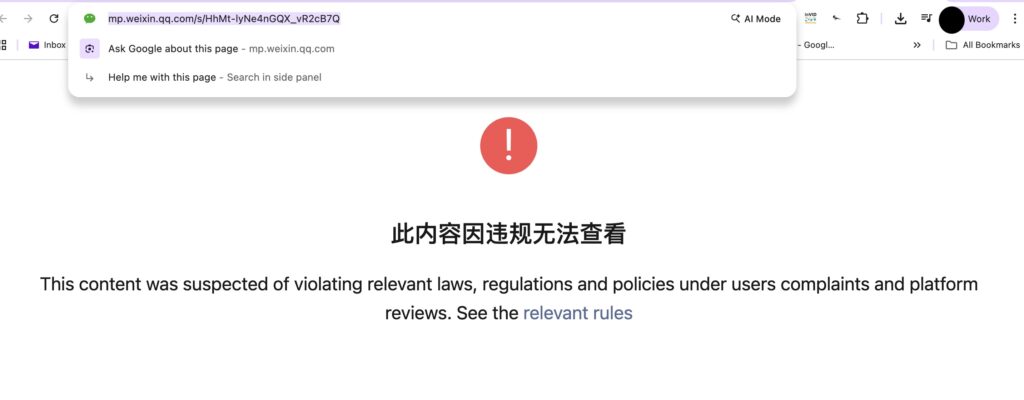
Despite the fact that this post made no directly correlation between the worsening journalism space and the unbending media and information control policies of Chinese leader Xi Jinping, it was removed from WeChat sometime earlier today, yielding a message that it was in violation of “relevant laws.”

A translation of the first two sections of the WeChat post follow, and we also provide a downloadable PDF down below for those who wish to read the original.

____________________

Since the outset of this year, at least 14 newspapers have announced they are closing shop. Thing about this for just a moment and you realize that notices of this kind are no longer news. By now, we should be long accustomed to the long winter of print. Some point to the frenetic pace of modern life — people are just too unsettled to sit back and read the newspaper. Others say that newspapers have simply been forsaken by the times.

I have a perspective that may be a bit tougher to hear. That it was the newspapers that first lost their capacity to produce content, and that it was they in fact who took the initiative in abandoning their readers.

01

Have you guys noticed that it’s not just newspaper readership that has cratered? It’s also the case that fewer people are watching television. These days, craving news or gossip, we turn first to Weibo, to the push notifications we received from news apps, to Douyin, to WeChat public accounts, or to Toutiao and scores of other such channels.

Print and television media no longer have the news that people need.

According to the Blue Book of Data Journalism (2024), 831 separate news website domains are operated by newspapers in our country, as well as 852 mobile apps and 9,393 WeChat public accounts. The total number of users of new media has passed 10 billion, and total revenue from the new media operations of traditional print newspapers reached 6.22 billion RMB, up 3.4 percent from 2023.

So, we can see that traditional print media have not simply been sitting around and waiting to die. They have been transforming.

The form has changed without a doubt. But to what end? Our mobile screens are filled with “shocking” headlines, with “plot twists” and “flowing tears.” Click in to have a look and you’ll find that the six most basic elements of any news story are nowhere to be found. The headline is just meant to grab your eyeballs (吸引眼球), but the content it incomplete from top to bottom, and at the end nothing is clear — or maybe there’s just borderline content tossed in to log an instant of traffic.

One example from a story I saw just yesterday. The headline: “US Military Official: American Forces Consumed 7.6 Million Cups of Coffee During Strikes on Iran.” The outlet that published it is one of the country’s leading domestic media outlets.

A video report from the official China News Service on Facebook shows the remark from US General Caine about the amount of coffee consumed by the US military amid strikes on Iran.

I couldn’t help but ask myself — what is the point of posting this sort of thing? Is this something that can raise public awareness, or something that can advance social progress?

In the meantime, things of genuine social concern go unreported, and stories from the grassroots go unreported. Most alarmingly, this mode of news that does not look like news (这种新闻不像新闻的模式) has already become the industry mainstream.

02

What is the role of the media? In the view of the West, media are “public instruments,” or a “Fourth Estate.”

You’ll find today that many reports bear bylines like “reporter so-and-so.” But read the entire report and you’ll find yourself asking: Where is this reporter exactly? Perhaps they are scrolling through Weibo or lying in wait in the comment sections, or they are waiting for official notices to come out. Whatever the case, they are anywhere but at the scene where news is happening.

When media no longer have the capacity to verify or produce information, but rather become the frontline consumers of information, the truth jostled about amid the flood and frenzy of public attention and traffic often proves too delicate to withstand it.

Back in January, one case in Taizhou, in Zhejiang province, went through three iterations involving a husband and wife and food safety. First, the pair claimed to have been “poisoned” after eating baby cabbage ordered online. Next, the story was that “the seller wrapped the vegetables in toxic newspaper.” Then, finally, it was that “the husband poisoned his wife.” Finally, the authorities announced that “the couple had colluded to poison themselves and fraudulently claim compensation.”

Early in the story, some outlets ran stories based on the couples’ own account that conclude that “the seller used toxic newspaper to wrap the vegetables.” As the story developed, some media spread the claim, without any clear or credible sourcing, that “the husband had poisoned his wife.” When the truth finally dawned and police disclosed that the couple was suspected of extortion and blackmail, some of the outlets that had leapt on the story from the start quietly pulled their posts offline, draining their last dregs of credibility.

The root cause here is that media have become like headless flies that buzz off toward the stench of traffic.

When media no longer provide [the public] with exclusives, no longer offer depth, no longer offer truth, what can possibly induce readers to stay? If media have been abandoned, they have only themselves to blame.

For those who wish to read on, we are posting a full archived version of the post below.

A Prize Against the Odds

Over the weekend, the results of the seventh edition of the Journalists Home News Prize (记者的家新闻奖), a grassroots journalism awards initiative that has been affectionately called “China’s Pulitzers” (中国普利策), were published through the WeChat public account of veteran investigative journalist Liu Hu (刘虎). The release is remarkable considering Liu’s circumstances just a few short weeks earlier.

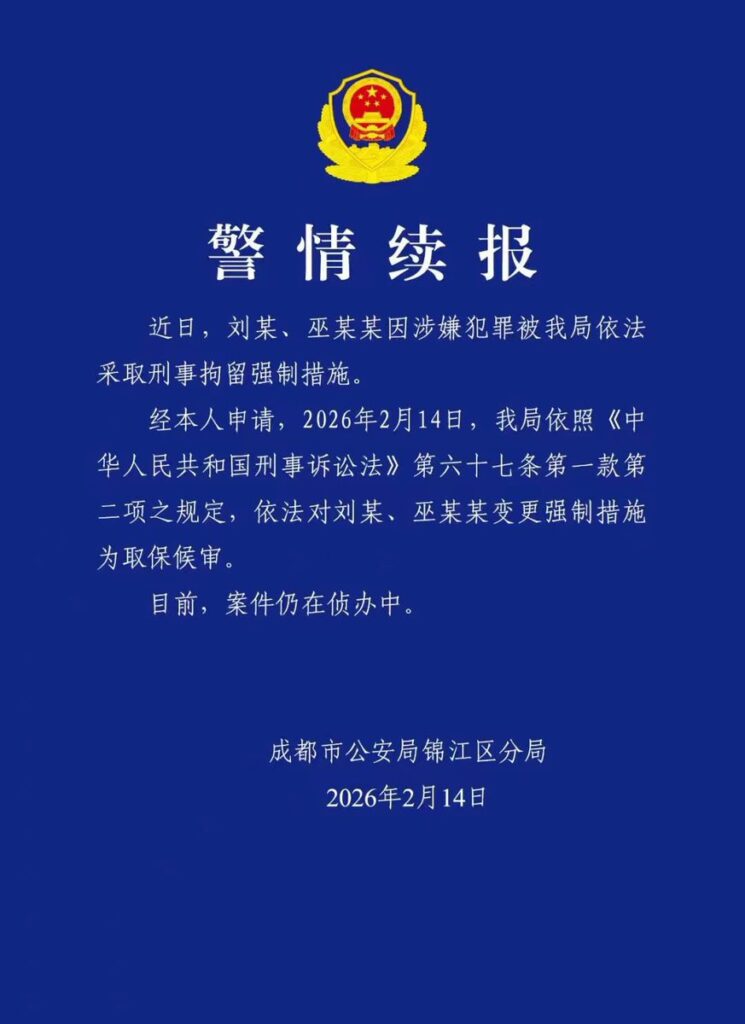
On February 1, public security officers in the western city of Chengdu detained both Liu and his colleague Wu Yingjiao (巫英蛟) as they were traveling separately — Liu en route to Beijing, and Wu in Hebei. The next day, Chengdu police formally announced that the journalists each faced criminal charges of false accusation (诬告陷害罪) and illegal business operations (非法经营罪) stemming from a report on WeChat alleging that local officials in Sichuan had broken a previous agreement with investors in a construction project, seizing control of the assets.

The police actions triggered a wave of public attention in China — and a countervailing wave of online censorship. China Digital Times reported that 21 articles dealing with the case were added to its deleted-content archive in the five days following the detentions, nearly double the total number of deleted articles added to CDT’s archive on all topics in December last year. The detentions backfired, as one blogger predicted they would. Writing in a post that was subsequently deleted, Xu Peng (徐鹏) observed that few people had actually read Liu’s article before it was taken down — but that the arrests had spread awareness of the case “at home and abroad,” leaving officials with a mess of their own making. “In the end, public opinion spiraled far beyond their control,” Xu wrote, “and the whole plan backfired.”

Liu Hu and Wu Yingjiao were released on bail on February 16, just two weeks before the prize results appeared. “I believe everyone will welcome this ‘follow-up police report,’” wrote rights defense lawyer Pu Zhiqiang (浦志强) on social media. “Best wishes to you both: get some proper rest and have a good New Year.”

SOURCE: Pu Zhiqiang on X.

This recent brush with the authorities was not Liu Hu’s first. He had previously been detained in 2013 on defamation charges after publicly naming officials he accused of corruption; those charges were eventually dropped.

It was against that backdrop that Liu launched the Journalists Home News Prize in 2019, reviving a name with deep roots in Chinese journalism. “Journalists Home” (记者的家) began as a BBS forum in 2000, a gathering place for reporters during an era of relative openness, when forms of journalism like investigative reporting were flourishing in a relative sense. The prize started with four categories, a public service award added in 2021. Now in its seventh year, it has become what one longtime participant called “possibly the best cross-platform journalism prize on the Chinese mainland.”

That the seventh edition appeared at all — published after delays caused by what Liu described only as ‘an unmentionable mishap’ (不可描述的意外) — is a reminder of the tug-and-pull that persists in China’s media environment, where idealistic professionals can actively seek out space for their work despite immense risks. This year’s jury added four additional commendations beyond the original slate, citing an unusually strong field — an expansion requiring an additional 50,000 yuan in prize money. Southern Weekly (南方周末), a commercial newspaper under Guangdong’s CCP-run Nanfang Daily Group, and the independent WeChat-based platform Aquarius Era (水瓶纪元) emerged as the strongest performers across categories, each taking two prizes.

The nonfiction grand prize went to Luo Ting (罗婷) for “Rape in the Bridal Chamber” (婚房里的强奸案), published in April 2025 in “Everyday People” (每日人物), a WeChat public account run by People (人物) magazine under Beijing Boya Tianxia Media Culture Development, a company majority owned by entrepreneur Rong Bo (荣波) . The piece reconstructed an engagement rape case in Shanxi province, tracing not only the assault itself but the months of family negotiation and legal maneuvering that followed. The story exposed what the jury described as “the brutal landscape of China’s county-town marriage market.”

The public service grand prize recognized Xie Chan’s (谢婵) return to Wuhan on the fifth anniversary of the COVID-19 lockdown, published by Aquarius Era. The report revisited journalists, artists, volunteers and ordinary citizens to recover recollections of the early chaos and grassroots mutual aid — memories the jury described as filling a gap in the collective memory of a national disaster.

The major social event reporting prize went to Han Qian (韩谦) of Southern Weekly for a multi-year series (archived) on the practice of residential surveillance at a designated location (指定居所监视居住), or RSDL, a legally defined but widely criticized form of residential surveillance that critics say has been systematically abused as a tool of extrajudicial interrogation. Han’s reporting helped transform an arcane legal debate into a public issue and was credited with contributing pressure that preceded new regulations jointly issued by the Supreme Procuratorate — China’s top prosecutorial authority — and the Ministry of Public Security.

i
Residential Surveillance at a Designated Location (RSDL)
指定居所监视居住
▼

Residential Surveillance at a Designated Location (RSDL) is a form of pre-trial detention authorized under Article 73 of China’s Criminal Procedure Law, as amended in 2012. It allows authorities to detain a suspect for up to six months at a location of the police’s choosing — typically a hotel, guesthouse, or other non-official facility — without disclosing that location to the suspect’s family or lawyer.

Although technically classified as a non-custodial measure weaker than formal arrest, RSDL functions in practice as incommunicado detention. Key features include:

  • Detention for up to six months without formal charges
  • No requirement to disclose the detention location, particularly in cases involving alleged national security offenses
  • Severely restricted or denied access to legal counsel
  • No meaningful judicial oversight or review

Between 2013 and 2020, an estimated 57,000 people were held under RSDL, with usage peaking in 2020 at a 136 percent increase over the previous year. UN human rights experts have concluded that RSDL, as applied, constitutes a form of enforced disappearance and may amount to torture or cruel, inhuman, or degrading treatment. It has been disproportionately used against journalists, lawyers, and human rights defenders. In June 2025, China’s Supreme Procuratorate and Ministry of Public Security jointly issued new regulations intended to curb RSDL abuses, including stricter approval requirements and mandatory prosecutorial oversight — reforms legal experts have welcomed while noting significant gaps remain.

Source: International Service for Human Rights

The outstanding media professional grand prize honored Zhou Zhimin (周智敏), a senior reporter at Shanghai Television (上海广播电视台), for a 24-minute video investigation into a school dormitory fire in Henan province that killed 13 primary school students in January 2024. Though authorities had quickly promised a public accounting, 16 months passed in silence. Zhou’s report, published in December 2025, pushed the story back into the spotlight, and within nine days the investigation results were released through Xinhua and CCTV, with the related trial opened to the public. Shanghai Television is the broadcast arm of the municipal-level Shanghai Media Group (SMG), run by the local CCP leadership through the Shanghai State-owned Assets Supervision and Administration Commission.

The best commentary prize recognized Peng Yuanwen (彭远文), a former CCTV producer, for more than thirty articles arguing for higher rural pension benefits — a campaign the jury said had helped build momentum toward what is now a growing policy consensus on one of China’s most urgent social questions.

One key lesson to emerge from these latest awards is that the efforts of Chinese journalists — even at state-run outlets, which accounted for half the prizes awarded — must not be overlooked. The awards and the work they recognize, which have appeared despite intense pressure at every level of China’s media control system, are a testament to that persistence.

China Issues Approved News Source List

Earlier this month, China’s top control body for the internet and social media released its updated list of approved internet news information sources, a roster of outlets first issued a decade ago to curtail the sharing of articles and news reports by unauthorized sources — those without close Chinese Communist Party (CCP) and government ties. The publication of the list starting in 2015 was part of a general tightening of control over news and information in the early Xi Jinping era, as the internet and social media came to dominate news consumption.

The 2025 list from the Cyberspace Administration of China (CAC), issued on August 14, includes 1,456 government-run media outlets whose content can be legally republished by other websites and news platforms — a carefully selected group that is meant to establish the CCP’s dominance over news content in China. All digital media platforms are forbidden from republishing news stories that originate from sources not included on the approved roster, including international media as well as public accounts on major platforms like WeChat and Weibo.

CAC Approved News Sources List

CAC Approved News Sources List (2021-2025)

Category 2021 2025 Change Growth Rate
Total Sources 1,358 1,456 +98 +7.2%
Central Level 286 286 0 0%
Provincial Level 992 1,074 +82 +8.3%
Government Platforms 80 96 +16 +20.0%
Source: Cyberspace Administration of China

The Cyberspace Administration of China (CAC) first introduced the system in 2015 as part of broader internet governance reforms under Xi that include the formation of the CAC as a powerful control and oversight body for cyberspace. The inaugural “Source List” included Caixin, a professional news outlet founded in 2009 by the highly-respected editor Hu Shuli (胡舒立), but the list was further tightened during the second iteration in 2021, at which time Caixin was removed. The 2021 list contained 1,358 approved sources, nearly four times the number in the 2016 list of just 340. These changes reflected the addition of official government accounts within the country’s expanding digital news ecosystem.

The CAC explained that the 2021 update followed three priorities: “adds a group” of trusted sources adhering to correct political orientation, “verifies a group” to update closures and name changes from institutional reforms, and “eliminates a group” of units with “poor regular performance” or lacking influence.

While the overall list grew by just 7.2 percent between this year and 2021 — from 1,358 to 1,456 sources — the distribution of this growth tells a more complex story about Beijing’s information control strategy. Central-level sources remained unchanged at 286 units, suggesting authorities consider the media structure at the national level to be complete. Provincial-level sources, meanwhile, expanded by 8.3 percent (from 992 to 1,074), reflecting efforts to strengthen regional information control infrastructure. This mirrors the trend since 2018 of encouraging the development of local and regional communication hubs, including the creation of “international communication centers” (国际传播中心), or ICCs, which are meant to enhance CCP messaging globally by leveraging provincial, city and county-level media resources.

Government platform sources showed the most dramatic growth at 20 percent, jumping from 80 to 96 units. Among the new additions are several municipal government social media platforms, including the official WeChat accounts of Shenzhen Municipal Government and Chengdu City Administration, reflecting a push in recent years to centralize local news creation by government agencies while adapting to social media-driven information consumption.

The CAC warned that websites not adhering strictly to the approved source list “will be punished according to law and regulations.”