Year: 2020

Reading the NPC Work Report

As the full import sinks in of China’s announcement last night that the National People’s Congress, opening today in Beijing, will “debate” the introduction of a new national security law in Hong Kong, perhaps it is a good moment to look at the full text of Li Keqiang’s government work report, which runs to just over 10,000 characters. Here is a quick review of some of the key buzzwords and priorities.

The work report itself deals only very briefly with the question of Hong Kong in the final section (in the fourth to last paragraph, in fact), following general language about the CCP’s leadership of the armed forces and the determined protection of “national sovereignty, security and development interests.” Hong Kong and Macau follow together, without any particular emphasis, before the issue of Taiwan is addressed. The paragraph in question reads: “We must fully and accurately implement the policies of high-degree autonomy under ‘One Country, Two Systems,’ ‘Hong Kong people ruling Hong Kong’ and ‘Macau people ruling Macau,” building and perfecting the legal systems and implementation mechanisms for maintaining national security in the special administration regions, realizing the constitutional responsibilities of the SARs. [We must] support Hong Kong and Macau in developing their economies, improving people’s lives, and better integrating with overall national development, ensuring the long-term prosperity and stability of Hong Kong and Macau.”

The work report is intended as a broad overview of goals and a summary of supposed achievements, so we should not be surprised that it glosses right over this major development. The details were more forthcoming, and the language far more astringent, in the speech this afternoon (on video here) from Wang Chen, vice-chairman of the NPC Standing Committee, specifically addressing the question of new legislation for Hong Kong. Wang said, to a chilling chorus of pre-scripted applause (his voice even rose in anticipation at precisely this point) that “strong measures must be taken to stop and to punish” what he characterized as actions “seriously challenging the bottom line of the principle of ‘One Country Two Systems’, and seriously damaging national sovereignty, security, and development interests.”

The image above is a screenshot of the no-joke expression on Xi Jinping’s face when official coverage of Wang Chen’s remarks cut to the General Secretary.

“Overall Stability”

The opening section of Li Keqiang’s work report outlines the “many difficulties and challenges” facing China’s development and the global economy over the past year, a reference principally to global trade tensions and “downward pressures on the domestic economy.” The epidemic, though it has occupied much of the past five months, is not mentioned here specifically, though of course it has been a major factor.

The overarching message is that there is “overall stability in the operation of the economy,” a phrase essentially meant to say that things are OK, even if there are plenty of reasons for them not to be.

There is a focus on domestic consumption, which has been a major issue in recent months – getting Chinese to open up their wallets even further. Li then runs in stepping stone fashion through a range of related issues, from rising urbanization to supply-side reform, essentially the elimination of excess capacity. It is in this relation, in fact, and not on the question of foreign policy, that we have our first mention of the “Belt and Road” in the report, a simple note that the initiative has “achieved new results.”

A Responsible Power

Several paragraphs down, after a brief feel-good mention of the 70th anniversary of the PRC in 2019 that “unleashed the patriotic fervour of people’s across the nation,” the report turns to foreign policy, referring to “great power diplomacy with Chinese characteristics” (中国特色大国外交) – a phrase China has chosen to officially translate “major country diplomacy,” because China (again officially) “does not dominate” ( 不称霸).

We have the usual language in this section about China as a responsible power and a stabilizing force in the world, though it is seeking the “reform” of the global system. Xi Jinping’s signature “common destiny” foreign policy concept is of course also there: “[We have] actively taken part in the building and reform of the global governance system, promoting the building of a community of common destiny for mankind. [We have] achieved results in economic diplomacy and cultural exchange. China has made major contributions to the promotion of world peace and development.”

It is in this section, in the context of international events, that we have direct mention of the coronavirus epidemic, a strategic choice that encourages focus on this issue as a global one – sidestepping touchy questions of origin and initial missteps – on which China has been fast and decisive, and has made immense sacrifices for the sake of the world. The fight against Covid-19 is characterized as a “people’s war” (人民战争) in which Chinese of all backgrounds were crucial, from medical personnel and scientific researchers to “grassroots cadres,” “news workers” and package couriers.

A summary of China’s response, including quarantine and control measures and the “extension of the Spring Festival holiday,” ends with language about overseas infections, suggesting these are the latest threat: “In response to the spread of overseas epidemic situations, we built a foreign import defense system in a timely manner, and strengthened concern and care for our citizens abroad. We actively carried out international cooperation in an open, transparent, and responsible manner, making timely reports of epidemic information, actively sharing epidemic prevention technologies and practices, and rendering mutual help in fighting against the epidemic together.”

Development Goals

The next section of Li’s report outlines the priorities for the upcoming work of the government, including development goals for the coming year. This section starts out with mention of the “442 Formula,” referring to the “Four Consciousnesses” (四个意识), the “Four Confidences” (四个自信) and the “Two Protections” (两个维护). Taken together, the “442 Formula” signifies the power of Xi Jinping and the need to remain loyal to his leadership in word and deed. CMP noted in March that both the “442 Formula” and the banner term “Xi Jinping Thought of Socialism With Chinese Characteristics for a New Era” (习近平中国特色社会主义思想), both being phrases signifying Xi’s paramount position, had been missing from success texts emerging from meetings of the Standing Committee of the CCP Politburo, the Communist Party’s highest decision-making body. This suggested some reputational tensions for Xi in the midst of the coronavirus epidemic, but by mid-March the tables had turned again.

In the government work report, both the “442 Formula” and Xi’s banner term are present, starting out the discussion o0f 2020 development goals.

The “Four Consciousnesses,” first raised by Xi Jinping in 2016, are as follows:“political consciousness” (政治意识), “consciousness of the overall situation” (大局意识), “consciousness of the core” (核心意识) and “compliance consciousness” (看齐意识). Together, they essentially boil down to allegiance to Xi Jinping, who in 2016 was designed as the “core” of the CCP. The “Four Confidences” are 1) confidence in the path, 2) confidence in the theories [of the Party], 3) confidence in the system [of socialism with Chinese characteristics], and 4) confidence in [China’s unique] civilization. The “Two Protections” (两个维护) are about protecting the core status of General Secretary Xi Jinping, and protecting the authority and the unified collective leadership of the Party’s Central Committee.

The bottom line in all of these buzzwords? Xi Jinping is the Party, and the Party reigns supreme.

The next buzzword in this very buzzword-loaded section of the work report is the “Six Stabilities” (六稳), or “Six Steadies.” This phrase is all about managing expectations of the economy, and ensuring that economic uncertainty does not translate into social unrest. They are: stable employment (稳就业), stable finance (稳金融), stable foreign trade (稳外贸), stable foreign investment (稳外资), stable investment (稳投资) and stable expectations (稳预期).

On this last “stability,” the question of expectations and their potentially uncomfortable implications, it is worth noting that China has now officially dropped the use of GDP targets. This is something that was in the cards for quite some time, and an interesting discussion of the use of GDP in China can be found here. The government work report says on this matter, after declaring that “China’s development must be full of hope,” that: “Based on comprehensive research and a considered assessment of the situation, we have made appropriate adjustments to the expected targets set before the epidemic.”

The focus economically, as in all areas, is stability. And in the next paragraph of the work report, the link becomes clear between the decision on GDP targets, the “Six  Stabilities” and a related buzzword, the “Six Guarantees,” referring to 1) employment, 2) basic livelihoods, 3) the market structure, 4) grain and energy security, 5) industry supply chains, and 6) operations at the grassroots:

It should be noted that we did not propose specific targets for the annual economic growth rate, mainly because the global epidemic situation and the economic and trade situation are highly uncertain, and China ’s development faces some unpredictable factors. In doing so, it is helpful to guide all parties to concentrate on the ‘Six Stabilities’ and the ‘Six Guarantees.’ The ‘Six Guarantees’ are the focus of this year’s ‘Six Stabilities’ work. By sticking to the bottom line of the ‘Six Guarantees,’ we can stabilize the economic fundamentals; to promote stability through these guarantees, and in stability seek progress, laying a solid foundation for the comprehensive construction of a well-off society.

Fighting Poverty

Despite the difficulties facing the Chinese economy, which were challenging enough even before this year’s Covid-19 epidemic, the work report is resolute in maintaining China’s anti-poverty goals. This uncompromising attitude is likely more about the propaganda necessities of 2020 than about real and practical determination. Before the outbreak in Wuhan in January, the die had already been cast in terms of the main propaganda themes for the year. The focus would be on the fight against poverty and the realization of a moderately well-off society (xiaokang shekui), 2020 having been set by Hu Jintao and Wen Jiabao years ago as the year by which to reach this development goal. As the official Xinhua News Agency reported back on January 1, less with optimism than with the surety of CCP spin: “The absolute poverty that has plagued the Chinese nation for thousands of years is about to end in 2020, a miracle in global poverty reduction history.”

Things changed dramatically as the country was shut down in late January, but propaganda on anti-poverty and the realization of xiaokang continued alongside the noisy official narrative of a “people’s war” against the coronavirus. Now we see the themes coming back with a vengeance, assuming their rightful places in the 2020 propaganda plan. The government work report reads: “Poverty alleviation is a firm task that must be completed in order to build a well-off society, and we must adhere to the current poverty alleviation standards . . . “

This is a basic rundown of the top themes and priorities laid out in Li’s work report today. But as I suggested at the start, the most pressing issue, and the one most urgently requiring the attention of the international community, is the issue summarily dealt with only toward the end of the report – the question, now an apparent certainty, of national security legislation, and new related mechanisms, in Hong Kong.

I include the full text of Wang Chen’s address on Hong Kong today below.

全国人大副委员长王晨对香港国安法草案的说明(全文)

香港回归以来,国家坚定贯彻一国两制,港人治港、高度自治的方针,一国两制实践在香港取得了前所未有的成功。同时一国两制实践过程中也遇到了一些新情况、新问题,面临着新的风险和挑战。

当前一个突出问题,就是香港特别行政区国家安全风险日益凸显,特别是2019年香港发生修例风波以来,反中乱港势力公然鼓吹港独,自决、公投等主张,从事破坏国家统一、分裂国家的活动,公然侮辱污损国旗、国徽,煽动港人反中反共,围攻中央主导机构,歧视和排挤内地在港人员,蓄意破坏香港社会秩序,暴力对抗警方执法,毁损公共设施和财物,瘫痪政府管治和立法会运作。还要看到近年来一些外国和境外势力公然干预香港事务,通过立法、行政、非政府组织等多种方式进行插手和捣乱,与香港反中乱港势力勾连合流、沆瀣一气,为香港反中乱港势力撑腰打气,提供保护伞,利用香港从事危害我国国家安全的活动。这些行为和活动严重挑战一国两制原则底线,严重损害法治,严重危害国家主权安全和发展利益,必须采取有力措施,依法予以防范、惩治。

香港基本法第23条规定,香港特别行政区应自行立法,禁止任何叛国、分裂国家、煽动叛乱,颠覆中央人民政府及窃取国家机密的行为,禁止外国的政治性组织或团体在香港特别行政区进行政治活动,禁止香港特别行政区的政治性组织或团体与外国的政治性组织或团体建立联系。这一规定就是通常所说的23条立法,它既体现了国家对香港特别行政区的信任,也明确了香港特别行政区负有维护国家安全的宪制责任和立法义务。

然而,香港回归20多年来,由于反中乱港势力和外部敌对势力的极力阻挠干扰,23条立场一直没有完成,而且自2003年23条立法受挫以来,这一立法在香港已被一些别有用心的人严重污名化、妖魔化,香港特别行政区完成23条立法,实际上已经很困难。

总的看,香港基本法明确规定的23条立法有被长期搁置的风险,香港特别行政区现行法律的有关规定难以有效执行,维护国家安全的法律制度和执行机制都明显存在不健全、不适应、不符合的短板问题,致使香港特别行政区危害国家安全的各种活动越演越烈,保持香港长期繁荣稳定,维护国家安全,面临着不容忽视的风险。

党的十九届四中全会明确提出,建立健全特别行政区维护国家安全的法律制度和执行机制,支持特别行政区强化执法力量,绝不容忍任何挑战一国两制底线的行为,绝不容忍任何分裂国家的行为。

贯彻落实党中央决策部署,在香港目前形势下,必须从国家层面建立健全香港特别行政区维护国家安全的法律制度和执行机制,改变国家安全领域长期不设防状况,确保香港一国两制事业行稳致远。

根据宪法和香港基本法,结合多年来,国家在特别行政区制度构建和发展方面的实践,从国家层面建立健全香港特别行政区维护国家安全的法律制度和执行机制,有多种可用方式,包括全国人大及其常委会作出决定,制定法律、修改法律、解释法律,将有关全国性法律列入香港基本法附件三和中央人民政府发出指令等。

中央国家有关部门经认真研究并与有关方面沟通后,提出了采取决定加立法的方式,分两步予以推进。

第一步,全国人民代表大会根据宪法和香港基本法的有关规定,作出关于建立健全香港特别行政区维护国家安全的法律制度和执行机制的决定,就有关问题作出若干基本规定。同时授权全国人大常委会就建立健全香港特别行政区维护国家安全的法律制度和执行机制,制定相关法律。

第二步,全国人大常委会根据宪法,香港基本法和全国人大有关决定授权,结合香港特别行政区具体情况,制定相关法律,并决定将相关法律列入香港基本法附件三,由香港特别行政区在当地公布实施。

2020年5月18日,十三届全国人大常委会十八次会议,听取和审议了国务院关于香港特别行政区维护国家安全的报告,会议认为有必要从国家层面建立健全香港特别行政区,维护国家安全的法律制度和执行机制。同意国务院有关报告提出的建议,根据宪法和香港基本法的有关规定,全国人大常委会法制工作委员会拟定了全国人民代表大会关于建立健全香港特别行政区,维护国家安全的法律制度和执行机制的决定草案。经全国人大常委会会议审议后,决定,由全国人大常委会提请十三届全国人大三次会议审议。

二,总体要求和基本原则

新形势下,从国家层面建立健全香港特别行政区维护国家安全的法律制度和执行机制工作的总体要求是,坚持以习近平新时代中国特色社会主义思想为指导,全面贯彻党的十九大和十九届二中三中四中全会精神,深入贯彻总体国家安全观,坚持完善一国两制制度体系,把维护中央对特别行政区全面管制权和保障特别行政区高度自治权有机结合起来,加强维护国家安全制度建设和执法工作,坚定维护国家主权安全发展利益,维护香港长期繁荣稳定,确保一国两制方针不会变、不动摇,确保一国两制实践不变形,不走样。

贯彻上述总体要求,必须遵循和把握好以下基本原则。一是坚决维护国家安全,二是坚持完善一国两制制度体系,三是坚持依法治港,四是坚决反对外来干涉,五是切实保障香港居民合法权益。

三,决定草案的主要内容

决定草案分为导语和正文两部分,导语部分扼要说明作出这一决定的起因、目的和依据。全国人民代表大会的相关决定是根据宪法第31条和第62条第二项,第14项、第16项的规定,以及香港基本法的有关规定,充分考虑维护国家安全的现实需要和香港特别行政区的具体情况,就建立健全香港特别行政区维护国家安全的法律制度和执行机制作出了制度安排。

这一制度安排符合宪法规定和宪法原则,与香港基本法有关规定是一致的。决定草案正文部分共有七条,

第一条,阐明国家坚定不移并全面准确贯彻一国两制,港人治港,高度自治的方针,强调必须采取必要措施建立健全香港特别行政区维护国家安全的法律制度和执行机制,依法防范、治理和惩治危害国家安全的行为活动。

第二条,阐明国家坚决反对任何外部的境外势力,以任何方式干预香港特别行政区事务,采取必要措施予以反制。

第三条,明确规定维护国家主权统一和领土完整是香港特别行政区的宪制责任,强调香港特别行政区应当尽早完成香港基本法规定的维护国家安全立法,香港特别行政区行政、立法、司法机关应当根据有关法律规定,有效防范制止和惩治危害国家安全的行为。

第四条,香港特别行政区应当建立健全维护国家安全的机制和机构和执行机制。中央人民政府维护国家安全的有关机关,根据需要在香港特别行政区设立机构,依法履行维护国家安全相关制度。

第五条,明确规定行政长官应当就香港特别行政区履行维护国家安全职责,开展国家安全推广教育,依法禁止危害国家安全的行为等情况,定期向中央人民政府提交报告。

第六条,明确全国人大常委会相关立场的宪制含义,包括三层含义。

一是授权全国人大常委会就建立健全香港特别行政区维护国家安全的法律制度和执行机制,制定相关法律。全国人大常委会将据此行使授权立法职权。

二是明确全国人大常委会相关法律的任务,是切实防范、治理和惩治发生在香港特别行政区内的任何分裂国家,颠覆国家政权,组织实施恐怖活动等严重危害国家安全行为,以及外国境外势力干预香港特别行政区事务的活动。

三是明确全国人大常委会相关法律在香港特别行政区实施的方式,即全国人大常委会决定将相关法律列入香港基本法附件三,由香港特别行政区在当地公布实施。

第七条,明确本决定的执行时间即自公布之日起执行。

本决定作出后,全国人大常委会将会同有关方面及早制定香港特别行政区维护国家安全的相关法律,积极推动解决香港特别行政区在维护国家安全制度方面存在的突出问题,加强专门机构执行机构和执法力量建设,确保有关法律在香港特别行政区有效实施。

全国人民代表大会《关于建立健全香港特别行政区维护国家安全的法律制度和执行机制的决定(草案)》和以上说明,请审议。
Pompeo, "Public Enemy"

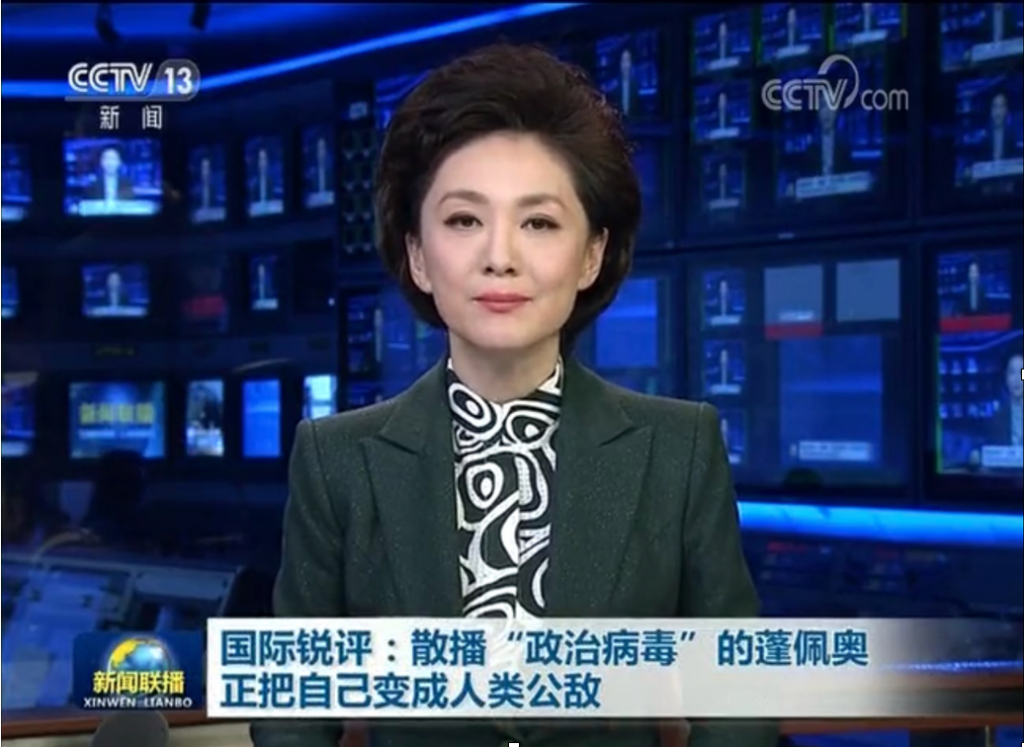
In recent days China Central Television has hurled a series of verbal attacks at US Secretary of State Mike Pompeo and others in the United States. As the US and China lock horns over the question of responsibility for the global coronavirus epidemic, the state-run network’s “International Commentary” (国际锐评) segment, which is featured on the nightly official news program “Xinwen Lianbo,” has been ruthless in its tone, and the attacks have sometimes been painful to read:

May 4:Searching desperately for cures! Wicked Pompeo spits out medicine and starts rumors in the face of science

May 4:The crazy-talking anti-China pioneer Bannon fears the world will not be chaotic

May 1:Aiming to threaten the WTO, Pompeo is making provocations around the world

May 2:Are American politicians ‘tossing the pot’ [eluding responsibility] to hide the truth about the epidemic?

April 29:Bearing the ‘four sins,” Pompeo has broken through the bottom line of being human

April 28:Pompeo, spreading ‘political disease,’ is turning himself into the public enemy of mankind

In this war of words, one word in particular should grab our attention — “public enemy,” or gongdi (公敌). “International Commentary” has labelled Pompeo “the public enemy of mankind.”

What exactly does this mean in the Chinese context? In the eyes of the Chinese Communist Party, what sort of people or things merit designation as common enemies?

Looking back into PRC history, we can find a string such “public enemies,” from the Kuomingtang leader Chiang Kai-shek to Hu Feng, the writer who dared to criticize Mao Zedong’s views on art and literature. From American imperialism to the Falun Gong and more recently the novel coronavirus.

Chiang Kai-shek: Public Enemy

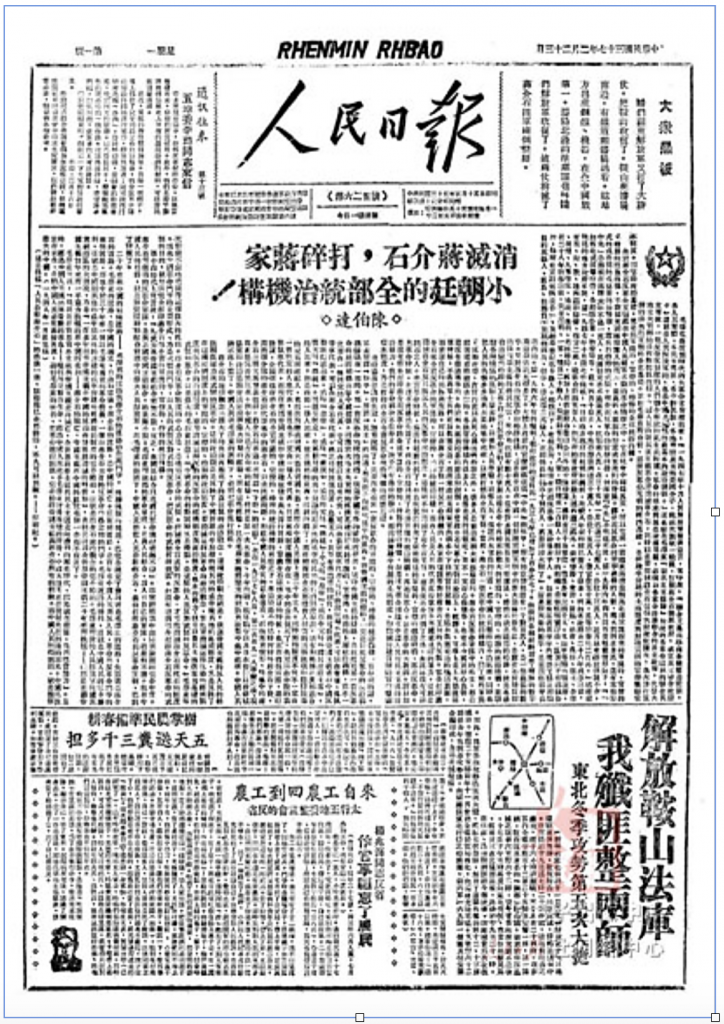
On February 23, 1948, the People’s Daily published on its front page a dispatch from Chen Boda, a close associate of Mao Zedong’s, called “Annihilate Chiang Kai-shek and destroy the ruling institutions of the Jiang family court!” Two small editor’s notes were added at the end of the piece. The first noted that the piece had been written in January of 1948, while the second noted that it was the last chapter in a book to be called “Public Enemy: Chiang Kai-shek.” The note indicated that the book had already been written, edited and typeset, and its publication was imminent.

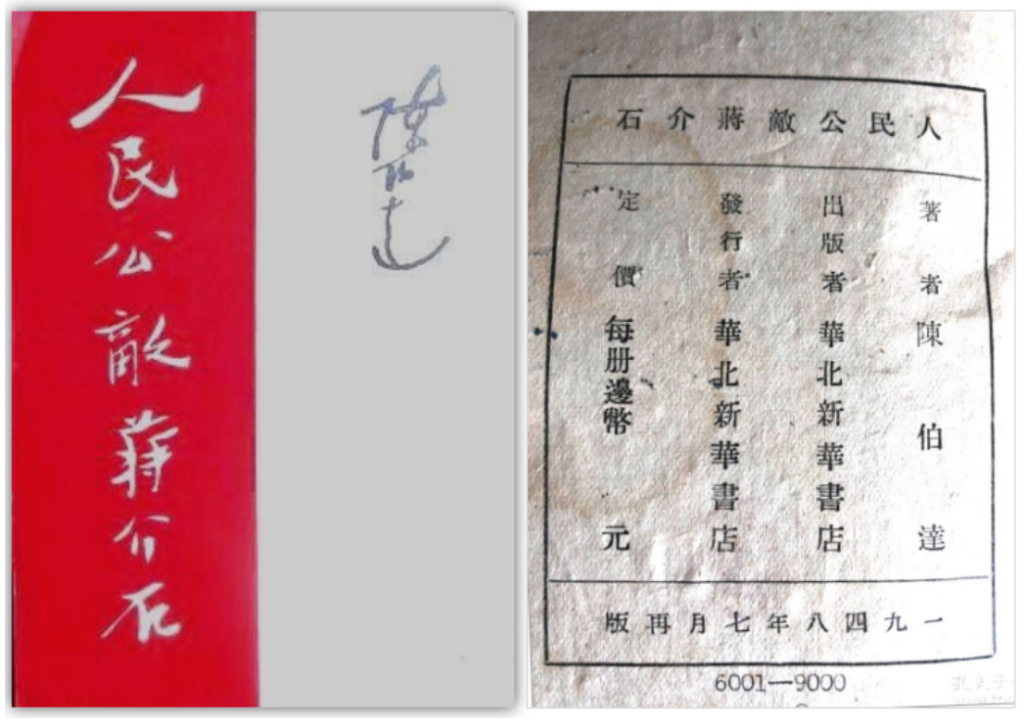
Five months later, in July 1948, Chen Boda’s book finally appeared, with just under 10,000 copies printed.

Chen Boda’s 1948 book Public Enemy: Chiang Kai-shek.

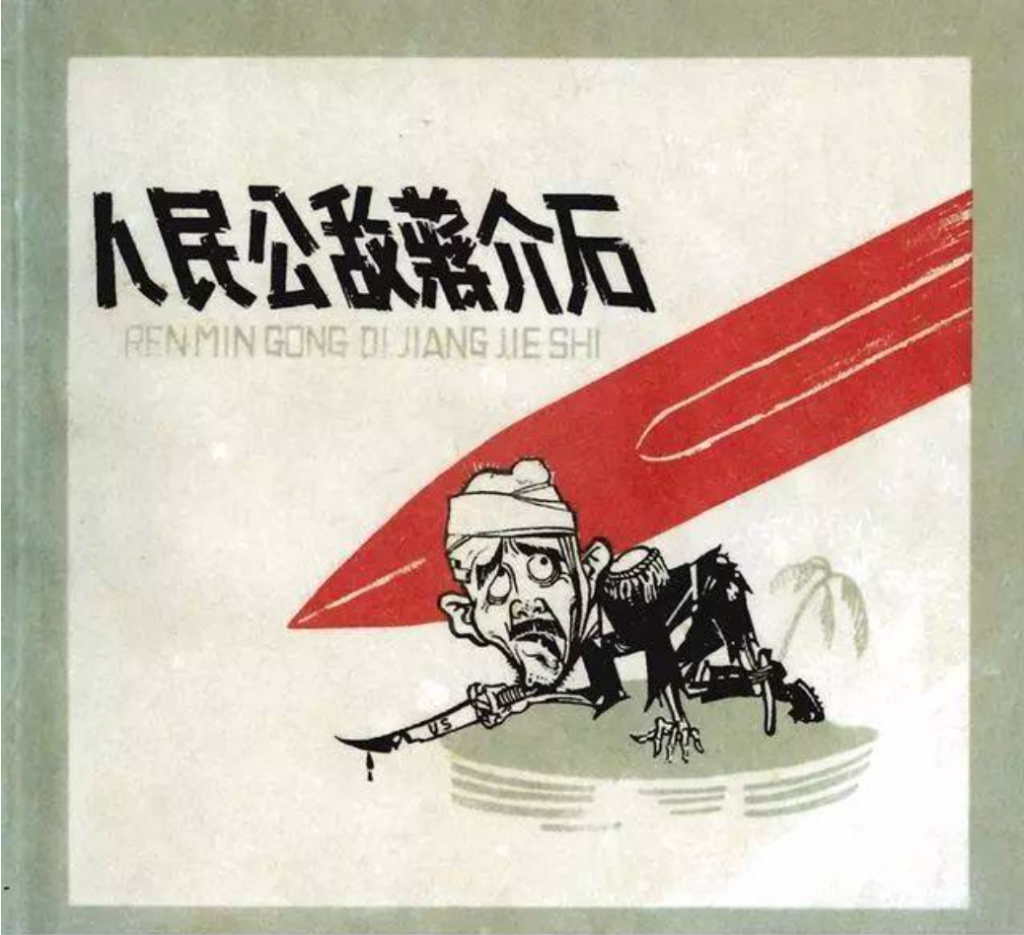
There was a documentary film to accompany the publication of Public Enemy: Chiang Kai-shek, and there were also comic strips and other adaptations. The label “public enemy” stuck with the KMT leader. In 1962, a cartoon of Chiang appeared on the cover of a graphic magazine published by the Liaoning Fine Arts Publishing House. Chiang was depicted as abandoned on the island of Taiwan as viewed from the coast of Fujian. The bloody dagger in Jiang’s hand bore the initials “US.” Across the top were the words: “Public Enemy: Chiang Kai-shek.”

An isolated Chiang Kai-shek, “public enemy,” appears on a 1962 comic magazine cover.

Also in 1962, a film called “Public Enemy: Chiang Kai-shek,” produced by the state-run August First Film Studio, was screened in Beijing. The following year the film won “best documentary” at the “Hundred Flowers Awards.” 

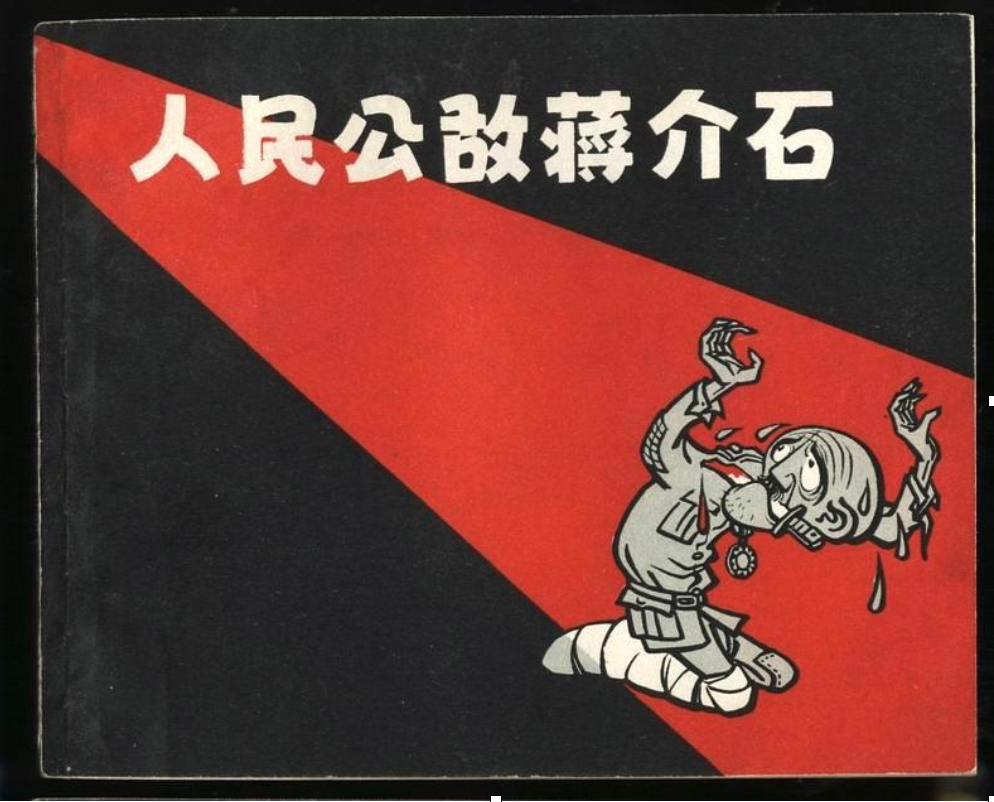
In July 1963, the Zhejiang Arts Publishing House published yet another collection of comics, this time by artists Zheng Wenzhong (郑文中) and Liu Yongfei (刘庸非). Chiang was depicted in a position of abject surrender, a dagger held in his teeth. The title: “Public Enemy: Chiang Kai-shek.”

American Imperialism and Soviet Socialist Imperialism

Under the foreign policy principle of “striking with two fists” (两个拳头打人) from the end of the 1950s and through the 1960s, both the United States and the Soviet Union were targets of Chinese ire, and both labelled as “public enemies of mankind” (人类公敌).

On July 25, 1958, the People’s Daily ran a piece called “The American imperialists are common enemies of the people of the world.” The rest of the headline alleged that newspapers in Jakarta had exposed American acts of sabotage in Indonesia happening even as “the United States set fire to the Middle East.” A piece in the newspaper the next month called the United States the “public enemy of the people of the Latin America,” while another about Thailand insisted that is was the “public enemy of the people of Asia.” Such headlines were not at all uncommon.

Meanwhile, though a bit later to the game, the Soviet Union came to share China’s rage with the United States. In March 1969, as a border conflict brought China and the Soviet Union to the brink of war, a wave of propaganda was unleashed against “Soviet revisionism.” On March 7 a report from the official Xinhua News Agency read: “The Soviet revisionists have bowed to the West German ruling clique to please US imperialism, have given way to the provocation of West German militarism, and have openly allowed West Germany to elect the West German president in West Berlin. The German people recognize that Soviet revisionism is the number one accomplice of the American imperialists, and is the public enemy of the German people and of the people of the world.”

Hu Feng and the “Gang of Four”

Public enemies were not just about foreign policy, but were also a way for the leadership to identify perceived internal threats. Both Hu Feng and the “Gang of Four” were labelled as “public enemies” in the midst of internal political campaigns. Articles criticizing Hu Feng as a “public enemy” appeared in the People’s Daily on May 26, 1955, and on June 12, 1969, under the headlines, “Hu Feng is the public enemy of the people,” and “Resolutely crushing the enemies of the people: the Hu Feng counterrevolutionary clique.”

As the Gang of Four were subdued in late October 1976, they were quickly labeled public enemies. On October 30, 1975, the People’s Daily published a front-page article decrying the crimes of the Gang, in which it said:

The “Gang of Four” are a group of bourgeois conspirators mixed in with the Party, bourgeois elements who suck the blood of the workers and poor peasants; walking capitalists who refuse to repent, they are public enemies of all the people of the nation.

Li Hongzhi and the Falun Gong

In emergence of the Falun Gang sect in China in 1999 presented the Chinese Communist Party leadership with another internal challenge. The group was outlawed in China in July 1999.

On February 2, 2001, the People’s Daily ran a front-page report called “The condemnation of the awakened,” which quoted a former (read, reformed) Falun Gong practitioner as saying: “When I saw reports yesterday about several deluded Falun Gong practitioners who blindly follow the cult of Li Hongzhi setting fire to themselves, I felt pained and so angry! These self-immolations again demonstrate that the Falun Gong is a wicked cult, and that Li Hongzhi is the public enemy of all the people of the nation, a running dog being used by anti-Chinese forces!”

The label “public enemy” was used frequently in reference to the Falun Gong. A People’s Daily article on July 10, 2002, for example, bore the headline: “The ‘Falun Gong’ is the public enemy of human society.”

The above examples from Chinese Communist Party history are just some of the more obvious illustrations of how the term “public enemy” has had a central role in the projection of the Party’s fears, of external threats and internal contagion. At its root, the notion of the “public enemy” is about the people and things China’s leaders imagine to pose an existential threat to the regime.  

For much of this year, the coronavirus has been public enemy number one in China, and leaders have hoped to focus anger and attention on the virus itself in order to deflect global criticism. Back in early March, after Fox News anchor Jesse Watters suggested China should be asked to apologize for its role in the spread of Covid-19, foreign ministry spokesman Zhao Lijian struck back, his first point emphasizing that facing the virus was an urgent struggle for whch all should be responsible: “First, the epidemic is the public enemy of mankind, and the people of all nations are victims. I don’t know where this idea of apologies even comes from?” Later that month, as the People’s Daily criticized Pompeo for calling Covid-19 the “Wuhan virus,” it again emphasized the human nature of the threat: “Diseases have no borders,” the paper said, “but are the public enemy of mankind, and for these American politicians to go against the most basic international consensus, if this is not just ignorance it is done with ulterior motives.”

As the war of words with the United States grows louder, the “public enemy” spotlight seems to have turned from the virus to Pompeo. The language is poisonous and personal, recalling the heat of attacks made against the public enemies of China’s past. Pompeo is “wicked Pompeo” (邪恶蓬佩奥). His remarks point to a “nervous disorder” (神经错乱). He “carries four sins on his shoulders” (背负四宗罪). He has “broken through the bottom line of being human” (突破做人底线).

Such direct attacks on a senior US official are very rare indeed — and a sign of just how seriously relations have deteriorated.

Blood-soaked Dumplings

Writing on social media back in February, Chinese writer Yi Zhongtian likened the excessive emotion, positivity and adulation in reporting and commentary on the coronavirus epidemic in China to “eating blood-soaked dumplings”  (吃人血馒头). This was a reference to Lu Xun’s 1919 short story “Medicine,” the writer’s indictment of senseless superstition, in which poor and illiterate parents attempt to cure their son’s tuberculosis by offering him a steamed bun soaked in the blood of an executed revolutionary.

Just as Lu Xun’s frequent references to “cannibalism” in works like “Medicine” and “A Madman’s Diary” denounced the devouring of individual consciousness by an oppressive feudal society, Yi Zhongtian calls on these insights to highlight the way individual convictions and criticism can be swallowed up in today’s China as people and institutions reflexively conform to power. 

This aspect of Chinese politics is most notable in times of tragedy and, as Yi writes, often takes the form of fawning and groveling. “Kissing up is a local specialty [of the Chinese],” he writes. “Every time national adversity strikes, they leap up eagerly and play at writing, which takes two standard forms: first, turning funeral rites into occasions of joy; second, showering leaders with adulation.”

After the Sichuan Earthquake in 2008, as furious parents protested over the death of thousands of schoolchildren in collapsed schools, a senior Shandong official named Wang Zhaoshan (王兆山) wrote a poem published in the Qilu Evening News that included these selected lines:

1.3 billion people cry as a single host,
We are blessed even if we are ghosts . . .
I just hope they place a screen before my grave,
So we can watch the Olympics together and rave.

The poem infuriated many Chinese, who railed against it in internet comments. Wang, and the newspaper, had gone too far. But the culture of “eating blood-soaked dumplings” is an irrepressible tool of the party-state, and it constantly demands the complicity of officials, journalists – and of course also citizens.

The manipulation of human emotion as propaganda kitsch, which I wrote about back in February, is one aspect of this “cannibalism.” Female nurses have been particular victims this year, their individuality consumed by the demands of party-state propaganda. When nurses were shorn of their hair, ostensibly to help prevent infection as they rushed to the front lines of the epidemic, their completely understandable tears were abstracted and exploited as uplifting propaganda. In another story of sacrifice, a local Wuhan newspaper reported that a young nurse had returned to work to fight the epidemic just 10 days after having a miscarriage. One WeChat-based essay took objection to this, calling it “the same old propaganda trick [of] using the sacrifice of ordinary individuals to strengthen solidarity.”

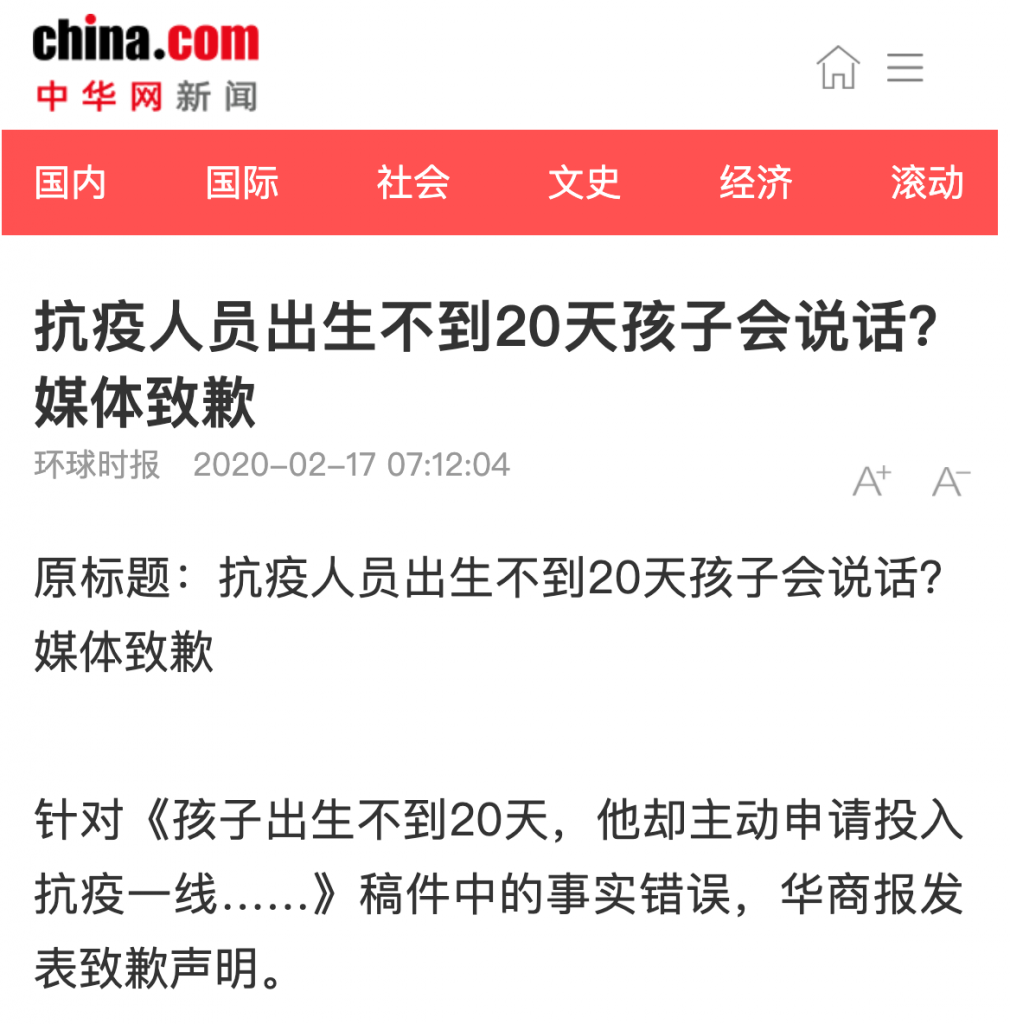
Power-conforming faith requires indulging in emotion and suspending disbelief. When the China Business Gazette was pressed to apologize in February for quoting the newborn twins of one front-line nurse as asking their father where mommy was, its only real sin was stretching belief too far (though they claimed the miraculously verbal infants had been an editing error).

As the coronavirus epidemic has been taken up by the Chinese party-state as a powerful propaganda tool this year, both domestically and in its foreign policy, the lines in this culture of “eating blood-soaked dumplings” have been constantly tested by skeptical Chinese who resent the dehumanization such propaganda demands.

One of several instances of “kissing up” that prompted Yi Zhongtian’s remarks on eating “eating blood-soaked dumplings” in February was a saccharine poem called “Thank You, COVID-19” that appeared on WeChat, and for many Chinese was too much to stomach. A taste of its nauseating sweetness:

I want to thank you, COVID-19, because you allowed me to see a blessing – unbreakable unity of will.
I want to thank you, COVID-19, because you allowed me to see a blessing – courageous advancement.
I want to thank you, COVID-19, because you allowed me to see a blessing – [people] facing death with equanimity.

The poem was criticized so roundly that it received attention even in the state-run media. Shanghai’s Liberation Daily spoke sharply against the poem’s insensitivity, cautioning that creative works needed to have “a human feel”  to find a place in people’s hearts. The official Xinhua News Agency felt obliged to report that the poem had “not only failed to elicit sympathies, but in fact had enraged masses of internet users.” Nevertheless, the same Xinhua report heaped praise on other “great works” clearly manipulating emotions to support Party-state themes, noting in particular this one and this one.

Such acts of misbegotten creativity have been broadly encouraged, not just through the emotive and exaggerated language of the party-state media, but also through the school system.

One former journalist in Beijing tells me his nephew in southwest China was tasked by teachers with compiling a “poetry collection” on the epidemic, writing a poem and also inviting friends and relatives to contribute. The purpose, he said, is to write poems urging solidarity, and praising China for its coronavirus response, following party-state themes of sacrifice and unity. The journalist’s personal compromise – as he agreed as a matter of avuncular duty to write his own poem for the child’s collection – was to avoid outright praise of the government, centering instead on the theme of “human community” (close enough to Xi Jinping’s foreign policy phrase, “community of common destiny”).

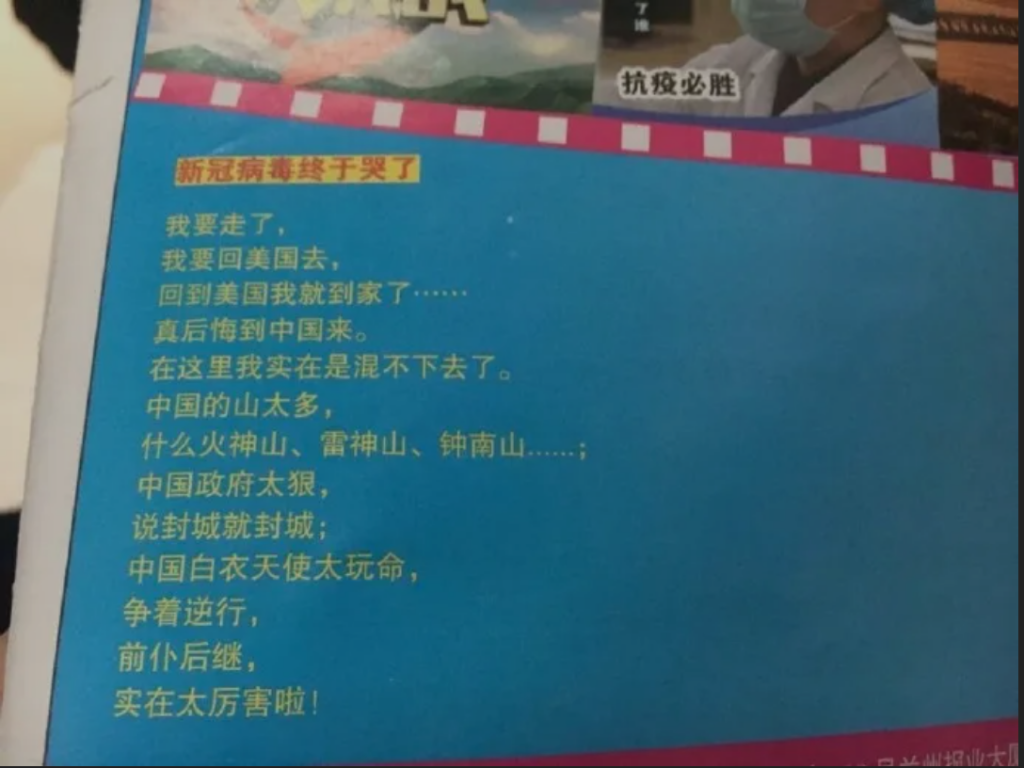
Chinese nerves over being obliged to “eat blood-soaked dumplings” were again tested last week, as the Beijing News and other Chinese media reported that the Middle School Student Guide (中学生导报), a nationally circulated publication for middle school students published by Lanzhou Daily, the official Party-run newspaper in the city of Lanzhou, had run a special issue called “College Entrance Exams: Predicting Hot Topics in Current Affairs” that included a particularly noxious coronavirus inspired poem. The news originated with a post on social media showing apparently authentic images of the newspaper.

The voice in the poem, which indirectly praises China’s handling of the coronavirus epidemic, is that of the virus itself. The virus bemoans its horrible fate in China in the face of robust measures to contain it, and it says it wishes to retreat to its place of origin: the United States:

I wish to leave,
I wish to return to America,
In returning to America I return home . . . .
I regret ever coming to China.
Here, I just can’t continue on.
China has too many mountains [to cross],
This Huoshen Mountain, and Leishen Mountain, and Zhong Nanshan [Note: first two are temporary field hospitals set up to fight Covid-19, the last a reference to Dr. Zhong Nanshan, whose name includes the character for mountain.]
China’s government is too fierce,
It says to close the city and the city is closed;
Play with China’s white-angel nurses and you toy with your life,
They charge to the front lines, eyes blazing
Where one falls, another steps into position.
They are too awesome!

The poem caused outrage across Chinese social media, and a commentary from The Beijing News called it “inhuman.” “In the end, a disaster is a disaster, and should not elicit songs of praise and embellishment,” it said. “Nor should distorted writings that describe disasters as good things appear in newspapers circulated to schools.”

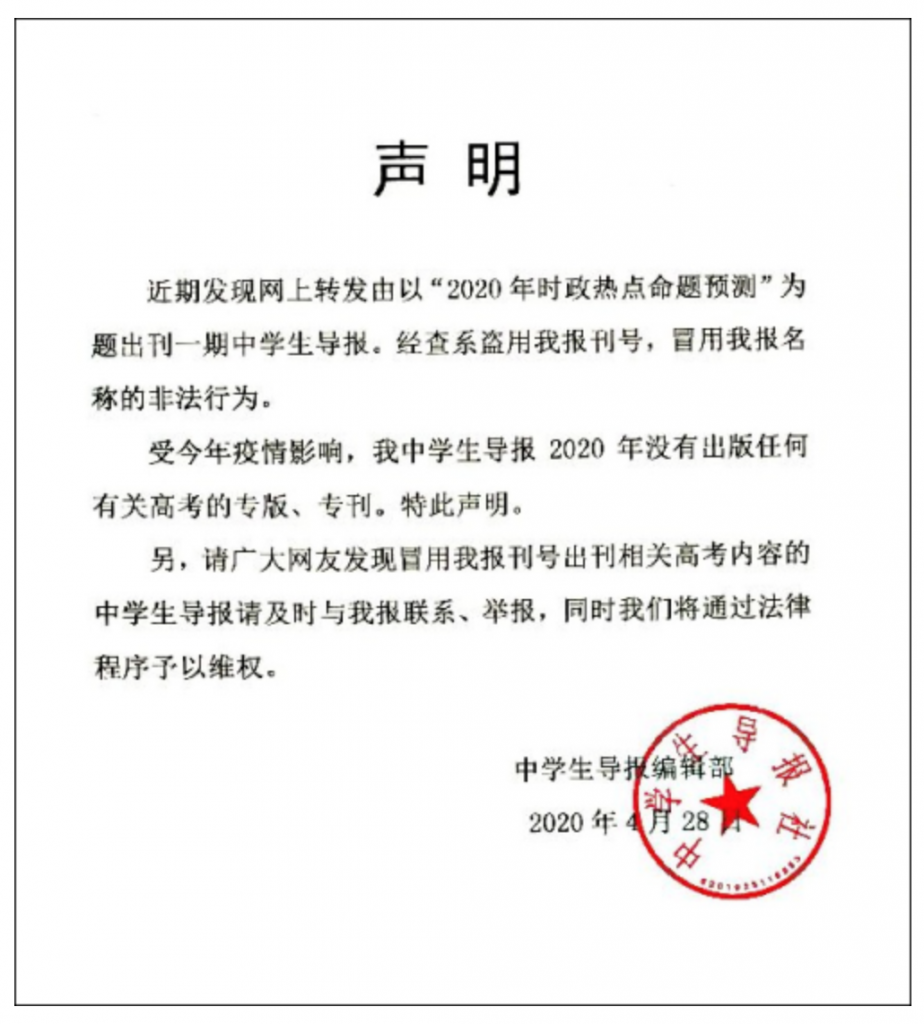
The last point quickly became the next point of controversy, as the Middle School Student Guide came out with a statement on April 28 alleging that the poem appearing online had been “illegal conduct misusing our publishing license number,” and that the publication had not in fact published a special issue about college entrance exams. Was the online photo a fake? Apparently not. Without getting into the tangled details, it seems based on subsequent reporting by the Shanghai Observer and others that the publishing license number of the Middle School Student Guide might indeed have been misused in some way by a company advertising with, or perhaps partnering with, the publication.

It does seem that a printed educational paper or supplement with the offending poem was indeed circulated, resulting in the online image that stoked this latest storm over fawning statements in the midst of national, and now global, tragedy. The piece from The Beijing News criticizing the poem has since disappeared.

On April 29, the WeChat account “Fisheye Observer” looked more closely at the poem supposedly written by a school student, exploring its origins, and found that it in fact was a shortened version of a poem written and posted online back in March by Tian Hexin (田和欣), identified online as having been an editor and “leader” at the Henan provincial branch of Xinhua News Agency and the state-run Consumer Daily newspaper. “Fisheye Observer” was unable, however, to find news content written by Tian or any information about his supposed leadership work, leading the account to suspect that his work with state media was “possibly exaggerated.”

Exaggerations and inventions like that of Tian Hexin have proliferated over the past few months. They arise, particularly in the midst of crisis, from a political culture in which exaggeration of the right kind is broadly encouraged – and even, as in the case of state-run media and the education system, explicitly assigned.

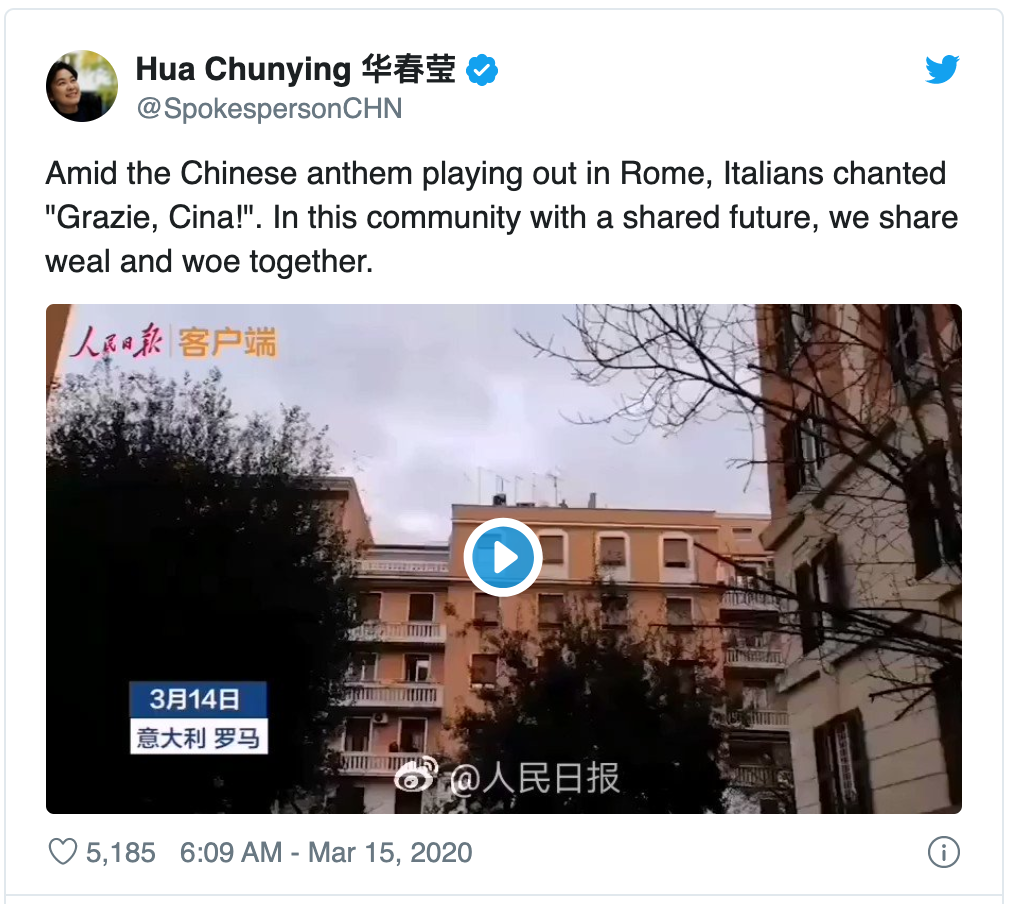
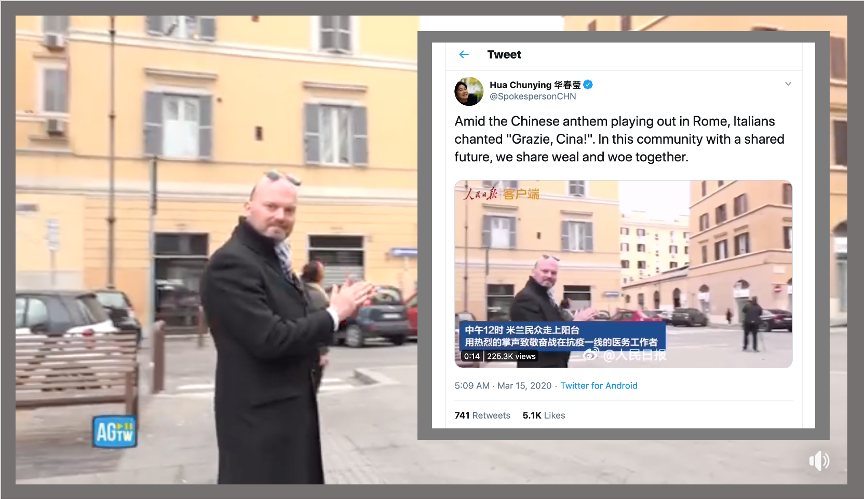
As China’s coronavirus propaganda campaign goes global, it should not surprise us to see foreign ministry spokeswoman Hua Chunying (华春莹) post an emotional tweet about sharing “weal and woe” surrounding a completely discredited story about Italians blaring the Chinese national anthem from their balconies to express their gratitude toward China. It should not surprise us be sold stories about the glories of China’s Covid-19 response, seasoned with words like “arduous,” “swift,” “decisive” and “victory”; to be told that “China’s model” in tackling the crisis points the way to a global solution; or to read glowing reports of China’s “institutional strength,” and a constant flow of accounts of countries thanking China for its aid during the epidemic.

Sure, there may be many directed efforts by China to influence international opinion. China’s government has pushed assertively to offset and contain global criticism over its handling of the coronavirus epidemic – exploiting every arrival of coronavirus supplies as a propaganda opportunity, pressuring the European Union to tone down criticism of China in its report on government disinformation, attempting to solicit public praise from Germany for its response, and so on. China’s so-called “Wolf Warrior” diplomats have taken to Twitter with strident tones, upbraided foreign journalists, and even written to suggest that “some Westerners are beginning to lose confidence in liberal democracy.”

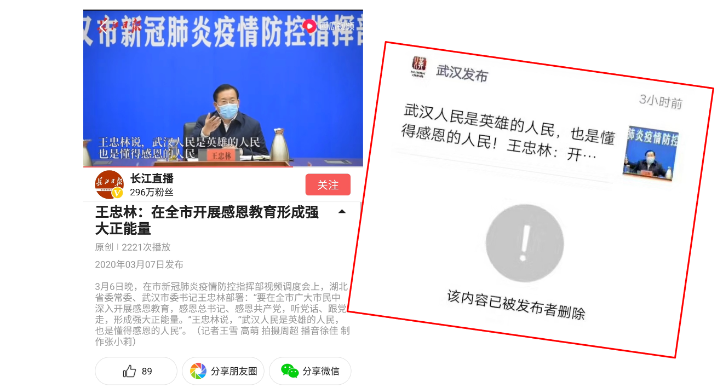
But we should also understand that officials like Hua Chunying are deeply invested in their own fictions, that much of their noisy self-congratulation arises from the conditioned positivity about which Yi Zhongtian writes. Their impulse is to face (and efface) tragedy by elevating emotion and brown-nosing national power. Far from being strategic or helpful, their actions and statements are likely to be deeply counterproductive. Nevertheless, they cannot help themselves, just as Wuhan’s new top official, Wang Zhonglin (王忠林), almost certainly cannot comprehend how his suggestion in March that the much-suffering people of his city should undergo “gratitude education” stirred up such a storm of controversy.

For many Chinese Communist Party officials and “Wolf Warrior” diplomats, the supposed greatness of the country’s response to the coronavirus epidemic is a matter not of strategy but of superstitious faith. And they cannot understand why the rest of us have failed to acquire a taste for their “blood-soaked dumplings.”

Unsolicited Advice

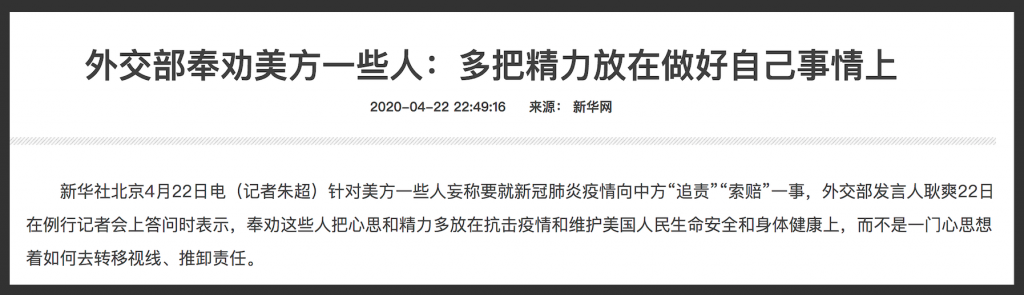
As I read through the Chinese media last week and saw the remarks of a spokesperson for China’s Ministry of Foreign Affairs attacking the United States over the coronavirus epidemic, there was one word in particular that popped out. Here is an image of a related report from Xinhua News Agency, published on April 22.

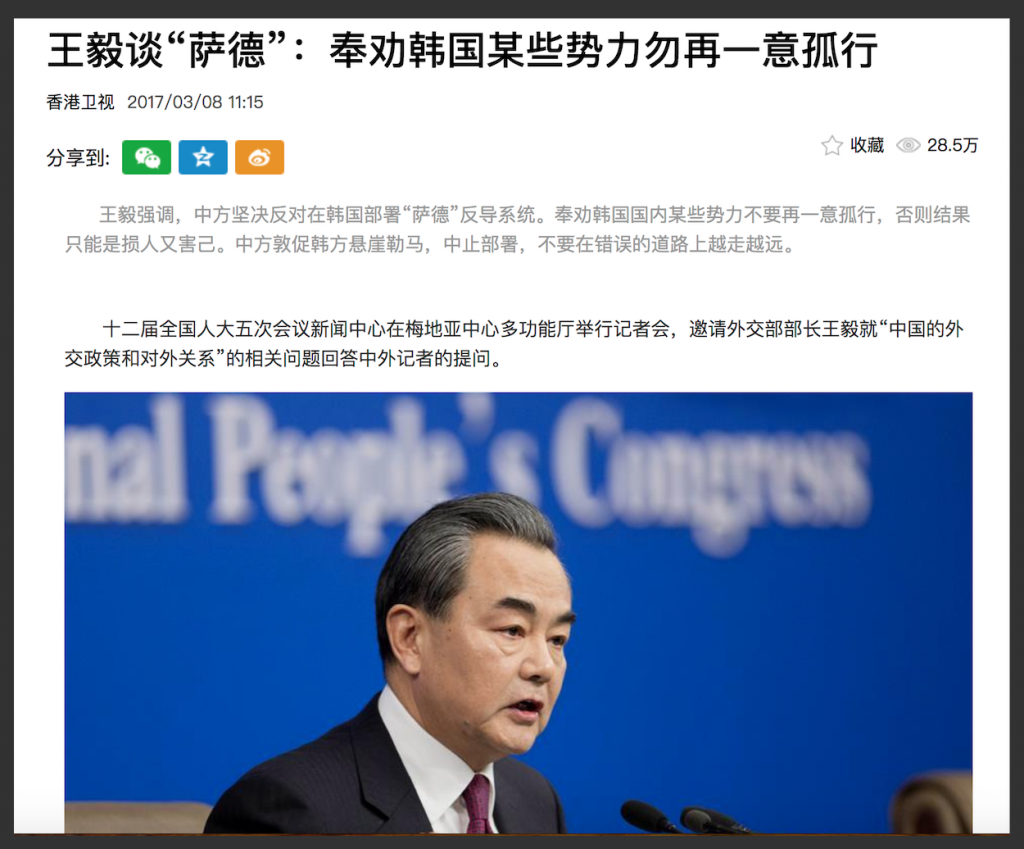
The word I’m talking about here is fèngquàn (奉劝), which essentially means “to offer a bit of advice”, or to “advise.” But the tone, far from being constructive or consultative, is withering. The headline reads: “Foreign Ministry Advises Certain People: Put More Energies into Doing Your Own Business Well.” It advises, specifically, against talk of China paying reparations over its role in the COVID-19 epidemic.

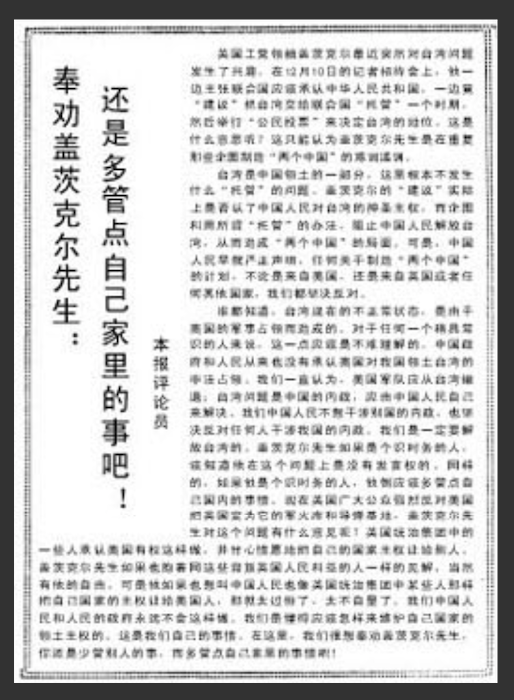
The tone is also very familiar. Below you can see another article, this time an editorial dating back to December 12, 1957, and appearing in the People’s Daily.

In this case, the editorial addresses former UK Labor party leader Hugh Gaitskell, who at the time spoke on the issue of Taiwan, incurring the outrage of the Chinese Communist Party. The two reports are separated by a space of 63 years, but they assume the same tone and use the same language. There are many other reports in China’s state media that employ similar discourse – what we might characterize as an “advisory vocabulary” (奉劝体).

The word fèngquàn (奉劝) is an ancient word in Chinese. Consult your Chinese dictionary, and you’ll find that fèng (奉) originally had the same meaning as the word gōngjìng (恭敬), which in adverb form means “deferentially” or “respectfully.” Fèngquàn originally had the sense of speaking in such a way as to respectfully advising or persuading someone. For example, one could “advise” others to drink wine at a formal banquet by using the word fèngquàn.

With the development of the Chinese language, however, the word fèngquàn gradually came to shed its sense of respect, morphing into a word having the sense of advising, or guīquàn (规劝), with more satirical overtones, to eventually bearing an unmistakable sense of warning or admonishment (警告). This transformation, and linguistic use, is shared whether one is in mainland China, Hong Kong or Taiwan.

When we look at the use of fèngquàn in China after 1949 to see who exactly was on the receiving end of such “advisory” language from the Chinese Communist Party, we find that the list is very long indeed.

In the 1950s, we find that the CCP most often advised both the Kuomintang Party in Taiwan and the United States. At the National People’s Congress in July 1957, one delegate was quoted as saying: “I sincerely advise military and government officials in Taiwan: How can Taiwan have freedom under the tightening control of the United States? I hope you can cast aside your concerns and quickly render a decision, striving for the peaceful liberation of Taiwan to reach true freedom.”

The US president too was subjected to such advice: “Eisenhower, I am truly ashamed for you!” raged a September 1958 poem by Guo Moruo (郭沫若) published in the People’s Daily. “You have no need again to lose face on behalf of the American people. I advise you to seek healing for your brain post haste. The American people are equally in search of peace, and I believe they will not embrace such a cheat as you!”

In addition to the US and Taiwan, advisories in the 1950s targeted the UK (as shown above), the actions of a French general in Tunisia, the words in support of Taiwan spoken by Japan’s ambassador to India, an Indian National Congress politician, the Dalai Lama and others. The Chinese military commander Chen Yi (陈毅), then China’s foreign minister, wrote a poem in 1959 urging the Dalai Lama, by that point already in exile, not to think of returning: “I have advice for you,” he wrote. “Do not stop on your way home. The CCP Central Committee has always been lenient. The Buddha said that looking back [and correcting one’s mistakes] is the way to the shore.”

There was of course also a great deal of “advice” directed internally. Rural landlords were “advised” in the midst of the land reform process in the early 1950s, and various “reactionaries” (反动分子) of all stripes (but particularly so-called “rightists”) were “advised” in the midst of repeated political movements.

There was even a case during the Great Leap Forward of the “advising” of unspecified “idle” (懒惰) women. Here is how the People’s Daily spoke in May 1958 of such women: “During the say they rest in bed with their eyes open, and in the middle of the night they get up to make fried rice that they gobble down; when you tell her to produce she won’t go, but says: ‘I won’t go even if the emperor calls me.’ These lazy women are advised to quickly set their bad habits in order!”

Not surprisingly, Mao Zedong could also be found “advising” the Chinese people on the correct path for the country. In 1955, he wrote of the experiences of a number of collectives, and encouraged cadres to go among the masses and learn from these experiences, saying: “This is effective medicine to cure stubborn right-leaning tendencies, and I advise people to give it a try.” By the end of the decade, Mao’s prescription for the country would prove disastrous, as the people’s communes and the ill-advised Great Leap Forward led to mass starvation.

In the 1960s, as relations with the Soviet Union soured, it was time to advise another external adversary. From September 6, 1963 to July 14, 1964, a series of nine strongly worked editorials appeared in the name of the editorial departments of both the People’s Daily and Red Flag magazine that criticized the “revisionism” (苏联修正主义) of the Soviet Union. The word “advise” appeared in each of the last three of these, later collectively known as the “Nine Commentaries” (九评).

“We wish to advise the leaders of the Soviet Union to consider cool-headedly what will ultimately be the result of the revisionism and separatism you encourage,” said an editorial on February 4, 1964. “We wish to advise the leaders and comrades of the Soviet Union to consider how many opportunists and revisionists have in the past been thrown onto the trash heap of history, and must you follow in their footsteps?” said another on March 31, 1964. And the final volley came on July 14, 1964: “Concerning the Soviet Union’s restoration of capitalism, how great are the hopes embraced by imperialism! How delighted they are! We advise the lords of capitalism to revel in their delight. Even if Khrushchev’s revisionist clique serves you, this cannot save imperialism from the inevitability of its destruction.” Through the 1970s and into the 1980s, the “social imperialism” of the Soviet Union became China’s number one enemy, and the object of much “advising,” including over China’s border war in Vietnam and Laos.  

When it came to political unrest in 1989, the blame was thrown again in the direction of the United States. An article in the People’s Daily in July 1989, more than a month after the crackdown, resorted to two advises: “We advise the American government and people at all levels of society to prioritize the overall state of US-China relations, not to interfere in China’s internal affairs, and also not to harbor vain hopes of fomenting a ‘peaceful evolution’ in China. The counter-revolutionary chaos in China’s capital has already quieted, and those who orchestrated the chaos have been defeated. We advise people not to have a myopic view of China.”

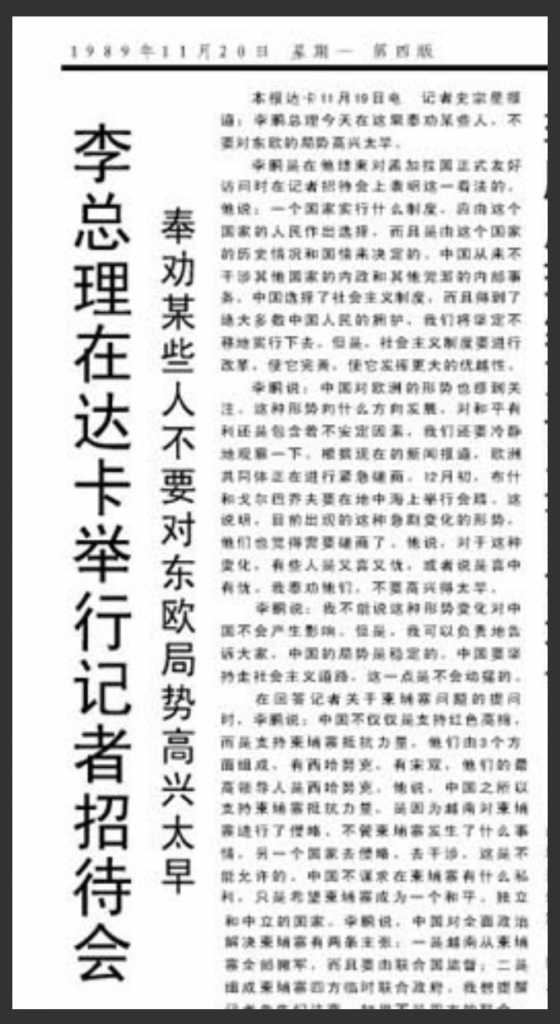
And as political change swept through the Eastern Bloc, Premier Li Peng (李鹏) felt in November 1989 that he had to “advise certain people not to be prematurely delighted with changes in Eastern Europe.”

In the 1990s, there was a downturn in the use of “advise” in the People’s Daily. At home, Deng Xiaoping promoted reform and opening, and in foreign policy the emphasis was on “concealing strengths and biding time” (韬光养晦). The idea was that it was in China’s advantage for the world to be focused on peace and development. Deng also emphasized “not casually criticizing or blaming others, not saying things that cross the line, and doing things that cross the line.”

In the Party media, “advise” is an aggressive and hostile posture. Since the 18th National Congress of the CCP, China has spoken confidently about “Awesome China” (厉害了, 我的国), and has made enemies left and right, attacking on all sides. Toward the outside world, the language has become increasingly arrogant. Correspondingly, we have seen a clear rise in the Party media of use of the word “advise.”

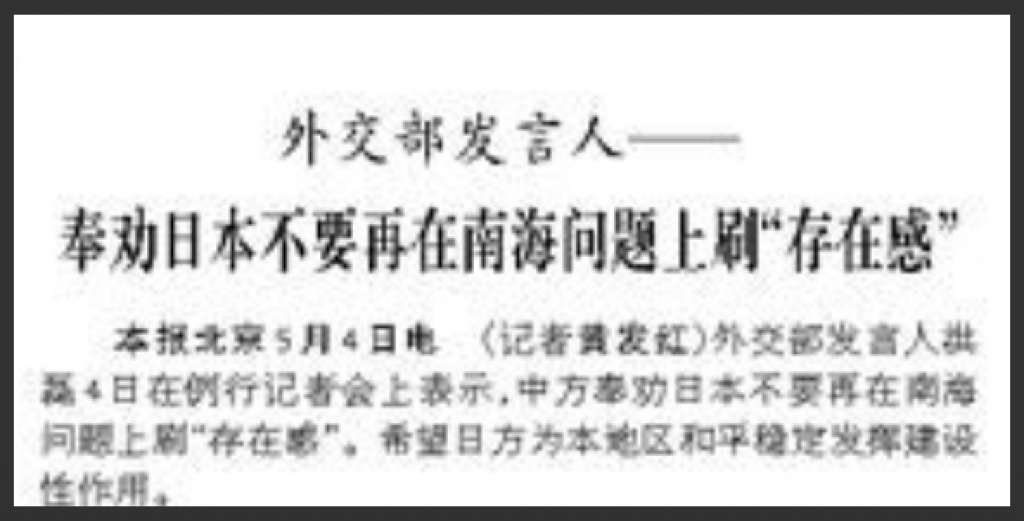
In 2016, in the midst of dispute over the South China Sea and the International Court decision in the case between China and the Philippines, the latter was sharply “advised” by the former. When Japanese Prime Minister Shinzo Abe and Japanese Foreign Minister Fumio Kishida voiced concern about the militarization of the South China Sea during trips to Europe and Southeast Asia, China’s foreign ministry said that China “advised Japan not to hype up a ‘sense of presence’ on the South China Sea issue.”

In 2017, Chinese Foreign Minister Wang Yi (王毅) “advised” South Korea, issuing a warning over the deployment of the Terminal High Altitude Area Defense (THAAD), an American anti-ballistic missile defense system.

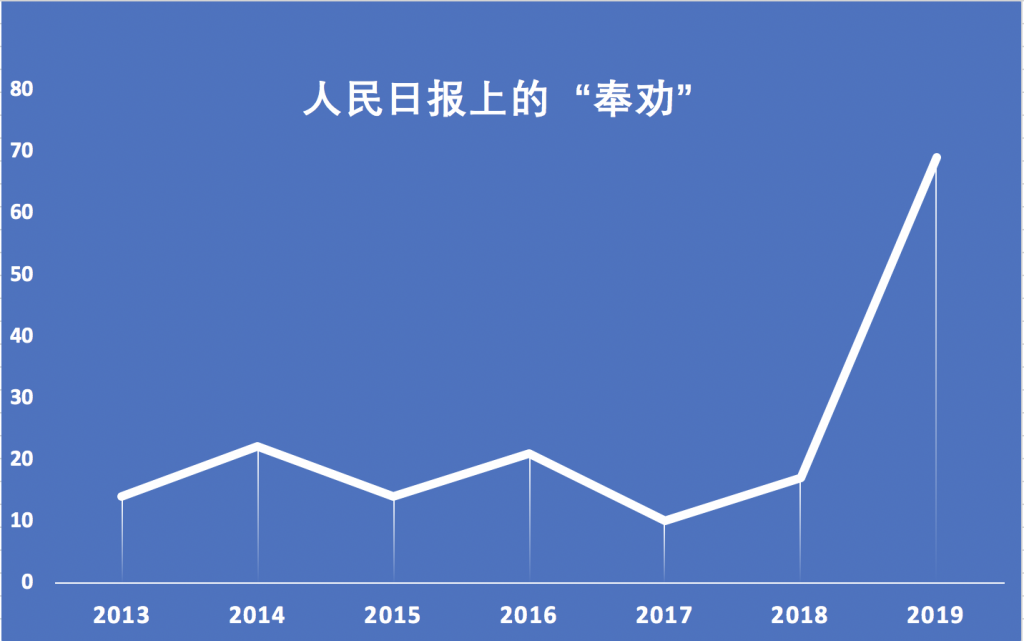
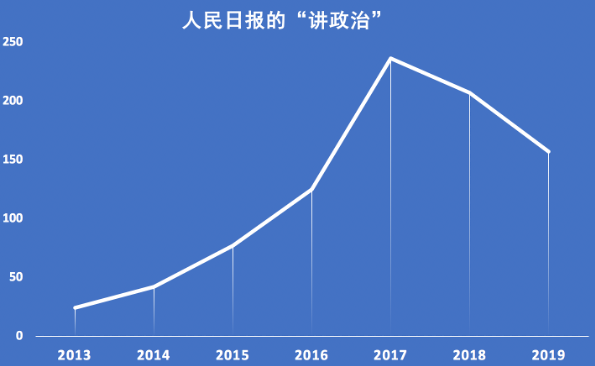
In 2019, as the United States and China were engaged in a prolonged trade war, the US was frequently advised in the pages of the People’s Daily, and nearly all uses of advise were directed at the US. Here is a graph of all uses of “advise” in the newspaper from 2013 through 2019:

This high level of use of the admonishing “advise” has continued so far this year. The “advisory vocabulary” of the Chinese Communist Party is something we should watch closely in the party-state media as an indicator of China’s attitude and tone in its foreign relations.

Returning to the Main Theme

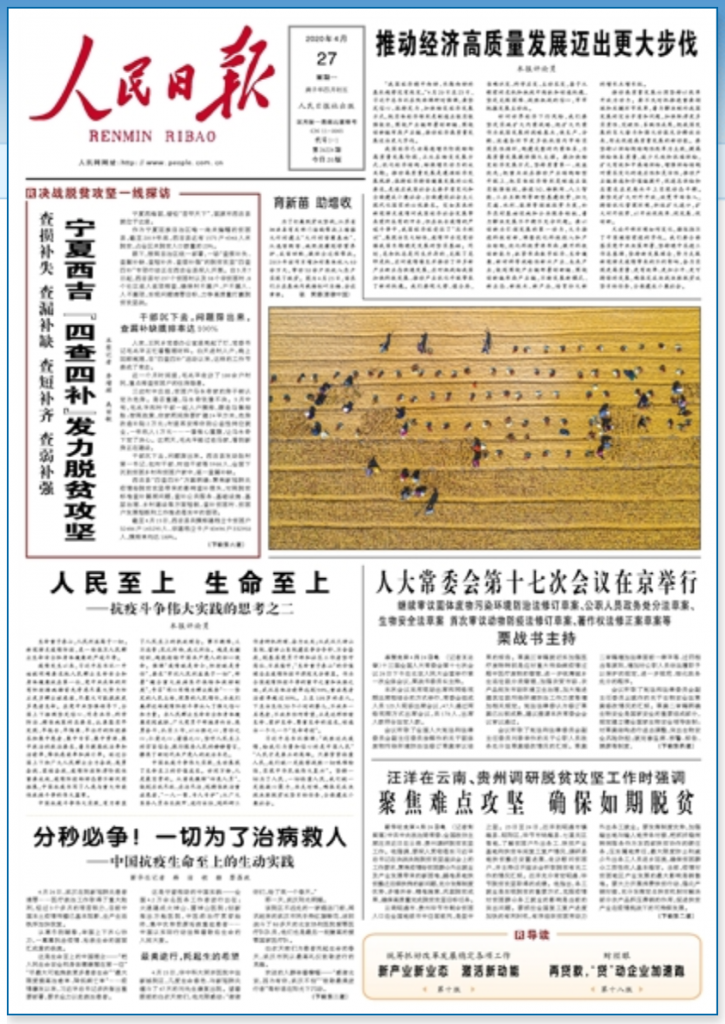
Spring has arrived in the People’s Daily, and the 2020 propaganda themes leaders had originally envisioned to dominate starting back in January are now in full bloom, having survived the frost of the coronavirus epidemic. Chief among these are the themes of eliminating poverty and achieving a so-called “all-round moderately prosperous” society – 2020 having been designated back in 2013, at the start of Xi Jinping’s rule, as the year China would achieve both. [Image Above: An online poster in Party-run media advertises China’s “decisive war against poverty.”]

As CMP co-director Qian Gang wrote back in February, the People’s Daily stuck stubbornly to these pre-established propaganda themes through much of January, even as the spread of the coronavirus was of most immediate concern. By February and March, however, the epidemic had finally come to be reported more prominently in the Party’s flagship newspaper.

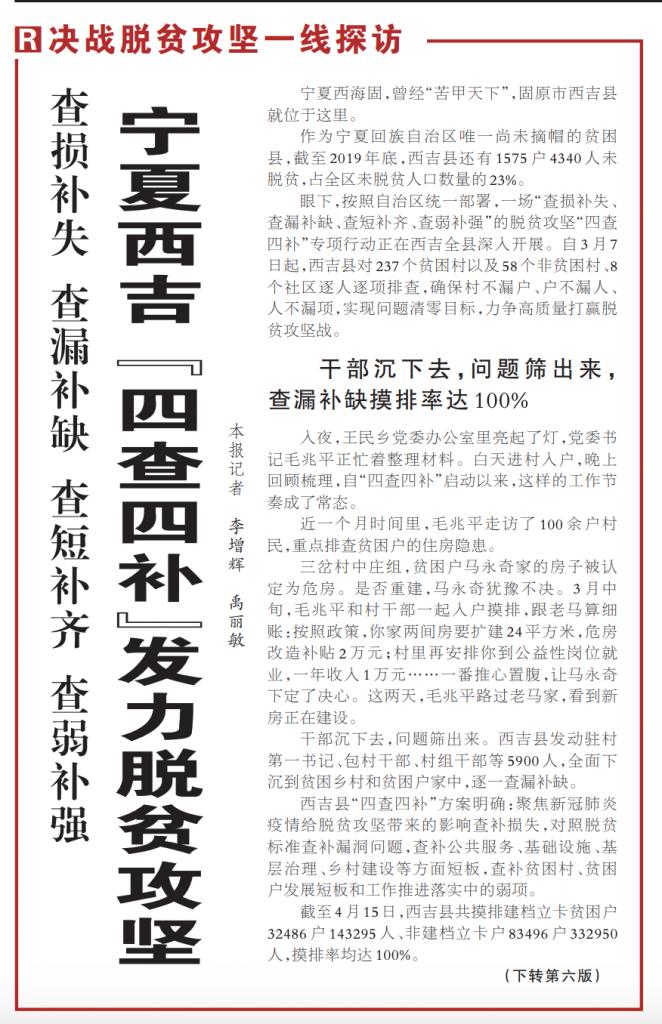
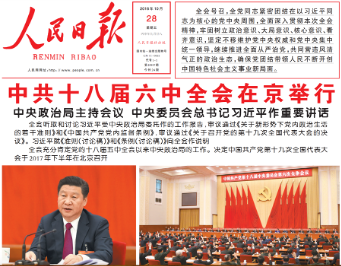
On the front page of today’s People’s Daily, the top three items all deal in some way with the war on poverty.

The first, placed directly under the masthead, is part of a series of community profiles in the “decisive war against poverty.” It talks about policies implemented in a poor county in Ningxia, and ends with the determined words of a local official: “Working together to overcome difficulties, we will not relax our efforts in overcoming poverty.”

Right beside this profile, text accompanying the main image on the front page is about the creation in one township in Jiangsu province of a nursery devoted to the selection and cultivation of seedlings. The text claims that the project, undertaken “in order to win the battle of poverty alleviation,” has “brought more than 50 low-income rural households out of poverty.”

The article immediately to the right of the masthead is a report on Xi Jinping’s recent trip to Shaanxi province, planned as part of the 2020 propaganda push on anti-poverty goals. While there is some suggestion that the global COVID-19 epidemic is a downward pressure on growth objectives, the determination to stay on theme is unchanged. The report concludes:

No matter how the external environment changes, it will not stop China from continuing to move forward. We must comprehensively implement the Central Committee’s decisions and deployments, adhere to the overall tone of steady progress, adhere to new development concepts, strive to overcome the adverse effects of the coronavirus epidemic, and strive to achieve higher quality, more efficient, fairer and more sustainable development, ensuring completion of the decisive battle and the goal of overcoming poverty, and building an all-round moderately prosperous society.

The report at the bottom right of the front page deals with Wang Yang’s inspection tour of Yunnan and Guizhou provinces. Coverage again stays with the central theme: “Wang Yang, member of the Politburo Standing Committee of the CCP and chairman of the National Committee of the Chinese People’s Political Consultative Conference, recently investigated poverty alleviation efforts in Yunnan and Guizhou.”

There is much talk, even in the headline of the Wang Yang report, of the importance of “alleviating poverty as scheduled” (如期脱贫), suggesting that the leadership’s “decisive victory” in the war on poverty is a goal that cannot be compromised, even in the face of a sharp economic downturn and an ongoing global pandemic. Even those articles on the front page that appear to deal more directly with the coronavirus epidemic are cast in the mold of the anti-poverty campaign.

Directly below the series profile under the masthead is an editorial by “this newspaper’s commentator,” signaling that it was written by the paper’s editors. Called, “People First, Life First,” the editorial is advertised as “the second thought on our great deeds in the fight against epidemic disease.” Emphasizing the “heroism” of the people as they stand with the CCP, the piece speaks of the “great efforts China has made in the struggle against the coronavirus,” but ultimately circles back to the theme of anti-poverty: “Insisting on the principle that everything is for the people and relies on the people, we will work together to overcome difficulties, ensuring completion of the decisive battle to overcome poverty, and building an all-round moderately prosperous society.”

The Delicate Dance of Loyalty

The “loyalty dance,” or zhongziwu (忠字舞), was a collective dance that became prevalent during the Cultural Revolution, at a time when Mao Zedong and his image reigned supreme over all aspects of life in China. The dancers, grasping their copies of the “little red book,” Quotations From Chairman Mao, would dance, leap and shout to the impassioned ring of the music – all to express their boundless loyalty to the Chairman.

One slogan older Chinese may remember from that time, related to the loyalty dance, is the “Three Loyalties” (三忠于): loyalty to Chairman Mao; loyalty to Mao Zedong Thought; loyalty to Chairman Mao’s revolutionary line. It is tempting to think of the loyalty dance and the “Three Loyalties” as relics of China’s political past. But in fact, there are unmistakable echoes in the present.

How, in Xi Jinping’s so-called “New Era,” does one dance the loyalty dance?

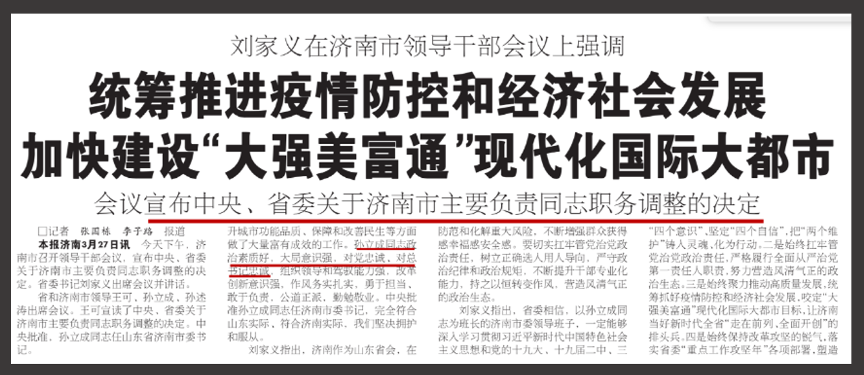
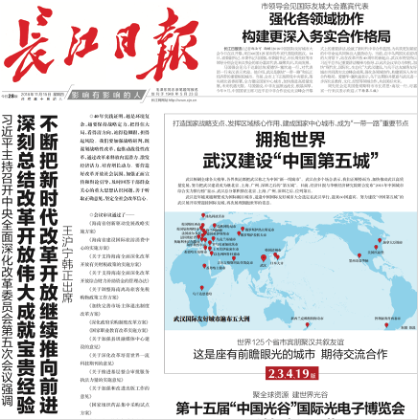
Last month, CMP wrote about how the top leader in the city of Wuhan stirred up trouble as he tried to signal his “gratitude” toward Xi Jinping, suggesting that the people of Wuhan, then still in recovering from the coronavirus epidemic, should undergo “gratitude education.” This leader, Wang Zhonglin, was previously the top Party official in the city of Jinan in Shandong province, and when official media recently reported the news of Wang’s replacement taking up his post, certain words caught my eye.

As Shandong’s provincial Party secretary praised Wang Zhonglin’s replacement in Jinan, we had a pair of loyalties: “He is loyal to the Party,” said Shangdong Secretary Liu Jiayi (刘家义), “and loyal to the General Secretary.”

When exactly did the music start in this present-day loyalty dance?

After Xi Jinping came to power, the word “loyalty” was, at least on the surface, applied to the Party and not to any individual. Xi said during his first five-year term: “Absolute loyalty to the party lies in the word ‘absolute’, which is the only, thorough, unconditional, uncontaminated, and undiluted loyalty.” Xi is of course unlikely to talk himself of the need to be loyal to himself; signaling the need for such expressions of loyalty is something that can be left to others at the top of the CCP.

But as Xi consolidated power at the top and emphasized the need for loyalty to the Party, Li Hongzhong (李鸿忠), the top leader in the municipality of Tianjin, offered what could be considered the most innovative (and perhaps humorous) rendition of the loyalty equation: “If loyalty is not absolute, then it is absolutely not loyalty,” he said.  

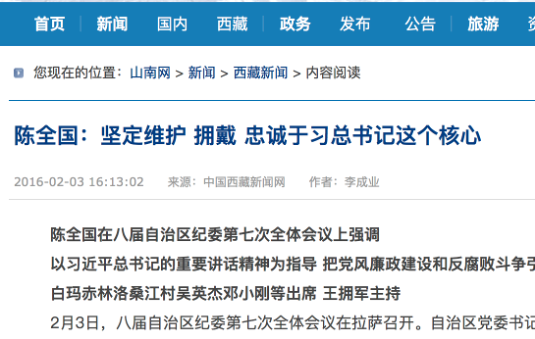
In October 2016, as the Party held its 6th Plenum, Xi Jinping’s status as the “core,” or hexin (核心) became definitive, an unmistakable sign of his solidified position. In fact, the writing had been on the wall through much of 2016, and local leaders correspondingly signalled their loyalty. In February 2016, Chen Quanguo (陈全国), then Party secretary of the Tibet Autonomous Region, led the way, introducing the phrase “firmly protecting, supporting and remaining loyal to the core that is General Secretary Xi Jinping.”

手机屏幕截图
描述已自动生成

After the 6th Plenum a slew of different phrases denoting loyalty to Xi cropped up in the Party media. These included:

“Trusting the core in thought, loyal to the core politically, loving the core emotionally, and maintaining the core in action.” – vice-governor of Qinghai province Zhang Guangrong (张光荣), appearing in the Qinghai Daily on November 24, 2016

“Clean, and loyal to General Secretary Xi Jinping.” – Pan Wujun (潘武俊), political commissar of the Ningxia Military Region, appearing in Ningxia Daily on January 11, 2017

“To General Secretary Xi Jinping, absolute loyalty and pure loyalty.” – Jilin Party Secretary Bayanqolu, appearing in Jilin Daily on January 11, 2017

“Loyalty to the Party, loyalty to the General Secretary.” – spoken first by a forestry official in Jilin province, appearing in the Yichun Daily on December 22, 2017

Liu Jiayi’s use of the “two loyalties” (两个忠诚) as he introduced the new leader in Jinan is only the latest example. But so far, the “two loyalties” and related phrases have not yet appeared in the People’s Daily. The loyalty dance is not yet a national dance, and whether it will become so remains to be seen.

Generally speaking, the Chinese Communist Party has three attitudes toward political slogans and key phrases. The first is to welcome and promote slogans, encouraging their use, which applies to mainstream CCP phrases like “Xi Jinping Thought on Socialism with Chinese Characteristics for a New Era,” the “two protections,” or “Belt and Road.” The second attitude is to prevent or restrict the use of certain phrases, particularly those regarded as sensitive, including “judicial independence,” “freedom of speech,” and so on. These are often blocked outright, prohibited from appearing in the media or online.

Finally, there are those terms on which the Party’s attitude might be characterized as ambiguous. These are words or phrases that can, depending on context, be regarded as either sensitive or non-sensitive. In the Jiang Zemin and Hu Jintao eras, for example, terms like “constitutionalism” and “civil society” were not necessarily regarded as negative, and could be found in the media (particularly the commercial media), but these terms were never used by top leaders, and they could seldom if ever be found in the flagship People’s Daily. Since 2013, these terms have been more explicitly designated as unacceptable, and have virtually disappeared from use in the media.

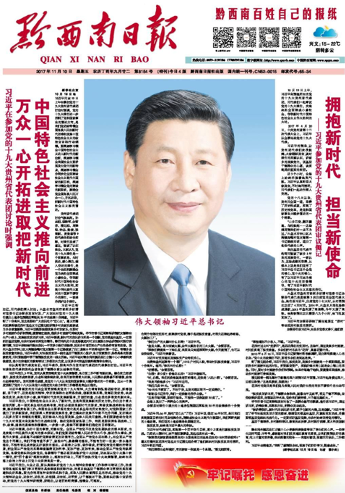
At the other end of the ambiguity spectrum are terms of praise or positivity that run the danger of being unseemly owing to historical associations or the potential for blowback. One of the most classic recent examples might be “great leader Xi Jinping” (伟大领袖习近平), a phrase that appeared in at least one local newspaper but was subsequently removed.

The phrase “loyalty to the Party, loyalty to the General Secretary” can be regarded as an ambiguous phrase under the current political environment, meaning that, though positive from the standpoint of CCP leaders, it does not appear in the People’s Daily or high-level speeches or other documents. But local officials know, at the same time, that there is little or no risk for them in shouting the phrase to the heavens, which might actually put them in good favour with senior officials.

Liu Jiayi, the Party secretary of Shandong province, knows this principle only too well, which is no doubt why he chose to express his loyalty to Xi Jinping and the CCP while inviting a new city leader to his post.

Nor is this Liu’s first time going beyond the call of duty to shower praise on Xi Jinping. Shortly after the 19th National Congress in October 2017, the CCP issued a notice standardizing the discourse of praise for Xi, okaying the use of “a leader cherished by the whole Party, loved and respected by the people, and worthy of the title” (全党拥护, 人民爱戴, 当之无愧). But even this moderated phrase, designed to tone down the parade of unctuous accolades for Xi, was soon withdrawn amid concerns of the emergence of a personality cult around the general secretary.

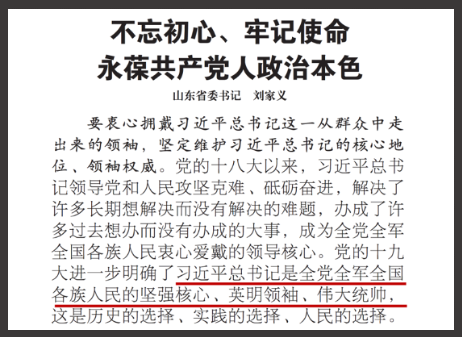
In Shandong, Liu Jiayi was determined to keep the adulation going. He spoke of Xi Jinping as “the staunch core, wise leader and great commander” (坚强核心, 英明领袖, 伟大统帅), the last of this trinity redolent of the title “commander” given in the pre-reform era to Mao Zedong.

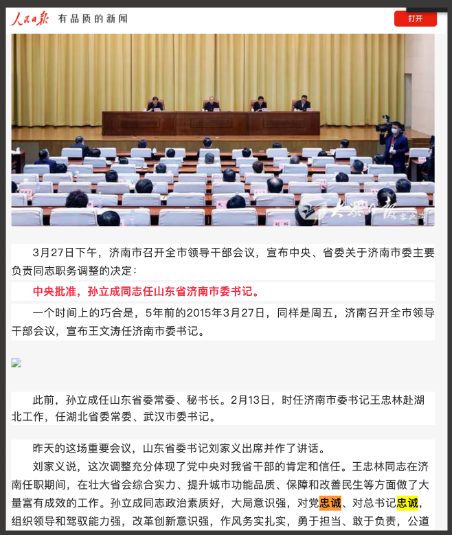
So far, Liu Jiayi is in a league of his own when it comes to dancing the loyalty dance. Since January 2020, the country has focused on fighting the coronavirus. When we search newspapers over the past few months, we find Liu is the only leader in the country openly signalling loyalty to Xi Jinping. Liu’s remarks appeared only in Dazhong Daily, Shandong’s official Party mouthpiece, the newspaper directly under Secretary Liu’s thumb, and a few other local Party papers – though they were included in several online sources (including on the People’s Daily news app, shown below).  

These days, there are no signs anywhere else in China’s official Party media of phrases of obeisance such as “loyal to General Secretary Xi” (对习总书记忠诚), “loyal to General Secretary Xi Jinping” (对习近平总书记忠诚), “loyal to the General Secretary” (忠诚于总书记), “treating General Secretary Xi with loyalty” (忠诚于习总书记) and so on.

In this “New Era,” will the loyalty dance become as popular as it was during the Cultural Revolution? As we observe Chinese politics, this is another interesting question to bear in mind, looking for signs of the dance in the ever-shifting discourse of the Party.

The Trouble with “Total War”

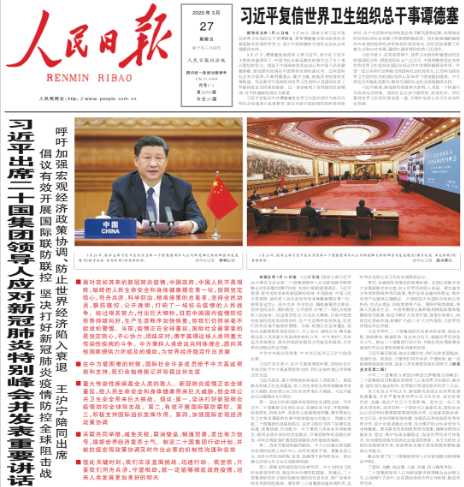
Xi Jinping took part yesterday in a video teleconference with G20 leaders to address the coronavirus epidemic. The news is reported prominently on the front page of today’s People’s Daily, just below the masthead. The headline, running vertically alongside an image of Xi, emphasizes his role in the teleconference: “Xi Jinping Attends G20 Leaders Special Summit on New Coronavirus and Delivers Important Speech.”

报纸上的文字
描述已自动生成

What was this “important speech”? It was called, “Working Together to Fight the Epidemic” (携手抗疫 共克时艰). China’s deputy foreign minister, Ma Zhaoxu, summarized Xi’s speech, saying that its chief purpose was to introduce “China’s experience,” set forth “China’s proposition,” put forward a “Chinese initiative,” and outline pledges for “China’s contribution.”

Ma praised the speech for “adhering to the concept of a community of common destiny for mankind,” a reference to Xi Jinping’s key foreign policy phrase. He said the speech “integrated China’s practical experience in fighting the epidemic, laying out a series of important propositions, and playing an important guiding role for strengthening international cooperation on epidemic control and stabilizing the global economy.”

In fact, Xi Jinping’s speech was incredibly brief, consisting of just 1,411 Chinese characters. Particularly of note is the fact that just a small portion of the speech, about 106 characters, or seven percent, deals with China’s experience at all. Here is what that section, found right at the outset of the speech, actually says:

Faced with the sudden rise of the novel coronavirus epidemic, the Chinese government and the Chinese people did not shrink from adversity, but placed people’s lives and health above all. With firm resolution, mutual aid, scientific prevention and precise policies, we undertook a people’s war against the epidemic through national mobilization, joint prevention and control, and openness and transparency.

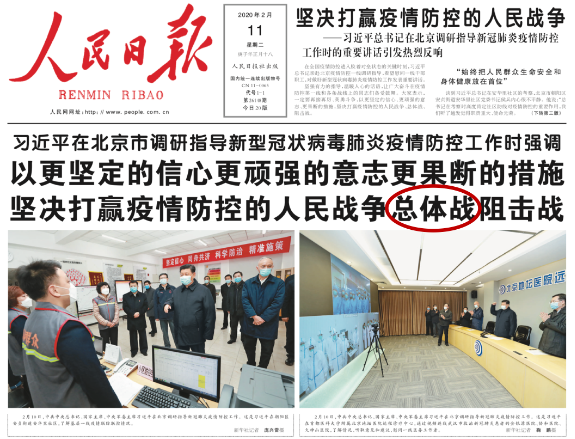
During his inspection tour in Beijing on February 10, Xi Jinping used the terms “people’s war” (人民战争), “total war” (总体战) and “battle” (阻击战) to describe the challenge facing China. All three of these terms appeared in the most prominent headline in the next day’s edition of the People’s Daily.

报纸上有人的照片上写着字
描述已自动生成

This trinity of terms has been central to sloganeering in official propaganda in the midst of Xi’s “war” against the coronavirus epidemic. The terms have been used in concert through February and March as successive Politburo Standing Committee meetings have been held, and as Xi visited the city of Wuhan, the epicenter of the epidemic.

During the G20 video teleconference, as Ma Zhaoxu tells us, Xi introduced “China’s experience,” using the term “people’s war,” a term going back to Mao Zedong. As Xi Jinping addressed the global response, he also spoke of a “battle,” or zujizhan (阻击战), using another term in his anti-epidemic trinity.

But the third term in the trinity, “total war,” or zongtizhan (总体战), was missing from Xi’s G20 speech. Why would this erstwhile crucial term suddenly be dropped? My guess is that the speech writer, having some knowledge of world history, made necessary adjustments. Why? Because speaking of “total war” before the leaders of the United States, the UK, Germany, France and Russia could invoke shades of the Second World War and seem completely out of context.

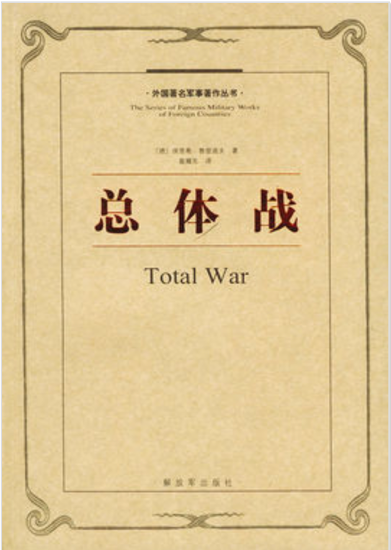
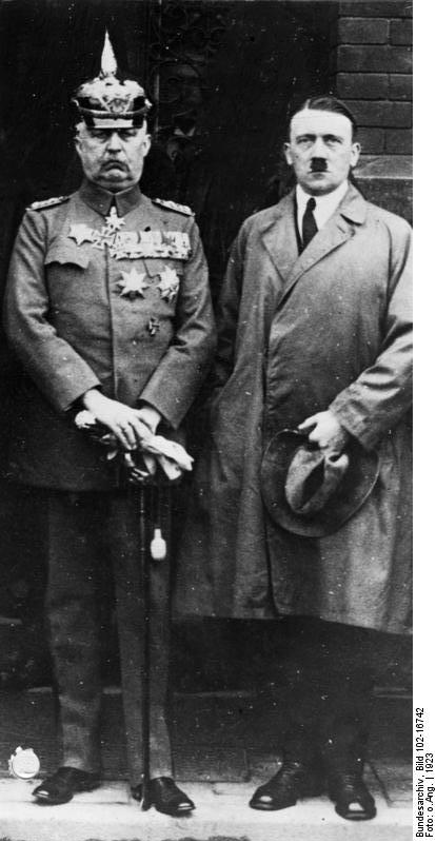
For China’s leaders, talk of “total war” may sound determined and resolute. But the  phrase, in fact, is not a positive one. It is generally attributed to general Erich Ludendorff, Germany’s chief military leader during the First World War, whose ideas, some have said, “paved the way for Hitler,” and who has been called “the first Nazi.”  

Below is an image of the cover of a Chinese translation of Ludendorff’s 1935 book Total War.

图片包含 游戏机
描述已自动生成

And here is an image of Ludendorff standing alongside Hitler, taken in Munich in April 1935 to mark Ludendorff’s 70th birthday. Hitler had ordered celebrations of the day across Germany, and the general was, according to the New York Times, “officially restored to the ranks of Germany’s heroic figures.”

Hitler and Ludendorff. Image from the German Federal Archives, available at Wikimedia Commons under CC license.

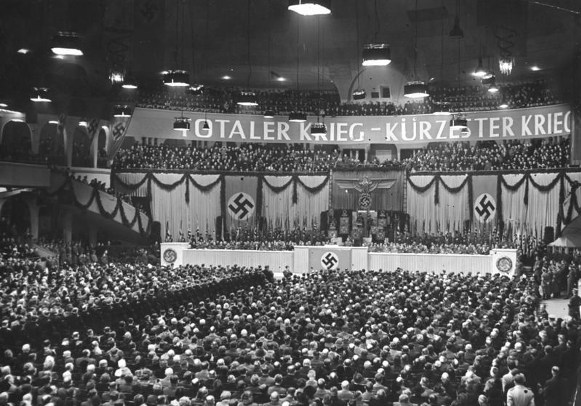
The notion of “total war” meant that a nation would mobilize all available resources for the purposes of war. The term came into wider use in 1943 as the situation in the Second World War took a dramatic turn. The German army was defeated at the Battle of Stalingrad, which began in September 1942 and lasted for several bitter months, and suffered grave setbacks in other key engagements. Finally, on February 18, 1943, Joseph Goebbels, the Reich Minister of Propaganda, delivered his infamous “Sportpalast speech” during which he called for “total war,” urging the German people to continue the war at all costs in order to turn back the threat of Bolshevism.

The scene on February 18, 1943, at the Berliner Sportpalast as Joseph Goebbels delivers his speech on “total war.” Image from German Federal Archives, available at Wikimedia Commons under CC license.

The term seen here on the banner flying over the grand stage at the Berliner Sportpalast in February 1943 – “total war,” or Totaler Krieg – is the very same word as the Chinese zongtizhan (总体战) that has formed part of Xi’s trinity of anti-epidemic slogans since last month.

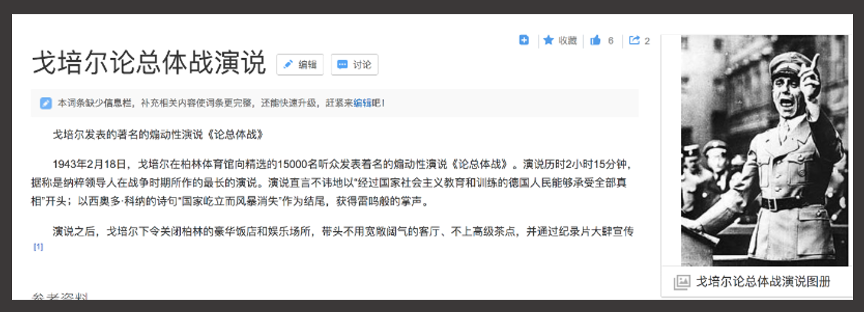
Search for information on “total war” in the Chinese search engine Baidu, and you quickly come to the following entry on Goebbels’ speech, which also notes that “after the speech Goebbels ordered the closure of luxury hotels and entertainment venues in Berlin.”

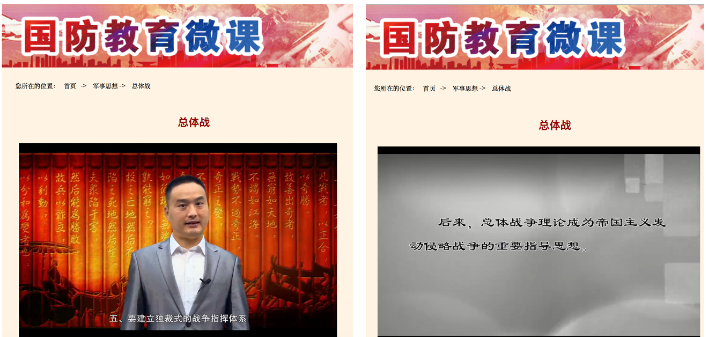
Within the discourse of the Chinese Communist Party, the “people’s war” is a now classic “red discourse” (红色词语), but in fact “total war” has always been what can be called “black discourse” (黑色词语), associated with capitalism and capitalist forces. In educational texts for national defense, the theory of “total war” is rejected as “an important guiding ideology of the imperialists in engaging in war,” as can be seen in the following image of related online study materials from the Ministry of Education.

手机截图图人的照片上写着字
描述已自动生成

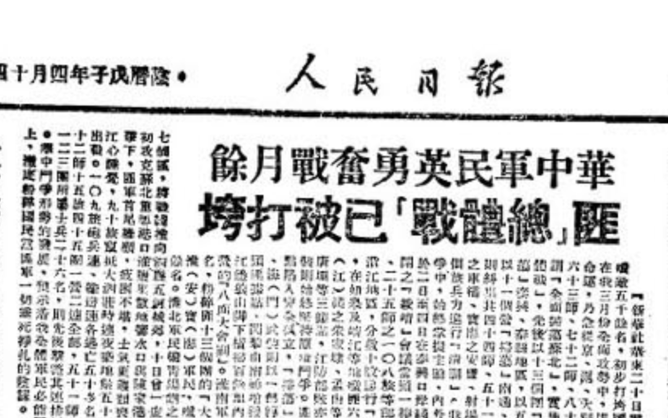
In 1948, as the Chinese Communist Party and the Kuomintang Party were locked in a bitter civil war, the People’s Daily, which had been launched two years earlier, ran a report with the headline: “After a Month of Brave Fighting By Liberation Army Soldiers in Jiangsu, the ‘Total War’ of the [KMT] Bandits Has Been Shattered.”   

文字图案
描述已自动生成

This history of “total war” was the reason for my astonishment as I spotted the term in the front-page headline in the People’s Daily on February 11. I’m sure others like me who are familiar with the discourse of the CCP felt exactly the same way.

In recent years under Xi Jinping, many old Maoist terminologies have been dusted off and given new life – phrases like, “East, south, north and center, Party, government, military, society and education – the Party rules all” (东西南北中,党政军民学,党是领导一切的). At the same time, a number of former “black words” seem to have been rehabilitated and appropriated – phrases like “in the highest position” (定于一尊), once decadent and imperial but now a positive expression of the lofty power of the top leader.

The simplest explanation for this inconsistency is the fact that in the so-called “New Era,” the functionaries in charge of penning speeches and official documents are not as sensitive as they once were to the CCP’s own history, much less to world history. They have no direct experience of Mao era, nor do they necessarily have a very deep sense of the early reform era under Deng Xiaoping. This has led to the absurd situation – absurd according to the internal logic of CCP discourse – that we find black words mixed into with the red.

In the case of Xi’s G20 video teleconference speech, the “total war” once shouted out by Goebbels cannot be found. But this does not mean the term has been shut out in the cold. A separate commentary in the People’s Daily today again chants the trinity on the new priority of getting the economy humming again, asserting that “the active and orderly return of production . . . concerns comprehensive victory in the people’s war, total war and battle to contain and control the coronavirus epidemic.”  

“Total war’ is almost certainly missing from Xi Jinping’s G20 speech out of recognition of its potential sensitivity in this context. The important question now is whether and how Xi Jinping might continue to use this dangerous phrase domestically — even long after the war against the epidemic has been won.

“Speaking Politics,” Rushing Into Disaster

Infectious diseases have no politics. In January 2020, through the course of the Wuhan people’s congress and the provincial people’s congress, no new coronavirus cases were reported in China. But the epidemic continued unabated – paying no heed to the political prerogatives of the Chinese Communist Party.

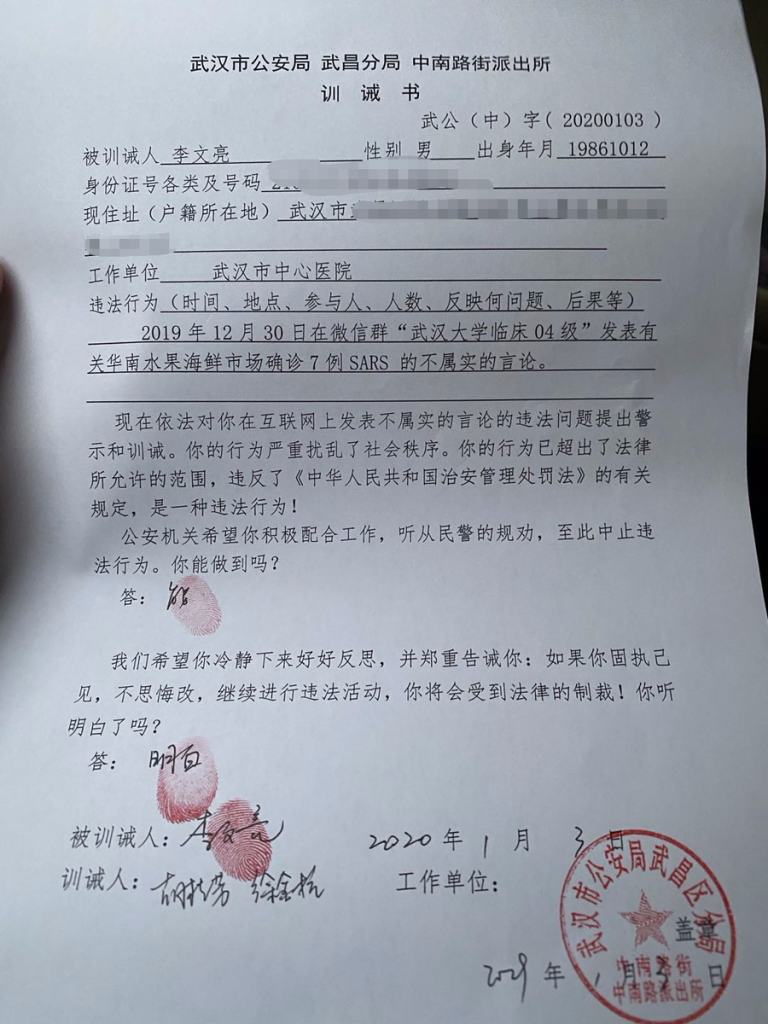
One of the medical facilities hardest hit by the coronavirus epidemic in Wuhan has been the Wuhan Central Hospital. On March 10, Caixin Media reported that the hospital, which has more than 4,000 employees, had at least 230 infections among its staff, the highest rate of infection among local hospitals. As of March 20, at least five of the hospital’s staff members had died of the coronavirus, including Li Wenliang (李文亮), Jiang Xueqing (江学庆), Mei Zhongming (梅仲明), Zhu Heping (朱和平) and Liu Li (刘励).

According to reports from Southern Weekly and China’s People magazine, on December 30, 2019, WeChat groups used by staff from various departments of Wuhan Central Hospital received the following information from the Wuhan City Health Commission: “We ask everyone please . . . . do not circulate at will to the outside notices and relevant information about a pneumonia of unclear origins . . . . otherwise the city health commission will subject them to severe investigation.”

On January 3, Wuhan Central Hospital called an emergency meeting of hospital department heads, emphasizing that they must “speak politics, speak discipline and speak science” (讲政治, 讲纪律, 讲科学), that they must not manufacture rumors or spread rumors, and that departments must closely monitor their own staff to ensure that strict discipline is maintained. Medical personnel were explicitly instructed not to disclose confidential information in public, and not to discuss the disease through the use of text, images or other means that might leave evidence.  

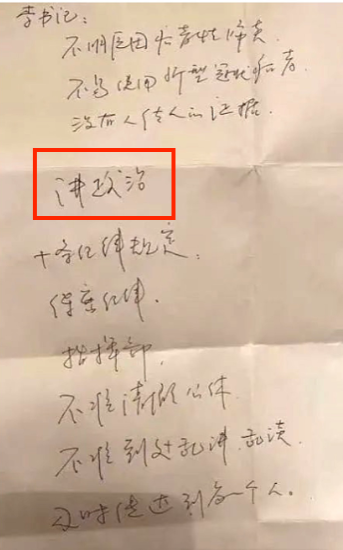
Since January, a digital copy of notes from that January 3 meeting, made by the now-deceased Jiang Xueqing, has appeared online, its authenticity verified by Chinese media. Jiang’s note include entries like: “10 discipline regulations”; “discipline in maintaining secrecy”; “no talking or discussion [without authorization.” And there is another phrase in Jiang’s notes – “speak politics.”

Notes taken of an internal hospital meeting by Wuhan doctor Jiang Xueqing on January 3, 2020.

The unfortunate deaths of Li Wenliang, Jiang Xueqing and others owe in large part to “speaking politics.” In the early stages of the coronavirus outbreak, “speaking politics” meant the muzzling of medical professionals in Wuhan, and it meant that doctors and nurses were deprived of critical protections at a time of great urgency.

Behind the rapid rise of the novel coronavirus outbreak that would overwhelm Wuhan Central Hospital and other hospitals in the city is a decades-long lineage of “speaking politics” that goes to the heart of the political culture of the Chinese Communist Party. What, then, does it mean to “speak politics”?

“Speaking” + “Politics”

The simple verb “to speak” in this context has layered meanings. Aside from the basic sense of “talking” and “saying” it bears the sense of “paying attention” and “taking into account.” Perhaps a better translation might be “prioritizing.”

In the Analects, the teachings and thoughts of Confucius, there is the phrase “speaking credibility in relationships,” or jiǎng xìn xiū mù (讲信修睦), which essentially means paying attention to or prioritizing trust, and seeking harmony. In this context, “speaking” is both similar and different in meaning to the word “grab” or “grasp” (抓) as it appears in CCP discourse, which CMP has deal with previously. Both of these words are used frequently in documents from the CCP’s Central Committee, and hang ever on the lips of Party and government officials. But “speaking” in fact implies an active choice made on the psychological level (精神层面主动选择).

“Politics,” though a simple enough word, is far more complicated when we talk about “speaking politics.” The layers entail such meanings as “distinguishing between the enemy and ourselves” (分清敌我), or “rooting out the alien [or dissident]” (铲除异己). There is also a sense of “making use of style” (发扬风格) – another complicated phrase in an of itself – and sometimes of “stressing the equitable” (讲求公正) or “[abiding by] the rules of the game” (游戏规则).

“Politics” can have meanings that are abstract and distant, or close and concrete, and these meanings of course shift with the times.

Earlier on within the discourse of the Chinese Communist Party, “speaking politics” had the sense in most cases of propaganda or oratory – speaking (or teaching) political lessons, or propagating political and economic ideas. At the same time, it bore the sense of emphasizing or prioritizing politics, which of course mean the Party’s politics.

In 1942, Mao Zedong said in his Yan’an Talks on Arts and Literature: “There are two standards for criticism in arts and literature; one is the political standard, and the other is the artistic standard.” These speeches by Mao would become the fountainhead of the notion within the Chinese Communist Party that the arts and literature must “speak politics.”

In the first decade following its launch in 1946, three years before the establishment of the PRC, uses of “speaking politics” in the People’s Daily were largely didactic, having to do with political instruction. And there was a related sense of “speaking of principles” (讲道理), which essentially meant just behaving properly. On the front page of the May 14, 1948 edition of the People’s Daily, for example, there was an article with the headline: “Examining Left-Leaning Mistakes Within the Party: Striking Others is Wrong.” A special working team had held a meeting, said the report, to discuss whether it was permissible to hit others. One old man was quoted as saying: “I used to gamble all the time, and I suffered much punishment under the old government. . . . But the Eight Route Army [of the Chinese Communist Party] has come, and I don’t hit others, and I don’t cuss, and I speak politics. Who in our village will gamble now?”

By the 1950s, “speaking politics” had already come in the arena of economics and the military to stand in opposition to the notion of specializing in doing business or in certain technologies or abilities without the proper nucleus of political consciousness. This stemmed from Mao Zedong’s notion, found in texts such as his essay “Concerning Agricultural Questions,” that one should develop expertise only on the basis of a core of correct communist ideas. In the following passage, “white” signifies capitalist ideas and impulses, set against the red of communism:

Our cadres in all walks of life must strive to be proficient in technology and business, so that they can become well-versed in their areas, both red and professional. But the idea of first professionalizing and then becoming red [turning to communist politics] is like first being white and then turning red, and this idea is wrong. Because this kind of person in fact wishes to continue being white, and to say they will later turn red is just a ruse. Right now, there are certain cadres who are red but not truly red, their ideas those of the wealthy farmer class.

Other slogans that expressed this idea in the relationship between business and politics included: “political work is the lifeline of all economic work” (政治工作是一切经济工作的生命线) and “red and professional” (又红又专), the latter found in the passage above. In this oppositional relationship between “speaking politics” and “speaking business” (讲业务) there is an undercurrent of power struggle, and this power struggle was present in the arts, in the military and in the economy.

After the Lushan Conference was held in 1959, Lin Biao, who catered to Mao and emphasized the spiritual role of people, succeeded Peng Dehuai as Minister of Defense and was appointed vice chairman of the Central Military Commission (CMC). The next year, the official commentary on National Day in the People’s Liberation Army Daily, the mouthpiece of the CMC, said: “The power of the material atomic bomb is great, but the power of the spiritual atomic bomb is greater still. This spiritual atomic bomb is the political consciousness and courage of the people.”

The term “spiritual atomic bomb” took the notion of “politics” and elevated it to the plane of strategic weaponry.

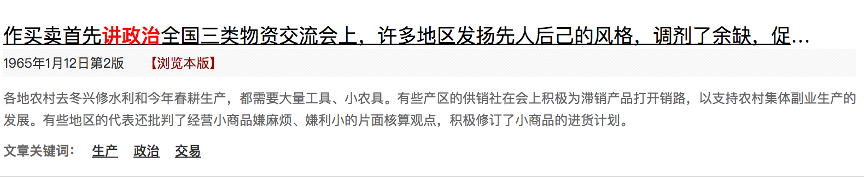
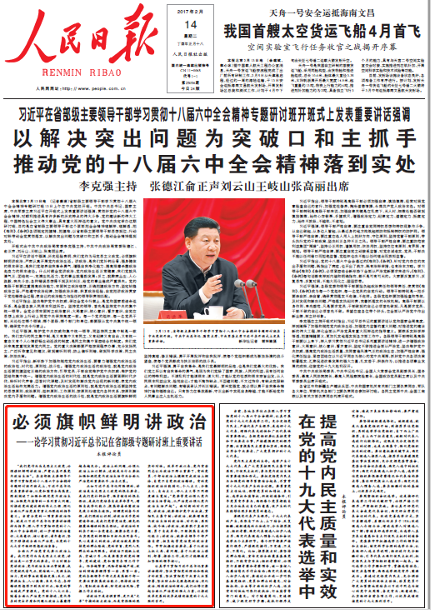
On January 12, 1965, a news story about “speaking politics” in the economic realm  was published in the People’s Daily, and this was also the first time that “speaking politics” emerged in a headline in the newspaper. The headline, somewhat shortened here, was: “Speaking Politics Must Come First in Buying and Selling.”

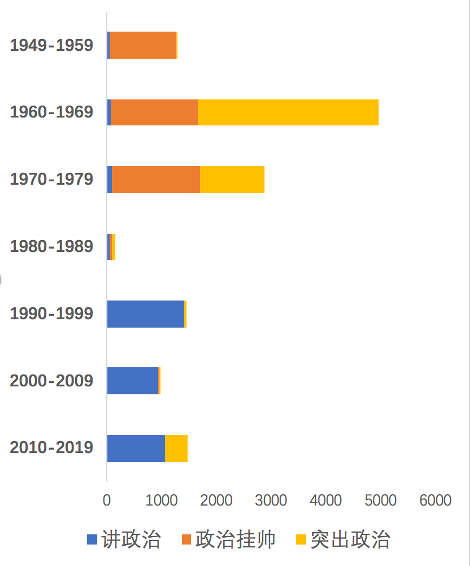
From the 1960s to the 1970s, the meaning of “speaking politics” can be equated with Mao Zedong Thought. During this period, which of course includes the Cultural Revolution, phrases like “giving prominence to politics” (突出政治) and “politics first” (政治第一) rise dramatically. After the end of the Cultural Revolution, these phrases came under sharp criticism, associated with Lin Biao and with the Gang of Four.

Deng Xiaoping’s priority was on business and the economy, and he famously said: “It does not matter whether a cat is black or white, but a cat that can catch mice is a good cat.” As Deng’s reform and opening policy defined a new direction for the country, Deng abandoned the Mao era slogan about “giving prominence to politics,” but he did not outright deny the important role of politics. In August 1986, Deng said during an inspection tour of the city of Tianjin: “If, alongside reform and modern science and technology, we speak politics, this will have the most power. At any time, we must speak politics.”

In the Jiang Era, “Speaking Politics” Becomes a Slogan

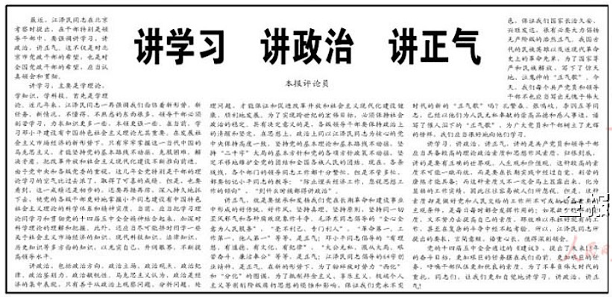
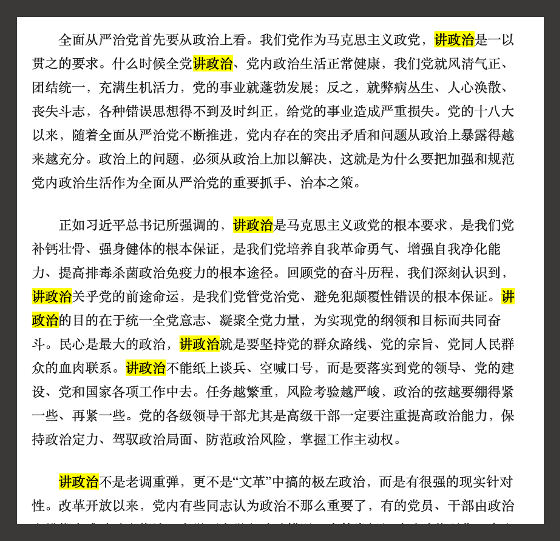
Consolidating power is a hard necessity for each leadership group. And after the criticizing of Lin Biao and the Gang of Four, it was no longer possible for Jiang to use Mao era slogans without incurring public resentment. In this context, the more direct phrase “speaking politics,” not over-burdened with Maoist associations, was chosen as a political slogan. The following graph show the slogans “speaking politics” (blue), “politics in command” (orange) and “giving prominence to politics” (yellow) in various eras.

On November 8, 1995, Jiang Zemin said during an inspection tour in Beijing: “When we conduct education for cadres, we must emphasize speaking study, speaking politics and speaking rightness. The entire country should act in this way, and the city of Beijing should serve a guiding role.” This speech initiated what at the time was referred to as the “three speaks education” (三讲教育). On November 25, two weeks later, “speaking politics” appeared in a headline in the People’s Daily:

This article in the People’s Daily offered an essential definition of the “three speaks, as follows:

Speaking politics includes political orientation (政治方向), political viewpoint (政治观点), political discipline (政治纪律), political discernment (政治鉴别力), political acumen (政治敏锐性) . . . . Leaders and cadres at all levels must remain sober and determined in their politics, maintaining unity in political and ideological terms with the Party of which Comrade Jiang Zemin is the core.

By this time, Deng Xiaoping was already old and frail, and in just over a year the old architect of the reform and opening policy would pass away. In order to consolidate his political power, Jiang Zemin defined and emphasized the notion of “speaking politics” as concession to his core leadership status, and obedience to his leadership.

Jiang Zemin emphasized again and again that news work (新闻工作), or journalism, must speak politics. In September 1996, Jiang made a visit to the People’s Daily, during which he said there was a need to “put the authority of leadership of news and public opinion in firmly in the hands of people who respect Marxism, respect the Party, and respect the people; news and public opinion units definitely must put adherence to the correct political orientation and adherence to correct guidance of public opinion in the primary position in all of their work.”

In the Xi Era, “Speaking Politics” is Renovated

In Xi Jinping’s so-called “New Era,” “speaking politics” has become more important than ever. In the seven years from 2013 to 2019, here is how the term “speaking politics” trended in the People’s Daily:

In January 2016, Xi Jinping said during the 6th full session of the 18th Central Discipline Inspection Commission: “We adhere to the [principle that] the Party must manage the Party, that the Party must be strictly governed. The investigation of the serious disciplinary and legal violations of Zhou Yongkang, Bo Xilai, Xu Caihou, Guo Boxiong, Ling Jihua, Su Rong and others have emphasized strict political discipline and the rules, creating an atmosphere of clear-cut politics and strict discipline.” From this point on, the phrase “speaking politics with a clear banner” would make frequent appearances in the Party-run media.

In October the same year, during the 6th Plenum of the 18th Central Committee of the CCP, Xi Jinping’s status as “core” leader was established, and on February 14 of the following year, “speaking politics” appeared in a related headline in the People’s Daily: “[We] Must Speak Politics With a Clear Banner.”

The phrase “speaking politics appeared no less than 13 times in the commentary. “Speaking politics is a fundamental requirement of a Marxist political party, our calcium supplement,” the commentary said at one point, attributing the idea to Xi Jinping. “Speaking politics concerns the future and fate of the Party,” is said at another point. And: “Speaking politics is not the repetition of old tunes, nor is it the far-left politics in the ‘Cultural Revolution’; rather, it is directed and practical.”

In terms of consolidation of power, the “New Era” has been a robust period of new slogan manufacturing, all lending fresh layers of discourse to the notion of “speaking politics.” Prominent among these slogans have been the so-called “Four Consciousnesses”—“political consciousness” (政治意识), “consciousness of the overall situation” (大局意识), “consciousness of the core” (核心意识) and “compliance consciousness” (看齐意识)—and the “two protections” (protection of the core leadership status of Xi Jinping, and of the centralized leadership of the Chinese Communist Party).

In his comprehensive review of Chinese political discourse in 2019, Qian Gang looked at how local Party media and military media (军报) used the “four consciousnesses “ and the “two protections,” signaling their loyalty to Xi Jinping and the Party. For example, on November 22, 2019, the local Wulong News in Chongqing used the phrase “respecting the core, protecting the core, complying with the core, and following the core” (忠诚核心、维护核心、看齐核心、追随核心). Jiangxi province’s official Gan’nan Daily wrote on the same day of “protecting the core, supporting the core, and following the core both in our hearts and in our outward actions” (将维护核心、拥戴核心、追随核心内化于心、外化于行).

At the 4th Plenum in October 2019, Politburo Member Ding Xuexiang wrote in the People’s Daily:

The ‘Two Protections’ have a clear meaning and demand, to protect the core status of General Secretary Xi Jinping, and the object is General Secretary Xi Jinping and no other person; to protect the centralized and unified authority of the Central Committee of the CCP, the object being the Party’s Central Committee and no other organization. The authority of the CCP Central Committee determines the authority of Party organizations at all levels, and the authority of Party organizations at all levels comes from the authority of the CCP Central Committee. The ‘Two Protections’ can neither be applied layer by layer nor extended at will.  

This passage makes it very explicit what is meant by “speaking politics.” As Ding Xuexiang lays out the essentials, there can be no doubt whatsoever.

As the Epidemic Raged, What Did “Speaking Politics” Mean?

2020 was meant to be China’s year of victory in its war against poverty and the building of a “moderately well-off society.” Early on in the year, before the coronavirus epidemic was pushed into the spotlight, it was clear that this supposed victory was the centerpiece of the Party’s propaganda strategy.

In Wuhan, which would soon become the epicenter of the epidemic, the Changjiang Daily, the official newspaper of the municipal Party committee, was not to be outdone in its declaration of victory in the war on poverty. A front-page article in  the paper declared that Wuhan would become “China’s Fifth City” after Beijing, Shanghai, Guangzhou and Shenzhen.

In early 2020, as the coronavirus outbreak spread, what took precedence in the politics of Wuhan and Hubei province? The priorities were the celebration of the annual Spring Festival, the holding of the city and provincial sessions of the people’s congress and political consultative conference, the touting of the Party’s victories in fighting poverty, and the “Two Protections.” All of these were ultimately about the “Four Consciousnesses,” and as such were about the core status of Xi Jinping and the leadership of the Central Committee.

On January 10, the Changjiang Daily, Wuhan’s official Party newspaper, published the speech given by the city’s top leader, Ma Guoqiang (马国强) to the local people’s congress. In his speech, Ma emphasized the need to “speak politics with a clear banner.” Nowhere in his speech did Ma mention the coronavirus outbreak, which at that point was still not being dealt with openly in China.

On February 15, not long after Ma Guoqiang’s replacement as Wuhan’s top leader, the Changjiang Daily ran a report about a study session led by the city’s new top leader, Wang Zhonglin, that again emphasized “speaking politics,” though by his point the response to the coronavirus epidemic was an open agenda, having redirected the focus of news and propaganda efforts since Xi Jinping’s first public comment on the epidemic on January 20. The Changjiang Daily piece read: “Under the provincial Party leadership of session leader Comrade Ying Yong, and under the guidance of session leader Comrade Wang Zhonglin of the city’s Party Committee, [the study session] spoke politics, attended to the general situation and abided by the rules.”

“Speaking politics” has had varying meanings at different times in China’s history. In the early days of 2020, as the virus silently spread, “speaking politics” meant “not talking haphazardly” (不准到处乱讲). Once the response effort had actually begun after January 20, “speaking politics” meant shutting down cities, closing off roads and building emergency field hospitals like Huoshenshan. At the most challenging point of the response effort, “speaking politics” meant carrying out stability preservation in restive residential districts – like the one in Wuhan that heckled Vice-Premier Sun Chunlan during her inspection tour on March 6. In the most recent stage of China’s response, “speaking politics” is about being tough on restricting international arrivals who might reintroduce the virus, and about getting economic activity going again.

“Speaking politics” has often meant rushing into disaster – and many, like Doctor Li Wenliang (李文亮) and Doctor Jiang Xueqing (江学庆), have paid with their lives for its expedient focus on the shifting interests of the CCP leadership. So long as China fails to face the painful lessons of “speaking politics” and its privilege over humanity and conscience, its flag will continue to fly high, drawing attention away from real threats and dangers.

The Politics of Gratitude

This month, as China has moved into a new phase in the fight against the novel coronavirus epidemic, and as CCP leaders have been keen to claim victory, the question of gratitude has become a contentious one – both inside and outside China. On March 4, a commentary from Xinhua News Agency balked at the suggestion from a host on Fox News that China, as the origin of the virus, owes the world an apology.

Recently, a view is being promoted that China owes the world an apology. This is extremely absurd. China has made massive sacrifices in fighting the coronavirus epidemic, and paid an immense economic cost to cut off the path of transmission of the coronavirus. No other country has made such huge sacrifices and put in so much effort in the midst of this epidemic.

The commentary then turned the tables, suggesting that the world in fact owes China a debt of gratitude. “Right now we should firmly say that America owes China an apology,” it said, “and the world owes China thanks.”

Gratitude now figures heavily in messaging from state media on the coronavirus epidemic. On March 16, following the arrival in Italy of a Chinese shipment of medical supplies and personnel, the People’s Daily ran a story called, “Thanks to the Special Team From China,” which reported contested claims that Italians in one residential area in Italy had played the Chinese national anthem and shouted “Grazie Cina!” – Thank you, China! – from their apartments.

One Italian site convincingly cast doubt late last week on the authenticity of related videos posted by top officials from China’s foreign ministry, including spokeswoman Hua Chunying, by locating sources of footage used to create the Chinese video. Below, for example, is a screenshot from the video playing on Hua Chunying’s Twitter account, alongside a screenshot from the original video – of Italians applauding Italians – from Italy’s AGTW.

The question of gratitude was also the source this month of controversy inside China. On March 7, on the eve of Xi Jinping’s visit to Wuhan, Wang Zhonglin (王忠林), who has served as the top leader of Wuhan for just over a month, announced that he planned to carry out “gratitude education” (感恩教育) for residents of the city, who should “thank the General Secretary, and thank the Chinese Communist Party.”

As soon as news of this statement from Wang came out, it was met with a wave of anger. Journalist Chu Chaoxin (褚朝新) wrote angrily: “No one with a modicum of decency would demand that the Wuhan people, just recovering from shock, would show their gratitude.” Wang Zhonglin’s talk of thanks brought a wave of such recriminations that continued for an entire day before it was completely brought under control. As the image below shows, the original post about Wang’s remarks from “Wuhan Release,” the official WeChat account of the local government, was deleted within hours in the face of the backlash.

图片包含 屏幕截图
描述已自动生成

For many Chinese speakers outside mainland China, in Hong Kong, Macau or Taiwan, “gratitude” is a plain and ordinary word for a commonplace sentiment. But when did “gratitude” become transformed into a political slogan in mainland China?

Tracing the Spread of “Gratitude”

Searching for the origins of discourse is not entirely unlike the work of investigating the origins of an epidemic. The use of databases and search engines can help us to trace the paths that certain words and phrases have taken through history.

In ancient Chinese, there is a word “gratitude” that is used in such idiomatic expressions as “being grateful for a kindness” (感恩戴德). The object of gratitude in most of these uses, judging from my search of Taiwan’s Scripta Sinica database, is the sovereign ruler (君王). In the newspapers of the Republican period, after the fall of the Qing Dynasty, the word “gratitude” appears in many instances having to do with religion, with talk of “Thanksgiving Day” (感恩节) and so on (searching Shanghai’s BKSY database). And newspapers can be located in Taiwan that continue with uses of “gratitude” that accord more or less with either the traditional Chinese sense or the Western religious sense, with a number of instances of “gratitude” to leaders also appearing – such as after the death of Chiang Kai-shek (Taiwan’s Infolinker database).

Now, I grew up “drinking red ink,” and I know by heart practically every red slogan of the Chinese Communist Party that has ever been. But I don’t have any strong recollection of “gratitude” being a part of this tradition. So I had to do my homework, and look back through the People’s Daily database to see what I could find. What I found was that since the newspaper’s launch in 1946, up to the end of the Cultural Revolution and the start of the reform and opening era in 1978, a period of 32 years in the Mao Zedong era, the word “gratitude” appeared in just 163 articles – less than once every two months, or about five per year.

This pie graph shows four different contexts for the word “gratitude” in the People’s Daily throughout this period:

“Being grateful for a kindness” (感恩戴德) and “endless gratitude” (感恩不尽) are both phrases that the Chinese Communist Party views as having shades of feudalism. Meanwhile, “Thanksgiving Day”(感恩节), being a Western term, is associated with imperialism and capitalism. These uses account for 84 percent of the total.

The “other” uses, seen in yellow, aside from a very few that are positive uses – for example, the “gratitude” of the people after Communist forces occupied former Kuomintang territory), and one use for a place name, “Gratitude County” (感恩县) – all have negative connotations. For example, they might deride the “gratitude” that the running dogs of imperialism show to their masters, and so on.

In the Mao era, “gratitude” was a word belonging to the sphere of feudalism and capitalism. But even as “gratitude” was seldom used, and rarely positive, the headlines were full of slogans like, “Our gratitude to Mao Zedong is higher than the sky” (毛主席的恩情比天高), “Thanks to Chairman Mao!” (感谢毛主席), “Thanks to the Chinese Communist Party!” and so on.

In the Deng Xiaoping era, the words “gratitude” and “thanks” in reference to leaders or the government was quite rate in the People’s Daily. In 1981, the Chinese Communist Party issued mild criticisms of Mao Zedong, passing its Resolution on Certain Questions in the History of Our Party since the Founding of the PRC. The People’s Daily ran an article called “Feelings of Gratitude Cannot Replace Scientific Analysis (感恩之情不能代替科学分析) that said, using the sense of “leader,” or lingxiu (领袖) that Xi Jinping has now claimed for himself: “If we begin from a sense of gratitude, we are unable to accurately recognize the historical role of the leader, but can easily confuse the distinction between respect for the leader and the cults of personality around Lin Biao and the ‘Gang of Four.’”

Deng Xiaoping was wary of personality cults. It goes without saying that while he was in power we did not see phrases like “showing gratitude to Deng Xiaoping” (感恩邓小平). But even expressions of “thanks” (感谢) towards Deng were rare. One example occurred in 1987, when a Tibetan monk from Qinhai was quoted as saying in the People’s Daily: “[We offer] thanks for such a good policy made for us by Grandpa Deng.” There have certainly been instances where Chinese made genuine gestures of thanks to Deng Xiaoping. The most obvious example was perhaps during the National Day march in 1984, when students hung out a banner that read, “Hello, Xiaoping!” (小平您好).

“Gratitude” Heats Up in the Hu Era

If we look at how the word “gratitude” trends in the People’s Daily through the Deng Xiaoping, Jiang Zemin and Hu Jintao eras, this is the pattern we see, where orange represents Deng, yellow Jiang and green Hu:

图片包含 名片
描述已自动生成

In the Deng and Jiang eras we find the word “gratitude” clearly in evidence. As China opened up to the world, “Thanksgiving Day” became an objective noun, without negative connotations. There was even coverage during Jiang Zemin’s visit to the United States of American workers introducing the customs of American Thanksgiving.

But the real increase in use of the word “gratitude” came in the Hu Jintao era. In the 10 years of Hu Jintao’s tenure in office, there were a total of 1,639 articles in the People’s Daily including the word “gratitude.” In the final year of Hu’s tenure, there were 320 articles, making the word a “hot” term according to the CMP heat scale for political discourse.

Some observers have said that the transition from Mao to Deng, Jiang and Hu marked a steady progression from “strongman politics” (强人政治) to “ordinary man politics” (常人政治). As Hu Jintao introduced his slogan “harmonious society” (和谐社会), the word “gratitude” heated up in the state media. For example, one article in September 2006 said: “Always be grateful, and there will be more harmony and less division between people; more unity and less friction; more understanding and less complaining.”

图片包含 文字, 报纸
描述已自动生成

This was the first time in the Hu Jintao era that the world “gratitude” appeared in a headline in the People’s Daily. At the time the whole country was in the midst of its fight against SARS, and the author of the piece praised science and technology workers and health workers, saying: “Disaster reminds each and every one of us that we must have a grateful heart.” “It’s only when you have a grateful heart that you can better understand respect. Respect life, respect labor, and respect creativity.”

In the Hu Jintao era, “gratitude” had many meanings in the media. These included: the gratitude felt by people in disaster areas for disaster relief workers (2006 being the 30-year anniversary of the Tangshan Earthquake); the gratitude felt by poor Chinese in the countryside for relatives that helped them; gratitude children felt for their parents, and so on. Below is a report in the People’s Daily from December 2006 about two sons who built a cart called “The Gratitude Express” (感恩号) to take their elderly mother traveling.

图片包含 人员, 户外, 男士, 建筑物
描述已自动生成

In 2005, the city of Shanghai added a clause to its High School Regulations about “learning to be grateful” (学会感恩). One commentator wrote in response to this change that this was a “required course for life,” and that a sense of gratitude was ”the soil in which social responsibility and patriotic hearts are nurtured.”

During this period, in the early Hu Jintao era, we also begin to see more frequent use of “gratitude” in the context of institutions, so that we begin to see “gratitude toward the organization” (感恩组织), and “gratitude toward the Chinese Communist Party” (感恩共产党). In 2010, the United Front Work Department organized a “gratitude movement” for private enterprises in which companies were encouraged to “show gratitude toward the Party, gratitude toward the nation, and gratitude toward the people.”

From this point, as we approach the Xi era, it seems, the word “gratitude” takes on a clear political coloring and association with the Chinese Communist Party. But in the Hu Jintao era, there was no giving of gratitude toward the “leader.” In fact, this was impossible, because Hu Jintao, quite unlike his successor, Xi Jinping, was never designated as “the core” (核心). All of this would change by 2013.

Gratitude for the General Secretary

As Xi Jinping came to power, he launched a concerted campaign against corruption in the CCP’s ranks. In some cases, officials were criticized for corrupt ways of thinking about the their relationship to others in society, and we see the notion of “gratitude” used in a critical way in this context. In 2013, an article in the People’s Daily called “Being Alert to Erroneous Concepts of Gratitude” (警惕错误的感恩观) said that “under the long-term influence of feudal ideas and [incomplete] social development, certain erroneous concepts of gratitude have permeated relations between the Party and cadres, and between different groups.” It continued: “Certain leading cadres regard the gratitude given by the masses for favorable policies by the Party and the government as the fruit of their own labors.”

From 2013 to 2017, during Xi Jinping’s first -five-year term, there were 1,164 articles in the People’s Daily using the word “gratitude,” showing a marked increase from the Hu Jintao era. Before 2015, however, while the phrase “gratitude toward the Party” (感恩党) could be found, expressions of gratitude toward the person of the leader himself did not occur.

On July 23, 2016, the People’s Daily ran a long report on the front page about Xi Jinping’s inspection tour of Ningxia. The article said that “the prosperous people who had thrown off poverty expressed gratitude toward their guide Xi Jinping.” This was a precursor to a phrase we see now, “gratitude for the General Secretary.”

Three months after this report, Xi Jinping took an important step further up the ladder of personal power.

图片包含 户外, 标牌, 建筑物, 地面
描述已自动生成

At the 6th Plenum of the 18th Central Committee of the CCP, Xi Jinping was formally designated as “the core” (党的核心). The emergence of a new CCP phrase, “the Central Committee with Comrade Xi Jinping as the core” (以习近平同志为核心的党中央) resulted in a reshuffling of political discourse, the upshot being a tidal wave of adulation for Xi Jinping before and after the 19th National Congress of the CCP in the fall of 2017.

Here is the front page of Xinjiang’s Aksu Daily, the official CCP mouthpiece in Aksu prefecture. The headline tells us about a disabled girl who wrote a poem “to express gratitude to the General Secretary.”

图片包含 报纸, 文字, 屏幕截图
描述已自动生成

On September 17, 2017, in a huge special report ahead of the 19th National Congress, Guizhou Party Secretary Sun Zhigang (孙志刚) became the first top provincial official in the People’s Daily to shout the slogan “Thanks to General Secretary Xi Jinping” (感恩习近平总书记). Not to be outdone, many top officials at that time, including Wu Yingjie (吴英杰), Party secretary of the Tibet Autonomous Region, expressed their “gratitude” toward Xi in this way during the 19th National Congress – and this brought a notable rise in the phrase in the People’s Daily.

This is the front page of the November 9, 2017, edition of Guizhou’s Qianxinan Daily. Notice the wall behind the women in their colorful garb. There is a portrait of the general secretary, along with a red caption that reads: “Great Leader General Secretary Xi Jinping” (伟大领袖习近平总书记). This is a level of elevation of Xi we rarely see even now, putting him squarely on par with Mao Zedong. The headline reads: “The sound of gratitude crosses the river.”

图片包含 文字, 报纸
描述已自动生成

The portrait actually appeared on the newspaper’s front page the very next day:

图片包含 报纸, 文字
描述已自动生成

This was the triumphal atmosphere that spawned the phrase “gratitude for the general secretary.” In 2018, the Party leadership actually moved to regulate the tide of enthusiastic praise for Xi Jinping, which risked going overboard. Qianxinan Daily quietly removed the November 9, 2017, front page from its online archive, replacing it with a fake front page. The Central Committee issued a notice specifying that the phrase “cherished by the whole Party, loved and respected by the people, and worthy of the title” (全党拥护,人民爱戴,当之无愧) could be used to praise Xi Jinping. But even this phrase fell out of use rather quickly. What did remain, and continue to flourish, was the phrase “gratitude to the general secretary,” which we can find in many articles in state media. 

In Guizhou, Party media chanted the slogan, “Forging ahead with gratitude” (牢记嘱托感恩奋进), and Party secretary Sun Zhigang managed to say in his report to the provincial people’s congress in 2019: “General Secretary Xi Jinping’s gratitude for the people of Guizhou is heavy as a mountain, and the people of Guizhou will forever be thankful to the General Secretary!” In the city of Ningde, in Fujian province, the Party Committee stated in its mouthpiece newspaper, the Mindong Daily, in January 2019: “[We] must in our ideology express gratitude to General Secretary Xi Jinping, love and respect General Secretary Xi Jinping, moving with the General Secretary in our actions, and protecting the General Secretary.”

In his “Spring Address” early this year, Zhangjiakou’s Party secretary, Hui Jian (回建) “express[ed] gratitude to General Secretary Xi Jinping for the unprecedented opportunities he has brought to Zhangjiakou.” Also in January, Liu Ning (刘宁), the governor of Qinghai province, wrote the phrase “showing gratitude to General Secretary Xi Jinping” into his government work report. And a report from the standing committee of the municipal CCP committee in Xi’an said in January that “[we must] always remember and always have gratitude toward General Secretary Xi Jinping for his care and concern for Xi’an.”

Through January this year, as the coronavirus outbreak exploded in China, and the entire country was prioritizing the fight against the epidemic, the People’s Daily stubbornly maintained its focus on the anti-poverty series it had already planned for the year. And twice these special reports spoke of having “gratitude for the General Secretary.”

This larger political context, and the cult of gratitude emerging around Xi Jinping, is crucial to understanding why Wang Zhonglin made his remarks about the need for “gratitude education” in Wuhan.

But in fact, Wang Zhonglin’s idea was not at all new. Others blazed this trail after the 19th National Congress of the CCP. Here is a report from Chun’an County in Zhejiang province. The headline reads: “Our county carries out ‘gratitude for the general secretary, advancing bravely in the new era’ study and propaganda education campaign” (我县开展”感恩书记, 奋进新时代”专题学习宣传教育活动). 

图片包含 文字, 报纸
描述已自动生成

Wang Zhonglin was merely following what has become mainstream direction on managing public opinion since the 6th Plenary Session of the 18th Central Committee back in 2016. He was reading from the same hymnbook as other CCP officials, with the same lyrics, his thought being to express his loyalty to the General Secretary. His failure was in misapprehending the current state of things in China. As Chinese face life and death concerns and harbor deep resentment over early missteps in dealing with the epidemic, their nerves are especially sensitive to the way leaders seem so keen on showering themselves with tributes and praise.

The evolution of “gratitude” can tell us a great deal about political evolution in China today. It can tell us, we might also say, about the evolution and spread of the political virus that has infected the body of the Chinese Communist Party.

Like me, Xi Jinping grew up “drinking red ink.” Since coming to power, he has revived many red terms from the Mao era, including phrases like: “East, south, north and center, Party, government, military, society and education – the Party rules all” (东西南北中,党政军民学,党是领导一切的). But in Xi’s new era, “gratitude,” that black word once associated with feudalism and capitalism, has become a bona fide red political slogan – and this is something entirely new.

(Additional research for this article was contributed by David Bandurski.)

Reclaiming Doctor Li

China’s anti-corruption agency has announced the results of its investigation into the summoning and formal reprimand by the Wuhan Public Security Bureau of Li Wenliang, the 34-year-old Wuhan doctor who tried to warn colleagues in December about the deadly coronavirus outbreak in his city. The investigation was a response to Dr. Li’s death from the coronavirus on February 7, which prompted a wave of public anger and turned Li into a symbol for many of personal and professional courage in the face of a callous and unaccountable system.

The message from China’s leadership today: Li Wenliang belongs to the Chinese Communist Party, and any attempt to portray him as a folk hero or oppositional figure is unacceptable.

Dated January 3, 2020, this letter of reprimand signed by Li Wenliang acknowledges to Wuhan police that his sharing of information through WeChat on December 30, 2019, about a SARS-like illness originating at the Huanan Wholesale Seafood Market in Wuhan was “illegal.”

The notice released today by China’s National Supervisory Commission consists almost entirely in a sequential recounting of events already generally known, including Li’s post to WeChat, his questioning by local police at the substation on Zhongnan Road (中南路派出所), and his subsequent contraction of the coronavirus and death.

The notice ends with a brief note about the conduct of police that urges further action at the discretion of local authorities: “Concerning the issuing of an improper letter of reprimand by the Zhongnan Road Substation [of the PSB] and irregular law enforcement procedures, the investigation team has already advised that Wuhan municipal supervisory authorities in Hubei province carry out supervision and correct this matter, urging public security organs to revoke the letter of reprimand and hold the relevant personnel accountable, promptly announcing the results to the public.”

While the release acknowledges here that the actions of local police were “irregular” and “improper,” it avoids addressing this core question further.

Perhaps more significant than the release of the investigation findings is a separate news release from the official Xinhua News Agency that includes a Q&A with the National Supervisory Commission on its findings. That release takes on a far more antagonistic tone, portraying the so-called “Li Wenliang incident” in early February as an attempt by “hostile forces” to undermine the Party’s leadership.

The Q&A release clearly seeks to emphasize Dr. Li’s status as both a member of the Chinese Communist Party and as one among many medical professionals who have sacrificed in the midst of a Party-led effort to control the epidemic. Responding to the question of what “social role” was played by Li Wenliang’s posting of information to colleagues through WeChat in late December, the National Supervisory Commission states:

Colleagues told [the team] that Li Wenliang was a cheerful person who enjoyed helping others, and a member of the Chinese Communist Party. [He was] a responsible and hardworking doctor. He also said while under treatment in the hospital that, “After I recover I want to return quickly to the front lines, continuing to see patients.” [He] demonstrated dedication as a medical professional. In sharing and releasing relevant information, Li Wenliang’s idea was to warn his classmates and colleagues to taken preventive measures, and after the information was forwarded, it aroused attention from society and objectively served to promote attention to the epidemic and strengthen prevention and control. On March 4, 2020, the National Health Commission and other departments decided to commend Dr. Li Wenliang as one of a number of advanced individuals (先进个人) in the national health and health system for the prevention and control of the coronavirus epidemic. This is a recognition and affirmation of Dr. Li Wenliang’s work.

After a general statement about the immense sacrifices made by healthcare professionals since the epidemic began, the report notes blandly: “Dr. Li Wenliang is one member of the medical team who fought heroically and made contributions and sacrifices in the epidemic control effort.”

The most important message comes at the end of the Xinhua release:

It should be recognized that certain hostile forces, in order to attack the Chinese Communist Party and the Chinese government, gave Dr. Li Wenliang the label of an anti-system “hero” and “awakener” (觉醒者). This is entirely against the facts. Li Wenliang is a Communist Party member, not a so-called “anti-institutional figure” (反体制人物), and those forces with ulterior motives who wish to fan the fires, deceive people and stir up emotions in society are doomed to fail.

“Hostile forces” is a phrase frequently invoked by the Chinese Communist Party to paint internal social forces, including unwanted criticism of the government, as a plot by often unspecified enemies.

In this case, the act of claiming Li Wenliang as the Party’s own is reminiscent of the leadership’s treatment of the centenary of the birth of pro-reform CCP leader Hu Yaobang (胡耀邦) in 2015, which avoided mention of Hu’s reform credentials. Internal propaganda instructions at the time emphasized the need to stay closely to the notion of “the Party’s Yaobang” (党的耀邦).