Tag: china

Sweeping the Ancestors Aside

Early Sunday morning, as China’s national anthem, “March of the Volunteers,” blared across the granite plaza of Longhua Martyrs Cemetery in Shanghai, honor guards marched in lockstep toward a tomb commemorating Communist martyrs executed nearly a century ago. Nearby, a group of Young Pioneers, the Chinese Communist Party organization for primary school-aged children, recited “Ode to the Green Pine,” a lyric poem standard at Party youth events, its imagery of pines standing unbowed through the cold of winter a tribute, borrowed from ancient aesthetic traditions, to the unyielding spirit of revolutionary martyrs — and to the Party’s unbending resolve.

The ceremony in Shanghai was echoed across the country over the weekend in celebrations that honored the multi-generational legacy of the Party. At the Shenyang cemetery for martyrs of the 1950–53 war on the Korean peninsula, students from Liaoning University climbed the steps to lay flowers before a martyr’s tombstone. “As I walk through the cemetery, the martyrs’ stories I once read in the textbooks feel more real,” physics student Yang Xinli (杨兴立) was quoted as saying in the official People’s Daily. The rest of his quote was a perfect roadmap pointing the way from remembrance to obligation. “As young people of the new era, we will forever remember the contributions of the revolutionary martyrs, deepen our love for the homeland, study diligently and put our learning into practice, and make the contributions necessary to our generation.”

In the headlines and public ceremonies, the martyrs to the cause of the Chinese Communist Party were honored in place of family ancestors, the mythology of sacrifice and struggle overlaid on Qingming — also known as “Tomb Sweeping Day” — one of the oldest folk observances in Chinese culture.

In its traditional form, the holiday is largely a family affair. Descendants gather at ancestral graves to clear away weeds, burn incense, and lay offerings of food. In places like Taiwan, visiting family members may cast divination blocks to learn whether their forebears have eaten their fill. The day is, at its heart, an opportunity for the reunion of the living and the dead. It is intimate, family-focused, and rooted in Confucian traditions of filial piety that predate the Communist era by more than two millennia. 

In the version that played out in official media in China this weekend, such heartfelt family affairs were consigned to a space outside the headlines. Emotion, such a powerful tool, was reserved for the Party itself.

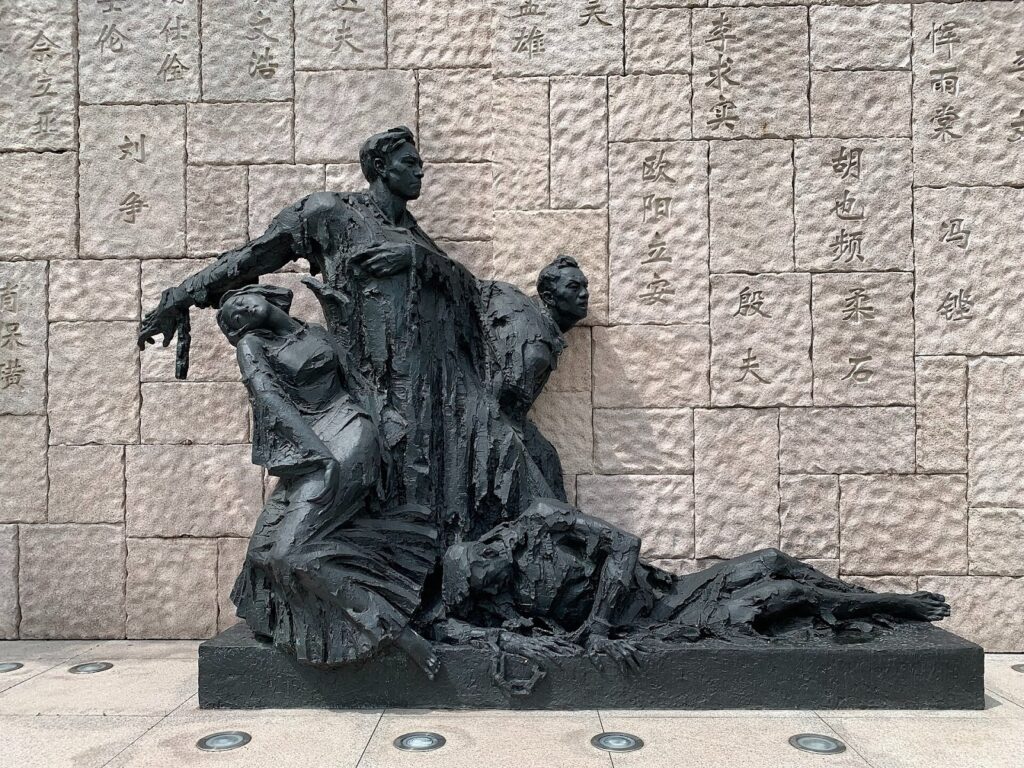
A bronze at Shanghai’s Longhua Martyrs Cemetery commemorates the sacrifices of previous generations for the Communist Party cause. One name on the wall behind is that of Ouyang Li’an (1914 – February 7, 1931), a native of Changsha, Hunan, who was arrested at a Party meeting in Shanghai and shot at Longhua at the age of 17 — the youngest of those executed. IMAGE: Wikimedia Commons. 

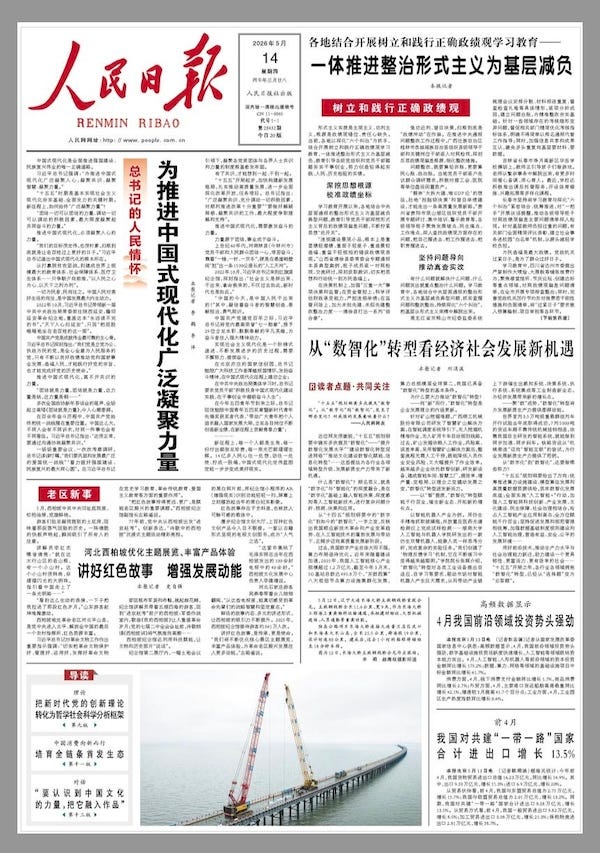
Across China on Sunday, the People’s Daily reported this week, “cadres and the masses” traveled not to family graves but to revolutionary sites, martyrs’ cemeteries, and red heritage zones, where they “drew on the strength of faith” and “carried forward the spirit of martyrs.” The piece was republished across Party-state media, including on the website of CCTV, China’s official state broadcaster.

The Ministry of National Defense website carried its own Qingming special, publishing a report from China National Defense News that dispatched reporters to sites along the route of the Communist Party’s much-mythologized “Long March” (1934–35), a trek during which they retreated to escape Nationalist forces under Chiang Kai-shek (蔣介石). The journey across rugged terrain has since been enshrined as a core founding myth of the Party’s rise to power. In Huining, in western Gansu province, at the point where three Red Army columns are said to have converged to mark the march’s end in 1936, tens of thousands of students across seven sites filed into formation and took oaths via livestream. 

In perhaps the most vivid illustration of the interbraiding of Party legacy and family obligation, the China National Defense News piece told the story of a Hubei family that had tended the grave of an unnamed Red Army soldier for five generations. The family had handed this volunteer tradition down from father to son since 1936, the paper reported. 

To the critical eye, such a story seems too good to be true, a perfect patrilineal line binding successive generations in an unbroken chain of duty. True or not, the license with which such details are delivered in the Party-run press has become an annual Qingming tradition in China, a ritual of displacement in which private and poignant commemorations of the dead are substituted with political mythmaking. 

For eight decades now, such propaganda has been inseverable from China’s Tomb Sweeping tradition. 

Revolutionary Ancestries

In April 1949, months before the PRC was formally proclaimed, the People’s Daily reported that Baoding, a city in Hebei province just southwest of Beijing, had organized public gatherings to commemorate the saints of the revolution during Qingming. Thousands reportedly attended the ceremonies, in which local officials pledged to carry forward the “unfinished work of the martyrs.” 

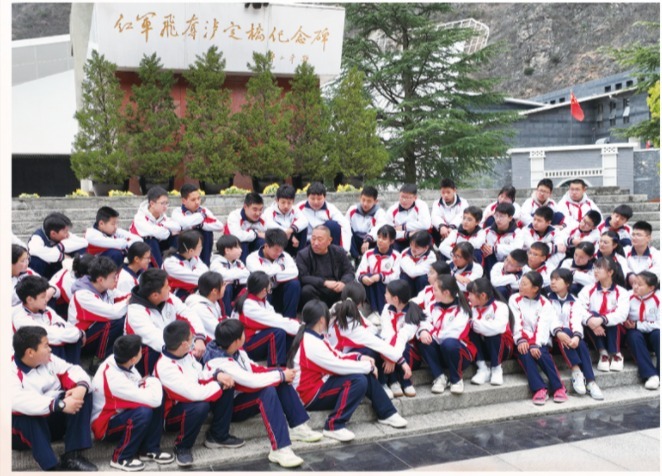
At the monument to the Red Army’s capture of Luding Bridge, a veteran is shown recounting Long March stories to students. Photo by Sun Junjie, China National Defense News.

By 1964, the People’s Daily reported that an estimated 50,000 people had visited graves at Babaoshan Revolutionary Cemetery in Beijing alone, and that Young Pioneers — in a historical echo of ceremonies this past week — had held induction ceremonies at the feet of martyrs’ tombs in cities from Nanjing to Guangzhou. The report even noted that more than 10,000 people in Fushun had swept the grave of Lei Feng (雷锋) — the model soldier whose martyrdom had been manufactured by propaganda teams just the year before.

The only significant interruption to the march of martyr celebrations on Tomb Sweeping Day came in 1976, as the Gang of Four, the radical clique that dominated Chinese politics in the waning years of the Mao era, dismissed Qingming as “a ghost festival.” The day was to be rooted out as a superstitious example of Mao’s “Four Olds” — outdated ideas, culture, customs, and habits. That year, according to an account published in the People’s Daily two years later, a young bulldozer driver named Han Zhixiong (韩志雄) had been arrested by plainclothes police for mourning the death of Premier Zhou Enlai (周恩来) and posting a satirical essay at the Monument to the People’s Heroes in the center of Tiananmen Square. Han was imprisoned for more than a year along with other conscientious mourners, but by November 1978 had been rehabilitated.

By April 1981, the Gang of Four tried and convicted and the historical resolution just two months away that would criticize the Cultural Revolution as an “error comprehensive in magnitude and protracted in duration,” the People’s Daily was again running Qingming coverage. Far from being an outmoded and superstitious tradition, the day was again a celebration of martyrs past that pointed the way to the Party’s enduring future. 

The Cultural Revolution had only interrupted what had already, by all official accounts, become tradition. In Qingming that year, 750 Young Pioneers from a Beijing primary school gathered before the Monument to the People’s Heroes. Beneath a national flag “undulating in the wind,” they recited in unison a poem called “Treading in the Footsteps of the Revolutionary Martyrs,” and inducted 37 new members into the mass organization intended to bear the Party’s legacy of rule into the future like the “blazing red flags” they held aloft. 

Interviewed by the People’s Daily, the head teacher from Shuncheng Street No. 1 Primary School was quoted as saying that Qingming remembrance of revolutionary martyrs was “our school’s longstanding tradition.” Just a few short decades after intimate tributes to the family had been supplanted in public life by grandiose gestures to the revolutionary heroes, things had always been this way. 

A Prize Against the Odds

Over the weekend, the results of the seventh edition of the Journalists Home News Prize (记者的家新闻奖), a grassroots journalism awards initiative that has been affectionately called “China’s Pulitzers” (中国普利策), were published through the WeChat public account of veteran investigative journalist Liu Hu (刘虎). The release is remarkable considering Liu’s circumstances just a few short weeks earlier.

On February 1, public security officers in the western city of Chengdu detained both Liu and his colleague Wu Yingjiao (巫英蛟) as they were traveling separately — Liu en route to Beijing, and Wu in Hebei. The next day, Chengdu police formally announced that the journalists each faced criminal charges of false accusation (诬告陷害罪) and illegal business operations (非法经营罪) stemming from a report on WeChat alleging that local officials in Sichuan had broken a previous agreement with investors in a construction project, seizing control of the assets.

The police actions triggered a wave of public attention in China — and a countervailing wave of online censorship. China Digital Times reported that 21 articles dealing with the case were added to its deleted-content archive in the five days following the detentions, nearly double the total number of deleted articles added to CDT’s archive on all topics in December last year. The detentions backfired, as one blogger predicted they would. Writing in a post that was subsequently deleted, Xu Peng (徐鹏) observed that few people had actually read Liu’s article before it was taken down — but that the arrests had spread awareness of the case “at home and abroad,” leaving officials with a mess of their own making. “In the end, public opinion spiraled far beyond their control,” Xu wrote, “and the whole plan backfired.”

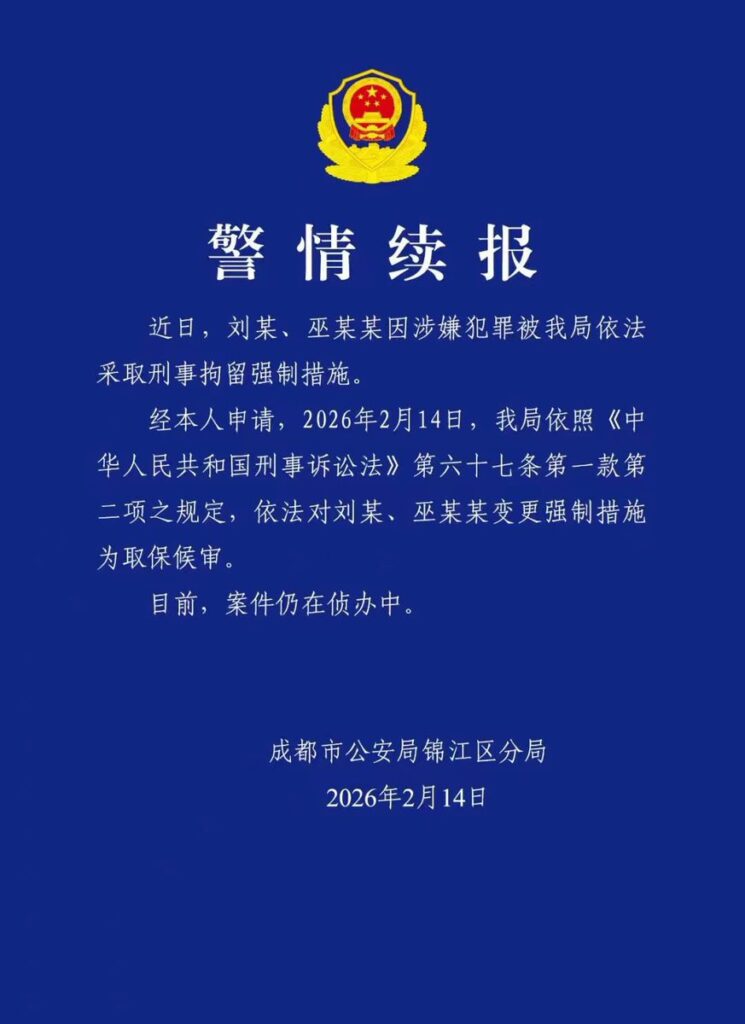
Liu Hu and Wu Yingjiao were released on bail on February 16, just two weeks before the prize results appeared. “I believe everyone will welcome this ‘follow-up police report,’” wrote rights defense lawyer Pu Zhiqiang (浦志强) on social media. “Best wishes to you both: get some proper rest and have a good New Year.”

SOURCE: Pu Zhiqiang on X.

This recent brush with the authorities was not Liu Hu’s first. He had previously been detained in 2013 on defamation charges after publicly naming officials he accused of corruption; those charges were eventually dropped.

It was against that backdrop that Liu launched the Journalists Home News Prize in 2019, reviving a name with deep roots in Chinese journalism. “Journalists Home” (记者的家) began as a BBS forum in 2000, a gathering place for reporters during an era of relative openness, when forms of journalism like investigative reporting were flourishing in a relative sense. The prize started with four categories, a public service award added in 2021. Now in its seventh year, it has become what one longtime participant called “possibly the best cross-platform journalism prize on the Chinese mainland.”

That the seventh edition appeared at all — published after delays caused by what Liu described only as ‘an unmentionable mishap’ (不可描述的意外) — is a reminder of the tug-and-pull that persists in China’s media environment, where idealistic professionals can actively seek out space for their work despite immense risks. This year’s jury added four additional commendations beyond the original slate, citing an unusually strong field — an expansion requiring an additional 50,000 yuan in prize money. Southern Weekly (南方周末), a commercial newspaper under Guangdong’s CCP-run Nanfang Daily Group, and the independent WeChat-based platform Aquarius Era (水瓶纪元) emerged as the strongest performers across categories, each taking two prizes.

The nonfiction grand prize went to Luo Ting (罗婷) for “Rape in the Bridal Chamber” (婚房里的强奸案), published in April 2025 in “Everyday People” (每日人物), a WeChat public account run by People (人物) magazine under Beijing Boya Tianxia Media Culture Development, a company majority owned by entrepreneur Rong Bo (荣波) . The piece reconstructed an engagement rape case in Shanxi province, tracing not only the assault itself but the months of family negotiation and legal maneuvering that followed. The story exposed what the jury described as “the brutal landscape of China’s county-town marriage market.”

The public service grand prize recognized Xie Chan’s (谢婵) return to Wuhan on the fifth anniversary of the COVID-19 lockdown, published by Aquarius Era. The report revisited journalists, artists, volunteers and ordinary citizens to recover recollections of the early chaos and grassroots mutual aid — memories the jury described as filling a gap in the collective memory of a national disaster.

The major social event reporting prize went to Han Qian (韩谦) of Southern Weekly for a multi-year series (archived) on the practice of residential surveillance at a designated location (指定居所监视居住), or RSDL, a legally defined but widely criticized form of residential surveillance that critics say has been systematically abused as a tool of extrajudicial interrogation. Han’s reporting helped transform an arcane legal debate into a public issue and was credited with contributing pressure that preceded new regulations jointly issued by the Supreme Procuratorate — China’s top prosecutorial authority — and the Ministry of Public Security.

i
Residential Surveillance at a Designated Location (RSDL)
指定居所监视居住

Residential Surveillance at a Designated Location (RSDL) is a form of pre-trial detention authorized under Article 73 of China’s Criminal Procedure Law, as amended in 2012. It allows authorities to detain a suspect for up to six months at a location of the police’s choosing — typically a hotel, guesthouse, or other non-official facility — without disclosing that location to the suspect’s family or lawyer.

Although technically classified as a non-custodial measure weaker than formal arrest, RSDL functions in practice as incommunicado detention. Key features include:

  • Detention for up to six months without formal charges
  • No requirement to disclose the detention location, particularly in cases involving alleged national security offenses
  • Severely restricted or denied access to legal counsel
  • No meaningful judicial oversight or review

Between 2013 and 2020, an estimated 57,000 people were held under RSDL, with usage peaking in 2020 at a 136 percent increase over the previous year. UN human rights experts have concluded that RSDL, as applied, constitutes a form of enforced disappearance and may amount to torture or cruel, inhuman, or degrading treatment. It has been disproportionately used against journalists, lawyers, and human rights defenders. In June 2025, China’s Supreme Procuratorate and Ministry of Public Security jointly issued new regulations intended to curb RSDL abuses, including stricter approval requirements and mandatory prosecutorial oversight — reforms legal experts have welcomed while noting significant gaps remain.

Source: International Service for Human Rights

The outstanding media professional grand prize honored Zhou Zhimin (周智敏), a senior reporter at Shanghai Television (上海广播电视台), for a 24-minute video investigation into a school dormitory fire in Henan province that killed 13 primary school students in January 2024. Though authorities had quickly promised a public accounting, 16 months passed in silence. Zhou’s report, published in December 2025, pushed the story back into the spotlight, and within nine days the investigation results were released through Xinhua and CCTV, with the related trial opened to the public. Shanghai Television is the broadcast arm of the municipal-level Shanghai Media Group (SMG), run by the local CCP leadership through the Shanghai State-owned Assets Supervision and Administration Commission.

The best commentary prize recognized Peng Yuanwen (彭远文), a former CCTV producer, for more than thirty articles arguing for higher rural pension benefits — a campaign the jury said had helped build momentum toward what is now a growing policy consensus on one of China’s most urgent social questions.

One key lesson to emerge from these latest awards is that the efforts of Chinese journalists — even at state-run outlets, which accounted for half the prizes awarded — must not be overlooked. The awards and the work they recognize, which have appeared despite intense pressure at every level of China’s media control system, are a testament to that persistence.

A Self-Serving Global Survey

A report released by Chinese state media on December 29 claims that the unwieldy official phrase for the governing ideology of the country’s top leader, Xi Jinping, has won “high recognition from the international community.” The assertion is absurd on its face. But lest this ruse pass unchallenged — however transparent it may seem — it’s worth being explicit about why.

Conducted by the Global Times Research Institute, a Chinese Communist Party-run think-tank directly under the state-run Global Times newspaper (under the CCP’s flagship People’s Daily), the “2025 Global Survey on Impression and Understanding of China” (2025年中国国际形象全球调查报告) claims to have surveyed approximately 51,700 people across 46 countries from August to October 2025. The survey was heavily promoted in China’s state media nationwide, with a related readout from the official newswire Xinhua circulated extensively. It was also shared across social media by Chinese official accounts, including the Facebook account of the office of China’s Ministry of Foreign Affairs in Hong Kong.

According to follow-up reports by the Global Times and other state media, the survey “selected some important concepts from Xi Jinping Thought on Socialism with Chinese Characteristics for a New Era” (习近平新时代中国特色社会主义思想), and asked foreign respondents for their opinions. Nearly 80 percent reportedly endorsed “building a community with a shared future for mankind” (构建人类命运共同体) and the even more mystifying “lucid waters and lush mountains are invaluable assets” (绿水青山就是金山银山), the Global Times reports. More than 70 percent approve of “comprehensively governing the party with strict discipline” (全面从严治党), “comprehensive deepening of reform” (全面深化改革), and “putting people at the center” (以人民为中心) — all concepts highly specific to the CCP political context and likely to draw blank stares from all but specialists in PRC political discourse.

How did the Global Times survey team manage to obtain such positive general feedback on what are decidedly political obscurities?

Reports from state media explicitly state that the survey “introduced” certain policies before soliciting opinions, suggesting the possibility — a certainty once you understand how propaganda works in China — that they were explained in positive terms before the survey questions were dropped. The report also claims that 39 percent of respondents favor China over the United States (which polls at 26 percent), a finding that runs counter most independent international polling on China.

How people in 24 countries view the U.S. and China

How people in 24 countries view the U.S. and China

% who have a favorable opinion of …

China
U.S.
Diff
Note: Statistically significant differences shown in bold.
Source: Spring 2025 Global Attitudes Survey, Pew Research Center.

The Global Times promotes the survey as having sparked “heated discussion among Chinese and foreign scholars” (中外学者热议). A follow-up report by the newspaper features interviews with figures including former Egyptian Prime Minister Essam Sharaf and Pakistani scholar Muhammad Asif Noor, who offer effusive praise for Xi Jinping Thought and China’s global role.

Yet despite this entirely unregarded storm in the Party’s own teapot, the full text of the survey — including its complete methodology, question wording, and raw data — has not been released. In English, only a smattering of related news briefs and videos, all stemming from the Global Times, are available.

The problem should be painfully obvious. These phrases are virtually unknown outside China, and even inside China are poorly understood by most ordinary Chinese. “Xi Jinping Thought on Socialism with Chinese Characteristics for a New Era” is a 19-character ideological construct that most people globally could not pronounce, much less define. The wave of reports about the as-yet-unreleased survey provide no evidence that respondents had any inkling they were evaluating components of this ideology, or that they understood what these concepts actually mean in Chinese political discourse.

The real story here is not what the survey reveals about global opinion on China and its governing ideology. Rather, it is what the survey demonstrates about how state-run media and organizations in the country use polling to give a patina of legitimacy to the pre-cooked propaganda of the Chinese leadership. Sometimes even the patently obvious needs to be stated explicitly.

Xi Jinping’s Global Quartet

The front page of today’s People’s Daily announces the publication of a major policy article by Chinese leader Xi Jinping (习近平) in the party’s flagship theoretical journal Qiushi (求是), bundling together what the party now characterizes as “Four Great Global Initiatives” (四大全球倡议) — a quartet of related solutions for international challenges. The article, titled “Promoting Implementation of the Global Development Initiative, Global Security Initiative, Global Civilization Initiative, and Global Governance Initiative,” collects Xi’s statements from September 2021 to September 2025, organizing them around his concept of a “community of shared future for mankind” (人类命运共同体).

The piece is meant to synthesize China’s response to what the party characterizes as four critical “deficits” (赤字) facing the world. These are: the “peace deficit” (和平赤字); the “development deficit” (发展赤字); the “security deficit” (安全赤字); and the “governance deficit” (治理赤字).

Xi’s Four Great Global Initiatives
四大全球倡议
Global Development Initiative Development Deficit
全球发展倡议发展赤字
Emphasizes “inclusive” economic globalization with six core principles, including development prioritization, people-centered approaches, and harmony between humanity and nature. Positions the Belt and Road Initiative as a practical vehicle for achieving these goals.
Global Security Initiative Security Deficit
全球安全倡议安全赤字
Promotes “common, comprehensive, cooperative and sustainable security” while rejecting countries “pursuing their own so-called absolute security”—a clear reference to U.S. security policy. Advocates for a security framework based on cooperation rather than zero-sum competition.
Global Civilization Initiative Peace Deficit
全球文明倡议和平赤字
Emphasizes respecting “diversity of world civilizations”—an implicit challenge to universal values that promotes China’s concept of “common values for all humanity.” This formula emphasizes the power of the nation state over citizens, with the “rights” of countries and their systems taking precedence over individual rights.
Global Governance Initiative Governance Deficit
全球治理倡议治理赤字
Confronts what Beijing portrays as threats from “Cold War mentality, hegemonism, and protectionism” — coded language for U.S. policies. Argues that global governance has reached a crossroads, with the implication that the world must turn in China’s direction.

This suite of global initiatives, the People’s Daily read-out today says, is China’s effort “to resolve the above deficits and promote the building of a better world” (破解上述赤字, 推动建设一个更加美好的世界). This framing positions Xi as a responsible and responsive global leader offering comprehensive solutions to international challenges. In this equation, the Belt and Road Initiative (一带一路), lionized during Xi’s first and second terms, is subordinated as a practical vehicle for these loftier aspirations.

The bundling of Xi’s “Four Great” initiatives has gathered pace particularly since late August and early September, taking the stage during the annual summit of the Shanghai Cooperation Organization (SCO). The push to promote the concepts has redoubled this month with a crucial CCP plenum next week and the upcoming 80th anniversary of the founding of the United Nations. The quartet signals Xi’s effort to consolidate his standing with both domestic party elites and the international community.

The People’s Daily read-out hailing the Qiushi article referred to this year “an important moment to remember history and create the future together” (铭记历史、共创未来的重要时刻). And the central idea here is that Xi Jinping is claiming this crossroads for China under the rule of the CCP.

Page 6 of the overseas edition of the CCP’s People’s Daily on October 13, a huge feature on China’s role in founding the UN (erasing the ROC from the story).

In recent weeks, before and through the grand military parade held in Beijing on September 3, state media have promoted a revisionist view of history in which China — meaning the current People’s Republic of China under the leadership of the party — played the most decisive role in the founding of the United Nations. Among these efforts, a large feature story in the overseas edition of the People’s Daily on Monday focused on China’s “immense contributions” to the founding of the UN, with framing that completely erased the role of the Republic of China (ROC) — the current name for Taiwan. The feature story showcased materials from the first session of the UN General Assembly now kept in Chongqing, the wartime capital of the ROC.

When it comes to China’s gaze on the future as glimpsed in Xi’s Qiushi article, there is an implicit but unmistakable message about the values of the West as failing to be “inclusive” (包容). Language about the Global Civilization Initiative (GCI) speaks of respecting “diversity of world civilizations” (世界文明多样性), an implicit challenge to the notion of universal values that promotes China’s own concept of “common values for all humanity” (全人类共同价值). While those may sound superficially similar, China’s formula emphasizes the power of the nation state over citizens and communities — the “rights” of countries and their systems taking precedence over individual rights.

Another clear message between the lines is about the United States as an irresponsible force. The Global Governance Initiative (GGI) directly confronts what the party portrays as threats from “Cold War mentality, hegemonism, and protectionism” (冷战思维、霸权主义、保护主义) — barely coded language that is a clear reference US policies. The article argues that while the UN emerged from the “painful lessons” (痛定思痛) of two world wars 80 years ago, “the world has entered a new period of turbulence and transformation, and global governance has reached a new crossroads” (世界进入新的动荡变革期,全球治理走到新的十字路口).

The underlying message is unmistakable: Standing at this crossroads, the world must turn in the direction of China.

Historical Revisions on Parade

For the Chinese leadership, the 80th anniversary of the country’s victory in the War of Resistance Against Japan in World War II is a major milestone — an opportunity to signal the power of the ruling Chinese Communist Party to people at home, and the country’s global ambitions to audiences abroad. These goals were on full display during the ritualized pageantry of the military parade yesterday in Beijing, attended by Russian leader Vladimir Putin and North Korean dictator Kim Jong Un.

Preparations for the celebrations, coinciding with this week’s Tianjin meeting of the Shanghai Cooperation Organization (SCO), an event that has sparked lively discussion and speculation about whether or not we are witnessing a fundamental shift in the world order, were months in the making. In recent days, the logistical preparations have brought the center of the capital to a literal standstill.

But in the days ahead of this week’s parade of high-tech weaponry, ideological moves of equal or greater importance have prepared the way for the CCP’s new historical consensus. This view rewrites the history of global war and peace to firm up the narrative of China’s centrality. It was the CCP, the story goes, that decisively won the war for Asia and for the world.

Backbone Narratives

On Sunday, the China Youth Daily, an official newspaper under the Chinese Communist Youth League (CCYL), ran an article by Shi Quanwei (史全伟), a research fellow at the Party History and Literature Research Institute of the CCP Central Committee. Shi argued the CCP had been the “backbone” (中流砥柱) of the entire nation’s resistance during the War of Resistance Against Japan. Furthermore, Shi says it was the united front leadership, guerrilla warfare tactics, and exemplary governance of the CCP that made it crucial to China’s wartime resistance.

“The experience of three revolutions, especially the War of Resistance, has given us and the Chinese people this confidence,” he wrote. “Without the efforts of the Communist Party, without Communists serving as the backbone of the Chinese people, China’s independence and liberation would have been impossible.”

Just as the celebrations yesterday invited talk of the conspicuous sidelining of the United States as a global leader — and by extension what state media like to call the “US-led West”(美西方) — reconstructed narratives made much of the historically inflated importance of the US in the global conflict 80 years ago. 

Quoting from several global talking heads, the government-run China Daily pressed the point that the attack on Pearl Harbor in 1941, the quintessential inflection point in American narratives of fascist resistance, had been given too central a role in the broader global story — as had the role of the United States in the Pacific theater. Instead, it was the CCP that had led the decisive grassroots resistance years before the belated American entry. As the descendant of one Soviet pilot was quoted as saying, glossing over the role of Republican forces in China at the time: “China’s resistance war was already underway before the Pearl Harbor incident. Chinese forces long tied down Japanese military strength and manpower, preventing them from extending their influence to the Pacific and the entire Far East region at that time.”

This wave of writing and commentary on WWII history was promoted through traditional state-run outlets and new social media accounts all through August. According to these pieces, the emphasis on the US role had for decades overshadowed, or inexcusably sidelined, China’s role in the global conflict.

On August 16, an article appeared on WeChat that claimed American academia had deliberately downplayed China’s role — which was to say, the role of the CCP. In recent years, the author wrote, the geopolitical rivalry between China and the US had led American historians to overlook China’s role in the Pacific theater, “fully exposing the United States’ political manipulation of history to gain political advantage.” 

A man identified as a descendant of a World War II-era Soviet fighter pilot praises China’s central role in the Pacific theater, accusing the US of broad historical revisionism.

That argument, of course, has many flaws — not least the absurd assumption that US historians (like Chinese ones?) are an organized and geopolitically-motivated force, lacking professional integrity and unable to distinguish between the present-day People’s Republic of China (PRC) and the Republic of China (ROC). This latter was China’s recognized government during World War II.

But the nature of the messenger in this and many other instances of historical redrafting in recent weeks is perhaps more telling than the substance. The author of this piece, “How Has American WWII Historical Research ‘Drifted’?,” was a scholar from the American Academy (美国研究所), a unit within the China Institute of Contemporary International Relations (中国现代国际关系研究院) — a front organization operated by the Ministry of State Security (MSS) and charged with engaging with foreign scholars.

And what of the outlet that published this piece — a drop in the wave of efforts to re-center China at the expense of the truth? It is a website launched in 2021 called “China’s Diplomacy in the New Era” (习近平外交思想和新时代中国外交), an outlet under the China International Communications Group (中国外文出版发行事业局), or CICG. The office, which masquerades as a press group, operates scores of online outlets including such government sites as China.com.cn, and has been tasked by Xi Jinping as a key vehicle for the CCP’s international communication. CICG’s parent is the Central Propaganda Department of the CCP Central Committee. 

The social media account of “China’s Diplomacy in the New Era” — whose Chinese moniker bears the name of Xi Jinping himself — has been pushing a variety of articles on World War II in recent weeks. These mostly re-interpret the conflict through the lens of current geopolitics, colored with familiar state narratives, including contemporary Chinese claims to sovereignty in the South China Sea.

As the soldiers, tanks, missiles and drones goose-stepped and rolled along Chang’an Avenue on Wednesday, and Vladimir Putin had his smiling moment with Xi Jinping, some might have felt a sense of America sliding out of contemporary relevance. But behind the physical demonstrations of military might and the cementing of partnerships, there was an insistent narrative effort on all fronts to re-position China — and by extension, the CCP — at the center of the global historical narrative. For the leadership’s vision of a “new type of international relations,” nudging American leadership out of contemporary geopolitics is only half the battle; ensuring that it slips out of the history books may be equally important.

China Issues Approved News Source List

Earlier this month, China’s top control body for the internet and social media released its updated list of approved internet news information sources, a roster of outlets first issued a decade ago to curtail the sharing of articles and news reports by unauthorized sources — those without close Chinese Communist Party (CCP) and government ties. The publication of the list starting in 2015 was part of a general tightening of control over news and information in the early Xi Jinping era, as the internet and social media came to dominate news consumption.

The 2025 list from the Cyberspace Administration of China (CAC), issued on August 14, includes 1,456 government-run media outlets whose content can be legally republished by other websites and news platforms — a carefully selected group that is meant to establish the CCP’s dominance over news content in China. All digital media platforms are forbidden from republishing news stories that originate from sources not included on the approved roster, including international media as well as public accounts on major platforms like WeChat and Weibo.

CAC Approved News Sources List

CAC Approved News Sources List (2021-2025)

Category 2021 2025 Change Growth Rate
Total Sources 1,358 1,456 +98 +7.2%
Central Level 286 286 0 0%
Provincial Level 992 1,074 +82 +8.3%
Government Platforms 80 96 +16 +20.0%
Source: Cyberspace Administration of China

The Cyberspace Administration of China (CAC) first introduced the system in 2015 as part of broader internet governance reforms under Xi that include the formation of the CAC as a powerful control and oversight body for cyberspace. The inaugural “Source List” included Caixin, a professional news outlet founded in 2009 by the highly-respected editor Hu Shuli (胡舒立), but the list was further tightened during the second iteration in 2021, at which time Caixin was removed. The 2021 list contained 1,358 approved sources, nearly four times the number in the 2016 list of just 340. These changes reflected the addition of official government accounts within the country’s expanding digital news ecosystem.

The CAC explained that the 2021 update followed three priorities: “adds a group” of trusted sources adhering to correct political orientation, “verifies a group” to update closures and name changes from institutional reforms, and “eliminates a group” of units with “poor regular performance” or lacking influence.

While the overall list grew by just 7.2 percent between this year and 2021 — from 1,358 to 1,456 sources — the distribution of this growth tells a more complex story about Beijing’s information control strategy. Central-level sources remained unchanged at 286 units, suggesting authorities consider the media structure at the national level to be complete. Provincial-level sources, meanwhile, expanded by 8.3 percent (from 992 to 1,074), reflecting efforts to strengthen regional information control infrastructure. This mirrors the trend since 2018 of encouraging the development of local and regional communication hubs, including the creation of “international communication centers” (国际传播中心), or ICCs, which are meant to enhance CCP messaging globally by leveraging provincial, city and county-level media resources.

Government platform sources showed the most dramatic growth at 20 percent, jumping from 80 to 96 units. Among the new additions are several municipal government social media platforms, including the official WeChat accounts of Shenzhen Municipal Government and Chengdu City Administration, reflecting a push in recent years to centralize local news creation by government agencies while adapting to social media-driven information consumption.

The CAC warned that websites not adhering strictly to the approved source list “will be punished according to law and regulations.”

From Mao to MAGA

The Cultural Revolution is barely mentioned in modern China, yet it has never been more relevant. While scholars have long pointed to the excesses of Maoism as a parallel for Xi Jinping’s authoritarian leadership, they have also spotted echoes in the chaotic populist forces Donald Trump has conjured up within American democracy. As early as 2017, China scholar Geremie Barmé tied the two men together for their desire to take a wrecking ball to an old order, “throwing the world into confusion.” The first 100 days of Trump’s second term have only made this similarity starker.

For insights into the Cultural Revolution and how its ripples are felt today, we sat down with Tania Branigan, a leader writer at The Guardian and author of Red Memory: Living, Remembering and Forgetting China’s Cultural Revolution, a gripping account of that tumultuous decade that in 2023 was winner of McGill University’s Cundill History Prize. In a recent article, Branigan, who previously served as The Guardian’s China correspondent for seven years, drew her own parallels between MAGA and the Cultural Revolution.

Alex Colville: How did your idea come about for a book exploring the Cultural Revolution as remembered in modern China? 

Tania Branigan: It just became increasingly apparent to me that all the things that I was looking at in modern day China linked back to that time. The key moment for me was going to lunch with Bill Bishop, who writes the excellent Sinocism newsletter. He started telling me about this trip he had made with his wife to try and find the body of his wife’s father, who was a victim of the Cultural Revolution. When they got to this village where he’d been held by Red Guards, the villagers were nice about it and remembered her father, but they were completely nonplussed by the idea that one might go looking for his body. They asked how they were supposed to know where it was, because there were so many of them. There was something about this story that I found hard to shake, showing how immediate and commonplace the Cultural Revolution still was. 

As a journalist you do a story, then move on. But although I was writing about different things, be it economics, culture, politics, I kept feeling that actually the key to all these things really lay in what happened in the 60s. 

AC: Can you elaborate? 

TB: Economically, the country’s turn towards reform and opening up was both necessary and possible because of the Cultural Revolution, because it so thoroughly discredited Maoism. Allowing individual entrepreneurialism was quite a pragmatic response to what to do with these millions of young people flooding back into cities [after being sent down to the countryside and forced to stay there during the Cultural Revolution]. They didn’t have the education to compete with the newer students coming out. 

If you want to understand the arts in China, and this extraordinary explosion of creativity that occurred [starting in the 1980s] it came from that destruction, and that vacuum, that hunger just for any kind of artistic or cultural expression beyond the dreaded 800 million people watching just eight model operas

Politically you could certainly argue for Xi Jinping’s tight control being a response to the Cultural Revolution. If you look back to his relatively early years in officialdom, around the time of the Tiananmen Square massacre in 1989 he spoke about the Cultural Revolution as “big democracy” (大民主), and said it was a source of “major chaos” (大动乱). So given his experiences, I don’t think it’s a stretch to see that need for tight control as being intimately linked to his experiences of the Cultural Revolution.

A public struggle session during China’s Cultural Revolution (1966-1976). Villagers gather before a banner with revolutionary slogans as accused “class enemies” are subjected to public criticism. These mass denunciations targeted those labeled as “cow demons and snake spirits” – a revolutionary term used to dehumanize perceived opponents of Mao’s political campaign. Source: Wikimedia Commons

AC: Do you think there’s anything in particular we in the West often fail to understand about the Cultural Revolution? 

TB: There’s still this idea that it was just young people running wild. What that fails to grasp is that they were able to do that because they’d had certain ideas inculcated by Mao. It wasn’t just his personality cult, it was also about creating paranoia, about Mao’s attempt to safeguard and strengthen his power and his legacy. Young people were only able to act really with his instigation, and for as long as he permitted them to do that. The reason why the Cultural Revolution had this stultifying, stagnated second half [1968-1976] was only because Mao eventually decided he’d had enough.

I think the other thing is that while the Cultural Revolution could only happen in that time and place, I think ultimately, it’s about what human nature is capable of under certain circumstances and with certain encouragement. Which is why it matters to all of us.

AC: Yes, we’ve been seeing a lot of people in the media comparing this political moment in the US to the Cultural Revolution. I don’t know what you think about that. 

TB: I think the comparison of Trump and Mao is a really powerful one. It’s obviously a point that people made even back in 2016, but it’s a point that has become more and more resonant as we see Trump move into a second term. He’s more revolutionary in his tactics, very much in the same way Mao moved into a stage of more disruptive and extreme power with the Cultural Revolution, no longer constrained by people around him in the way that he was earlier. 

While there are a lot of strongmen around the world, most of them have a fairly rigid form of discipline and control. What’s really Mao-esque about Trump is that he relishes disruption and chaos, and he sees opportunities in it in a way that Mao did. Trump’s able to tap into the public id and use emotion in politics, he has that ability to channel people’s emotions against institutions for his own political interests. 

The attack on the US Capitol on January 6, 2021, involved Trump trying to incite the masses to violence in order to retain power, in a way that has echoes to the Cultural Revolution. Source: Wikimedia Commons

A venomous mindset was, in a sense, key to the Cultural Revolution, it was all about the weaponization of division and hatred. When I was writing the book one thing that struck me was that Mao had to say, “Who are our enemies? Who are our friends?” And reading Adam Serwer [Staff Writer at The Atlantic, who argues that demonizing parts of American society is a calculated power play by Trump], for example, talking about Trump and the fact that cruelty is the purpose, it struck me that the parallel for Trump is it’s always them and us, in or out, and he draws those lines so strictly. By drawing those lines, he strengthens his power. You can pick a whole host more comparisons, like Trump installing himself as chair of the Kennedy Center, attacks on culture through libraries and so forth.

What’s really Mao-esque about Trump is that he relishes 

disruption and chaos, and he sees opportunities 

in it in a way that Mao did.

It’s obviously not a repetition, nobody’s suggesting that two million people are going to be killed in the US. It’s a fundamentally different context, in a system where you have checks and balances. Trump was elected, Trump can be removed. But I suppose the lesson that we should take from it is that many people around Mao did not fully realize what he was planning until it was too late.

AC: I have concerns about comparing this moment to the Cultural Revolution because I don’t think you can disentangle that term from public displays of violence, and the ensuing generational trauma you unpack in your book. There are many different historical moments that have had similar strains of tribalism, nationalism and populism to it. Doesn’t it make people more scared if you point to the Cultural Revolution specifically? 

TB: I sometimes felt in China that the Cultural Revolution was the Chinese equivalent of Godwin’s law, that all the arguments on the internet [in the West] end up with somebody being compared to Hitler. So, you know, the Cultural Revolution can be very easily invoked on relatively flimsy grounds. So I completely understand why people are concerned or feel the comparisons are inappropriate. But I have to say quite a few intellectuals in China have now made the comparison themselves. I think it’s Trump’s ruthlessness, that disruptive chaotic quality [he has]. That the turmoil is not a byproduct of Trump’s ambition, but is actually intrinsic to it and something he draws power from. 

Again, it’s absolutely not about saying this is a repeat of the Cultural Revolution. It’s about how the Cultural Revolution can help us better understand the present moment. [This is possible] even in a system with elections, entrenched checks and balances. This is a really astonishing and disturbing political moment, with possibilities that I don’t think we fully understand yet. There is something about the parallels to the Cultural Revolution that are very striking. It’s interesting to me that so many people now have drawn this comparison, including scholars of the Cultural Revolution such as Michel Bonnin, Geremie Barmé drew it quite early on [in 2017]. 

AC: So how do you think the Cultural Revolution can help us understand the present moment? 

TB: By seeing the way that emotion is weaponized. By understanding that, particularly for Republicans, if you fail to challenge now, there comes a point where you cannot do so. I suspect quite a few Republicans have already concluded that that point has been reached. I would hope that more people on the right are alert to what we’re seeing now in terms of the administration’s conception of executive power, and the scope that it’s been given by the Supreme Court. It’s less about understanding as it is about responding.   

AC: I wonder if the Cultural Revolution has a place as a parallel for China today. I lived there all the way through the zero-Covid policy (2020-2022), and there were certain moments in that final year where I thought this political system which gave birth to the Cultural Revolution can still be taken to extremes in certain areas, especially when power is concentrated in one man and people are scared for themselves, that same paranoia you mentioned earlier. Obviously, this is not a level of violence whereby two million people ended up being killed. But at the same time, there was a sense in 2022 these policies were becoming as dangerous as the virus itself. There is also collective amnesia around the zero-Covid policy and the damage it wrought. 

TB: It’s interesting how many people in China made that comparison. And I think that’s partly because Covid was the ultimate expression that the Party has reasserted very tight control over the last ten years. There was this sense that the Party had partially retreated, from large areas of cultural life or private life or business life. Certainly [during Covid], people spoke to me about being quizzed by neighborhood committees about where they’d been, who they’d been with, all these things that, to young Chinese people would have been unthinkable under normal circumstances. At that point there was this mindset that we [the Party] can now determine what you do. The fact that you had people going into people’s homes and dragging them out, for some people clearly did evoke strong memories of the Cultural Revolution. 

Minor protests against the zero-Covid policy in 2022 were dealt with harshly. An artist who wrote out the sentence “I’ve already been numb for three years” on Covid testing booths in Beijing was removed from his home by police and placed in prison until the end of the policy, 108 days later. Source: Nanyang Business Daily

But with regard to the amnesia around zero-COVID, I have to say one thing the pandemic here [in the UK] has shown me is that people don’t like remembering bad things, and this accounts for a lot of the silence around the Cultural Revolution. We’ve just had the fifth anniversary of the pandemic in the UK. It had this huge impact on people’s lives, but it’s barely mentioned.  

AC: Yes, usually the media publishes articles to commemorate anniversaries of major events, but I haven’t seen many for Covid. 

TB: Yeah, one thing that I did find when writing the book is that I thought it was going to be a book about political control of memory. It obviously is about that, but what surprised me was how important personal trauma was in silencing the Cultural Revolution. 

AC: So I think we could generalize this last question: what happens if a society tries to move on from a form of collective trauma, but does not try to remember it. 

TB: I think it can’t understand itself, and I think it’s much more vulnerable. Both to repetition, not an exact repetition because China today is clearly a very, very different nation from the China of 1966. As we’ve just discussed, you can’t see the Cultural Revolution transplanted outside China, or in time either. But I think the other thing is that people can’t understand the profound scars it leaves behind. And that was for me why it was really important to speak to psychotherapists [whose private conversations with individuals has probed the inherited trauma that often stems from events that happened in the Cultural Revolution]. But also just talking to people for the book, the level of the trauma was still evident. There are small things on a personal level, such as Wang Xilin [an interviewee in Branigan’s book who was forced to take part in multiple show trials where he was beaten so hard it left him deaf] talking about how when a friend calls out his name on the street he jumps. Because it takes him back to that experience of waiting at a struggle session for his name to be called as the next victim. 

But I think on a much deeper, more profound level, the way people are unable to trust. You’ve had a generation who were taught that you could not trust at all. It’s not that you couldn’t trust strangers, you can’t trust those around you. Again, it was a psychotherapist who said to me, you know, that afterwards you might talk about it to a stranger on the train, but you’d never talk about it to someone in your workplace, you might not even speak about it within your family. So I think that fracturing of the bonds of trust is something so profound that still hasn’t been addressed. The fear of speaking out. The idea that speech itself, being open with people, is fundamentally dangerous. One survivor of the Cultural Revolution told Arthur Kleinman he tried to be bland like rice in a meal, “taking on the flavor of its surroundings while giving off no flavor of its own,” that was the safest thing to be. One of the psychotherapists said to me they increasingly admired people just for surviving.