In recent weeks and months, China has made artificial intelligence a centerpiece not just of its domestic economic development planning, but also of its global influence strategy. But rarely has its vision of AI been so vivid as on the front page of yesterday’s edition of the official People’s Daily newspaper.
Just below the masthead in the Monday edition of the paper, a bright red column title announced the solicitude of the country’s top leader, Xi Jinping, and claimed substantive victories where it matters to everyone: “The General Secretary’s Concern and Its Echoes on the Ground” (总书记的关切,落地的回响).
But as is far more rarely seen, this header was displayed across a pair of vertical columns of nearly identical design, in near-perfect symmetry. On the left, a headline and profile declaring the benefits that China’s AI policies have had for all Chinese at home. On the right, a headline and profile making the case for the immense contributions China’s leadership says it is making, and plans to make, toward global development of AI — in ways that selflessly benefit the entire world, and especially the Global South.
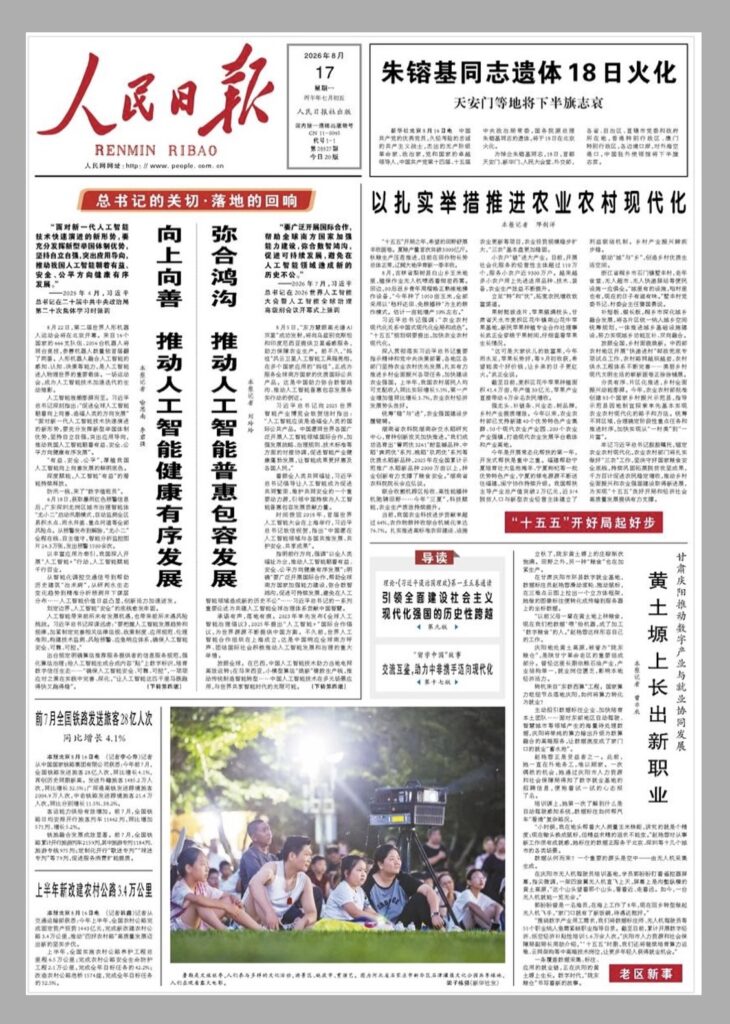
The unusual column design, with its carefully conceived symmetry — a propaganda appropriation of the traditional parallel saying, or duilian (对联) — is meant no doubt to be a powerful parallelism announcing the Chinese Communist Party leadership’s twin convictions on artificial intelligence, for the country and for the world. The joint column is a claim to the internal and external legitimacy of China’s approach to AI, with the conviction that the technology will shape social, cultural, and political life in the 21st century.
What concrete message does this parallelism convey?
Domestically, on the left, the first article, “Striving for Excellence and Goodness,” is about Xi Jinping’s conviction to “promote the healthy and orderly development of China’s artificial intelligence in a way that is beneficial, safe, and equitable.” You will not be placed in danger, it says, by this emerging and rapidly changing technology. Rather, we — the CCP leadership — will guarantee that development will be beneficial (有益), safe (安全) and equitable (公平) for all Chinese.
Internationally, on the right, the second article, “Bridging the Gap,” is about a cooperative global approach to AI development, ensuring that the advancements led by China as an AI powerhouse become human advancements shared by all, particularly those in the less developed Global South.
This point builds on Xi’s remarks at the opening ceremony of the 2026 World Artificial Intelligence Conference in Shanghai back in July, which are printed right across the top of the article: “We must actively pursue international cooperation to help countries in the Global South strengthen their capacity-building efforts, bridge the digital and technological divide, promote sustainable development, and prevent the creation of new historical injustices in the field of artificial intelligence.”
In both cases, these enlightened approaches and attitudes — for that is how they are presented — arise from uniquely “Chinese wisdom” (中国智慧), and from a superior political system (the not-so-subtly implied message) that emphasizes national, coordinated leadership (发挥新型举国体制优势) over short-term, zero-sum calculations.
This pitch carries political costs that remain largely hidden from view, not least within China’s emphasis on state power over the agency of citizens. The community backlash against AI data centers unfolding across the United States, in the UK, in Germany and elsewhere is not something we are likely to see in China, where AI futures are a promise from on high, not a conversation boiling up from below.
But the proposition in yesterday’s People’s Daily is clear enough. When it comes to AI development, the CCP is offering fairness, balance, order, and that most duplicitous of promised goods: harmony.