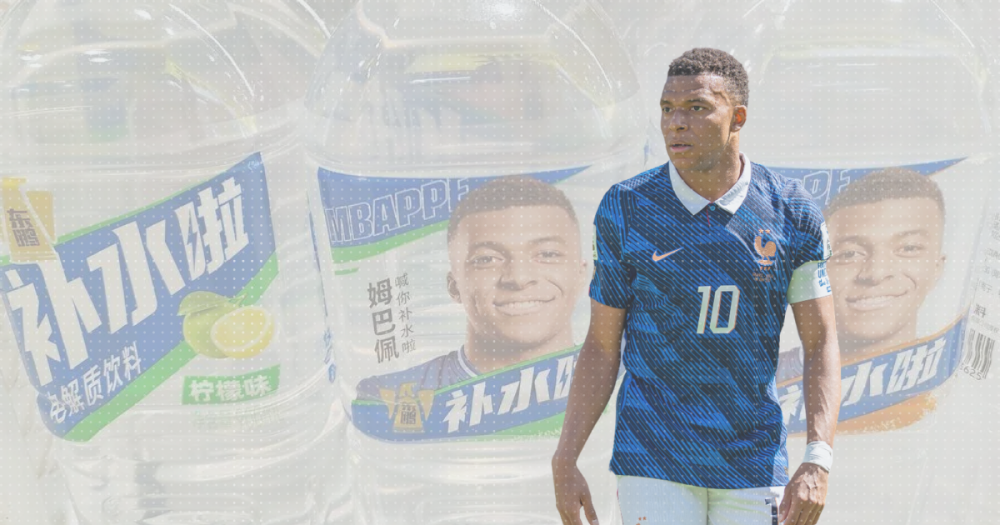
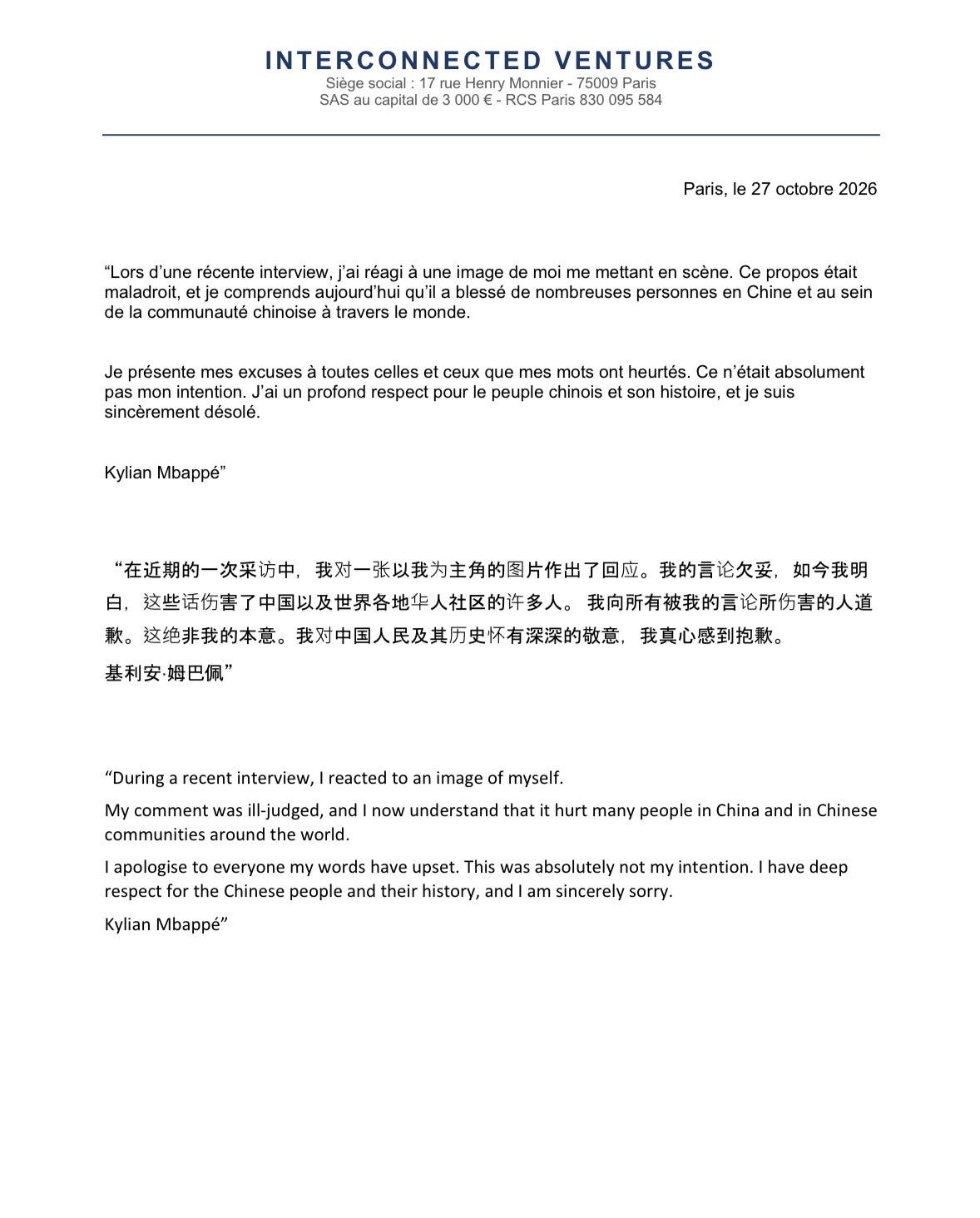
This week, French football superstar Kylian Mbappé issued a statement apologizing for indirectly referring to the former Chinese leader Mao Zedong as a “dictator” during an interview on a French podcast. “My comment was ill-judged,” Mbappé said after the scandal became one of the most-discussed topics on the Chinese internet and prompted several Chinese brands to drop him. “I now understand that it hurt many people in China and in Chinese communities around the world,” he said.
At first glance, Mbappe’s China scandal may seem to offer well-worn lessons about intercultural sensitivity, national pride, and the pitfalls of global celebrity and the unguarded comment. But the incident also invites closer scrutiny of the unique sensitivities of the Chinese Communist Party and its marshalling of outrage for domestic political objectives. The telling phrase at the center of this controversy is hinted at in the footballer’s own terms of apology, conveyed in Chinese, English and French over social media: “hurt many people in China.”
Who exactly was hurt? And why?
While Mbappe’s words may appear as natural expressions of remorse, they in fact mirror a key Chinese foreign policy phrase that first emerged in the Mao Zedong era from the late 1950s through the 1970s — the very period, and person, China’s recent wave of displeasure has rushed to defend. That phrase, “hurting the feelings of the Chinese people” (伤害中国人民感情), clearly references not the grievances of conscientious Chinese citizens but those of the Party itself, which co-opts and manipulates the collective voice.
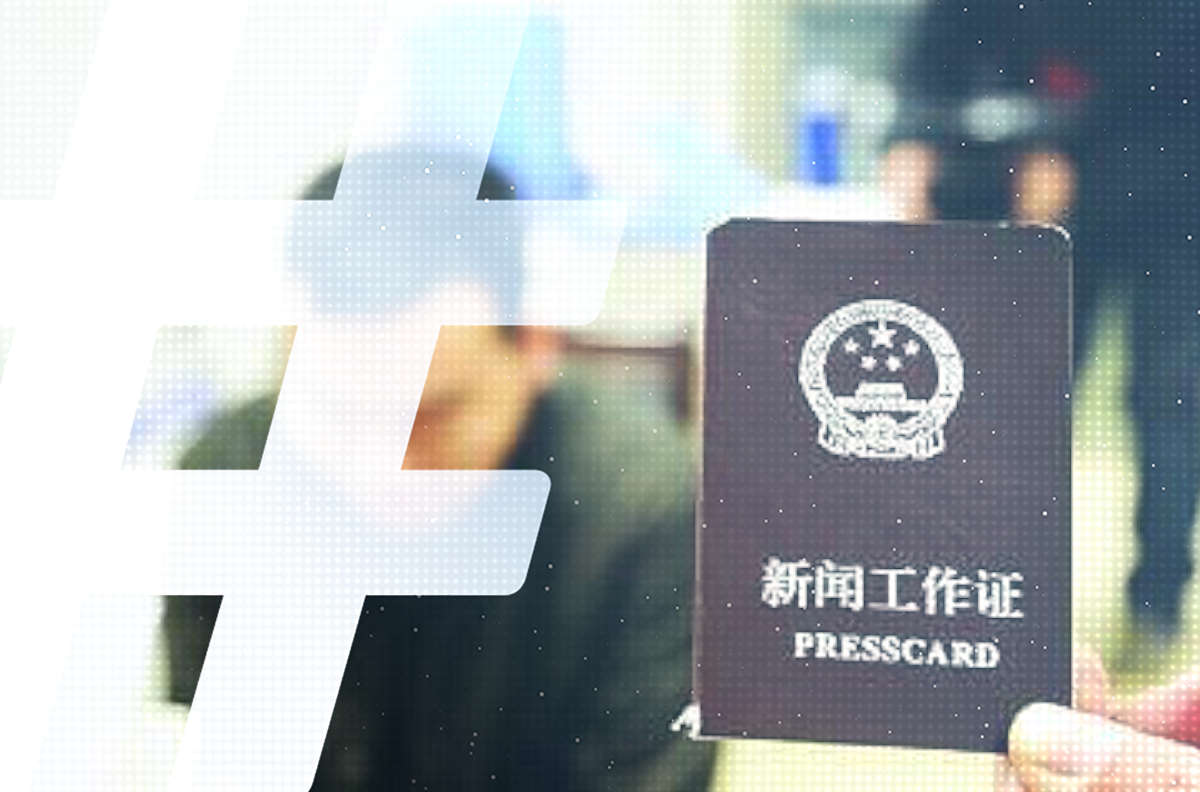
After 1978, the phrase, which first surfaced in 1959 in the People’s Daily in reference to India, became a fixture of official discourse — always referring to the protests of the leadership. In a study by the China Media Project ten years ago, published soon after the phrase appeared in a forced televised confession by Swedish activist Peter Dahlin, we noted more than 140 articles using the phrase through 2015. The most frequent offender in that sample was Japan, which faced 51 accusations of having “hurt the feelings of the Chinese people.”
In the CMP study, the United States distantly trailed Japan historically, faced with 35 accusations from China over “hurt feelings.” One instance followed President Barack Obama’s July 2011 White House visit with the Dalai Lama, Tibet’s exiled spiritual leader. Foreign Ministry spokesperson Ma Zhaoxu (马朝旭) said during a press conference that the incident had “hurt the feelings of the Chinese people.” Given the extreme sensitivities surrounding the Dalai Lama inside China, however, the visit never appeared on Chinese state television. Nor did it gain traction online, where “Dalai Lama” was on the list of prohibited words on the popular Weibo platform.
The same strange vacuum yawns at the center of this latest controversy. Chinese people — real Chinese people — may understand that there has been a kerfuffle, and that Mbappé has been dropped by Chinese brands. But without access to foreign sources or a VPN, they are most likely at a complete loss as to what exactly was said. Consider a commentary about the football player’s “flop” (翻车) posted by the official People’s Daily Online on October 28, day three of the incident. It refers to Mbappé’s “improper China-related remarks,” but never once mentions Mao Zedong or the word “dictator.”

“Mbappé’s remarks have seriously hurt me, and yet I have no idea what he said. I hate him to death, and yet I don’t know why. I don’t even care about football. Damn it, I’m a Leonard fan. But hate I must, and so the hatred comes pouring down from every side.”
Click 伦纳德 in the screenshot for a note on “Leonard.”
NBA star Kawhi Leonard. The poster is a basketball fan, not a football fan.

“He said Tang Guoqiang is an art student. Only a discourse system like ours could produce a metaphor like this.”
Together, the two references mean Mbappé called Mao a dictator. Click 唐国强 and 美术生 in the screenshot for notes.
The actor best known for playing Mao Zedong, used here as a stand-in for Mao himself.
Online slang for Hitler, a failed painter.
In fact, the Mbappé controversy bears many of the hallmarks of a homegrown political storm — one that started blowing from the top of the government and the official state media.
The Anatomy of Political Offense
Until this week, Mbappé enjoyed millions of followers on Chinese social media, and was a clear favorite of Chinese football fans. The footballer even had a fond nickname, “Guigui” (龟龟), or “little turtle.” Did Mbappé really and truly disappoint these fans?
The sequence of events offers some clues. The offending clip, in which Mbappé told an interviewer on the French podcast The Bridge that his favorite meme was an image pasting his face onto a photo of “a Chinese dictator,” surfaced on October 26, posted online by the program as unaired backstage footage from an episode aired months before. Inside China, the controversy seems to have started with the privately-owned online football fan app Dongqiudi (懂球帝), which according to one Chinese report, “broke the news that Mbappé had said something he shouldn’t have in an interview with foreign media.” In fact, the erasure of all reference to Mao or to dictators appears to have originated also with Dongqiudi, which said in its original October 26 post that Mbappe’s remarks “cannot be translated” (不能进行翻译), “owing to the hurt they have done to China and to the Chinese people.”
In the wake of the Dongqiudi post, China Central Television moved quickly, likely playing a crucial role in escalating the controversy. That night, within hours of the clip surfacing, it pulled all La Liga matches and Mbappé-related ads. The broadcaster sent a letter in the name of its chief to La Liga demanding that Mbappé and Real Madrid apologize publicly and submit a written apology. A follow-up statement the next day, again in the name of the CCTV leadership, insisted there would be no further discussion of La Liga broadcasts in China without such an apology. CCTV’s director, it should be noted, is Shen Haixiong (慎海雄), who is also a deputy head of the CCP’s powerful Central Propaganda Department.
Neither of the above-mentioned letters made any mention of Mao Zedong or of the objectionable word “dictator,” and referred only to the “seriously negative China-related remarks” Mbappé had allegedly made.
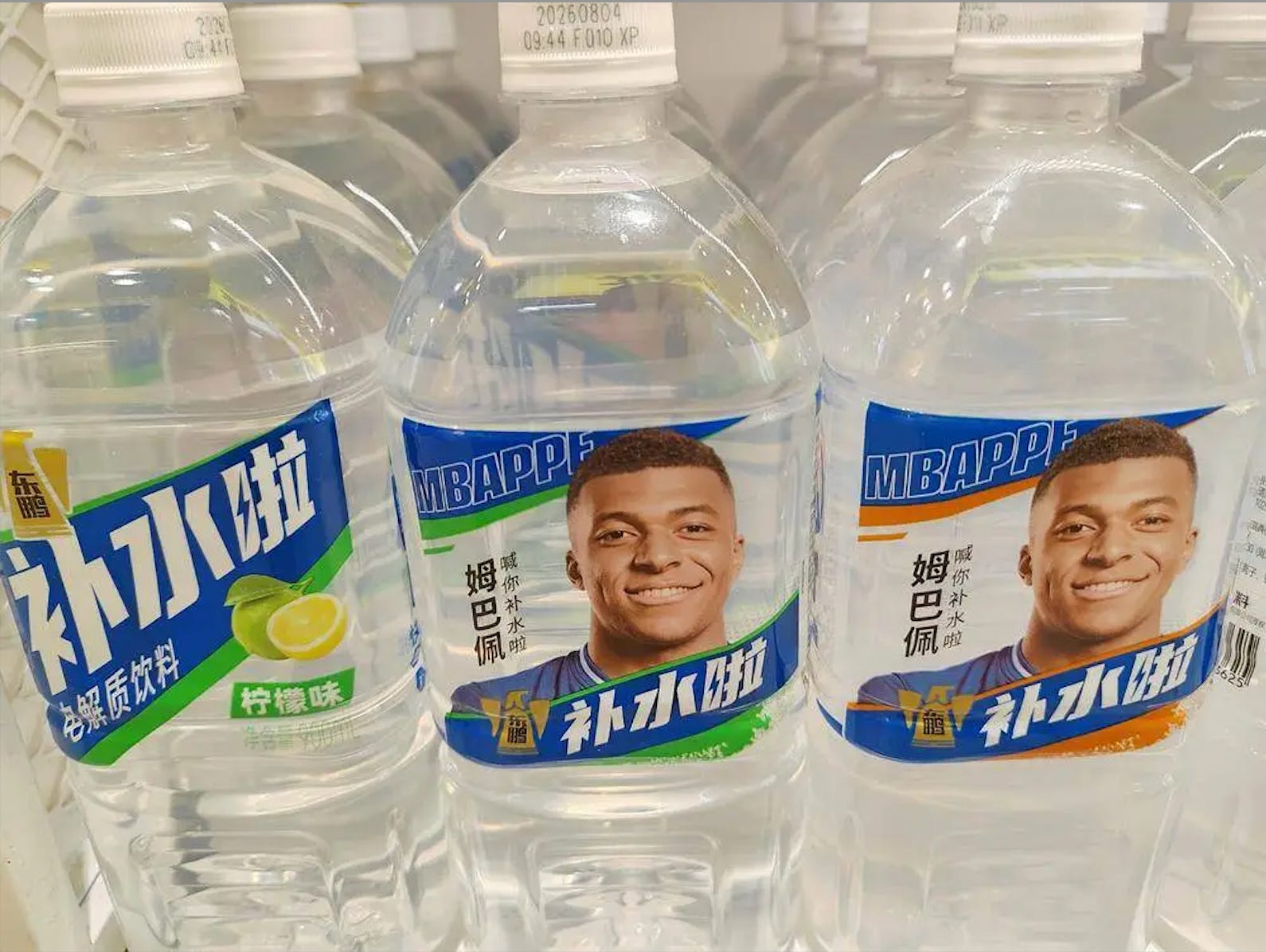
On October 27, the day after the clip surfaced, “hurting the feelings of the Chinese people” quickly came to frame the controversy in comments from the government, the Chinese Football Association and Chinese brands. At his regular press briefing, Foreign Ministry spokesperson Guo Jiakun (郭嘉昆) told reporters that words and actions that “hurt the feelings of the Chinese people” would be met with a boycott by all sectors of Chinese society. Brands and corporations including dairy giant Mengniu (蒙牛) and beverage maker Eastroc (东鹏饮料) issued their own condemnations and cancelled partnerships.
Mbappe’s apology came that evening, in French, English and Chinese. “I apologize to everyone my words have upset,” his statement read. “This was absolutely not my intention. I have deep respect for the Chinese people and their history, and I am sincerely sorry.”
The storm, however, continued to blow from the heights. Later that night, the Chinese Football Association said it had lodged “solemn representations” with Real Madrid, declaring that it “firmly opposes any remarks that hurt the feelings of the Chinese people.”
Offside at the Plenum?
Why would Chinese media choose to draw so much attention to a comment its citizenry can’t even access? The answer might lie in the particularly sensitive political moment in which it occurred. October 26 — the day Dongqiudi fired the first shot at Mbappé — was the first day of the CCP Central Committee’s four-day plenary session, or Fifth Plenum (五中全会), a closed-door meeting of top Party leadership that focused on Party governance and discipline.
The 90th anniversary of the “victory” of the Long March, the CCP retreat during the Chinese Civil War that consolidated Mao’s leadership, is also playing a central role in the CCP’s reframing of its legitimacy as the Fifth Plenum is held in Beijing, and as it readies for the crucial 21st National Congress next year — ahead of which questions about possible leadership succession are already mounting. The leadership has emphasized national Long March commemorations through new tourism initiatives as well as the production of a slate of new documentaries, feature films and TV dramas for both domestic and international audiences. A front page People’s Daily piece by Ren Zhongping (任仲平), a pen name for the paper’s commentary department, about the importance of Party governance and loyalty to the country’s success, was also published the same day the controversy happened. Framed through the narrative of the “New Long March,” (新长征) the 7,000-character commentary draws a direct line from Mao’s leadership of the Communist Party all the way through to Xi Jinping and to the country’s future success and prosperity.
People’s Daily, October 16, 2026, original text
Uphold and strengthen the Party’s overall leadership, resolutely safeguard the authority and centralized, unified leadership of the Party Central Committee, firmly support the “Two Establishes,” and resolutely achieve the “Two Safeguards.”
The victory of the Long March was a victory of the Party’s leadership.
Comrade Mao Zedong pointed out: “Who brought the Long March to victory? The Communist Party. Without the Communist Party, a long march of this kind would have been inconceivable.”
The Zunyi Conference, held during the Long March, in fact established Comrade Mao Zedong’s leadership position in the Party Central Committee and the Red Army, began to establish the leading position in the Party Central Committee of the correct Marxist line represented chiefly by Comrade Mao Zedong, and began to form the Party’s first-generation central leadership collective with Comrade Mao Zedong at its core.
This was the most important guarantee that our Party and the revolutionary cause could turn danger into safety and continually open up new prospects.
First raised in 2018 and elevated by the CCP’s November 2021 historical resolution, the phrase establishes Xi Jinping as the Party’s unquestionable “core” leader, and his ideas as the bedrock of the “New Era.” At base, it is a claim to the legitimacy of Xi’s rule.
Read the CMP Dictionary entry →The pledge to safeguard Xi Jinping’s status as “core” of the Central Committee and the whole Party, and to safeguard the Central Committee’s authority and centralized, unified leadership. Paired with the “Two Establishes,” it makes protecting Xi’s position a chief task of the Party.
Read more at CMP →Whatever calculations were being made in the corridors of power, or in the studio at CCTV, it is far from clear where on the spectrum of emotions ordinary Chinese actually were. Many, in fact, seemed entirely unsure what they were meant to feel — and why. A look at reactions on social media shines light on this dissonance: overwhelmingly, the emotion expressed online, more than hurt, has been confusion.
One exasperated Weibo user put it bluntly: “Mbappe’s words seriously hurt me, but I don’t know what he said; I hate him, but I don’t know why. I don’t even care about football.”


“So what did he actually say?”