During afternoon rush hour last Friday, a single-engine aircraft smashed into the upper floors of Beijing’s CITIC Tower, a glittering skyscraper towering above the city’s central business district. Footage and eyewitness accounts of the crash circulated rapidly on Chinese social media, including video of the aircraft breaking apart on impact, debris raining down on the street below. Just as swiftly, as local police cordoned off the area, these posts vanished, leaving in their wake a dense and deliberate official silence.
For nearly 22 hours, in an odd departure from the general practice of releasing an official news release, or tonggao (通稿), to set out the basic facts and direct subsequent media coverage, not a single report appeared from the country’s central state media. From the government’s Xinhua News Agency, the standard “authoritative” source of such reports — nothing. From China Central Television, the state broadcast network — nothing.
It was only late on Saturday that the first whisper of news came through official channels about this astonishing story unfolding just miles from the seat of power at Zhongnanhai. But even this notice was peripheral, a situation bulletin, or tongbao (通报), issued through an official social media account of Beijing’s Chaoyang District, where the CITIC Tower is located:
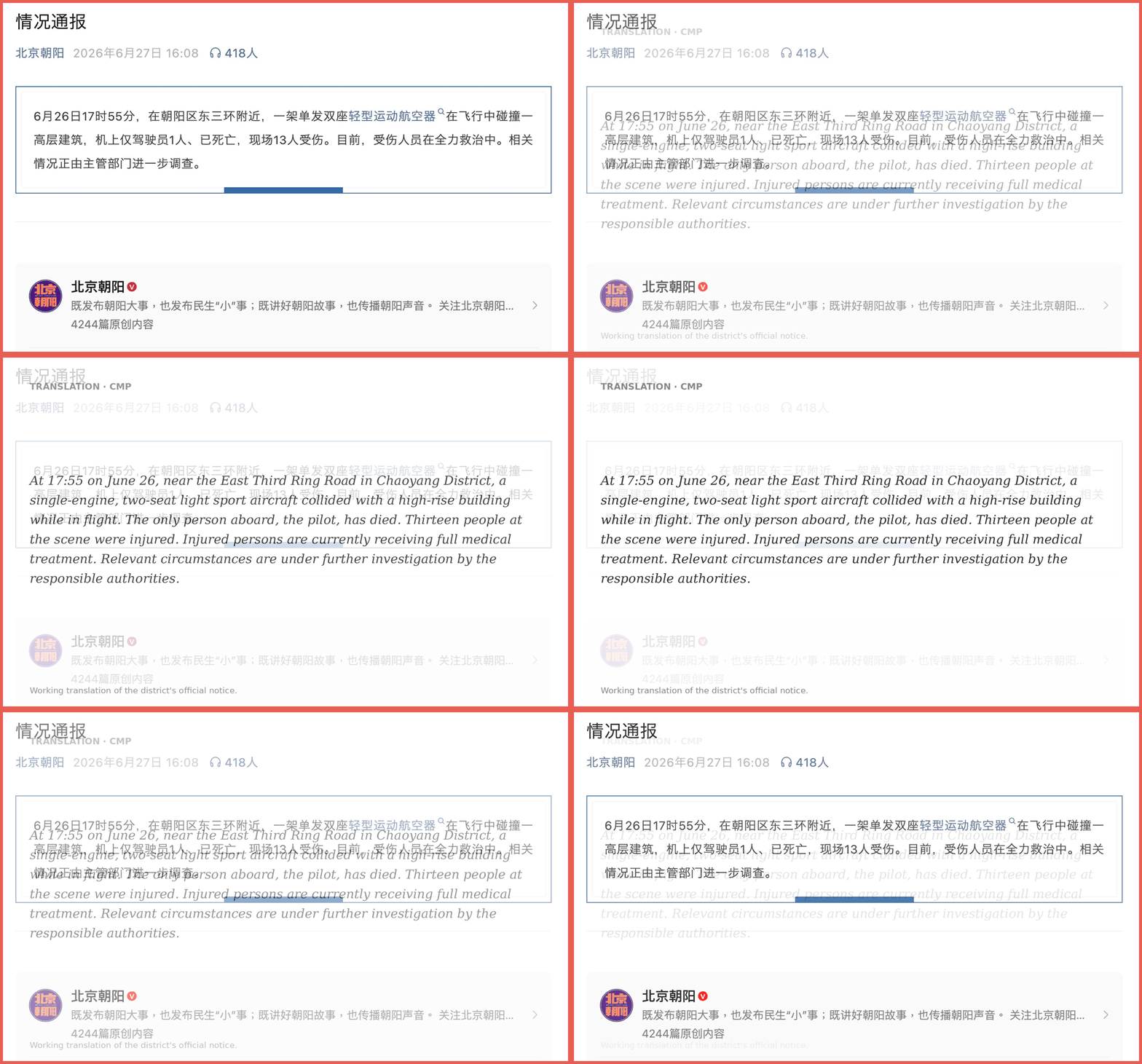
“Beijing Chaoyang” (北京朝阳) is the official information release platform of the local government in Chaoyang District, which covers much of the most vibrant central urban area in the capital, and is home to most of the city’s foreign embassies. But this “situation bulletin,” which in fact failed even to identify the iconic CITIC Tower, was not taken up — as a tonggao from Xinhua generally would be — by other state-run media and other websites across the country.
A search in the Wisers media database returns more than 1,400 Chinese-language results since Friday for the keywords “small plane” (小飞机) and “CITIC Tower” (中信大廈), including news media reports and social media posts. Just 10 of those recorded in the database appear on platforms inside China — WeChat, Zhihu and Weibo. And all of these posts have now been deleted from the platforms where they originally appeared.
An additional search for the key phrase “light sport aircraft” (轻型运动航空器), which appears as the description in the situation bulletin, returns again just 10 results, on platforms including Toutiao and Netease, a major online news portal, as well as Sputnik.cn, the Chinese-language portal of the Russian government-run Sputnik News. Versions of the story at Netease like this one, and at Toutiao like this one, were deleted over the weekend. Oddly, and probably owing to the “partnership without limits” between China and Russia, the Sputnik.cn version remains live. There are no results for major news outlets.

Our Wisers search confirms what we observed on Friday and through the weekend when searching for news coverage — any news coverage — of the collision in Beijing. There has been a total, or near total, information blackout.
Without historical context, we might imagine that such a vacuum is normal for a Chinese Communist Party leadership obsessed with the control of information and public opinion. Is this not simply how news censors behave in an authoritarian system?
In fact, far from being typical practice, the silence we are witnessing over the past week is the result of a thorough dismantling under Xi Jinping of a consensus on information policy that emerged in China’s leadership nearly two decades ago — namely, that complete information suppression is untenable owing to its potentially calamitous knock-on effects.
Balancing Control with Information Release
In the late 2000s — when Xi Jinping was a junior member of the top leadership — one of the clearest expressions of this consensus shift was the country’s Emergency Response Law (突发事件应对法), which took effect in November 2007. Understanding that local-level government and Party officials had a clear vested interest in keeping under wraps incidents that might impact their political performance, the law required government bodies handling “sudden-breaking incidents,” or tufa shijian (突发事件), to release information on its development and response in a “unified, accurate, and timely” manner.
The clearest impetus for the new law was the 2003 SARS epidemic, when cover-ups in Guangdong and Beijing let the virus spread for months before central authorities admitted its scale. The suppression was so damaging to China’s international standing that it was compared at the time to the Soviet Union’s handling of the April 1986 Chernobyl disaster, when a reactor at Ukraine’s Chernobyl Nuclear Power Plant exploded.
Without historical context, we might imagine that such a vacuum is normal for a Chinese Communist Party leadership obsessed with the control of information and public opinion. Is this not simply how news censors behave in an authoritarian system?
But another political shift, in 2008, further defined this evolving balance between control and information release. In the immediate aftermath of the catastrophic Sichuan earthquake on May 12 of that year, Chinese media, knowing that the demand for information would be unstoppable, had defied an initial central-level ban on reporting from the scene. It was a full week before press control authorities could reassert control over the narrative, and in the process they came to understand how essential it was that the public have access to at least basic information to ensure that information vacuums were not filled with rumors and hysteria.
The next month, in his first official speech on media policy, Hu Jintao offered a compromise of sorts. He urged authorities to “release authoritative information at the earliest moment” (第一时间发布权威信息), introducing a policy under which central media such as Xinhua would move quickly to report breaking stories, seizing the initiative in setting the public agenda rather than relying on suppression alone. CMP dubbed this policy at the time Control 2.0.

The idea that suppressed information could itself become dangerous even entered the political vocabulary of the moment in 2008. That spring, landslides had dammed rivers across the quake zone, forming unstable “barrier lakes,” or yansaihu (堰塞湖), which were a concern because their collapse might at any moment send floodwaters coursing through areas already devastated by the quake. During a training session in the weeks after the quake, then-Guangdong party secretary Wang Yang (汪洋) — who nearly a decade later would become the fourth-ranking member of the Party’s elite Politburo Standing Committee — warned cadres against building “language barrier lakes,” or yansaihu (言塞湖). Wang suggested that blocking the flow of public opinion resulted in the same kind of catastrophic pressure as a dammed river. The phrase was picked up widely in official media, including in a commentary in a Wuhan-based official CCP newspaper arguing that stemming such “language barrier lakes” required more scrutiny, not less, of local governance failures.
By the time Xi Jinping came to power in late 2012, there was already an emerging consensus about the need to ensure a definite level of information release on sudden-breaking incidents in order to avoid information vacuums that had the potential to destabilize — and in order to check local corruption and malfeasance.
Turning Back the Clock
What we are witnessing in the CITIC Tower case is the unfortunate result of more than a decade of reassertion of CCP control over the media, and the parallel rise of ever more effective and all-encompassing cyber controls.
As already indicated, there has been a complete lack of domestic media coverage, including from central state media, which ordinarily might be employed to set the agenda. This is not just a story about powerful restraints under Xi Jinping since 2013 on the capacity of Chinese media to pursue real reporting, as they did insistently on so many breaking news stories through the 2000s. It is also a story about how China’s leadership under Xi has turned back the clock on the Hu-era policy of strategic information release over outright suppression as a means of information control.
How can the leadership feel so self-assured in suppressing information outright without destabilizing information vacuums — or “language barrier lakes” — of the kind that spawned the SARS crisis? This likely has to do with another key aspect of this story, the apparent effectiveness of cyber controls.
For a similar case of effective social media blackout, we can look back to the Changfeng Hospital fire in April 2023, in which 29 people died when a fire broke out in a private hospital in Beijing’s Fengtai District. Despite the fact that the fire unfolded in the early afternoon in a populated urban district, it went unreported for almost eight hours. A follow-up report from Initium Media, translated by CMP, noted the astonishment of local reporters that such a serious sudden-breaking story had been so effectively suppressed, many not learning of it until an evening bulletin was released by Beijing Daily, the city’s official CCP outlet. There had of course been eyewitness video and accounts on social media, but these had been scrubbed within minutes of being posted, stopping wider information sharing in its tracks.
There has been a complete lack of domestic media coverage, including from central state media, which ordinarily might be employed to set the agenda.
Tellingly, a brief wave of media coverage followed the release of the Beijing Daily bulletin, which came alongside a press conference on the incident at which the deputy head of Beijing’s health department addressed the fire directly. The release, far more detailed than the “Beijing Chaoyang” situation bulletin on Saturday, informed follow-up reports by such outlets as China Newsweekly. And even when more robust controls on media coverage came down 24 hours later, the bulletin remained visible nationwide, re-published in media across the country, including at the news portal Netease.
The third aspect worthy of note in the CITIC Tower story is the complete reversion to local responsibility for news and information release, a growing trend in the Xi era that goes directly against the consensus emerging in the late 2000s — that rapid release is necessary, and that central state media should play a primary role.
We can see this local dynamic quite plainly in the latest whiff of information we have, released only yesterday, a full six days after the plane collided into the CITIC Tower.
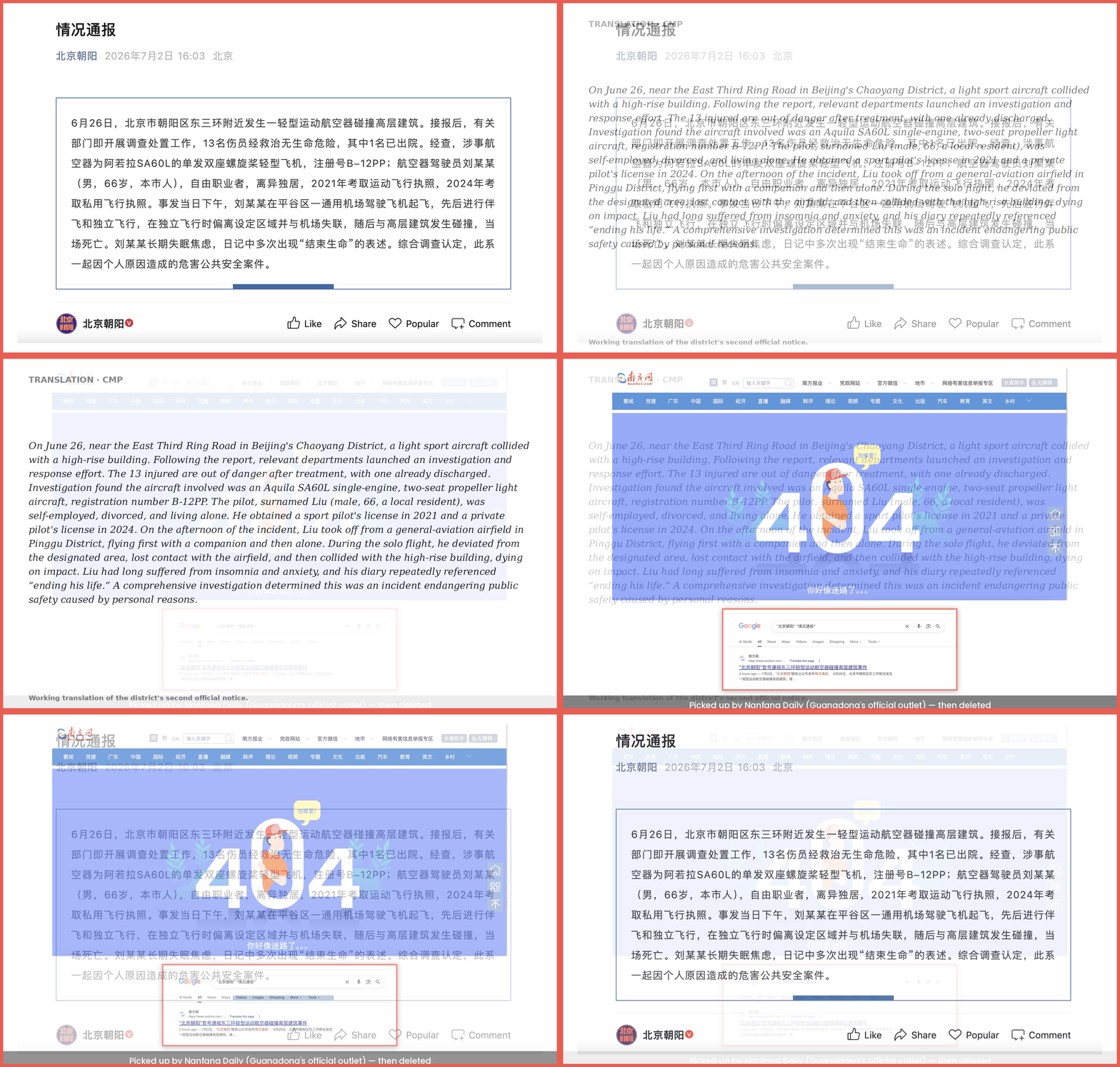
Released at 4:03 PM on Thursday, the second notice, again a “situation bulletin,” is once again from the social media account “Beijing Chaoyang.” This is the same local government information account for the district where the incident occurred. To reiterate the key point above, this information release is happening against the backdrop of a total vacuum at the top of China’s information hierarchy — nothing still from Xinhua, and nothing from other central-level media outlets.
The new bulletin supplies some additional details about last Friday’s incident, including the make and model of the plane — an Aquila SA60L, a single-engine, two-seat propeller light aircraft, with registration number B-12PP — and the age and surname of the pilot. On the pilot’s details, the bulletin seems eager to tie this story off with a personal explanation for what precipitated the dramatic events nearly a week ago. The pilot, a 66-year-old man surnamed Liu, was suffering from psychological problems, including chronic insomnia and anxiety. The bulletin even cites diary entries making repeated references to “ending his life.”
The bulletin’s last line amounts to a declaration that the story is over — nothing more to see here. “A comprehensive investigation determined that this was an incident endangering public safety caused by personal reasons,” it reads.
Bulletin? What Bulletin?
But the oddest thing of all, one week on from this bizarre incident unfolding in the heart of Beijing’s central business district, in full view of thousands, is how the second situation bulletin has been instantly secreted from the Chinese public. It appears nowhere on the websites, social media accounts, or news apps of major media outlets, and its circulation is again being curtailed across social media more broadly
Shortly after the bulletin appeared yesterday, some news media did attempt coverage. A news search turns up the link to a post relaying the news of the situation bulletin’s release that comes from Nanfang Daily (南方日报), the official CCP outlet in China’s southern Guangdong province. Click on the post and it is already gone, leaving a 404 message in its wake. Yangcheng Evening News, a commercial news outlet operated under the city of Guangzhou, also apparently attempted to post the situation bulletin, but the content is no longer available.
News of the bulletin in Chinese is everywhere today — but struggling to find any foothold in the headlines inside China. It appears across Hong Kong, Taiwan and Southeast Asia, in outlets like Ming Pao and Hong Kong Economic Times, in the Taiwan-based Yahoo! News, and nearly everywhere on Facebook and Threads, which are not accessible inside China.
There is one live re-post as of noon today on the fringe website Red Song Online (红歌会网), and there are scores of database mentions on Wisers for social media platforms like Weibo, where users sharing the situation bulletin seem to be doing so in their isolated cubicles, without comment or engagement by others. One Beijing-based user posted on Weibo just before noon, “Geez, flying a plane to off oneself?” This was a re-post with comment of a post from the official Weibo account of Beijing Daily, the aforementioned official CCP-run outlet in the capital, that reported the second “Beijing Chaoyang” bulletin verbatim. The Beijing Daily post seems to be driving what little mention the story has inside China. Tellingly, though, it had only just over 800 comments by early afternoon today — and reposts of it, like the one above, appear to have comments disabled entirely.
The strategy, it seems, is to leave people in social news isolation, with only the most limited facts required to declare “The End” on this story one full week after it unfolded.

To recap, the absence of the story in mainstream news outlets, outside the social account of Beijing Daily, is astounding. An online news search for Chinese outlets this afternoon turns up a solitary link for the news portal Sohu.com. A sliver of light, perhaps? Has a portal site found its way through the thicket of controls? But no, that online post too has been deleted, yielding the message: “Yikes! We can’t find the page you are looking for.”
Yikes, indeed. Or aiya! (哎呀) as the deletion notice is rendered in Chinese.
Aiya! The word offers perhaps the most cogent concluding remark on the significance and shock value of this instance of media and information control on a globally visible story unfolding at the very center of the capital city of the world’s second-largest economy. China has become an information dead zone, where journalists cannot report, where only county, district and city-level officials have the power to determine the facts and speak through their private digital megaphones — and where, incredibly, even those megaphones often cannot be heard by a public whose ears can be plugged at will.
Aiya! What does this information dead zone at the center of a global power mean for the rest of the world?