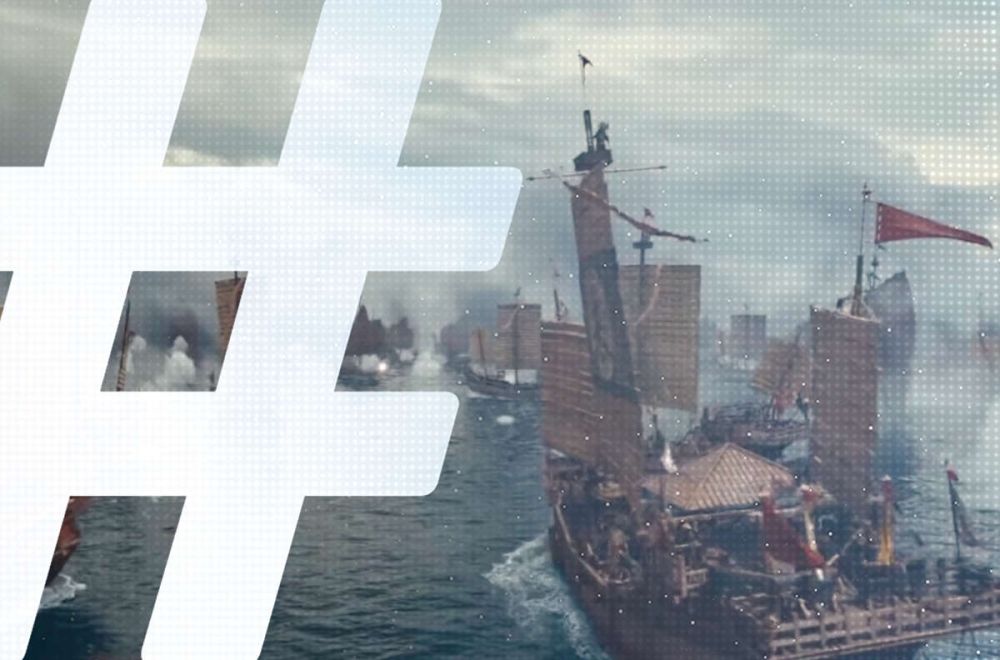
Scheduled for release over the past weekend, the Chinese action war film The Belief (澎湖海戰), a dramatic depiction of the 1683 Qing conquest of Taiwan, seemed on track to define a new and, for many, concerning genre — the “forced-unification blockbuster.” But the film, it appears, has run aground, its planned debut coming and going in silence.
Produced by a consortium of investors with a reported budget of 500 million yuan (about 70 million dollars), and backed by the state-owned Changchun Film Studio, The Belief centers on the 1683 naval battle at Penghu, an island 50 kilometers from the main island of present-day Taiwan, a country official policy in Beijing insists has been “an inalienable part of Chinese territory since ancient times.” The setting is the outset of the Qing dynasty (1644-1911), as Qing forces seek to defeat remnants of the Ming dynasty (1368-1644) holding out in Taiwan.
The allegorical connection to present-day tensions, which have resulted in persistent military exercises in the strait and containment of Taiwan internationally, is so plain it scarcely needs mentioning. The Chinese Communist Party (CCP) regards the island as unresolved business from a civil war fought in the 1940s with the Kuomintang, now one of several political parties in a democratic Taiwan.
The Belief has been heavily promoted by state media, including the CCP’s People’s Daily, since its first trailer dropped on October 25, 2025, the 80th anniversary of Taiwan’s “retrocession” from Japanese colonial rule at the end of World War II. An announcement on May 22 said it would be released on July 25. But the film, with its swashbuckling scenes of battles at sea, has so far not set sail — leading to speculation about what calculations China might be making.
And this is reportedly not the first delay the film has faced. According to BBC Chinese, it was already pulled from a planned Lunar New Year release back in February — prior to the May reschedule giving it the summer release date that passed on Saturday.
Media outside China have noted over the past week that the film’s official Weibo account has not been updated since June, and that the film remains unavailable on China’s domestic movie-ticketing website.
The film has stimulated heated discussion in the media in Taiwan, Hong Kong, and beyond. The Taipei Times noted in an editorial that the film’s tagline, “the unification of Taiwan is an unstoppable trend,” was lifted straight from a speech by Chinese President Xi Jinping.Storm Media quoted Liu Hsing-jen (劉性仁), an associate professor at Chinese Culture University’s Institute for National Development and Cross-Strait Studies, warning that the film’s marketing — casting a historical civil war as a clash of “us or them” — could send the international community the wrong signal that China was preparing for war, undercutting Beijing’s actual strategy of favoring “peaceful unification” while applying gray-zone pressure.
Taiwan outlets ETtoday and Newtalk both cited Fan Shih-ping (范世平), a professor of East Asian studies at National Taiwan Normal University, as saying the film has likely courted controversy on several fronts. First, it risks being read by audiences as an implicit rebuke of China’s leadership for not acting on its strong rhetoric about the “reunification” of Taiwan, in contrast to the conquering Shi Lang.
Further, it glosses over an inconvenient historical fact, according to Newtalk’s account of Fan’s analysis. Shi Lang’s attack on Taiwan was essentially a military conquest, not something the Taiwanese people actively welcomed, said the professor. If history is romanticized this way, he argued, the international community may more readily conclude that a Chinese military invasion of Taiwan would likewise constitute an act of aggression — seriously damaging Beijing’s international image.
Perhaps adding to the trouble, Shi Lang, the film’s protagonist, is a historically fraught choice of hero.
Media in Taiwan have generally referred to The Belief as a “force-unification blockbuster” (武統大片), giving the invasion scenario it depicts exactly that sense of unwantedness. “And that’s not really unfair,” Hong Kong’s HK01 noted in a related report.
Perhaps adding to the trouble, Shi Lang, the film’s protagonist, is a historically fraught choice of hero. He originally served Zheng Chenggong (鄭成功), the Ming loyalist commander, before defecting to the Qing and leading the campaign to crush Zheng’s successors. This betrayal, as Newtalk and others have reported, has made him the target of online accusations that he was in fact a “Han traitor” (漢奸).
Understandably, the film has also sparked lively debate online among so-called “Han nationalists,” also known as Huang Han (皇漢). These nationalists subscribe to a narrative called the “1644 historic perspective” (1644史觀), whose intellectual roots trace back to the Republic of China era (1912-1949), when some scholars attributed China’s modern-day weakness and humiliation entirely to Qing rule, casting the Manchus, the ethnic group that founded the dynasty, as colonizers. A related trend of “Ming fans” (明粉) emerged in China about twenty years ago, driven by the runaway popularity of a bestselling history book Those Things in Ming Dynasty (明朝那些事兒), which told the stories of Ming-era figures in an accessible, humorous style. The book was originally published in an online forum.
The current controversy, however, has more recent origins. According to BBC Chinese, it emerged in China last year with a claim by a Chinese video blogger that the classical novelDream of the Red Chamber was secretly a coded work of anti-Qing, pro-Ming loyalism. The perspective is sharply at odds with the ethos of The Belief, a state-backed “main melody” (主旋律) film in which the Qing invaders are cast as heroes.
While it is unclear exactly why The Belief has been shelved, the contested status of the Qing conquerors valorized in the film could be at least part of the reason. Chinese authorities have been wary of the impact of the “1644 historic perspective,” which drew a harsh official rebuttal on December 17, 2025, when Zhejiang province’s provincial propaganda office published a commentary using the phrase and warning against politicizing history, saying some social media accounts had misled the public by “cherry-picking fragmented historical materials” (截取碎片化史料).
One core aspect of China’s understanding and insistence over its “sovereignty” over Taiwan has been the fact that the island was annexed by the Qing dynasty in 1683, after which the Qing court began establishing administrative institutions there. This expansion of administrative bodies (扩增行政机构) is also perhaps the most concrete claim to historical sovereignty inThe Taiwan Question and China’s Reunification in the New Era, the white paper China’s government issued in the wake of a visit to Taiwan by then-Speaker of the US House of Representatives Nancy Pelosi in August 2022.
Amid unwanted chatter about the significance of 1644, the film’s positioning of Qing conquerors as heroes of national unity has been problematized by a countervailing narrative casting those same conquerors as illegitimate outsiders. The suspended state of The Belief likely has something to do with these contradictions — which China’s leaders cannot afford to amplify through entertainment. That could spell trouble for a film that invested its box office hopes in stirring up patriotic sentiment over Taiwan.