A Chinese singer’s improvised tribute to a lost friend — and the media’s response — has given way to a new term: “informant-style reporting” (举报式采访). In pluralistic media environments, media “informants,” or whistleblowers, are typically citizens who provide journalists with sensitive information meant to benefit the public, oftentimes in cases of official or corporate wrongdoing. But in this case, it’s the journalists themselves informing on their subjects to ensure that citizens have followed the law.
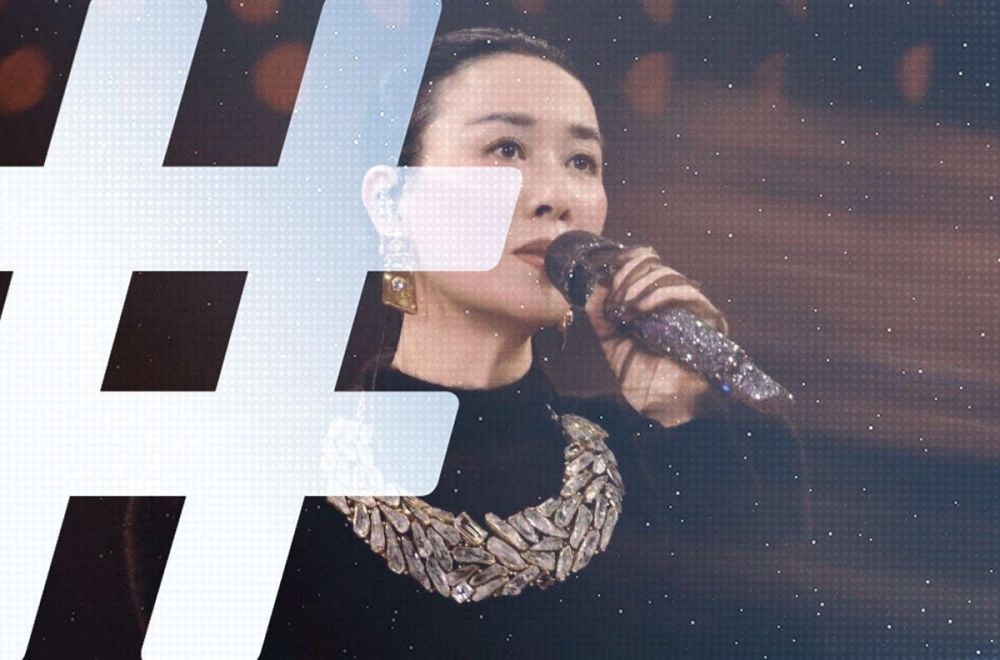
The term emerged out of a recent scandal that swept China’s internet in late September. Singer Na Ying (那英), a Mandopop diva who rose to stardom in the 1980s, improvised a song at a Chengdu concert to pay tribute to her friend and mentor Liu Huan (刘欢), who had died one day before. When netizens began discussing her potential violation of performance censorship rules demanding prior song approval, journalists began to ask local authorities whether Na had potentially violated the law.
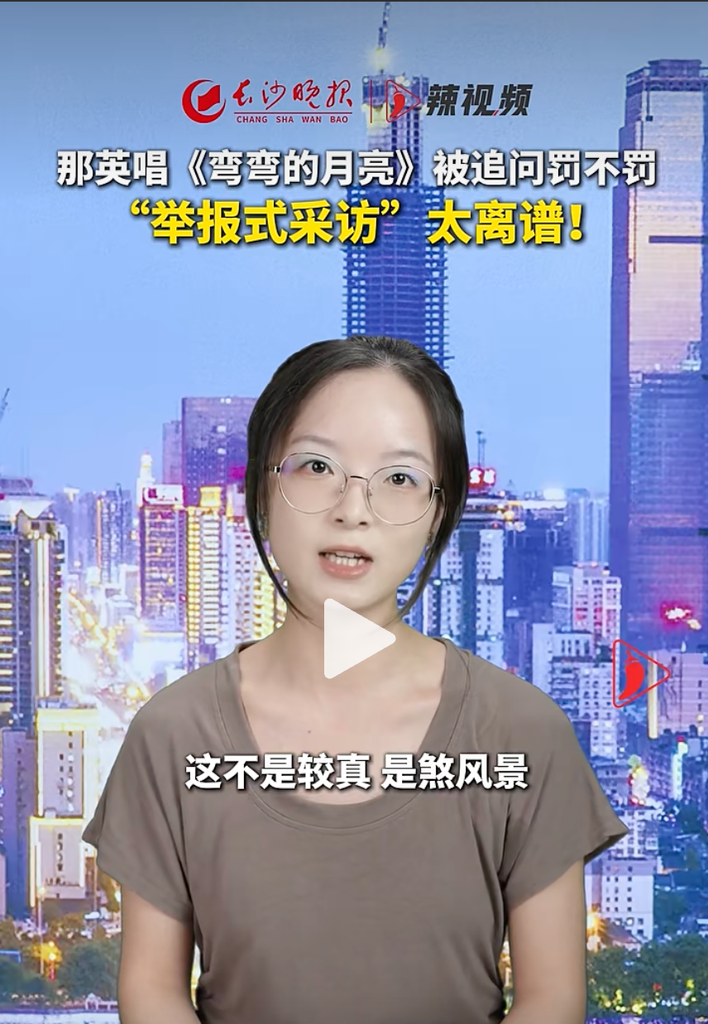
Chinese journalists and media haven’t welcomed this form of “journalism.” Instead, “informant-style reporting” — whose meaning is more akin to “snitch journalism” — has become a derogatory term that crosses the line into journalistic malpractice by “forcing a response to public discourse” (把问答推上舆论场), as one municipal media outlet put it.
In Na’s case, the public had raised concern about her potential violation of article 16 of China’s Regulations of the Administration of Commercial Performances (营业性演出管理条例), which states that performance details like songs or scripts should be submitted for approval in advance by local authorities. Artists and organizers violating the regulation can be fined for up to 30 thousand yuan (4,486 dollars).
“Informant-style reporting” — whose meaning is more akin to “snitch journalism” — has become a derogatory term that crosses the line into journalistic malpractice by “forcing a response to public discourse.”
Journalists began reaching out to authorities not long after videos of Na’s performance began spreading online. Two days after the concert, the Xiaoxiang Morning Post (潇湘晨报), a provincial newspaper from Hunan, reported that it had reached out to several responsible bodies, including the concert organizer (which did not comment), the local culture, sports and tourism bureau (which said it was investigating the matter), and the Chengdu Municipal Bureau of Culture, Radio, Television and Tourism, which had not offered an “effective response” (有效回复) to the newspaper’s inquiries.
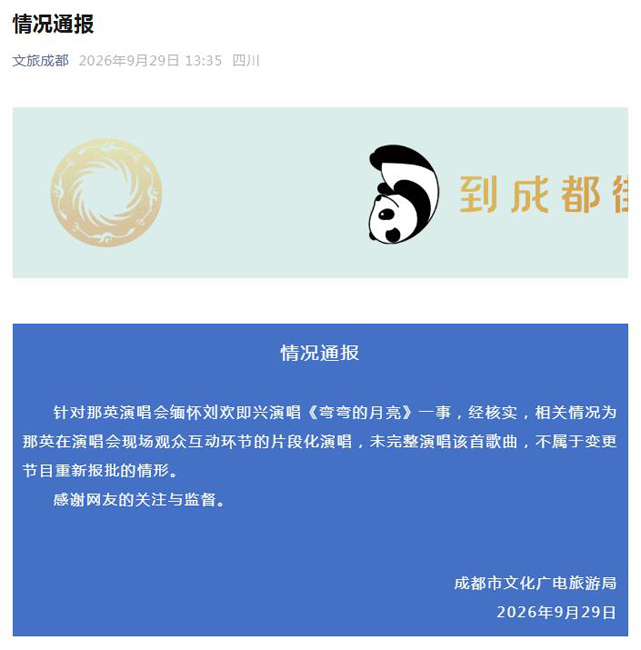
Three hours later, the Chengdu Municipal Bureau of Culture, Radio, Television and Tourism released a statement stating that Na’s “brief and fragmentary” improvisation was performed in the audience interaction section, and that “re-approval” (重新报批) was not required in this scenario.
Commentators were quick to point out the absurdity of the Xiaoxiang Morning Post’s actions, while praising the Chengdu Municipal Bureau of Culture, Radio, Television and Tourism’s response.
“What’s so ridiculous is that both netizens and the media take it for granted that every word and every action performers make on stage must be approved in advance, which suppresses normal human emotion,” wrote Huang Zhijie (黃志杰), a former journalist for Xinhua’s Oriental Outlook (瞭望东方周刊) magazine, in a WeChat article. “In the end, it’s given rise to a new concept in news, ‘informant-style journalism.’”
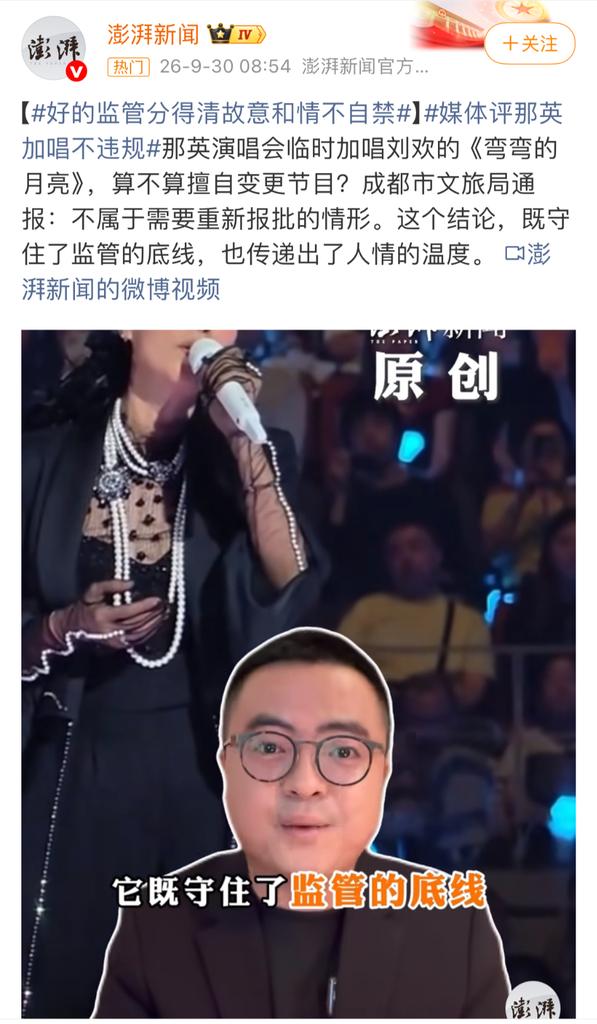
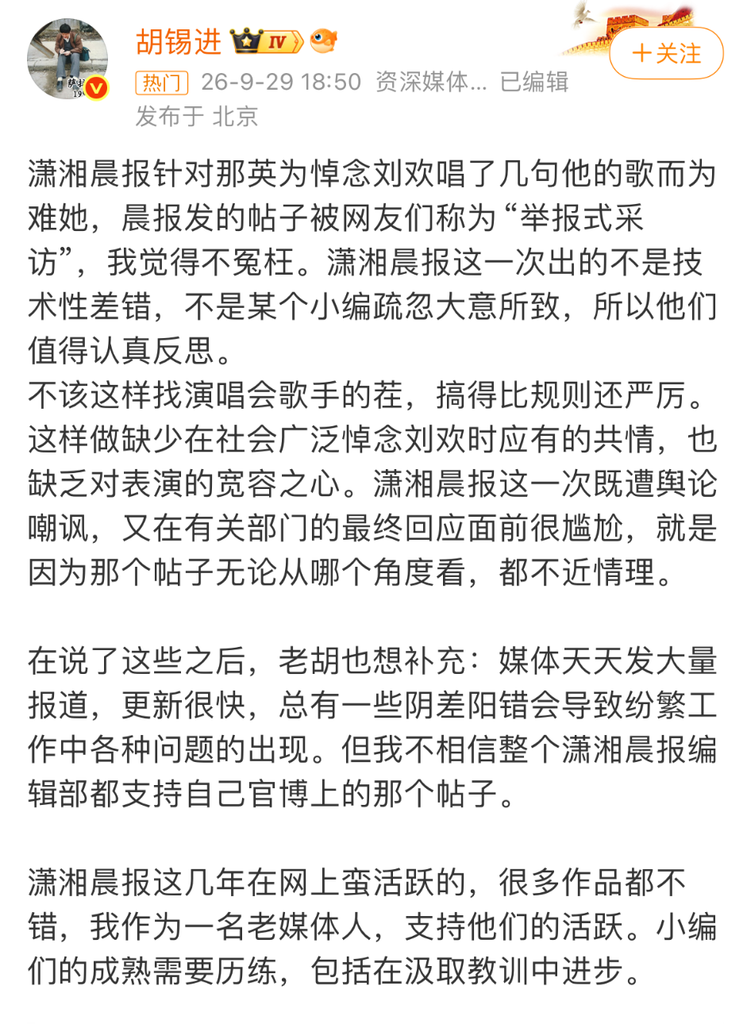
Hu Xijin (胡錫進), the former editor-in-chief of the Global Times, wrote on Chinese social media platform Weibo that the Xiaoxiang Morning Post’s approach “lacks empathy” (缺少共情). Official provincial and municipal media also took aim at the newspaper. Shanghai’s The Paper and the Elephant News, operated by Henan Broadcasting System, pointed out on Weibo that the statement made by the Chengdu Municipal Bureau of Culture, Radio, Television and Tourism not only “upholds the regulatory standard” but “keeps the humanity.” The post by Xiaoxiang Morning Post has now been taken down.
Violating performance regulations can hold serious consequences for performers in China, and the government’s intensification of performance pre-approval standards by the Ministry of Culture and Tourism and Ministry of Public Security — which, since 2023, have strengthened on-site inspections and risk evaluations — have only made the Chinese public more sensitive to the Xiaoxiang Morning Post’s “informant-style journalism,” according to the Singaporean news outlet Lianhe Zaobao. Earlier this year, several performances by the famous cross-talk performer Guo Degang (郭德纲) were canceled and performance organizers were fined after he improvised a song about the War of Resistance Against Japan. Another singer, Jane Zhang (张靓颖), recently announced she might never again add spontaneous a capella segments to her shows after being fined a total of 760 thousand yuan (113.5 thousand dollars) for multiple violations.
But the Xiaoxiang Morning Post’s “informant-style journalism” also raises questions about the role of media in today’s China. Xi Jinping’s declaration at a 2016 Party media symposium that the media must be “surnamed ‘party’” — and the subsequent push to tighten the leadership’s reins on the media — has nearly eliminated the space for the kind of enterprising reporting of government and corporate wrongdoing known as “public opinion supervision” (舆论监督), which was far more commonplace in the early 2000s. “Public opinion supervision,” which has also been translated by Chinese advocates of a freer press as “watchdog journalism” or the media’s serving a “watchdog role,” was embraced by the Party in the late 1980s as a means of “monitoring” social, economic and political problems to encourage unity and social stability.
By the late 2000s, however, the Party had begun seeing watchdog reports that appeared in commercial metropolitan dailies as a direct threat to Party legitimacy and stability. Xi’s post-2012 media crackdown targeted what one internal document identified as the problem of “Western” principles rampant in China’s media. In Xi’s same 2016 speech at the Party media symposium, he declared that public opinion supervision and “positive propaganda” must be “unified” (统一), closing any gap where unaligned reporting might seep through.
But the demand that media work solely on behalf of the Party, with little latitude for critical coverage, has also raised new questions about the function of media and the line between “reporting” and “enforcement.” In September, the Zhejiang Media Group’s Li Xinglin (李星霖) wrote in a since-deleted article that public opinion supervision “inevitably touches upon the interests of some local governments and departments,” arguing that negative public opinion and dissenting voices could not simply be avoided.
While Li was defending critical reporting, his analysis also illuminates the uncomfortable gray area “informant-style journalism” exists in. It’s clear to critics that the Xiaoxiang Morning Post’s actions weren’t serving the public interest, as “public opinion supervision” is supposed to do at its best. But the paper was simply following current media orthodoxy — to act solely in the Party’s interest — to an extreme end. The ultimate irony, in this case, was that the media attempted to play the enforcer while the regulatory body acted with more “humanity,” closing its announcement by thanking the online public for their “attention and supervision.”