Last month, the case of Sun Meihua (孫美華) rattled China before her name disappeared from the internet. The now 58-year-old Beijing-born woman was found in a village in Cao County, Shandong Province, by a Douyin vlogger, Chuxin (初心). After 26 years, videos of Sun appeared online, looking frail and hungry, eating a plate of noodles Chuxin had handed her.
Sun had been diagnosed with schizophrenia and went missing in August 2000 after her husband allegedly left her at an intersection near her parents’ house, reports the independent media outlet Free Nora (自由娜拉), which monitors human trafficking and abuse against minorities in China. According to another outlet, The Aquarian (水瓶紀元), her family tried to report her disappearance, but the police did not open a case.
Sun was found living with an elderly man villagers call “Uncle Long” (龍叔). In August, villagers told Du Xiaohua (杜小华), a Douyin vlogger who met Sun, that Uncle Long abused her and forced her into prostitution. When Du went to the police to try to file a report, an officer told him that they had found no evidence of abuse and that relocating her was “not their business,” according to Free Nora’s reporting.
Before media outlets could begin reporting, Chinese social media platforms were already widely discussing Sun Meihua’s case. According to data from Wisers, a media monitoring database, there were dozens to hundreds of posts about Sun every day between September 8 and 11. The number reached 345 in one day on September 9. But from September 13, the number of posts dropped to fewer than 10 per day, Wisers data shows. The posts are now inaccessible, having been either deleted or blocked for violating platform rules.
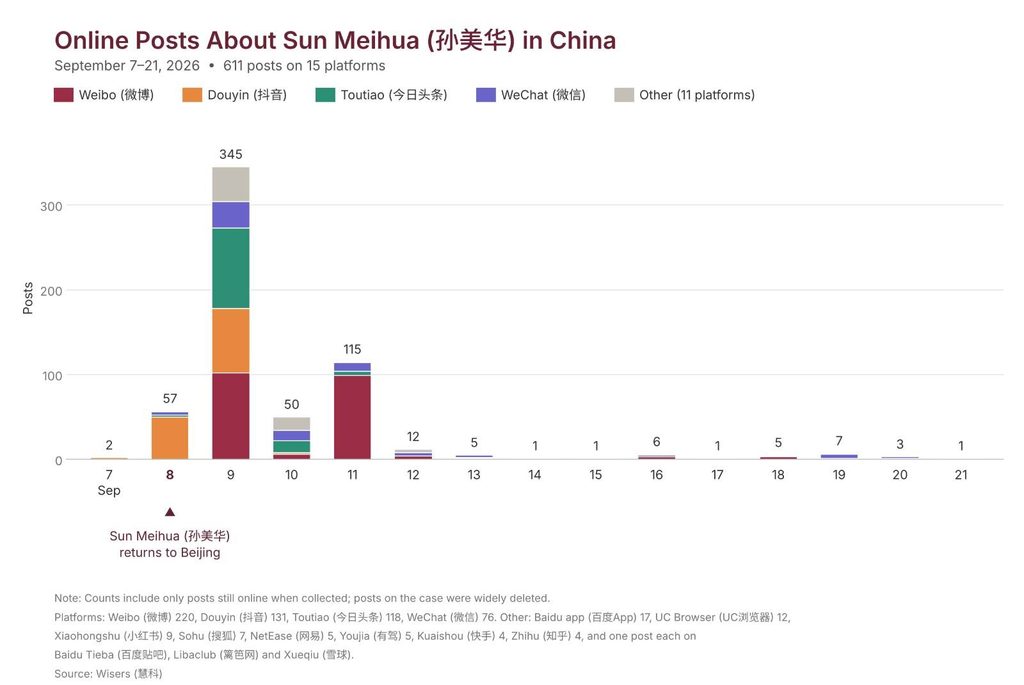
In terms of media coverage, Free Nora was the first Chinese media outlet to report on Sun’s case on September 18. Free Nora also encouraged readers to continue following the case and to write about, share and discuss Sun’s suspected abduction on social media in China. The Chinese independent media outlet The Aquarian (水瓶紀元) followed on September 26, but its report on WeChat was deleted. No other Chinese media reports about the case were identified. The Douyin vloggers also deleted all videos related to Sun.
A familiar pattern
Netizens in China had been here before. The 2022 case of Xiaohuamei, who later became known as “the chained woman,” followed a similar pattern. After videos of a woman chained to a shed in Fengxian County, Jiangsu Province, circulated online, local officials released several statements initially identifying the woman as surnamed Yang, denying trafficking claims and attempting to explain her condition as mental illness-related. The local government blocked media from reporting at the scene before the city of Xuzhou later announced that it had discovered that the woman’s real name was Xiaohuamei, and that she was originally from Yunnan, arresting her husband on suspicion of illegal detention. Like in Sun’s case, authorities cracked down heavily on online discourse about the matter.
Also familiar in this case is where Sun was found. Cao County is located close to where Shandong, Henan, Jiangsu, and Anhui meet, an area identified by researchers as a trafficking “hotspot.” According to court judgments made public in 2024, most victims of human trafficking are rural women with mental or intellectual disabilities.
But what distinguishes the Sun Meihua case from Xiaohuamei’s is the public silence from authorities. As of this writing, no official statement from Cao County or Beijing has been released — what seems to be a deliberate departure from four years ago, when police were forced to backtrack on their previous statements following nationwide online backlash. Police instead seem to have dealt with Sun’s case quietly and privately, though again, only after much urging from online bloggers.
On September 4, Sun’s brother was notified by police in Beijing’s Xicheng district that his sister was in Cao County, and after several days he went to Shandong to pick her up. After allowing one brief video call with their sister, Meihua’s brother cut off contact with family members and refused to let anyone visit them, Liu Anjun (劉安軍), Meihua’s brother-in-law, told Free Nora.
In a column for Deutsche Welle (DW), Chang Ping (長平), editor of the China Digital Times, wrote that during the case of the chained woman, the public had hoped the government would investigate, but the authorities’ top priority was maintaining social stability. Information control today has only intensified. “Those who are punished are often not the traffickers, but the people who expose human trafficking,” he wrote.