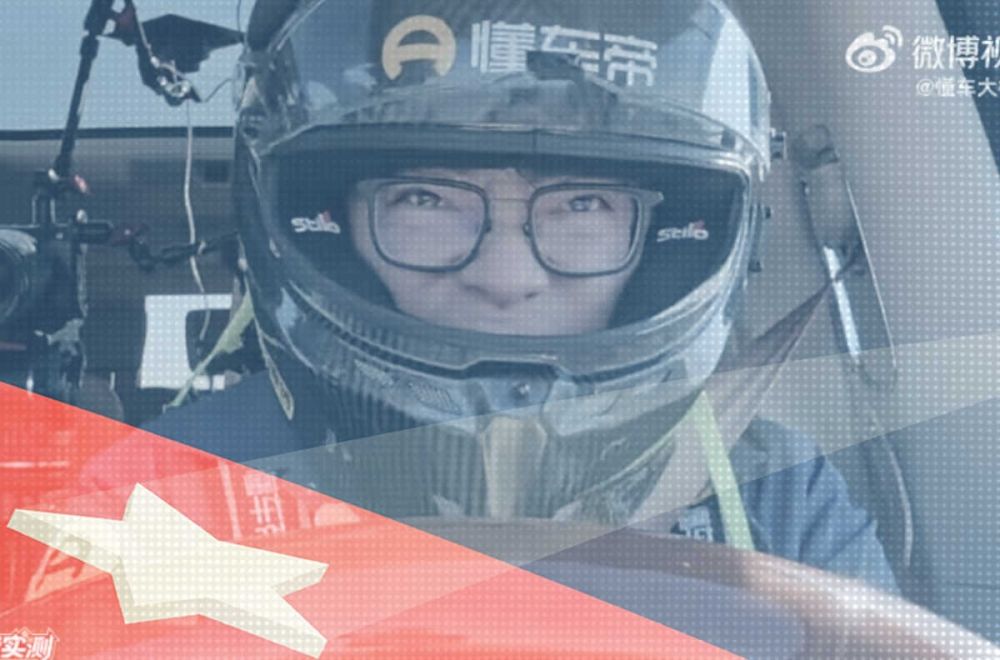
This month, one of China’s most popular auto-review platforms, Dongchedi (懂车帝), also known as “DCar,” put a new luxury minivan model through a tough highway test — braking hard to a full stop from a speed of 100 kilometers per hour. The results, revealed in a video posted across Chinese online platforms, were enough to terrify potential buyers. In three live tests of the model with vehicles purchased from separate production batches, the bracket mounting the brake pedal to the van’s frame snapped.
As attention to the video soared on platforms like WeChat, Douyin and Bilibili, becoming the number one search term within hours, it was the worst possible news for Anhui-based JAC Group and the Chinese tech giant Huawei, the companies behind the vehicle in question, the Maextro V800 multi-purpose electric vehicle (EV). In a statement the same day, Maextro called the test non-standard and extreme, and promised the part would be redesigned. But the damage was done. Only the daily limit on stock drops imposed under Chinese exchange rules could keep shares of JAC Group from heading to the bottom of the hill. They ended the day down 10.01 percent.
A controversy over a faulty brake pedal may seem far removed from the issue of media and censorship. But within 24 hours, the video had disappeared from Chinese platforms such as Bilibili, and several related online posts and reports had vanished too. Viewers on WeChat Video were informed the video could not be played due to an unspecified “violation.” The case prompted discussion of the benefits and limits of consumer reporting in China — a vibrant consumer society with some of the world’s strictest controls on information.
Faulty Brakes on Valid Concerns?
Online, the story quickly shifted to the vanishing of the Dongchedi test video. On the business news platform Huxiu (虎嗅), a commentary noted how the entire focus had turned. “By the time everyone realized the review video had suddenly disappeared, the public discourse had already shifted,” it said. “People were no longer discussing whether the pedal should have broken, but rather who made the video disappear?”
Many suspected Huawei, suggesting the tech giant, which has a growing interest in automated driving systems and other car technology, had applied pressure. Some went even further, speculating that the powerful Huawei was being shielded by authorities.
These questions were deepened by the disappearance of other critical posts. Among these was a post made on the WeChat public account Xinjiang Release (新疆发布), run by the government information office in China’s northwestern Xinjiang region. The post faulted Maextro for failing to address the real safety concerns head on, instead resorting to the citation of complex technical standards. It was called, “Can You Speak Like a Human When Responding to Product Safety Concerns?”
On October 11, a commentary on the news app of the CCP’s People’s Daily newspaper came closest to an official response from the authorities. It addressed the V800 row directly, though it focused squarely again on the product safety concerns, cutting through the justifications offered by Maextro. “Widespread public opinion has focused in recent days on the Maextro V800 brake pedal bracket breakage incident,” it said. “While the case awaits an authoritative investigative conclusion, one thing is beyond doubt: a car’s brake pedal should never ‘snap’ while being driven!”
On October 15, a full week on from the start of the controversy, and shortly after Maextro released its own favorable test results for its vehicle from a third-party lab, the Ministry of Industry and Information Technology, which regulates the auto industry, announced that an investigation into the safety concerns was underway. Interesting, however, was the fact that the Cyberspace Administration of China (CAC), the country’s top internet control body, would be joining the investigation to look into the problem “reflected online.”

Many online remained skeptical. Was this a sign that Dongchedi would come under greater pressure for its critical reviews? Or were the authorities keen to look deeper into possible manipulation of online information by commercial interests? On October 16, Hong Kong’s Sing Tao (星岛日报) newspaper asked the question point-blank in a column titled “Why Has the CAC Entered the Stage?” (网信办为何登场). Noting that the video’s apparent removal had fueled speculation about “whether someone was controlling comments and suppressing attention,” it suggested the CAC’s role might be to address such manipulation.
These swirling questions about the video’s disappearance come against the backdrop of China’s deeply conflicted record when it comes to reporting on product safety issues and consumer rights.
In some cases, consumer product stories, particularly when they stay away from powerful interests and touch instead on the violations of small and medium-sized companies, can offer a relatively safe avenue for critical coverage — what can sometimes be called “swatting flies” (打苍蝇).
At the small bore end of the spectrum, state broadcaster China Central Television (CCTV) has made the revelation of safety violations at mostly small companies and industries the mainstay of its annual Consumer Rights Gala. In one segment this year CCTV reporters went undercover to expose the use of hydrogen peroxide in the manufacture of low-price chicken feet in a Sichuan factory.
But China’s media history in the reform era has also demonstrated that consumer reporting can bring down “tigers,” implicating major companies and government officials. Back in 2008, an investigation by a reporter at Shanghai’s now-defunct Oriental Morning Post blew the lid on a scandal that rocked China and became international news. Jian Guangzhou (简光洲) and other Chinese journalists exposed the widespread use of the toxic industrial compound melamine in the manufacture of baby formula by Sanlu and other dairy giants. The crisis resulted in the death of at least six infants, and the sickening of some 300,000 across the country.
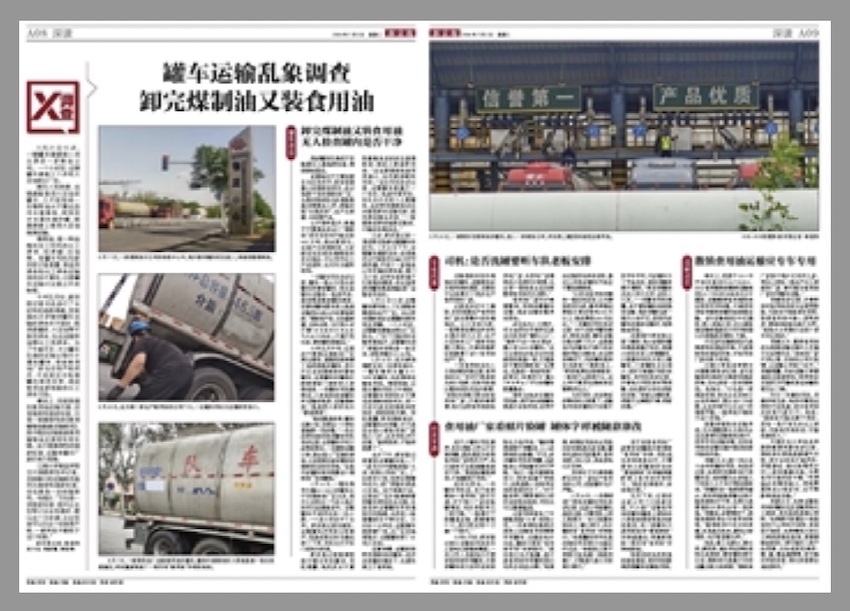
Such major cases of consumer reporting are almost never seen today, following a sharp contraction of the space for critical journalism through the late 2000s and into the 2010s. One of the more outstanding recent cases was reported in July 2024 by The Beijing News (新京报), which revealed that a state-run grain stockpiler, Sinograin, had been using the same tanker trucks to transport both food oil products and potentially toxic fuel products, without cleaning its containers.
China’s State Council Food Safety Office followed by announcing an investigation in the toxic food oil case, and Sinograin issued an apology. But this outstanding work by The Beijing News did not mark a shift for investigative reporting, or signal greater latitude in pursuing product safety stories.
Shortly after the toxic food oil story broke, a post on a WeChat public account credited the story for its “enormous courage,” and noted the importance of investigative reporting. “In every food safety incident, you can always find investigative reporters charging out in front,” it said, while mourning the fact that such journalists were “withering away.” The post was quickly deleted.
To date, there has been no explanation for why the video and articles about the Maextro V800 disappeared. Speaking to BBC Chinese, Rose Luqiu (閭丘露薇), a former broadcast journalist and a professor of journalism at Hong Kong Baptist University, said it was not known whether press control authorities, such as from the Central Propaganda Department, had been at all involved. But she noted that pressures at the commercial end of the spectrum could also come to bear in light of Huawei’s stature as a national symbol of China’s development and technological prowess. Luqiu said it was possible that Chinese online platforms would be mindful of the political risks and their commercial costs — leading possibly to self-censorship.